What makes certain Christian traditions unique in their approach to spirituality? At the heart of one major movement lies a focus on direct connection rather than institutional structures. With over 1.2 billion followers globally, this branch emphasizes personal faith and scriptural authority as foundations of religious practice.
Historical reformers reshaped how communities engage with spiritual teachings. Leaders like Martin Luther challenged existing norms, prioritizing individual access to sacred texts over hierarchical mediation. This shift created lasting changes in worship styles and community organization.
Central to these beliefs is the idea that divine grace, not human effort, determines spiritual outcomes. Followers maintain that sacred writings alone guide their faith journey, rejecting external interpretations not rooted in scripture. This principle continues to influence modern church activities and ethical frameworks.
Today, these theological perspectives shape everything from Sunday services to social initiatives. Communities often emphasize collaborative participation, reflecting the conviction that every believer holds equal spiritual value. Such ideas have also inspired cultural movements advocating for education and civic engagement.
Key Takeaways
- Personal faith outweighs institutional rituals in daily spiritual life
- Sacred texts serve as the ultimate guide for religious practice
- Historical reforms permanently altered Christian worship patterns
- Modern communities prioritize collective participation over hierarchy
- Theological principles influence both worship and social action
- Divine grace forms the foundation of salvation beliefs
Historical Foundations of Protestantism and Its Declaration of Faith
Long before the 16th-century Reformation, courageous thinkers began challenging religious norms. The late medieval period saw growing discontent with practices that seemed to prioritize power over spiritual growth. This tension created fertile ground for new ideas about faith and community.
Proto-Protestantism and Early Reform Movements
Groups like the Waldensians and Hussites paved the way for change. They believed ordinary people could connect with the divine through personal Bible study rather than relying solely on clergy. John Wycliffe’s groundbreaking efforts to translate scripture into common languages made sacred texts accessible beyond Latin-educated elites.
Jan Hus took these ideas further, openly criticizing the church’s wealth and the pope’s authority. His execution in 1415 shocked Europe but inspired future reformers. These movements shared a core belief: spiritual truth comes from scripture, not human traditions.
From Medieval Traditions to Reformation Ideals
The medieval Catholic Church’s practices, like selling forgiveness through indulgences, sparked intense debate. Reformers argued such actions distorted teachings about divine mercy. They asked: Could human institutions truly represent heavenly authority?
Early reformers answered with a resounding “no”. Their work laid the foundation for key principles later embraced during the Reformation. By prioritizing scripture over hierarchy, they reshaped how communities understood their relationship with the sacred.
The Reformation: A Catalyst for Change in the Role of God
A perfect storm of social change and political ambition fueled the Protestant Reformation. The 16th century saw rulers and thinkers challenge traditional power structures, creating new ways to understand spiritual relationships.
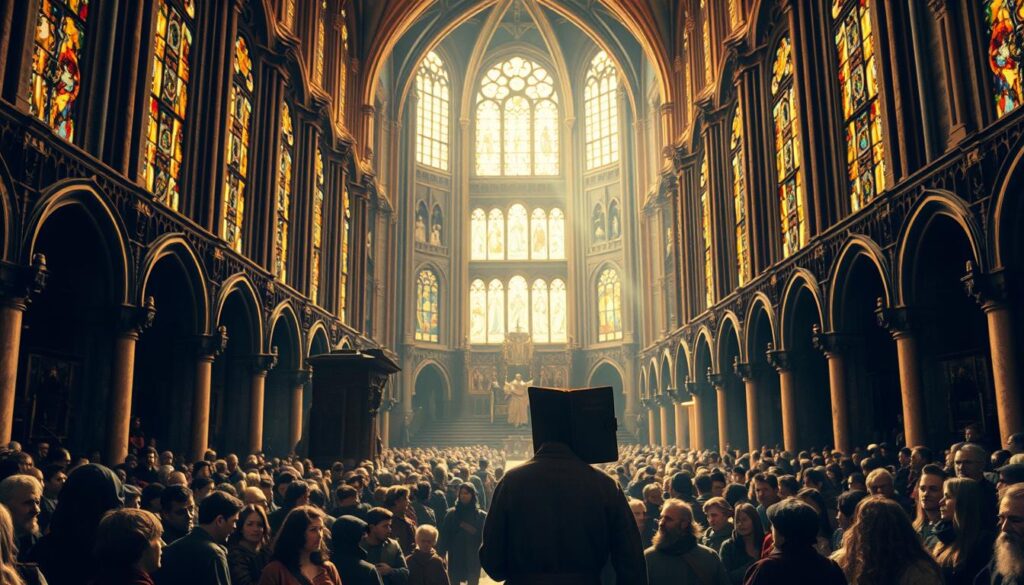
Political and Social Context of the 16th Century
Martin Luther’s 1517 critique of indulgences struck at the heart of Catholic Church practices. His famous question – “Why does the pope not empty purgatory for love’s sake?” – exposed tensions between institutional wealth and spiritual ideals.
The 1529 Diet of Speyer became a turning point. When leaders declared:
“In matters concerning God’s honor and our soul’s salvation, each must stand before God and answer for himself.”
This bold statement gave the movement its name: Protestant. Rulers used religious reform to gain independence from both Rome and the Holy Roman Empire.
Three key factors accelerated change:
| Factor | Impact | Outcome |
|---|---|---|
| Printing Press | Spread ideas rapidly | Vernacular Bibles reached common people |
| Political Rivalries | Local rulers vs. central powers | Territorial churches emerged |
| Social Mobility | Growing merchant class | Demand for accessible faith practices |
These shifts made divine grace feel personal rather than institutional. Over 50 years, the Reformation reshaped how communities worshipped and governed themselves.
Key Figures Shaping Protestant Theology
The transformation of Christian thought in the 16th century owes much to visionary leaders who redefined spiritual authority. Their ideas didn’t just challenge existing systems—they rewrote the rules of religious practice entirely.
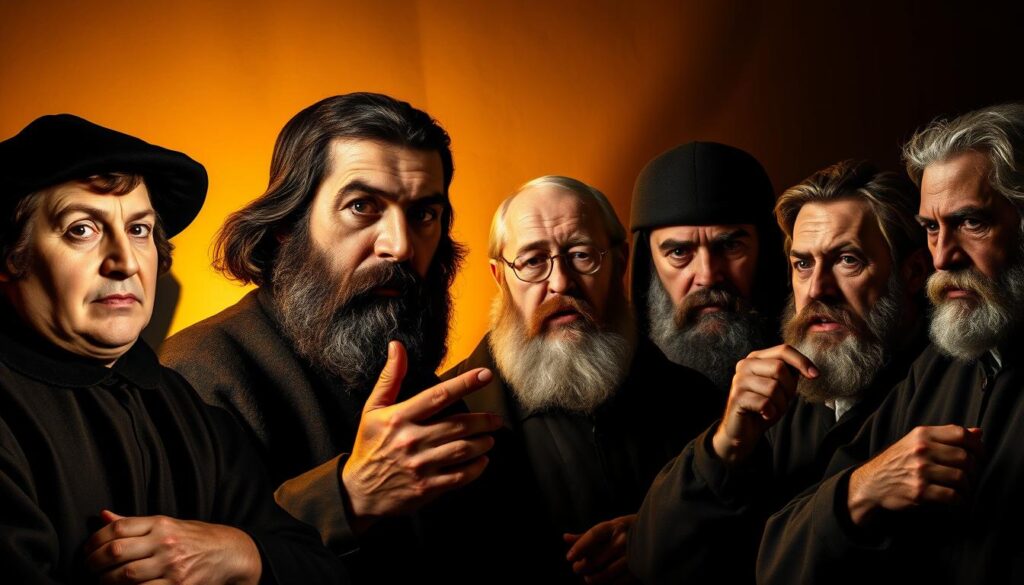
Martin Luther and the Impact of the Ninety-Five Theses
When Martin Luther nailed his Ninety-Five Theses to a church door in 1517, he sparked a revolution. His bold claim? Salvation comes through faith alone, not payments or rituals. This directly opposed the Catholic Church’s role as mediator between people and divine forgiveness.
Luther argued that scripture—not church authority—should guide spiritual life. His translation of the Bible into German let ordinary people engage with sacred texts firsthand. “Why should the pope’s voice matter more than Christ’s own word?” he famously challenged.
John Calvin, Huldrych Zwingli, and Their Legacies
While Luther’s ideas spread, John Calvin built a theological framework emphasizing God’s ultimate control over human destiny. His concept of predestination taught that salvation was predetermined, not earned through deeds.
Meanwhile, Huldrych Zwingli stripped Swiss churches of ornate rituals, insisting worship reflect biblical teachings alone. Both reformers agreed: true faith required direct engagement with scripture, free from institutional interference.
These leaders shaped diverse beliefs across Europe. From Scotland to Hungary, their legacies prove how individual conviction can redefine centuries of tradition.
Understanding the Five Solas and Their Impact
How did Reformation leaders distill complex theology into practical principles? The answer lies in five Latin phrases that became battle cries for spiritual renewal. These Solas reshaped how communities approached sacred teachings, prioritizing direct engagement over institutional gatekeeping.
Sola Scriptura: Emphasizing Biblical Authority
At the heart of Reformation thought stood Sola Scriptura – scripture alone as ultimate truth. This principle rejected the idea that church traditions held equal weight with biblical texts. Reformers argued that every believer could interpret divine word personally, needing no priestly decoder.
This shift democratized spiritual authority. Suddenly, farmers and merchants could debate theology as equals with clergy. As one reformer declared:
“The Bible belongs to the people, not the palace.”
Sola Fide and Sola Gratia: Faith and Grace Explored
The twin concepts of faith and grace upended medieval ideas about salvation. Sola Fide taught that trust in divine mercy – not good deeds – opened heaven’s gates. Sola Gratia went further: this mercy came freely, never earned through rituals or payments.
Together, these ideas created a spiritual revolution. Believers no longer saw themselves as beggars pleading for scraps of grace. Instead, they stood confident in a love freely given – a radical understanding that still shapes worship today.
Church Doctrines: Salvation, Sacraments, and the Eucharist
How do sacred practices shape spiritual identity? Across Christian traditions, sacraments serve as visible expressions of beliefs about divine connection. While rituals vary, their meaning often sparks deep reflection on what makes faith tangible.
The Role of Sacraments in Protestant Worship
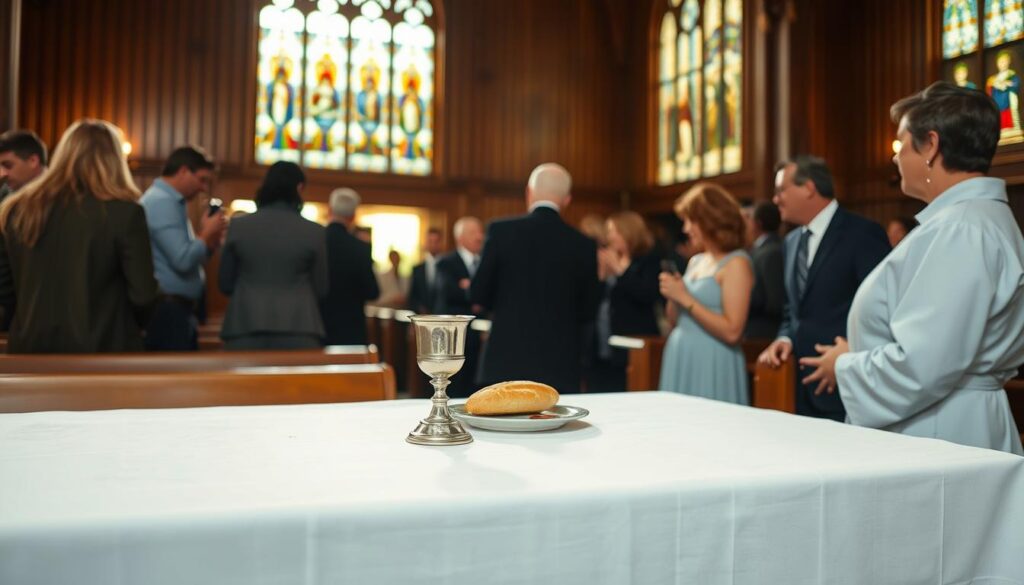
Most Protestant groups recognize just two sacraments: baptism and communion. This contrasts with the Catholic Church’s seven sacraments, highlighting a key difference in scriptural interpretation. As one reformer noted:
“Christ instituted two signs of grace—water for rebirth, bread for remembrance.”
Communion debates reveal deeper theological differences. Lutherans teach Christ’s presence exists “in, with, and under” the bread and wine, avoiding literal transformation claims. Reformed traditions view these elements as spiritual reminders rather than physical changes.
Three core ideas shape Protestant sacramental worship:
- Baptism marks entry into faith communities
- Communion renews commitment to sacred teachings
- Marriage honors partnerships without conferring divine grace
These practices emphasize personal engagement over ritual mechanics. By focusing on faith rather than form, Protestant traditions keep scripture central to communal life. This approach continues to define modern church services worldwide.
The Significance of “protestantism god” in Modern Protestant Theology
Modern theology navigates a delicate balance between centuries-old convictions and evolving societal values. At its core lies a revolutionary idea: spiritual worth stems from unconditional love rather than human achievement. This principle shapes how believers approach both personal faith and community engagement today.
Redefining Spiritual Value and Community
Contemporary teachings emphasize that every person holds inherent dignity through divine grace. Unlike systems measuring worth by status or deeds, this understanding roots human value in sacred love freely given. Such ideas inspire church initiatives promoting social justice and individual conscience rights.
The role of grace in salvation remains central to theological discussions. Modern believers often view spiritual life as a journey shaped by trust rather than ritual. This perspective encourages active participation in both worship and societal improvement, reflecting timeless principles through fresh applications.
By prioritizing compassion over hierarchy, these teachings continue to transform how communities live out their faith. The result? A vibrant spiritual legacy that adapts to new challenges while staying anchored in its revolutionary roots.
FAQ
How does the role of divine authority differ between Protestant and Roman Catholic teachings?
Protestant beliefs emphasize Scripture alone (Sola Scriptura) as the ultimate authority, rejecting the Catholic Church’s reliance on papal decrees or tradition. This shift during the Reformation prioritized individual interpretation of the Bible over institutional hierarchy.
What sparked the Protestant Reformation in the 16th century?
Martin Luther’s Ninety-Five Theses (1517) critiqued practices like indulgences, igniting reforms. Social, political, and theological tensions—such as corruption in medieval churches and rising nationalism—fueled movements led by figures like John Calvin and Huldrych Zwingli.
Why do many Protestant churches recognize only two sacraments?
Reformers like Luther and Calvin limited sacraments to baptism and communion, viewing them as biblically mandated. They rejected medieval traditions like confession or marriage as sacraments, focusing instead on symbolic acts tied to grace and faith.
How do the “Five Solas” shape Protestant views on salvation?
The Solas—Scriptura, Fide, Gratia, Christus, and Deo Gloria—stress that salvation comes through faith and grace alone, not works. This contrasts with Catholic teachings emphasizing sacraments and merit, reinforcing a direct relationship between believers and divine mercy.
What role did political leaders play in spreading Reformation ideas?
Rulers like German princes and Henry VIII used reforms to challenge papal authority, gaining control over regional churches. This alliance between reformers and governments accelerated doctrinal changes and decentralized religious power across Europe.
How do modern Protestant denominations interpret the Eucharist differently?
Lutherans view communion as Christ’s real presence, while Calvinists see it as symbolic. Zwingli’s followers emphasize remembrance, reflecting broader debates about the sacraments’ spiritual vs. literal meaning in worship practices today.