Across continents and cultures, ancient visual language shapes spiritual practices for over a billion people. These icons act as keys to philosophical ideas, blending art with devotion in ways that resonate globally. Rooted in traditions spanning millennia, they reveal universal truths about existence and human purpose.
Many of these emblems originated along the Indus River, where early communities developed rituals still practiced today. Unlike ordinary images, they embody living principles that bridge earthly life and cosmic order. From intricate mandalas to revered animals, each carries layered meanings passed through generations.
Modern seekers appreciate how these designs simplify complex teachings. A lotus flower’s growth through muddy waters, for example, teaches resilience. Such metaphors remain relevant in our fast-paced world, offering calm amid chaos.
What makes these icons endure? Their ability to adapt while keeping core truths intact. They speak to shared human experiences—love, struggle, and transcendence—making them accessible across cultural boundaries.
Key Takeaways
- Visual icons simplify complex spiritual ideas for daily practice
- Origins trace back to ancient river valley civilizations
- Meanings evolve while preserving core principles
- Natural motifs teach universal life lessons
- Global appeal stems from shared human experiences
Introduction to Hinduism and Its Profound Symbolism
Imagine a spiritual path where fire rituals, meditation circles, and temple bells coexist with modern yoga studios. This vibrant tapestry of practices stems from ancient roots that value personal discovery over rigid doctrines. As Mahatma Gandhi noted,
“A man may not believe in God and still call himself a Hindu.”
With origins dating back over 4,000 years, these traditions form one of humanity’s oldest continuous wisdom systems. Unlike most world religions, there’s no single holy book or founding prophet. Instead, shared concepts like dharma (duty) and karma (action) unite diverse practices.
| Aspect | Western Religions | Eastern Traditions |
|---|---|---|
| Founder | Specific individual | Collective evolution |
| Core Focus | Divine commandments | Self-realization |
| Symbolic Approach | Fixed meanings | Layered interpretations |
Visual elements act as spiritual shortcuts. A dancing figure might represent cosmic cycles, while a conch shell symbolizes sacred sound. These icons adapt across regions – a elephant-headed deity in Mumbai might wear different flowers in Chennai.
What makes this approach unique? The idea that ultimate truth wears countless masks. A farmer might see divine love in monsoon rains, while a philosopher contemplates eternity in a lotus bloom. Both perspectives hold equal value, united by shared aspirations for meaning.
Historical Origins of Hindu Symbols in Hinduism
Long before skyscrapers dotted landscapes, ancient communities etched stories into clay. Archaeological digs reveal how early societies expressed spiritual ideas through visual language. These early markings became the building blocks for enduring icons still cherished today.

Influences from the Indus Valley Civilization
Excavations at Harappa and Mohenjo-daro changed our understanding of early indian religions. Clay seals from 2500 BCE show horned figures resembling later deities. Sacred bulls and lotus motifs appear alongside geometric patterns still used in temple art.
One famous seal depicts a cross-legged figure surrounded by animals. Scholars see this as the beginning of yogic symbolism. These discoveries prove spiritual traditions evolved through cultural exchange, not isolation.
Evolution through the Vedic and Classical Eras
The vedic period (1500-500 BCE) brought new layers of meaning. Ritual fire ceremonies developed symbolic gestures still used in worship. Sacred chants from this period became linked to natural elements like water and wind.
| Historical Phase | Key Developments | Lasting Impact |
|---|---|---|
| Indus Valley | Animal seals, proto-deities | Foundation of visual symbolism |
| Vedic Era | Fire rituals, nature hymns | Connection to natural elements |
| Classical Age | Epic stories, temple art | Standardized iconography |
By the classical period (300 BCE-500 CE), symbols gained standardized forms. Temple carvings made complex ideas accessible to all. This blending of traditions created a visual language that united diverse communities across South Asia.
Understanding the hinduism religion symbol: Meaning and Significance
At the heart of spiritual expression lies a single character that bridges art and metaphysics. This iconic design combines three flowing curves with a dot and crescent moon shape, each element mapping humanity’s journey toward enlightenment. The lower curve signifies waking consciousness, while the upper arc represents dreamless sleep—together forming a complete picture of human awareness.
More than just a visual mark, this emblem carries cosmic vibrations heard in temples and meditation spaces worldwide. Chanting its corresponding syllable creates resonance believed to align body rhythms with universal energy patterns. Ancient texts describe it as the “seed syllable” from which all languages and meanings grow.
Four distinct components reveal layered aspects of existence. The dot symbolizes pure consciousness beyond daily experiences—a reminder of life’s ultimate purpose. Modern science echoes this concept through studies on vibrational frequencies affecting matter.
Historical facts show the term ‘Hindu’ originated from ‘Sindhu,’ the Sanskrit name for the Indus River. This linguistic root mirrors how simple forms can hold deep cultural significance. Today, you’ll find this universal icon in yoga studios, jewelry designs, and digital meditation apps—proof of its timeless relevance.
From silent contemplation to communal chants, this fusion of sound and shape demonstrates how spiritual tools adapt across generations. It serves not as a rigid doctrine but as a living bridge between individual seekers and eternal truths.
Symbolism of Divine Figures: Supreme God, Gods, and Goddesses
Divine figures in ancient traditions serve as mirrors reflecting different facets of cosmic truth. These sacred forms help devotees connect with the supreme God—an infinite force present in all existence. Through vibrant stories and symbolic imagery, they make profound philosophies tangible for daily life.
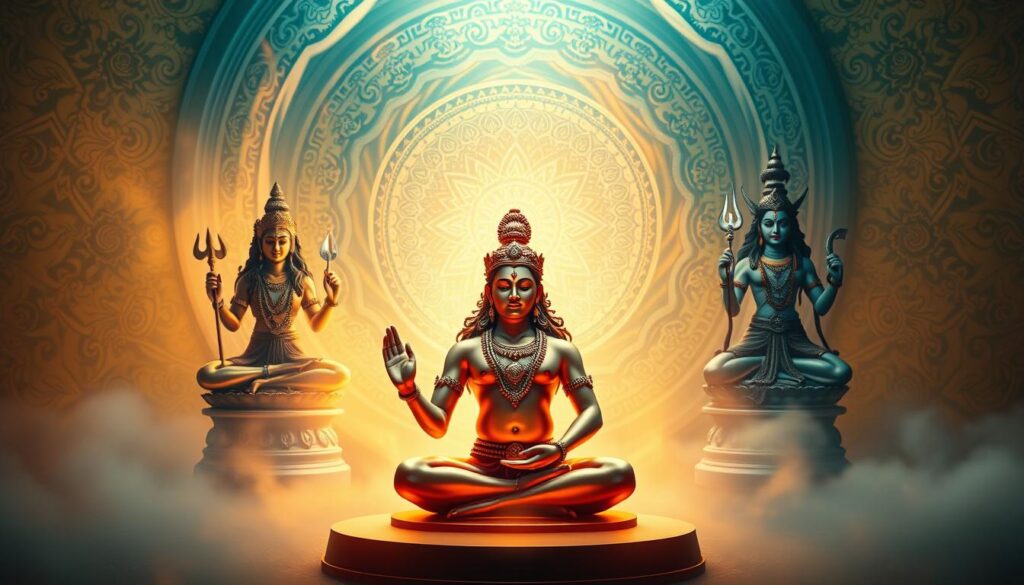
Exploring the Trimurti Concept: Brahma, Vishnu, Shiva
Three primary deities form a cosmic management system. Brahma sparks new beginnings, Vishnu maintains balance, and Shiva clears space for renewal. Together, they show how creation needs both stability and change.
| Deity | Role | Symbols |
|---|---|---|
| Brahma | Creator | Four heads (knowledge), lotus (purity) |
| Vishnu | Preserver | Conch (divine sound), mace (strength) |
| Shiva | Transformer | Third eye (wisdom), trident (cosmic laws) |
Brahma’s four faces represent the Vedas—ancient wisdom texts. Vishnu’s blue skin symbolizes boundless space, while Shiva’s dance depicts universal rhythms. These details turn abstract ideas into relatable characters.
Celebrating Feminine Energy in Shaktism
Goddess traditions highlight dynamic feminine power. Devi embodies raw creative energy, often shown riding a tiger into battle against ignorance. Lakshmi brings abundance, her golden coins representing both material and spiritual wealth.
Saraswati’s white sari and veena instrument remind seekers that true knowledge harmonizes mind and heart. As one temple priest explains:
“The goddess isn’t separate from us—she’s the courage in our voices and the spark in our curiosity.”
Through these gods and goddesses, personal worship becomes a dialogue with the divine. A student might pray to Saraswati before exams, while a gardener honors Lakshmi during harvest. Each interaction reinforces connections to the supreme God within all life.
Worship Practices and Rituals: From Puja to Arti
Daily spiritual routines blend ancient traditions with modern life, creating bridges between community gatherings and personal reflection. Whether in grand structures or quiet corners of homes, these practices turn ordinary moments into sacred connections.
Mandir and Home Shrine Traditions
Communal spaces called Mandirs pulse with energy during festivals, while home altars offer intimate spaces for morning prayers. Many families keep a dedicated shrine with deity images, oil lamps, and fresh flowers—tools that transform living rooms into meditation zones.
A priest from New Jersey shares:
“Our temple’s murti isn’t just stone—it becomes alive through daily care and devotion.”
This belief fuels rituals like washing sacred statues or ringing brass bells to announce divine presence.
Offerings and Symbolic Acts of Devotion
Presenting fruits or lighting incense isn’t about gifts—it’s a language of reverence. During arti, flames circle deities before touching worshippers’ palms, symbolizing shared blessings. A coconut might represent ego surrender, while turmeric powder signifies purification.
These acts adapt seamlessly. Office workers might whisper prayers at desktop shrines, while grandparents teach toddlers temple dances. Whether through elaborate puja ceremonies or silent meditation, the goal remains: mindful connection beyond routine.
Depicting the Symbol through Art and Architecture
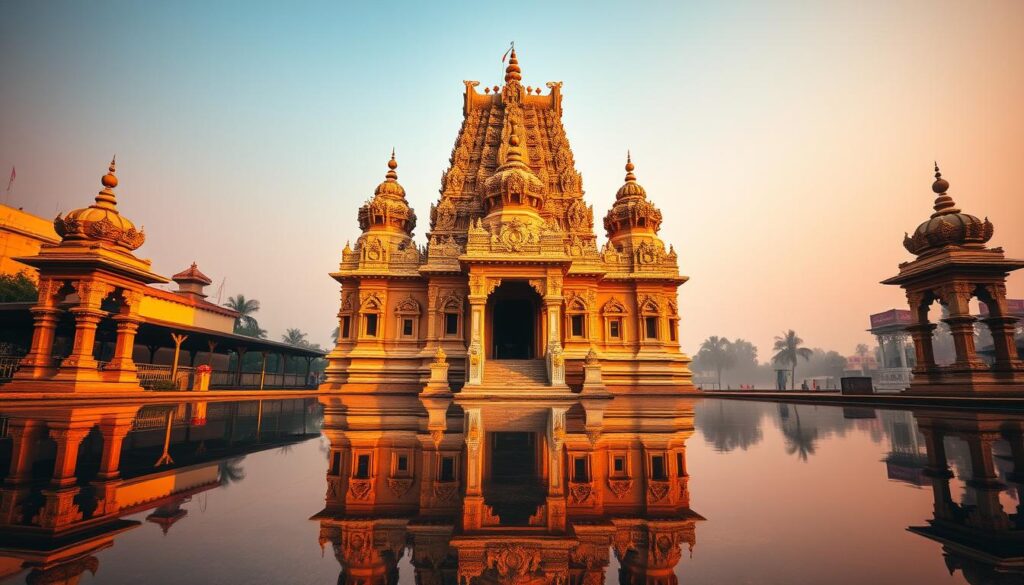
Stone becomes scripture in sacred spaces where geometry whispers cosmic truths. Every curve and carving in these structures follows ancient design rules called Shilpa Shastras, turning buildings into 3D maps of spiritual principles. Towering spires point toward enlightenment, while foundation stones mirror earthly stability.
Walk through any major hindu temple, and you’ll find walls alive with stories. A dancing Shiva here, a lotus medallion there—each sculpture serves multiple roles. They educate visitors, focus meditation, and celebrate artistic skill. As one artist from Rajasthan explains:
“Our chisels don’t just shape stone—they reveal truths hidden within.”
Central courtyards often follow mandala patterns, creating zones of sacred energy. The innermost chamber holds the primary deity, surrounded by rings of decreasing sanctity. This layout mirrors the journey from daily life to divine connection.
Regional styles showcase creative adaptation. South Indian temples boast colorful pyramid towers, while North Indian designs favor intricate marble screens. Despite these differences, core traditions remain—like using specific materials for symbolic resonance. Sandstone represents endurance, gold leaf signifies purity.
Modern architects blend these aspects with steel and glass. A New York gallery recently featured laser-cut metalwork mimicking temple jali screens. Such innovations prove ancient design principles still find their place in contemporary spaces, bridging millennia through shared visual language.
Traditions and Ritual Narratives: Connecting Mythology with Daily Life
Morning coffee meets morning prayers in homes where ancient wisdom shapes modern routines. A grandmother lights a lamp while her granddaughter checks school alerts—both honoring traditions that bind generations. These daily acts turn mythic stories into living guides for navigating today’s challenges.
Seasonal festivals color calendars with shared memories. Diwali’s lights teach triumph over darkness, while Holi’s colors celebrate unity. Families blend old recipes with new tech—streaming rituals when relatives live oceans apart. Time becomes a dance between eternal truths and temporary moments.
Communal meals transform into spiritual acts when stories of divine love season conversations. A father explains harvest legends as his child plants window-box herbs. Through these exchanges, family bonds strengthen like sacred threads in ritual garments.
Modern adaptations prove traditions thrive through reinvention. Yoga mats replace temple floors for some, while others find mindfulness in subway commutes. What remains constant? The human need to connect daily rhythms with timeless meaning—a bridge between kitchen tables and cosmic order.
FAQ
What does the Om symbol represent in Hindu traditions?
The sacred sound Om symbolizes the universe’s essence and connects devotees to Brahman, the ultimate reality. It’s chanted during prayers and meditation to unify mind, body, and spirit.
How did ancient Indus Valley art influence Hindu symbolism?
Artifacts like seals depicting yogic postures and nature deities suggest early roots of practices like meditation and reverence for divine energy, later evolving into today’s rituals.
Are Brahma, Vishnu, and Shiva worshipped equally?
While the Trimurti represents creation, preservation, and destruction, many devotees focus on Vishnu or Shiva. Brahma’s worship is less common, reflecting diverse practices across denominations.
Why do many households have personal shrines?
Home altars allow daily connection with deities through puja (worship). Offerings like flowers or incense honor divine presence while fostering spiritual discipline and family unity.
What role does feminine energy play in worship?
In Shaktism, goddesses like Durga or Kali embody cosmic power. Festivals such as Navaratri celebrate their strength, highlighting balance between masculine and feminine divine forces.
How do temple designs reflect spiritual beliefs?
Mandirs often mirror cosmic order, with towering spires symbolizing sacred mountains. Intricate carvings of deities and stories guide devotees toward enlightenment through visual storytelling.
Does the caste system define Hindu practices today?
While ancient texts mention social roles, modern interpretations emphasize personal duty (dharma) and ethics over birth-based systems. Many reject rigid caste divisions as outdated.
What makes the Bhagavad Gita central to daily life?
This epic dialogue between Krishna and Arjuna addresses duty, righteousness, and devotion. Its teachings on selfless action inspire millions to align choices with spiritual growth.