How did one of the world’s largest religious institutions take shape? Let’s travel back to first-century Palestine, where a small group of followers embraced the teachings of Jesus Christ. His life and messages laid the groundwork for what would become a transformative spiritual movement.
The pivotal moment arrived during Pentecost, described in the New Testament. Followers believe the Holy Spirit empowered the apostles to spread their message boldly. This event marks what many consider the birth of organized Christian outreach.
Early communities faced Roman Empire challenges while sharing their faith. Over time, practical needs shaped their structure – from worship practices to leadership roles. These adaptations helped the movement grow across diverse cultures.
By the fourth century, Roman Catholicism began emerging as a distinct tradition. The church maintained its connection to apostolic teachings while developing formal doctrines. This blend of continuity and change remains central to its identity today.
Key Takeaways
- Jesus Christ’s teachings inspired the earliest Christian communities
- Pentecost catalyzed organized missionary efforts
- Roman Empire dynamics influenced early growth patterns
- Practical needs drove organizational development
- Apostolic succession remains a core belief
- Cultural adaptation shaped traditions over centuries
Historical Overview of the Catholic Church’s Origins
Understanding the Roman Catholic Church’s early days reveals a blend of divine inspiration and practical organization. Just weeks after Jesus’s resurrection, his followers experienced a life-changing event that would fuel their mission.
From Upper Room to Urban Centers
The Day of Pentecost marked a turning point. According to Catholic Church tradition, the Holy Spirit empowered disciples to preach boldly. This sparked rapid growth – over 40 communities formed across the Roman Empire by 100 AD.
Cities became natural hubs for spreading teachings. Trade routes helped ideas travel, while diverse populations created receptive audiences. Early converts often came from lower social ranks, finding hope in messages of equality.
Building Blocks of Belief
Three key elements shaped early Roman Catholic identity:
- Apostolic leadership tracing back to Peter
- Shared rituals like the Eucharist
- Urban networks connecting distant groups
Wealthy women later joined the movement, providing resources and influence. By the second century, these traditions created a stable framework. The church maintained unity through shared practices while adapting to local cultures.
The Apostolic Foundation and Early Community
At the heart of the Roman Catholic Church lies a transformative partnership between a teacher and his students. Jesus Christ spent three years mentoring twelve ordinary men who would become extraordinary leaders.
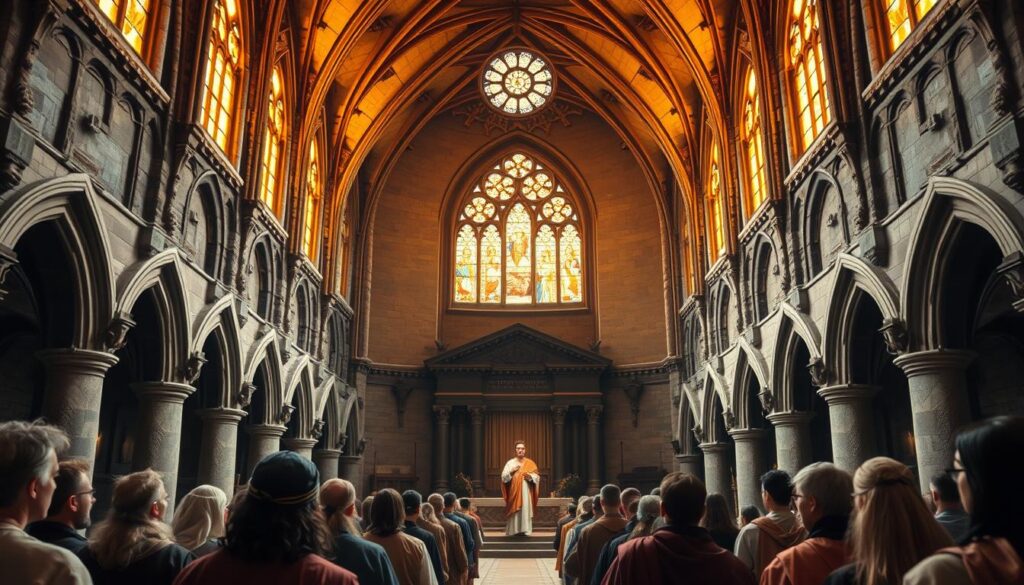
Jesus Christ’s Teachings and the Twelve Apostles
The Gospels show Jesus preparing his followers through parables and personal example. He gave the Twelve Apostles authority to heal, forgive sins, and spread his message. Their most famous member, St. Peter, received a special promise: “You are Peter, and on this rock I will build my church.”
This declaration from Matthew’s Gospel became central to the Catholic Church’s structure. Early believers saw Peter’s leadership continue through successors like Linus and Clement. These bishops maintained unity across growing Christian communities.
| Apostle | Role | Key Contribution |
|---|---|---|
| Peter | First Bishop of Rome | Established papal succession |
| Andrew | Missionary to Greece | Spread teachings in Eastern Europe |
| James | Jerusalem Council Leader | Shaped early church policies |
The apostles’ work created a blueprint still used today. They trained new leaders, celebrated shared rituals, and adapted teachings for different cultures. This foundation allowed the Roman Catholic tradition to grow while keeping its core identity.
Foundations of Early Doctrines and Teachings
Defining religious truth became crucial as Christian groups multiplied. By the second century, thinkers like Ignatius of Antioch took bold steps to solidify core beliefs. Their work created a roadmap for what we now recognize as Roman Catholic theology.
Role of the New Testament in Shaping Beliefs
The New Testament served as both anchor and compass for early believers. Church Fathers meticulously compared texts to preserve Jesus’s original message. Irenaeus, a second-century bishop, argued: “Scripture forms the bedrock of true doctrine.”
Three key developments shaped this era:
- Church councils evaluating sacred writings
- Debates rejecting mystical interpretations like Gnosticism
- Standardized teaching methods for diverse communities
In 382 AD, the Catholic Church reached a milestone. The Council of Rome officially recognized 73 books as divinely inspired. This decision unified worship practices across the Roman Empire.
Early theologians didn’t just defend beliefs – they built systems. Their frameworks addressed practical questions about leadership and daily faith practices. Today’s Roman Catholic teachings still reflect their careful balance of tradition and adaptation.
Early Organization and the Rise of Bishops
The growth of Christian communities demanded new systems of governance. By the late 2nd century, leaders faced practical challenges – from settling disputes to maintaining unity across vast regions. Their solution? A network of regional councils that mirrored Rome’s administrative genius.
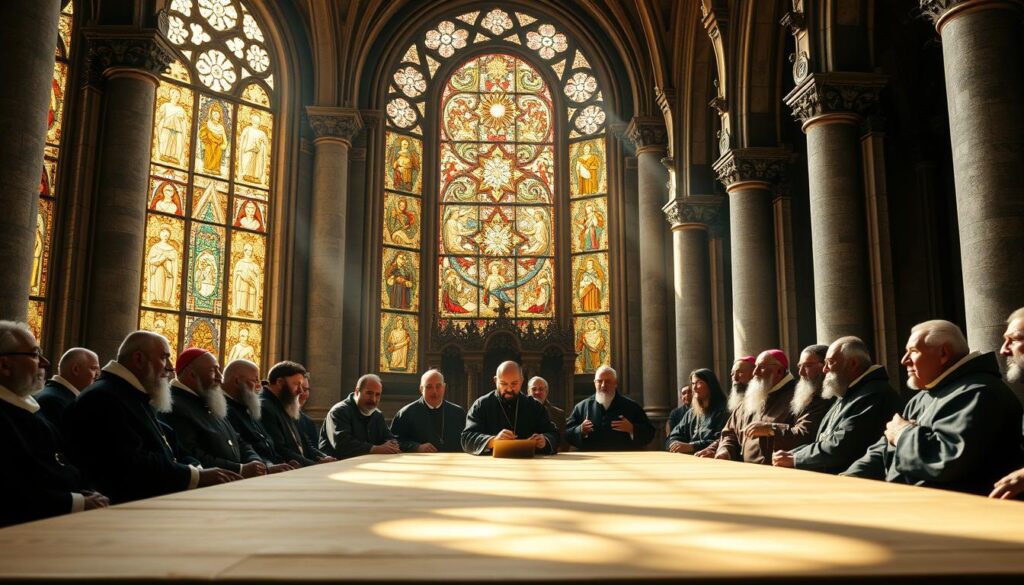
Development of Regional Synods and Apostolic Succession
Bishops began meeting regularly in synods – collaborative gatherings to address pressing issues. These assemblies tackled everything from doctrinal debates to festival dates. As historian Eamon Duffy notes:
“The bishop of Rome became the ultimate referee when local leaders reached impasses.”
Three key cities emerged as spiritual powerhouses:
| City | Influence | Notable Contribution |
|---|---|---|
| Rome | Final authority on disputes | Developed appeals process |
| Antioch | Eastern theology hub | Standardized baptism rituals |
| Alexandria | Scriptural interpretation | Pioneered catechetical schools |
The Roman Catholic Church adopted organizational patterns from imperial administration. Bishops in strategic cities naturally gained more authority, creating a hierarchy that stabilized growing communities. This structure proved vital for coordinating missionary work and resource distribution.
Apostolic succession became the glue holding everything together. Each bishop could trace their spiritual lineage back to Christ’s original followers through:
- Documented ordination records
- Shared sacramental practices
- Geographical continuity
By the 3rd century, this system enabled the church to function as a unified body despite cultural differences. The bishop of Rome’s rising prominence laid groundwork for future papal leadership while preserving local traditions.
Understanding Early Christian Evangelization
The ancient world became a highway for spiritual transformation as early believers carried their message across continents. Missionaries used Roman Catholic teachings to build bridges between cultures, starting with Jewish settlements near the Mediterranean. By 100 AD, over 40 vibrant churches dotted the map from Antioch to Ephesus.
Expansion from Urban Centers to the World
Rome’s infrastructure became Christianity’s unexpected ally. The empire’s roads let travelers cover 25 miles daily – enough to reach new cities every week. Safe sea routes under Pax Romana enabled risky journeys to distant lands like Armenia and India’s Malabar Coast.
Three factors turbocharged this growth:
- Greek language fluency in cities
- Trade hubs doubling as message relays
- House churches serving as community anchors
Urban areas acted like spiritual megaphones. Converts in Rome or Alexandria could share teachings with visiting merchants, who then carried ideas home. This network effect helped the Catholic Church plant roots in Persia and beyond within one century.
Missionaries adapted brilliantly to local customs. They trained leaders from within communities rather than imposing outsiders. This approach created self-sustaining church networks that survived political upheavals and cultural shifts.
“We became all things to all people so that by all possible means we might save some.”
By focusing on cities first, early evangelists ensured their message rippled outward to rural areas. Their legacy shaped how the Roman Catholic tradition engages with the world – through practical methods wrapped in timeless teaching.
The Impact of Persecutions and Legalization
The story of early Christians isn’t just about growth—it’s a tale of courage under fire. For nearly three centuries, believers navigated a hostile Roman Empire that saw their faith as a threat to social order.
When Faith Collided With Tradition
Early Roman Catholic communities faced impossible choices. Refusing to join pagan festivals meant missing weddings, markets, and civic events. Neighbors feared their monotheism angered the gods, fueling suspicion. By the late 3rd century, emperors launched organized crackdowns.
Persecution ranged from property seizures to public executions. Some accounts suggest up to 50,000 martyrs died defending their beliefs. Yet these trials strengthened the church’s identity—underground networks grew tighter, and stories of sacrifice inspired new converts.
Everything changed in 313 AD. Emperor Constantine’s Edict of Milan stopped the violence, allowing open worship. This landmark moment in Catholic Church history shifted Christianity from persecuted sect to protected religion. The Roman Empire’s tolerance paved the way for future development of doctrines and institutions.
Through struggle and resilience, early believers laid foundations that still shape the Roman Catholic tradition today. Their journey from catacombs to cathedrals remains one of history’s most dramatic transformations.
FAQ
When did the Roman Catholic Church officially begin?
The roots of the Roman Catholic Church trace back to Jesus Christ and the Twelve Apostles, but its formal structure developed over centuries. Key milestones include Pentecost (30–33 AD), the Council of Nicaea (325 AD), and the establishment of papal authority under early bishops of Rome like Pope Leo I.
What role did the New Testament play in early Catholic teachings?
The New Testament served as the foundation for core doctrines like salvation, sacraments, and Christ’s divinity. Early leaders, such as St. Augustine, used these texts to address theological debates and unify believers across regions.
How did the Edict of Milan change Christianity?
Issued in 313 AD by Emperor Constantine, the Edict of Milan legalized Christianity, ending widespread persecution. This allowed churches to grow publicly, build grand structures like St. Peter’s Basilica, and influence Roman laws and culture.
Why is apostolic succession important to Catholics?
Apostolic succession ensures continuity from Jesus’ Apostles to modern bishops. This unbroken lineage, emphasized by figures like St. Irenaeus, reinforces the Church’s authority to teach and preserve traditions authentically.
How did early Christians spread their faith globally?
Missionaries like St. Paul traveled Roman roads to urban centers such as Ephesus and Corinth. Later, monastic orders and explorers, including Spanish and Portuguese friars, brought Christianity to Africa, Asia, and the Americas.
What were the effects of Roman persecutions on the Church?
Persecutions under emperors like Nero and Diocletian led to martyrdom but also strengthened communal bonds. Stories of saints like Perpetua and Felicity inspired courage, while secret worship practices deepened spiritual resilience.
How did regional synods shape early Church governance?
Synods, such as the Council of Carthage (251 AD), helped standardize practices like baptism and resolve disputes. These meetings laid groundwork for ecumenical councils, ensuring unity amid diverse cultural contexts.