For many believers, prayer is a quiet conversation with God. But some experience a form of worship that defies ordinary language. This spiritual expression, often called glossolalia, allows individuals to connect with the divine through sounds and syllables that transcend human understanding.
Though this practice may seem unusual to some, it has roots in centuries of faith traditions. Stories from scripture and modern testimonies reveal how people describe it as a gift that deepens their relationship with God. When words fail, these heartfelt utterances become a bridge between the soul and the sacred.
Misconceptions about this prayer style often arise from its association with other Christian groups. However, it’s quietly embraced by a growing number of Catholics who view it as a personal, Spirit-led practice. They emphasize its role in fostering humility and trust, aligning with the Church’s teachings on openness to grace.
Key Takeaways
- Rooted in scripture, this prayer form has historical ties to Catholic spirituality
- Personal accounts highlight its role in deepening faith beyond traditional methods
- Practitioners stress its alignment with reverence and Church-approved worship
- Common concerns often stem from misunderstandings about its purpose
- Church leadership recognizes its validity when practiced with proper discernment
Historical Roots and Theological Perspectives
Acts of the Apostles reveals a transformative event that birthed a unique mode of prayer. When flames resembling “tongues of fire” rested on Christ’s followers, they began communicating in unlearned languages. This Pentecost moment, described in Acts 2:4, marked the first biblical account of divine speech transcending human barriers.
Early Church Practices and Pentecost Accounts
The Holy Spirit empowered believers to share the gospel across cultural divides. While some spoke recognizable languages, others used mysterious utterances for personal worship. Early Christians viewed this gift as a sign of God’s presence, though debates about its purpose arose quickly.
| Type of Tongues | Purpose | Biblical Reference |
|---|---|---|
| Private Prayer | Deepening personal connection with God | 1 Corinthians 14:2 |
| Prophetic Utterance | Delivering messages needing interpretation | 1 Corinthians 14:5 |
| Missionary Proclamation | Sharing faith across language barriers | Acts 2:6-11 |
St. Paul’s Teachings on Tongues
In his letters to Corinth, St. Paul acknowledged tongues’ value but prioritized clarity. “I would rather speak five intelligible words… than ten thousand in a tongue” (1 Corinthians 14:19). He taught that love must guide all spiritual practices, urging believers to seek gifts that build community understanding.
Despite personal use of this prayer form, Paul established guidelines. Public worship required interpretation to prevent confusion. His teachings remind modern practitioners that spiritual gifts serve others—not personal prestige.
The Role of catholicism speaking in tongues in Modern Worship
In 1967, a spiritual revival sparked fresh interest in ancient worship practices. The Catholic Charismatic Renewal emerged, blending traditional faith with vibrant expressions of devotion. This movement emphasized personal encounters with the Holy Spirit through prayer forms like glossolalia.
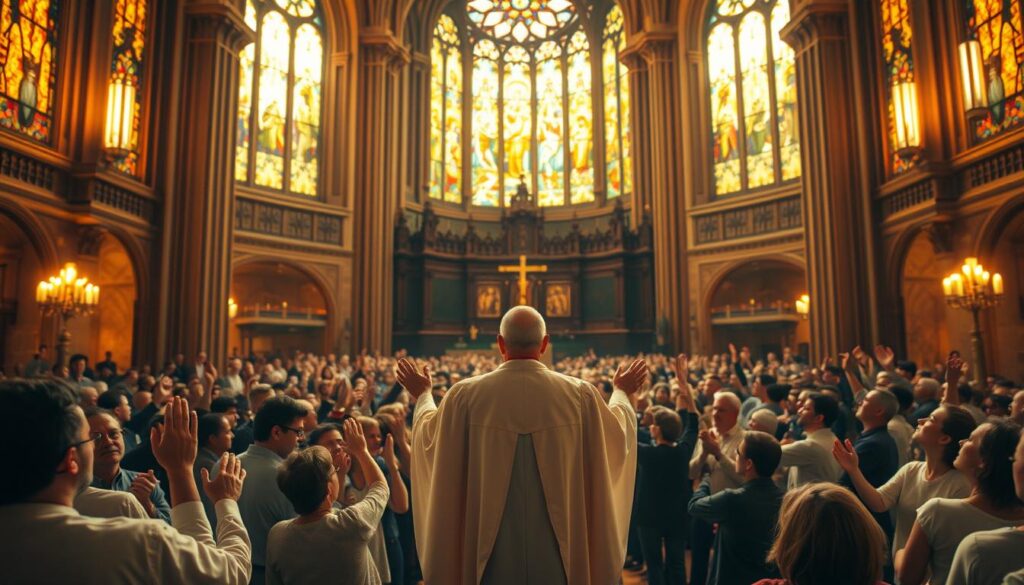
Catholic Charismatic Renewal Movement
Popes have consistently supported this renewal movement since its start. Pope Francis called it “a current of grace”, highlighting its role in modern spirituality. A landmark 1975 Mass in St. Peter’s Basilica featured cardinals and laypeople praying in unison—a powerful display of unity.
Brazil saw particular growth, where the Catholic charismatic approach helped retain members facing Pentecostal outreach. Communities reported renewed passion for sacraments and service, proving its lasting impact.
Contemporary Experiences and Spiritual Significance
Neuroscience offers intriguing insights into these prayer experiences. University of Pennsylvania researchers observed reduced frontal lobe activity during glossolalia, suggesting focused spiritual engagement rather than random vocalizations.
| Aspect | Finding | Implication |
|---|---|---|
| Mental Health | Higher emotional stability in practitioners | Supports holistic well-being |
| Community Impact | Strengthened Catholic identity in Brazil | Counteracts denominational shifts |
| Scientific Validation | Distinct brain activity patterns | Confirms unique spiritual state |
Studies of 1,000 believers revealed those embracing this gift showed greater resilience. While mysterious, these experiences continue shaping worship today—bridging personal faith and communal tradition.
Practical Approaches and Liturgy Considerations
Balancing spiritual freedom with liturgical reverence requires thoughtful guidance. The Brazilian bishops’ 1994 document offers a helpful framework, distinguishing between private devotion and communal worship. Their wisdom helps believers embrace this gift while honoring the Church’s sacred rhythms.
Guidelines from Church Authorities
The bishops clarified two forms of this charism: personal praying tongues for divine connection and speaking tongues meant for community edification. Public Mass settings follow strict rules—utterances need interpretation to avoid confusion. As one guideline states: “Love for others shapes how we use spiritual gifts.”
Integrating Tongues into Personal and Community Prayer
For private prayer, the Church suggests quiet spaces where believers can surrender to the Spirit’s flow. Start by asking for grace to communicate authentically, even through wordless sounds. Many find this practice deepens their sense of God’s presence beyond structured language.
| Practice Type | Purpose | Key Consideration |
|---|---|---|
| Personal Devotion | Intimate connection with God | Focus on heartfelt sincerity |
| Group Worship | Building up others | Requires interpretation if public |
| Mass Participation | Unity through liturgy | Follow approved rubrics strictly |
The Catechism reminds us that all charisms serve the Church’s healing and growth. Whether in solitude or together, this gift becomes most powerful when guided by love and discernment.
Conclusion
Spiritual growth thrives when love guides every practice. As St. Paul taught, even the most extraordinary gifts become hollow without compassion (1 Corinthians 13:1-2). This truth anchors the Church’s balanced view of divine prayer forms—valuing their role while keeping salvation rooted in grace, not specific expressions.
The Catholic Charismatic movement shows how these experiences can enrich faith when aligned with tradition. Church guidelines protect both personal devotion and communal harmony, ensuring spiritual gifts build unity rather than division. As Pope Francis notes, diversity in worship reflects the Spirit’s creativity.
Whether one embraces this practice or prefers silent meditation, what matters is seeking God authentically. The church reminds us that true spirituality always bears fruit in service to others—quietly drawing hearts closer to divine love.
FAQ
How does the practice of glossolalia connect to early Christian traditions?
The roots trace back to Pentecost, where the Holy Spirit enabled apostles to speak diverse languages. This event, celebrated as the Church’s birth, highlights unity through the Spirit. Early communities, as noted in Acts and Paul’s letters, viewed it as a spiritual gift for edification.
What did St. Paul emphasize about the use of tongues in worship?
Paul stressed order and clarity in worship. In 1 Corinthians, he advised that glossolalia should build up the community, preferably with interpretation. He prioritized prophecy for communal understanding but acknowledged the value of tongues when aligned with love and discernment.
How has the Charismatic Renewal influenced modern Catholic worship?
Since the 1960s, this movement revitalized emphasis on the Holy Spirit’s gifts, including glossolalia. It encourages personal and communal renewal through prayer groups, fostering deeper faith experiences while staying within Church teachings.
Does the Catholic Church officially endorse speaking in tongues today?
The Church recognizes it as a valid charism when used orderly and in line with doctrine. Documents like Iuvenescit Ecclesia affirm its role in personal and communal growth, provided it complements sacraments and liturgy.
Can individuals incorporate glossolalia into private prayer practices?
Yes, many use it privately as a form of contemplative prayer. It’s seen as a way to deepen one’s relationship with God, though discernment and alignment with broader spiritual practices are encouraged.
How does Catholic teaching distinguish glossolalia from other traditions?
The focus is on harmony with liturgy and community edification. Unlike some traditions, Catholicism emphasizes that such gifts should enhance, not disrupt, sacramental life and require pastoral guidance to avoid division.