Sacred imagery has shaped spiritual practices for nearly two millennia, acting as a bridge between earthly life and divine truth. These visual elements first emerged in ancient times when early believers needed discreet ways to express their faith. Over centuries, they evolved into a shared language that unites millions across continents and cultures.
From the fish emblem to intricate stained-glass designs, these representations serve multiple roles in religious life. They appear in worship spaces, personal prayer items, and community celebrations. Many designs connect to specific figures like saints or events from scripture, creating layered meanings that deepen with study.
The power of these icons lies in their ability to communicate complex ideas through simple forms. A single image can reference entire biblical stories or theological concepts. This visual approach helps people grasp abstract teachings while fostering personal connections to sacred narratives.
Key Takeaways
- Sacred imagery forms a visual language developed over 2,000 years
- Early designs helped believers identify safe gathering places
- Modern symbols maintain ties to ancient traditions while adapting to new contexts
- Visual elements teach faith principles through accessible formats
- Common designs unite global communities across language barriers
Introduction to Catholic Symbols and Their Impact
From stained glass to personal medallions, these images bridge daily life with sacred truths. They turn ordinary objects into reminders of spiritual realities, helping people grasp complex ideas through familiar shapes and patterns.
Many often used designs carry layered meanings. A simple cross might represent sacrifice, hope, and eternal life all at once. These visuals work like spiritual shortcuts, triggering memories of biblical stories or teachings during prayer or reflection.
Shared symbols create unity across cultures. A Mexican grandmother and Filipino teenager might both find comfort in the same Marian emblem. This common language strengthens community bonds while respecting local traditions.
| Visual Element | Spiritual Meaning | Common Use |
|---|---|---|
| Dove | Holy Spirit’s presence | Baptism ceremonies |
| Lily | Purity and resurrection | Easter celebrations |
| Chi-Rho | Christ’s authority | Church decorations |
The educational significance of these markers shines in religious classes. Children remember theological concepts better when paired with vivid illustrations. Adults too find deeper faith connections through symbolic art in worship spaces.
These timeless images do more than decorate – they inspire action. A crucifix might motivate charity work, while a fish emblem could encourage sharing one’s beliefs. Their power lies in speaking directly to the heart, bypassing language barriers.
Historical Origins of the Catholicism Symbol
Hidden markings in ancient tunnels tell stories of faith under pressure. Early believers developed coded visuals during Roman persecution, using everyday objects to share spiritual truths safely.

Early Christian Adoption and Catacomb Imagery
Second-century followers left clues in burial chambers near Rome. The fish outline (Ichthys) served dual purposes – identifying safe spaces and spelling “Jesus Christ” in Greek letters. Archaeologists found these markings in sites like Santi Sebastiano, often paired with anchors representing hope.
Constantine’s 4th-century vision changed everything. His soldiers carried shields marked with ΧΡ, the first two letters of “Christos” in Greek. This Chi-Rho emblem became symbol of imperial approval, moving faith expressions from shadows to public spaces.
Evolution Through the Medieval Period
Monastic artists transformed simple designs into teaching tools. By the 9th century, stained glass windows used color-coded imagery to explain Bible stories to non-readers. Gold leaf in manuscripts highlighted sacred moments, making complex ideas accessible.
| Element | Original Purpose | Medieval Adaptation |
|---|---|---|
| Fish | Secret identifier | Communion references |
| Chi-Rho | Military standard | Altar decorations |
| Vine Patterns | Natural camouflage | Church architecture |
These visual tools helped unify growing communities across Europe. Local craftsmen added regional touches while keeping core meanings intact, creating a shared spiritual language that lasts today.
Role of Symbols in Modern Catholic Faith Practices
Visual markers remain vital in daily spiritual routines, connecting ancient tradition to modern believers. During Mass, elements like candles and incense engage multiple senses, creating immersive worship experiences. These tools help focus attention during sacred moments, from baptismal fonts to communion rituals.
Many individuals use portable icons for personal reflection. Pocket rosaries or phone wallpapers featuring sacred art provide quick access to spiritual grounding. A teacher might touch a cross necklace before class, while a nurse could glance at a St. Luke medal during shifts.
Religious education programs leverage these visuals to simplify complex ideas. Color-coded liturgical calendars and saint figurines make abstract concepts tangible for young learners. Adults rediscover faith through symbolic art exhibits that blend classic motifs with modern designs.
| Element | Modern Application | Purpose |
|---|---|---|
| Oil Lamp | Home prayer spaces | Divine presence reminder |
| Dove | Confirmation certificates | Holy Spirit representation |
| Alpha-Omega | Youth group logos | Timeless faith connection |
New churches creatively adapt tradition through materials like laser-cut metal or LED-lit altars. These updates maintain core meanings while resonating with tech-savvy congregations. Intergenerational Bible studies often use comparison exercises between ancient and contemporary designs.
Therapeutic practices incorporate symbolic meditation for stress relief. Coloring pages of stained glass patterns or arranging floral emblems helps people process emotions through sacred geometry. This approach bridges devotional life with mental wellness strategies.
Artistic Interpretations in Catholic Iconography
Light filters through vibrant glass panels, casting stories in color across stone floors. For centuries, artists have transformed sacred concepts into tangible art that educates and inspires. These creations turn abstract ideas into visual lessons accessible to all.
Stained Glass and Ecclesiastical Artworks
Medieval craftsmen perfected the often depicted practice of turning sunlight into sermons. Windows at Chartres Cathedral show biblical scenes through jewel-toned glass, their patterns teaching scripture to those who couldn’t read. Modern churches continue this tradition with abstract designs that spark personal reflection.
Three key elements define these luminous works:
- Color symbolism: Blue for divinity, red for sacrifice
- Narrative sequencing: Multiple panels showing story progression
- Architectural integration: Shapes matching building structures
Sculptures and Religious Frescoes
Carved stone and painted plaster bring sacred figures into three-dimensional form. Bernini’s dramatic marble works capture emotional moments, like Saint Teresa’s ecstatic vision. Fresco artists like Giotto used wet plaster techniques to create durable wall paintings that survived centuries.
| Medium | Famous Example | Teaching Purpose |
|---|---|---|
| Stained Glass | Rose Window, Notre Dame | Apocalypse symbolism |
| Sculpture | Pietà, Michelangelo | Compassion through form |
| Fresco | Sistine Chapel Ceiling | Creation narrative |
Contemporary artists reimagine these traditions using new materials. Laser-cut metal screens and digital projections now join classic christian art forms, proving ancient symbols remain relevant across changing creative landscapes.
Iconography and Religious Imagery in Catholicism
Golden halos and scarlet robes speak a silent language in sacred spaces. These visual rules help believers recognize holy figures instantly, whether in Mexican murals or Polish chapels. A saint holding keys always means Peter, while a woman with lilies points to Mary – this coded system crosses language barriers.
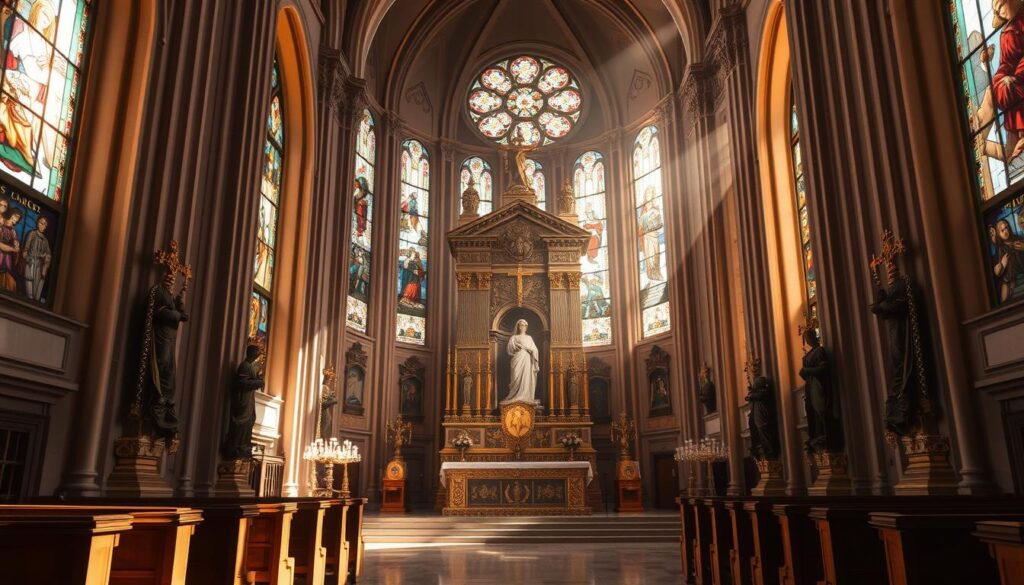
Artists follow strict guidelines to maintain significance across centuries. Blue garments denote heavenly grace, while three fingers raised together symbolize the Trinity. “Iconography isn’t about creativity,” explains art historian Lydia Miller. “It’s about preserving truth through carefully guarded visual formulas.”
Churches use these images like spiritual storyboards. Wall paintings might show Creation to Resurrection in sequence, guiding viewers through salvation history. Stained glass windows often pair Old Testament scenes with New Testament fulfillments, creating dialogue between ancient texts.
| Figure | Attribute | Meaning |
|---|---|---|
| St. Paul | Sword | Martyrdom & Scripture |
| St. Agnes | Lamb | Innocence & Sacrifice |
| St. Luke | Ox | Gospel Strength |
This visual tradition prevents confusion in teaching core beliefs. A 15th-century Italian farmer and modern Texan student both understand Christ’s kingship through crown imagery. Color-coded liturgical items – purple for penance, white for joy – reinforce lessons through repeated exposure.
For communities with limited literacy, these images became living textbooks. Carved Stations of the Cross let worshippers walk Jesus’ final hours. Statue gestures – blessing hands versus praying palms – teach different types of divine interaction. Even today, confirmation classes use symbolic flashcards to explain complex doctrines.
The system’s significance shines in global consistency. Philippine processions and French tapestries both depict Matthew with angel wings, proving shared visual roots. This unified approach keeps theological messages clear while allowing local artistic flavors to enhance, not obscure, sacred truths.
The Cross and Its Many Representations
What began as a Roman execution tool transformed into humanity’s most recognized emblem of hope. After Emperor Constantine’s 313 AD Edict of Milan, the cross emerged from secrecy to become Christianity’s defining marker. Its evolution reflects deep spiritual truths about sacrifice and redemption.
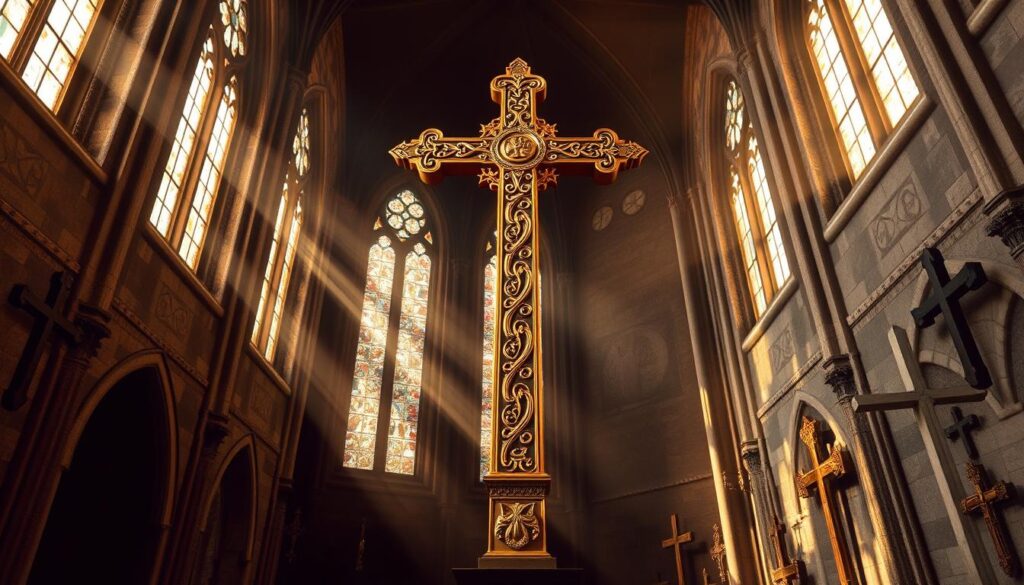
Crucifix and Sacred Heart
Catholic spaces uniquely feature the crucifix – a cross bearing Jesus Christ’s body. This vivid reminder of sacrifice differs from empty crosses used elsewhere. “The corpus keeps our focus on Christ’s physical suffering and victory,” explains liturgical scholar Dr. Maria Torres.
Seventeenth-century France birthed another profound devotion. Saint Margaret Mary Alacoque’s visions popularized the Sacred Heart image – Christ pointing to a heart encircled by thorns. This symbol emphasizes divine compassion, with flames representing endless love.
| Feature | Crucifix | Sacred Heart |
|---|---|---|
| Origin | Early Christian era | 1670s visions |
| Key Elements | Corpus, INRI inscription | Radiant heart, crown of thorns |
| Modern Use | Altars, rosaries | Home shrines, medallions |
Churches use processional crosses during important rituals, while families display miniature versions in living spaces. Many believers touch these cross representations during prayer, physically connecting to their faith’s central mystery.
The crucifixion story comes alive through these visual tools. From Gothic cathedral carvings to hospital chapel prints, they adapt to new settings while preserving core meanings. This flexibility ensures the cross remains relevant across changing generations.
Marian Symbols: Lily, Fleur-de-lis, and Rosary
White petals unfurl in sacred art, whispering tales of spiritual devotion. The lily stands as nature’s perfect metaphor for purity, its unblemished form mirroring the Virgin Mary‘s sinless nature. Medieval painters often showed Gabriel holding this flower during Annunciation scenes, linking divine messages to floral beauty.
French artisans transformed the lily into the regal fleur-de-lis. This three-petaled design honors Mary’s title as Queen of Heaven while subtly nodding to the Trinity. You’ll spot it in cathedral stonework and royal banners, blending earthly majesty with heavenly grace.
Prayer beads become botanical metaphors through the rosary. Thirteenth-century tradition says Mary gave St. Dominic this “garland of roses” – each prayer blooming like fragrant petals. Modern versions range from simple wood beads to military-grade cord wraps, adapting ancient practice to contemporary life.
| Element | Meaning | Cultural Adaptation |
|---|---|---|
| Lily | Innocence | Mexican altar designs |
| Fleur-de-lis | Royal devotion | New Orleans architecture |
| Rosary | Contemplative prayer | Filipino festival jewelry |
These emblems teach through beauty rather than words. A Korean mother and Italian nun both understand Mary’s purity through lily imagery. Summer processions in Spain drape statues in floral mantles, making theology tangible through scent and color.
Churches celebrate Mary’s Assumption with lily arrangements each August. Home shrines feature the Virgin Mary surrounded by carved roses, inviting personal reflection. These living traditions prove ancient symbols still breathe fresh meaning into modern faith journeys.
Symbols of Jesus Christ and His Passion
Ancient believers crafted coded messages to share their devotion safely. Two designs in particular carried hidden references to Jesus Christ while avoiding detection during times of persecution.
Secret Signs to Sacred Emblems
The fish outline, called Ichthys, served as more than a simple drawing. Its Greek word origin spells out “Jesus Christ, Son of God, Savior” through its first letters. Early followers used this mark to identify safe meeting spots, scratching it into walls or dirt as a silent invitation.
Another powerful emblem emerged from military history. The Chi-Rho combines the first two Greek word characters for “Christos.” After Emperor Constantine’s vision, this symbol christ appeared on shields and banners, transforming from secret code to public declaration.
These designs connect Jesus Christ‘s story to daily life. The fish references his miracle of multiplication, while the Chi-Rho echoes his triumph over death. Both point to the resurrection, using geometric simplicity to convey profound hope.
Modern believers still use these emblems as conversation starters. A car bumper sticker or necklace becomes a quiet testimony, continuing the ancient practice of sharing faith through visual language.
FAQ
Why is the cross central to Catholic traditions?
The cross represents Christ’s sacrifice and victory over death. It’s a universal sign of hope, redemption, and eternal life, deeply woven into prayers, rituals, and church architecture.
What does the lily symbolize in religious art?
Often linked to the Virgin Mary, the lily signifies purity, innocence, and divine grace. It’s featured in artworks, feast days, and rituals honoring her role in Christian teachings.
How did early Christians use symbols like the fish (Ichthys)?
The fish, from the Greek “Ichthys,” served as a secret code during persecution. It affirmed beliefs in Jesus’ divinity and united believers through shared faith under Roman rule.
What role do stained-glass windows play in churches?
These vibrant artworks illustrate biblical stories and saints, creating a visual connection to sacred teachings. Light passing through them symbolizes God’s presence illuminating spiritual truths.
Why is the Chi-Rho symbol significant?
Combining the first two Greek letters of “Christ,” the Chi-Rho represents Jesus’ authority and resurrection. It’s used in liturgy, art, and celebrations like Easter to honor His triumph.
How did medieval art shape Catholic iconography?
Medieval artists blended scripture with symbolism, using motifs like the lamb (for Christ) and the dove (for the Holy Spirit). These designs deepened spiritual reflection in churches and manuscripts.
What does the Fleur-de-lis represent in Marian devotion?
Linked to Mary’s purity and the Holy Trinity, this stylized lily appears in statues, prayers, and French Catholic heritage—emphasizing her role as a guiding figure in faith.