Welcome to an easy, friendly roadmap that explains what this faith teaches and why it matters today in the United States and around the world.
This Ultimate Guide will unpack the Nicene Creed, sacraments, Scripture and Sacred Tradition, and the role of the pope and bishops in clear language. You will see how doctrine shows up in worship, mercy work, and daily life.
Readers will find reliable summaries in the Catechism and practical examples from liturgy and mission. This guide focuses on teaching, not debate, and aims to deepen your relationship with God through clear definitions and context.
Whether new or returning, you are invited to explore without pressure. Jump to topics that interest you while keeping sight of the whole picture: God’s love in Jesus, grace, and hope for life to come.
Key Takeaways
- The Nicene Creed gives a concise summary of core teaching.
- Sacraments and liturgy show doctrine in living practice.
- The Catechism offers an accessible compendium of essential content.
- Apostolic succession and papal leadership shape continuity across history.
- This guide aims to explain faith in clear, practical terms for everyday life.
Why This Ultimate Guide Matters for Understanding the Catholic Church in the United States
This guide helps U.S. readers place local parish life within a global, centuries-old tradition.
Size and structure matter. The catholic church includes 24 sui iuris churches, with the Latin Church and 23 Eastern churches, and nearly 3,500 dioceses and eparchies worldwide. Governance flows from the Holy See and the pope, with support from the Roman Curia.
In the United States, parishes share the Nicene Creed and sacraments while meeting local needs. That unity helps Americans see how teaching, liturgy, and mission connect across time and place.
Use this guide to answer common questions: What does the church really teach? How do Scripture and Tradition work together? What role do bishops, dioceses, and the pope play?
Readers will also find how long history shapes present practice and how faith affects daily life — family choices, service to the poor, and civic action. Urban parishes and rural missions live out the same content in diverse ways.
- Practical navigation: clear summaries for busy readers.
- Informed relationship: build a balanced view of worship and mission.
The Nicene Creed: The Core Summary of Catholic Faith
Clear, concise words in the Creed shape how people pray, learn, and live their faith together.
What it is: The Nicene Creed is a concise, authoritative statement that sums up belief in God the Father, Jesus Christ, and the Holy Spirit. It grew from early councils to preserve apostolic teaching across centuries.
About Jesus: The phrase consubstantial with the Father affirms that the Son is truly divine and truly human. That truth anchors the historical events of Passion, death, resurrection, and ascension as central to salvation.
About the Holy Spirit: The holy spirit is named “Lord, giver of life” and credited with speaking through prophets and guiding the community today.
Community and hope: The Creed proclaims one, holy, catholic and apostolic church, one Baptism for forgiveness, and the resurrection and life of the world to come. These words unite worship at Mass and ground moral choices in hope.
- It links teaching led by the pope and bishops with everyday prayer.
- It is used in catechesis, Baptism, and public worship worldwide.
Jesus Christ and the Paschal Mystery: Salvation at the Heart of Catholicism
Central to this faith is the claim that God became human in Jesus to heal and restore creation. This truth insists Jesus Christ is both fully divine and fully human, the Son consubstantial with the Father.
True God and true man
Why this matters: If God truly entered history, salvation is not a distant idea but a real act. Being consubstantial shows God shares our life without ceasing to be God.
Crucifixion, resurrection, and final hope
The Creed names a concrete event: crucified under Pontius Pilate, he died and was buried, and rose on the third day. This anchors the story in history and gives the early church firm witness.
Through Passion, death, and resurrection—the Paschal Mystery—humans are freed from sin and death. Every Mass and the liturgical year make that saving action present and active for believers.
- Personal change follows: dying to sin and rising to new life becomes a daily pattern.
- Suffering finds comfort: God’s own Son entered pain and conquered it by love.
- Hope looks forward: Christ will come again in glory, shaping moral urgency and mission now.
| Element | What it Means | Practical Effect |
|---|---|---|
| Consubstantial Son | God truly shared human nature | Salvation is personal and historical |
| Crucifixion under Pilate | Grounded account in history | Credibility for apostolic witness |
| Resurrection & Ascension | Victory over death | Foundation for hope and preaching |
To sum up: The Paschal Mystery is both truth and power. It shapes scripture reading, sacraments, and mission led by the pope and local leaders in the catholic church today.
The Holy Spirit and the Life of the Church
A living presence guides worship, strengthens disciples, and fuels mission across cultures. The Creed names the holy spirit as “Lord, giver of life” who has spoken through ancient prophets and still guides teaching and prayer today.
Giver of life and source of grace
The Spirit is a divine person who brings life, sanctifies communities, and pours out gifts that help believers witness and serve. In sacraments like Confirmation and the Eucharist, that grace strengthens disciples for everyday holiness.
Gifts, guidance, and the mission to the world
The Spirit equipped prophets, shapes teaching, and helps leaders—including pope and bishops—discern faithful priorities. Fruits and gifts animate prayer, care for the poor, evangelization, and brave moral action.
- Unity: the Spirit keeps a diverse people one in faith and love under pastoral authority.
- Discernment: listening for guidance shapes personal choices and parish life.
- Sending: the Spirit empowers creative ministries to meet real needs in local places.
Practical hope: ask the Spirit for wisdom and strength. Christian life is cooperative—God leads; we respond—and that partnership renews hearts, ministries, and the global catholic church for present challenges.
Scripture and Sacred Tradition: One Deposit of Faith
Both Scripture and living tradition form a single deposit that guides worship, doctrine, and daily practice.
The Bible as inspired Word and its canon
Catholics hold the Bible as inspired words that communities recognized in early history.
Early councils and monastic libraries preserved the canon through careful copying and study.
Living transmission through apostles and bishops
Tradition means handing on the Gospel in preaching, liturgy, and pastoral care.
Bishops, in apostolic line, keep that witness alive so local parishes stay connected across time.
How both inform teaching and worship
The Magisterium, led by pope and bishops, interprets Scripture and Tradition to safeguard teaching.
The holy spirit guides interpretation so theology grows without losing apostolic roots.
- Examples: liturgical calendar, Creed wording, sacramental formulas.
- Practical help: read Scripture with the Catechism for clear connections.
Result: One shared deposit gives confident preaching, steady catechesis, and unity across the catholic church.
Authority and the Magisterium: Pope, Bishops, and Apostolic Succession
A single verse from Scripture gives a foundation for how leadership and unity work in this tradition. Jesus told Peter,
“You are the rock on which I will build my church.”
Catholics read that as a scriptural root for the papal office and its pastoral role.
“You are the rock”: Peter and the papacy
Why Peter matters: The pope is understood as Peter’s successor, a visible sign of unity. That office helps hold together local communities across time and place.
Teaching office and infallibility in preserving doctrine
Apostolic succession links apostles to today’s bishops, ensuring continuity in worship, governance, and teaching. This unbroken line supports confidence that core truth passes down through generations.
Infallibility is a specific charism. It protects definitive teaching on faith and morals from error. It does not mean every statement by a pope or bishop is free from mistake.
- The Magisterium serves the Word, offering authoritative guidance for belief and practice.
- Local dioceses, episcopal conferences, and the Holy See coordinate pastoral care and governance.
- Historical appeals to Rome helped resolve disputes in early centuries and kept unity across regions.
Authority as service: Bishops and the pope are called to shepherd, teach, and sanctify. Their role aims at truth and charity, forming consciences and helping everyday holiness.
The Sacraments: Signs That Convey Grace
Sacraments serve as visible channels through which grace meets people in real moments of life.
What a sacrament is: Effective signs instituted by Christ and entrusted to the catholic church that communicate God’s grace. They work ex opere operato—by Christ’s saving action—so grace flows even when ministers are flawed.
Seven sacraments: Baptism, Confirmation, Eucharist, Reconciliation, Anointing of the Sick, Matrimony, Holy Orders. These rites guide believers from initiation through vocation and healing across centuries.
Why form and matter matter
Thomistic terminology names two essentials: matter (the elements used) and form (the words spoken). Proper form and matter preserve meaning and ensure the sacrament’s effect.
| Aspect | What it Means | Practical Effect |
|---|---|---|
| Ex opere operato | Sacrament works by Christ’s promise | Grace is given regardless of minister’s holiness |
| Matter and form | Elements and words required | Preserves sign’s meaning and effect |
| Historic witness | Council of Trent affirmed seven sacraments | Stable teaching across reform and centuries |
Think of it like an inauguration: the ritual truly effects a new reality by authority. Ministers serve as instruments, but Christ is the primary actor. See each sacrament as a personal encounter, not a mere ritual. Read on for detailed guides to initiation, healing, and vocation rites.
Sacraments of Initiation: Baptism, Confirmation, Eucharist
Baptism, Confirmation, and Eucharist form a linked path that shapes a new spiritual identity. These rites begin life in faith by giving forgiveness, sealing with grace, and feeding believers at the table.
Baptism: Forgiveness and entry into the Body
Baptism cleanses sins, makes one a child of God, and incorporates the person into the Body of Christ. It is called “one Baptism” in creedal witness and marks full entry into community life.
Confirmation: Strengthening by the Holy Spirit
Confirmation deepens baptismal grace. It seals a person with the holy spirit and equips them for witness, service, and steady growth in faith.
Eucharist: Real presence and communion
The Eucharist is the source and summit of life in faith. In Mass, Christ’s real presence—Body and Blood—is given so believers share in unity and are transformed for mission.
| Rite | Main Effect | Pastoral Note |
|---|---|---|
| Baptism | Forgiveness of sins; entry into community | Infant practice with later catechesis; RCIA for adults |
| Confirmation | Sealing with the Holy Spirit | Prepares for mature witness and service |
| Eucharist | Real presence; communion and unity | Regular participation builds parish life |
Parents and sponsors play ongoing roles. They guide prayer, learning, and virtue so new members grow into active, loving participants under pastoral care and papal guidance when needed.
Sacraments of Healing: Reconciliation and Anointing of the Sick
Healing in this tradition arrives through concrete rites that restore spirit and community. These sacraments show how mercy meets daily struggle and prepares believers for life’s hardest moments, including illness and eventual death.
Penance and reconciliation: Confession, absolution, and healing
Reconciliation is Christ’s gift of mercy given through the church. Jesus breathed on the apostles and said,
“If you forgive the sins of any, they are forgiven” (John 20:21-23).
Steps include honest confession, sincere contrition, absolution by a priest, and assigned penance that fosters conversion and repair. This rite lifts guilt, restores grace, and brings peace of conscience.
Confession is pastoral and confidential. It invites renewal, not shame, and helps believers resist temptation and grow in virtue.
Anointing: Grace in illness and preparation for eternal life
Anointing of the Sick serves those facing serious illness or old age. It offers spiritual healing, comfort, and union with Christ’s suffering.
If a person cannot confess, anointing may include forgiveness of sins. It also prepares the faithful for the journey toward eternal life, giving strength for present trials.
- Reconciliation restores relationship with God and community.
- Anointing brings consolation, courage, and spiritual support in illness.
- Both rites continue Jesus’ ministry of healing through the pope-led and local pastoral ministry.
Practical note: Regular use of reconciliation, especially during penitential seasons or before major decisions, helps sustain spiritual health and ongoing friendship with the Lord.
Sacraments of Vocation: Marriage and Holy Orders
Vocation comes in distinct forms that build family life and sustain public ministry. Both sacraments strengthen daily fidelity and send people into service.
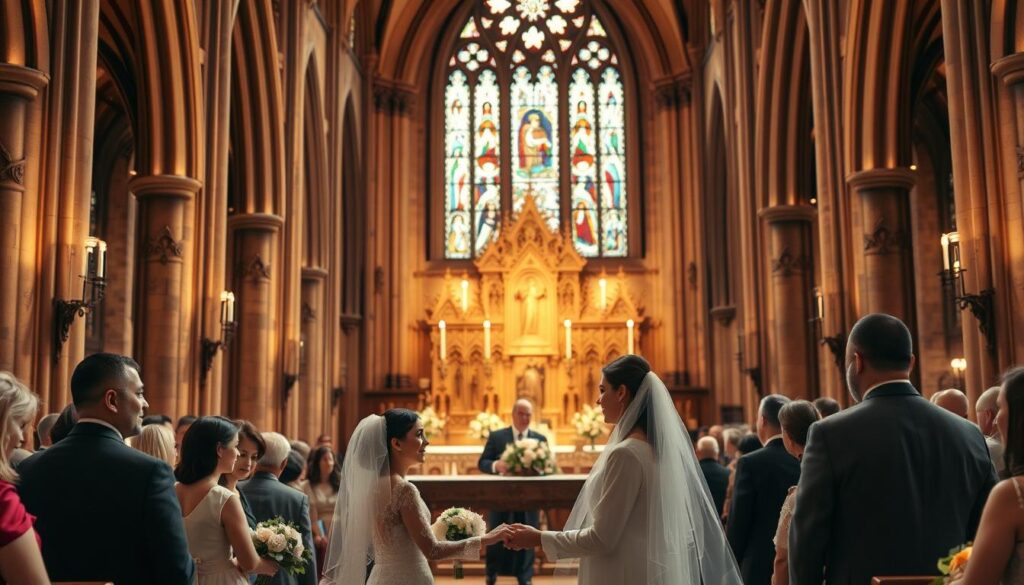
Matrimony: Covenant, family, and the domestic church
Marriage is a lifelong covenant where two spouses give themselves freely and faithfully. This bond creates a family that serves as a domestic church, a place where faith and virtue take root.
Key goods include unity, indissolubility, and openness to children. Parents are primary educators in faith and morality, aided by parish programs and Catholic schools.
Holy Orders: Deacons, priests, bishops, and service
Holy Orders includes deacons, priests, and bishops. Deacons serve in charity and proclamation. Priests sanctify and shepherd parishes. Bishops teach and govern as successors to the apostles, ensuring apostolic succession.
Both vocations orient people to mission. Across centuries ordained ministry has sustained sacramental life and apostolic teaching under the pope and local leaders.
- Discernment: each person should seek God’s call—marriage, priesthood, diaconate, or consecrated life.
- Preparation: marriage catechesis and seminary formation help readiness for lifelong commitment.
- Grace: these sacraments strengthen spouses in mutual self-gift and clergy in pastoral charity.
The Eucharist and the Mass: Source and Summit of Catholic Life
Sunday Mass shapes weekly life by bringing an ancient meal into present worship. At the Last Supper Jesus Christ said,
“This is my body… this is my blood.”
That moment gives us the real presence promised in the Eucharist, a principal sacrament celebrated in every Mass.
From the Last Supper to today: Thanksgiving and sacrifice
The Eucharist continues that meal. It unites thanksgiving and sacrifice as the central act of worship in the catholic church and gathers people around a shared altar.
Liturgy of the Word and Liturgy of the Eucharist
Mass has two main parts. In the Liturgy of the Word, God speaks through Scripture and homily. In the Liturgy of the Eucharist, Christ feeds us with his Body and Blood after consecration by a priest.
Real presence: By the power of the holy spirit and Christ’s words of institution, bread and wine truly become his body and blood. The priest acts in persona Christi, serving the community.
- Keep proper dispositions: faith, freedom from grave sin, and recommended fasting.
- Connect baptism to full participation at the altar.
- Respect the form and words of the rite so unity holds across parishes and under the pope.
Invite: Rediscover Sunday Mass as an encounter that strengthens, heals, and sends people into mission.
Mary and the Saints: Honor, Intercession, and Discipleship
Devotion to Mary and honor for saints springs from a desire to follow Christ more closely.
Mary holds a special place as Mother of God (Theotokos). Catholics affirm dogmas called the Immaculate Conception and the Assumption. These teachings grew from long reflection in theology and worship and point back to Gospel history.
Communion and intercession
The communion of saints pictures a single family across heaven and earth. Holy men and women pray for one another, so asking their intercession is like asking a friend to pray.
Use of sacred images
Images and statues serve as aids: they teach, inspire, and recall Gospel truth. Catholics do not worship carved forms; worship belongs to God alone.
| Focus | What it Means | Practical Result |
|---|---|---|
| Mary, Mother of God | Unique role in redemption history | Model of faithful “yes” and discipleship |
| Communion of saints | Unity across heaven and earth | Spiritual solidarity and prayer support |
| Sacred images & devotions | Visual memory aids in prayer | Rosary, litanies, feast days that lead to imitation |
- Veneration honors saints; worship is due to God alone.
- Mary’s assent models free cooperation with grace.
- Choose a patron saint and learn from that life.
Good devotion moves hearts toward charity and mission. Let Mary’s example and the saints’ witness point you to Jesus, the Son, and to active love for neighbor under pastoral guidance from the pope and local pastors.
Sin, Original Sin, Grace, and the Journey of Faith
This section explains how sin shapes human choice and how grace heals. Original sin names a universal moral wound inherited by every person. It describes an inclination to hurt God, others, and self, and it shows why a Savior is needed.
Human freedom remains real. We are moral agents who must choose good. Yet we need help to form good habits and resist harm. Grace is that help: God’s loving initiative that heals, elevates, and transforms life.
Grace and the theological virtues
Grace gives the theological virtues that shape daily growth. Faith opens the heart to truth. Hope trusts God’s promises. Charity turns belief into loving action.
Sin wounds relationships and, unchecked, leads to spiritual death. Christ’s Paschal Mystery conquers sin and death, offering forgiveness and new life through sacraments. Daily conversion—prayer, examen, and works of mercy—keeps a person moving forward.
- Conscience forms through Scripture, teaching, and wise mentors.
- Holiness unfolds slowly, with setbacks and steady growth.
- Rely on God’s love: grace meets us where we are and leads further.
Catholic Moral and Social Teaching: Love in Action
Catholic moral and social teaching asks communities to turn faith into concrete acts of mercy that heal real needs.
At its heart, this teaching makes the Gospel public. It frames dignity, solidarity, and care for the vulnerable as daily duties. Practical works—feeding the hungry, visiting the sick, sheltering the homeless—show love in life.
Works of mercy and care for the vulnerable
Corporal and spiritual works guide parish and civic action. Schools, hospitals, and charities run by the catholic church serve millions worldwide. They focus especially on the poor, sick, and marginalized.
Human dignity, family life, and the common good
Teaching affirms human dignity from conception to natural death. Marriage and family form the first school of love and civic virtue. Principles—solidarity, subsidiarity, and preferential option for the poor—help shape public choices.
| Focus | What It Means | Examples |
|---|---|---|
| Solidarity | Stand with the vulnerable | Food pantries, disaster aid |
| Subsidiarity | Local initiative matters | Parish outreach, local schools |
| Common good | Shared flourishing | Public policy, healthcare access |
Next steps: volunteer, advocate, or support ethical programs so love becomes visible in your neighborhood and the wider world.
Images, Sacramentals, and Beauty in Catholic Worship
Visual and musical beauty serves as a catechism in wood, glass, and song. Sacred images and careful architecture teach and invite prayer. They make worship spaces clear, ordered, and lovely so people can focus on God.
Why sacred art and architecture matter
Images, frescoes, and stained glass tell Gospel stories at a glance. Paintings and statues help memory and guide meditation. Music, light, and layout lift the mind and shape communal worship.
Sacramentals: blessings, holy water, medals, and devotion
Sacramentals are blessed signs—holy water, medals, scapulars, and prayers—that prepare a person to receive grace. They do not work like a sacrament; their effect depends on faith and devotion.
- Veneration of saints via images honors their witness. It differs from worship, which belongs to God alone.
- Sacraments are instituted by Christ and act ex opere operato. Sacramentals dispose hearts and require reverent use.
- The church preserves form and words in rites to keep meaning and unity across parishes under the pope’s pastoral guidance.
Practical tips: bless family meals, use holy water on entering home, and wear a blessed medal as a prayer reminder. Avoid seeing objects as magical; they point to God and help interior devotion.
Explore local art: Visit nearby parishes, learn the stories behind icons and stations, and let beauty draw you toward truth, charity, and deeper prayer.
Beliefs of the Catholic Church Across History and the World
What began in small Mediterranean communities grew into a worldwide communion that includes many liturgical families.
From early Christianity to a global community
Across centuries, faith spread through ecumenical councils, monasteries, and missionaries who engaged local cultures. Learning, art, and hospitals grew with missionary work and immigration, shaping schools and social care that still serve millions worldwide.
Apostolic continuity in Latin and Eastern traditions
One communion exists in 24 sui iuris churches: the Latin Church and 23 Eastern rites (Byzantine, Alexandrian, Armenian, Syro-Malabar, and more). Together they share Creed, sacraments, and apostolic succession, so a person can feel at home at Mass in many lands.
- Global reach: Roughly 1.27–1.41 billion members across about 3,500 dioceses and eparchies.
- Variety in unity: Diverse liturgies enrich worship while holding to core teaching.
- Invitation: Visit an Eastern parish to experience different rites within one communion.
“Continuity across time preserves unity amid cultural diversity.”
Eschatology: Death, Judgment, Heaven, Hell, and the Resurrection of the Body
This brief guide explains what happens after death and how hope and responsibility shape life now.
Particular and final judgment: Faith, works, and mercy
Every person faces a particular judgment immediately after death. That judgment reflects a lifetime of choices, faith, and works.
At the end of time Christ will return for a final judgment when all are revealed and justice and mercy meet.
Heaven, hell, purgatory, and the risen body
Heaven is eternal communion with God and the communion of saints. It fulfills every holy desire and brings true joy.
Hell is the definitive self-exclusion from God’s love; its deepest pain is separation from the source of joy.
Purgatory is final purification for those who die in friendship with God but need cleansing before seeing God face-to-face.
Resurrection affirms that we will share in a transformed bodily life, modeled on Christ’s own resurrection.
- Justice and mercy both matter: conversion and trust shape final outcomes.
- Hope is central: the church prays for the dead and trusts God desires all to be saved.
- Practical readiness: regular confession, Mass, prayer, and service prepare us for meeting the Lord.
Conclusion
This guide offers a clear invitation: meet Jesus Christ, welcome grace, and walk a steady path of faith.
Core belief centers on the Son and the Holy Spirit, shaping worship, prayer, and daily life. Keep learning with Scripture, the Catechism, and trusted parish resources to deepen understanding.
If you have stepped away, know that a parish is a home ready to welcome, guide, and offer reconciliation for sins. Practical next steps: attend Mass, speak with a pastor, explore RCIA/OCIA, or join a small group to grow.
Belief matures over time through prayer, sacraments, and service. One global communion lives in countless local communities across the world. Share this guide with friends, and trust that grace will walk with you on this journey.
FAQ
What are the core truths summarized in the Nicene Creed?
The Nicene Creed affirms one God who created heaven and earth, Jesus Christ as true God and true man who suffered, rose, and ascended, the Holy Spirit as giver of life, one holy and apostolic Church, one baptism for the forgiveness of sins, and the hope of the life to come.
How does Jesus’ Paschal Mystery save people?
Through the Passion, death, and Resurrection, Jesus conquered sin and death. His sacrifice restores our relationship with God, offers forgiveness, and opens the promise of new life and final resurrection for those who believe and follow his teachings.
What role does the Holy Spirit play in daily life?
The Holy Spirit gives life, guides the faithful, and bestows gifts and grace. The Spirit works in prayer, sacraments, ministry, and the Church’s mission to renew hearts and send believers into the world.
How do Scripture and Tradition work together?
Scripture is the inspired Word; Tradition is the living transmission of faith passed down by the apostles and bishops. Both form one deposit of faith that guides teaching, liturgy, and moral life under the Church’s guidance.
Why is papal authority important?
The pope, as successor of Peter, and the bishops in apostolic succession preserve unity and authentic teaching. The magisterium interprets Scripture and Tradition to protect doctrine and guide the faithful.
What are the sacraments and why do they matter?
The seven sacraments are visible signs that give grace: Baptism, Confirmation, Eucharist, Reconciliation, Anointing of the Sick, Matrimony, and Holy Orders. They mark key moments of Christian life and strengthen unity with Christ.
What happens in Baptism, Confirmation, and the Eucharist?
Baptism cleanses original sin and enters a person into the Body of Christ. Confirmation strengthens by the Holy Spirit. The Eucharist, the real presence of Christ’s Body and Blood, nourishes and unites believers in communion.
How do Reconciliation and Anointing help the sick and suffering?
Reconciliation (confession) offers forgiveness, healing, and restoration after sin. Anointing of the Sick brings grace, comfort, and spiritual strength during illness, sometimes preparing a person for passing to eternal life.
What is the purpose of Matrimony and Holy Orders?
Matrimony forms a lifelong covenant of love, creating family and the domestic church. Holy Orders ordains deacons, priests, and bishops for service, sacramental ministry, and pastoral leadership.
Why is the Eucharist called the source and summit?
The Eucharist contains Christ’s real presence and is the central act of worship. It gives spiritual life, shapes Christian identity, and unites believers around thanksgiving and sacrificial love.
How are Mary and the saints honored?
Mary and the saints are venerated for their witness to Christ. Catholics ask for their intercession, honor key Marian beliefs such as the Immaculate Conception and Assumption, and see the communion of saints as spiritual support.
What is original sin and how does grace address it?
Original sin describes the fallen state inherited from Adam and Eve, which weakens human freedom. Grace, given through faith and the sacraments, heals wounds, restores relationship with God, and empowers virtuous living.
How does Catholic social teaching guide action in the world?
Social teaching emphasizes human dignity, care for the poor and vulnerable, family life, and the common good. It calls for works of mercy, justice, and policies that protect life and promote solidarity.
Why are images, art, and sacramentals used in worship?
Sacred images and beauty lift the mind to God and teach the faith visually. Sacramentals—blessings, holy water, medals—prepare hearts for grace, foster devotion, and support spiritual life.
How has this faith developed across history and around the world?
From early Christianity through councils and centuries of theologians, the Church maintained apostolic continuity. Latin and Eastern rites reflect cultural variety while sharing core doctrines and sacramental life globally.
What does Catholic teaching say about death, judgment, heaven, and hell?
At death each person faces particular judgment. Final judgment at Christ’s return reveals God’s justice and mercy. The Church professes hope in resurrection of the body, eternal life with God, and warns of separation from God in hell for definitive rejection.