Christianity spans the globe with over 2 billion followers, yet its traditions are far from uniform. Among its oldest branches, the Orthodox and Catholic traditions stand out as pillars of faith with deep historical roots. Though they share a common origin, centuries of cultural and theological evolution have shaped their unique identities.
The division between these two branches traces back to the Great Schism of 1054, a turning point that split Christianity into Eastern and Western traditions. Long before this split, early Christian communities already grappled with differences in leadership and practice, as noted in Paul’s letters to the Corinthians.
Today, both churches maintain rich liturgical traditions and spiritual practices. The Catholic tradition emphasizes papal authority, while the Orthodox tradition operates through a collective of patriarchs. These structural contrasts reflect broader theological nuances, such as views on sacraments and doctrine.
This guide will unpack these distinctions with clarity, offering insights into how history, theology, and culture shaped each tradition. Whether you’re curious about worship styles or church governance, you’ll gain a balanced perspective on what unites and separates these ancient faiths.
Key Takeaways
- The Orthodox and Catholic Churches split in 1054, marking Christianity’s first major division.
- Both traditions share ancient roots but developed distinct theological views over time.
- Differences in leadership structure remain a key contrast between the two.
- Worship practices, like liturgy and sacraments, reflect unique cultural influences.
- Modern efforts aim to foster dialogue and mutual understanding between the churches.
Historical Foundations and the Great Schism
The roots of the East-West split stretch back to the Roman Empire’s twilight years. While early Christians shared core beliefs, geography and politics slowly pulled communities apart. “One of you says, ‘I follow Paul’; another, ‘I follow Apollos'” – Paul’s first-century words to the Corinthians reveal how factionalism existed even before empires rose and fell.
Origins of the Early Church Divisions
Constantine’s 313 CE Edict of Milan changed everything. By legalizing Christianity, he transformed a persecuted faith into an imperial institution. When Rome split in 395 CE, its eastern and western halves developed unique religious identities. Eastern emperors in Constantinople shaped church leadership directly, while Western bishops in Rome gradually centralized power under the Pope.
The Impact of the Great Schism of 1054
Tensions reached breaking point over leavened bread. The West used unleavened wafers for Communion, while the East insisted on risen loaves. This seemingly small practice symbolized deeper divides about tradition and authority. Though 1054 is the official split date, most believers didn’t notice immediate changes. As one historian notes: “The schism wasn’t an earthquake, but a slow continental drift.”
| Aspect | Eastern Tradition | Western Tradition |
|---|---|---|
| Leadership | Emperor-appointed patriarchs | Papal authority |
| Liturgical Bread | Leavened | Unleavened |
| Political Center | Constantinople | Rome |
Byzantine rulers saw themselves as Rome’s true heirs, creating a “Second Rome” that blended faith with imperial ambition. Meanwhile, Western churches rebuilt Europe’s spiritual landscape after Rome’s 476 CE collapse. These parallel journeys set the stage for Christianity’s enduring divide.
Core Beliefs and Ecumenical Councils
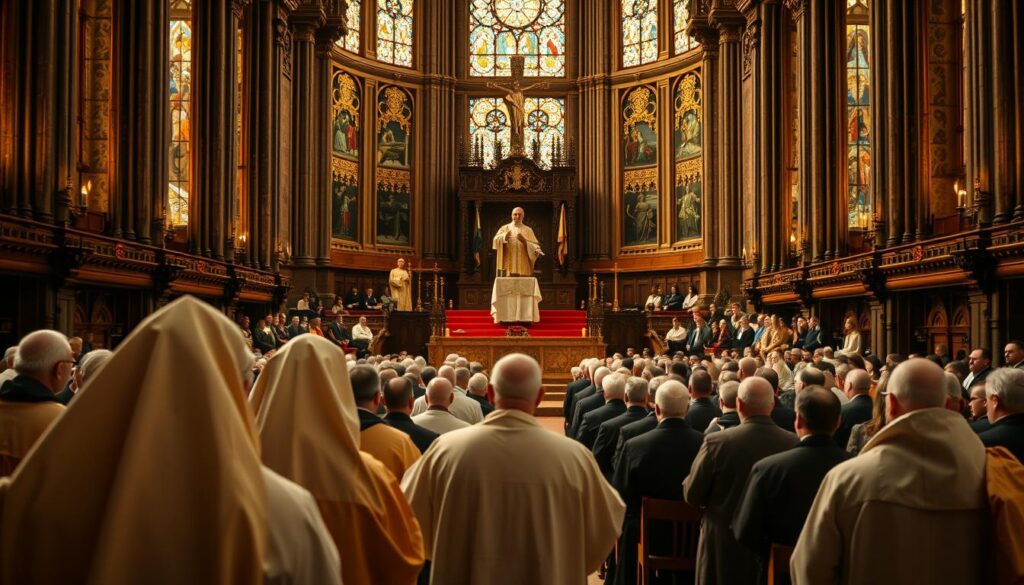
Theological debates in early Christianity led to defining moments through gatherings of bishops. These meetings, called ecumenical councils, shaped doctrines that still unite Orthodox and Catholic communities today. Like architects drafting blueprints, fourth-century leaders established frameworks for understanding divine mysteries.
Shared Doctrines in Early Christianity
Both traditions anchor their faith in foundational truths affirmed by early believers. The Trinity – one God in three persons – and Christ’s divine nature remain non-negotiable. As one Byzantine hymn proclaims: “Light of Light, true God of true God, begotten not created.”
Four landmark councils settled these beliefs between 325-451 CE. They declared Jesus fully human and divine, confirmed the Holy Spirit’s divinity, and defended Mary’s title as “God-bearer.” Even Mary’s perpetual virginity finds agreement across both traditions.
The Role of Ecumenical Councils
Seven councils form the bedrock of Eastern Orthodox teaching, while Catholic churches recognize twenty-one. This gap reflects contrasting views on authority. “Councils clarify truth,” notes theologian John Anthony McGuckin, “but who calls them matters as much as what they decide.”
Here’s where paths diverge:
| Tradition | Recognized Councils | Final Authority |
|---|---|---|
| Eastern Orthodox | First 7 (325-787 CE) | Consensus of bishops |
| Catholic | 21 (325-1965 CE) | Papal approval |
Modern councils like Vatican II remain unrecognized by Orthodox leaders. Yet both value these ancient meetings as vital for preserving faith across generations.
Governance and Authority in the Churches
At the heart of many religious divides lies the question: Who holds the keys to authority? This central issue shapes how communities interpret sacred texts, make decisions, and maintain unity across centuries. While both traditions cherish ancient roots, their approaches to leadership reveal contrasting visions of spiritual stewardship.
Papal Supremacy vs. Conciliarity
The Catholic Church views papal authority as foundational. Citing Jesus’ words to Peter—“You are Peter, and on this rock I will build my church”—it teaches that each Pope inherits Peter’s role as chief shepherd. This belief grants the Pope final say in matters of faith and global church governance.
In contrast, the Orthodox Church operates through conciliarity—a shared leadership model. Major decisions require consensus among bishops, reflecting the early Church’s collaborative spirit. As one Orthodox theologian explains: “Truth isn’t owned by one person. It’s discovered together.”
| Aspect | Catholic Model | Orthodox Model |
|---|---|---|
| Leadership | Papal supremacy | Council of bishops |
| Decision-making | Centralized | Decentralized |
| Source of Authority | Papal office | Collective tradition |
The Influence of Church Fathers and Tradition
Both traditions revere early Christian thinkers like Augustine and Chrysostom. However, they diverge in applying their teachings. Catholic doctrine allows for evolving interpretations under papal guidance, while Orthodox communities prioritize preserving ancient practices unchanged.
This distinction echoes in their structures. The Eastern Orthodox Church functions as a family of self-governing bodies, united by liturgy and creed but independent in administration. Meanwhile, the Catholic hierarchy emphasizes unity through the Pope’s role as visible head.
Liturgical Practices and Ritual Distinctions
Worship spaces come alive through rituals that engage all senses. From the aroma of incense to the glow of candlelight, these traditions shape spiritual experiences. While sharing core sacraments like the Eucharist and baptism, Eastern and Western Christian communities developed unique expressions of devotion over centuries.
Eucharistic Celebrations and Baptismal Rites
The sacred meal uniting believers takes distinct forms. Roman Catholic liturgies use unleavened bread, recalling Jesus’ Last Supper during Passover. Priests consecrate the elements through precise prayers, affirming the body and blood of Christ through transubstantiation.
Eastern Orthodox services feature leavened bread, symbolizing the risen Savior. Their theology describes the change as metousiosis – a mysterious transformation beyond human logic. As one worshiper shared: “We don’t explain the miracle; we experience it.”
| Sacrament | Western Practice | Eastern Practice |
|---|---|---|
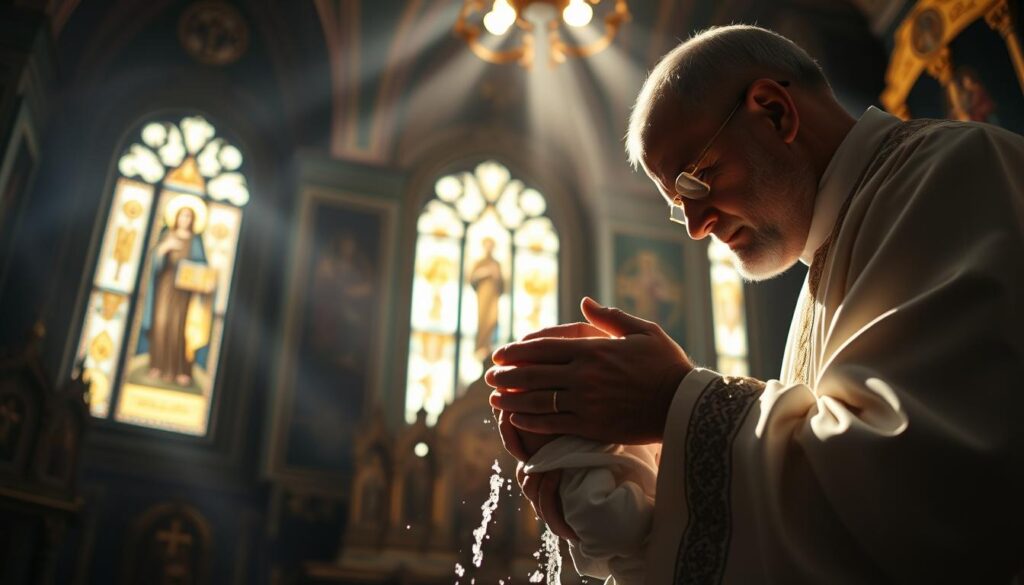
| Baptism | Water poured over head | Full immersion |
| Chrismation | Forehead anointing | Full-body anointing |
| Eucharistic Bread | Unleavened | Leavened |
Iconography, Statues, and Aesthetics
Walk into an Orthodox sanctuary, and you’ll face a wall of icons – the iconostasis. These painted images of saints and biblical scenes aren’t mere decorations. They’re considered portals connecting earthly worship to heavenly realities.
Roman Catholic churches often feature statues that depict sacred figures in three dimensions. While respecting religious art, Western tradition historically focused more on sculptural expressions. Both approaches reflect deep reverence, yet their visual languages differ as much as poetry and prose.
These practices, shaped by history and theology, continue to inspire millions. Whether through the splash of baptismal waters or the gaze of a saint’s icon, both traditions invite believers into sacred encounters.
difference between orthodox church and catholic church
Unresolved debates from centuries past continue to shape spiritual identities today. At the core of these discussions lies the Filioque controversy, a disagreement about the nature of divine relationships. This dispute remains a defining feature separating two ancient Christian traditions.
The Filioque Debate’s Lasting Impact
Western churches affirm the Holy Spirit proceeds from both the Father and Son, expressed through the added Latin term Filioque. Eastern theologians argue this alters the original Creed’s balance, claiming the spirit proceeds from the Father alone. They view this addition as overstepping early church consensus.
Everyday Faith Expressions
Practical contrasts extend beyond theology. Married clergy serve in Eastern communities, while Western priests traditionally embrace celibacy. Visual traditions also differ—vibrant icons dominate Orthodox spaces, whereas statues often fill Catholic sanctuaries.
These distinctions reflect deeper convictions about authority and tradition. Yet both traditions share a commitment to preserving ancient wisdom while navigating modern spiritual challenges. Their parallel paths remind us that faith thrives through both unity and diversity.
FAQ
What caused the split between the Orthodox and Catholic Churches?
The Great Schism of 1054 marked the formal division over theological, cultural, and political disputes. Key issues included disagreements about papal authority and the Filioque clause in the Nicene Creed.
How do views on leadership differ between the two traditions?
The Catholic Church teaches papal supremacy, recognizing the Pope as Christ’s representative. Orthodox Christians emphasize shared leadership among bishops, rooted in early church councils.
Are there differences in how sacraments like baptism are practiced?
Both practice infant baptism, but Orthodox churches typically use full immersion three times, while Catholics often pour water. Theologies around original sin also shape these rituals.
Why do Orthodox churches avoid statues in worship spaces?
Orthodox tradition prioritizes icons as windows to the divine, avoiding statues to prevent idolatry. Catholic churches often use statues to depict saints and biblical figures.
What is the Filioque controversy about?
The Catholic Church added the phrase “and the Son” (Filioque) to the Nicene Creed, stating the Holy Spirit proceeds from the Father and Son. Orthodox Christians reject this, citing early creedal texts.
Do both traditions recognize the same saints and councils?
They share many early saints and the first seven ecumenical councils. Later Catholic saints and councils, like Vatican I, aren’t recognized by Orthodox communities.
How does the Eucharist differ in practice?
Orthodox liturgies use leavened bread and mix the Eucharist with warm water. Catholics use unleavened bread, reflecting Jesus’ Last Supper, and reserve consecrated hosts for adoration.
Are there differences in marriage practices?
Catholic priests cannot marry after ordination, while Orthodox priests can marry before becoming clergy. Divorce is also approached differently, with Orthodox churches allowing limited remarriage.