When you hear the word “Catholic,” you might picture a single, unified church. But this ancient faith holds a vibrant tapestry of traditions that stretch across continents and centuries. Rooted in the Greek term katholikós—meaning “universal”—Catholicism has grown into a global family of communities united by core beliefs yet shaped by unique cultural expressions.
From its earliest days, the church embraced diversity while maintaining essential teachings. The Nicene Creed’s declaration of “one, holy, catholic, and apostolic church” laid the foundation for unity. Yet history shows how geography, language, and local customs created distinct ways of worshiping within this shared framework.
Think of Catholicism like a mighty tree with many branches. Eastern rites developed rich liturgical practices, while Western traditions forged their own identity. Major historical events, like the Great Schism of 1054, led to new expressions of faith that still honor ancient roots. Today, over 1.3 billion Catholics worldwide celebrate their beliefs through varied rituals, art forms, and community structures.
Key Takeaways
- Catholicism’s core meaning of “universal” reflects its global reach and inclusive nature
- Shared beliefs in sacraments and apostolic succession unite all Catholic communities
- Historical events and cultural influences shaped regional worship styles
- Eastern and Western traditions maintain distinct practices while honoring common roots
- Modern Catholicism continues evolving through new spiritual movements
- Local customs blend with ancient rituals in worldwide Catholic celebrations
Introduction: Overview of Catholic Tradition and Diversity
The Catholic Church acts as a living mosaic where ancient rituals meet modern expressions. At its heart lies the idea of katholikós—a faith meant for everyone, everywhere. This universality isn’t about sameness but celebrates how shared beliefs take shape through unique cultural lenses.
Rooted in early Christian communities, Catholic tradition has adapted across 2,000 years without losing its core. Byzantine chant echoes in Lebanon’s Maronite churches, while Franciscan friars lead quiet prayers in California missions. Each practice honors the same sacraments but speaks the language of local history.
Consider these distinct expressions:
| Tradition | Key Feature | Cultural Influence |
|---|---|---|
| Eastern Catholic | Iconostasis use | Greek & Slavic heritage |
| Roman Catholic | Latin Mass | European medieval roots |
| Syro-Malabar | East Syrian rites | Indian cultural blend |
Major councils like Vatican II reshaped worship styles while keeping essential doctrines intact. Today, a teenager in Manila might attend a charismatic prayer meeting, while their counterpart in Warsaw kneels at a traditional Eucharistic adoration. Both experiences reflect the same faith, proving unity thrives through diversity.
What Does “Catholic” Mean?
At its linguistic core, “catholic” carries the weight of centuries. Derived from the Greek katholikos—meaning “universal”—this term shaped Christianity’s earliest identity. Early believers saw their faith as a global invitation, not limited by borders or bloodlines.
Historical and Theological Context
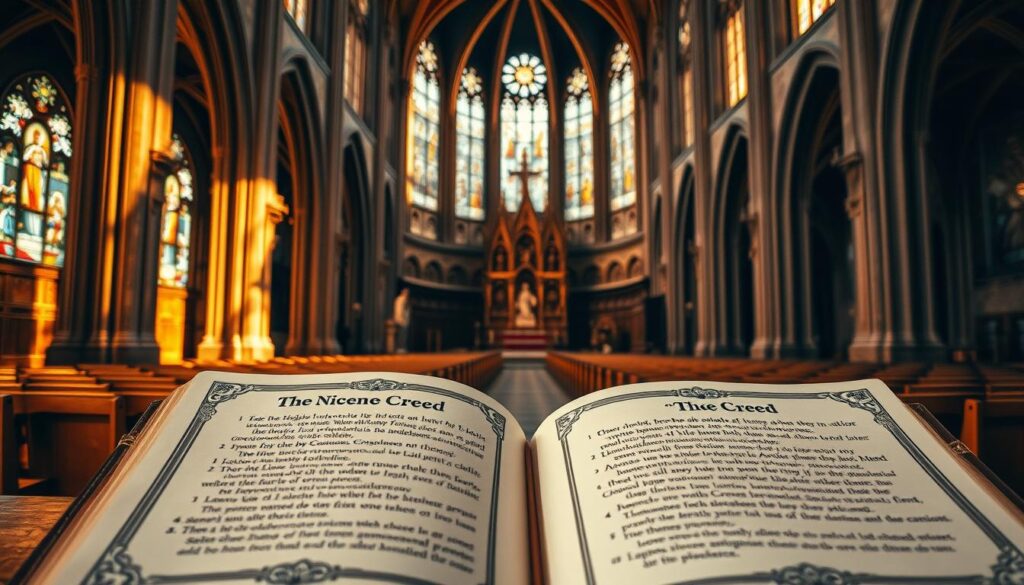
By the 4th century, the church faced a crucial question: How do we define truth? The Nicene Creed answered by declaring four marks—one, holy, catholic, apostolic. These became Christianity’s compass, guiding through political shifts and cultural changes.
Saint Vincent of Lérins later offered a practical test for authenticity. His 5th-century rule states true catholicity requires beliefs held “everywhere, always, by all.” This standard preserved core teachings while allowing regional adaptations.
The Nicene Creed and Universal Faith
Imagine a Roman soldier and Egyptian monk reciting the same creed. The 381 Council of Constantinople made this real. Its words unified diverse communities under shared beliefs, from baptism rituals to resurrection hope.
This theology of wholeness explains why a Mexican processional and Korean prayer meeting both feel authentically Catholic. They express the same spiritual completeness through distinct cultural lenses—proof that universality thrives in variety.
Historical Evolution of Catholicism Through the Ages
The story of Catholicism is marked by pivotal moments that forged its diverse traditions. Five ancient patriarchates—Rome, Alexandria, Antioch, Constantinople, and Jerusalem—once guided the early church. This “Pentarchy” system balanced unity with regional flexibility, planting seeds for future growth.
Major councils became turning points in Catholic history. The 431 Ephesus Council addressed Nestorian teachings, while Chalcedon’s 451 meeting clarified Christ’s divine-human nature. Each dispute sharpened doctrines, though some groups formed separate traditions over these definitions.
Consider these transformative events:
| Year | Event | Outcome |
|---|---|---|
| 1054 | East-West Schism | Split between Roman and Eastern traditions |
| 1517 | Protestant Reformation | Counter-Reformation and Council of Trent |
| 1870 | Vatican I | Old Catholic movement emerges |
As historian Jaroslav Pelikan noted:
“Tradition is the living faith of the dead, traditionalism the dead faith of the living.”
This truth echoes through centuries—from medieval monastic reforms to today’s liturgical renewals.
The 16th-century Reformation sparked urgent changes. Rome’s response through the Council of Trent (1545-63) standardized sacraments and clergy training. Yet even in modern times, groups like the Old Catholics show how adaptation continues within ancient frameworks.
Over 2,000 years, challenges became catalysts. Persecutions, schisms, and debates didn’t weaken the church—they refined its ability to hold truth while embracing new cultural landscapes.
Eastern Catholic Traditions and Their Unique Practices
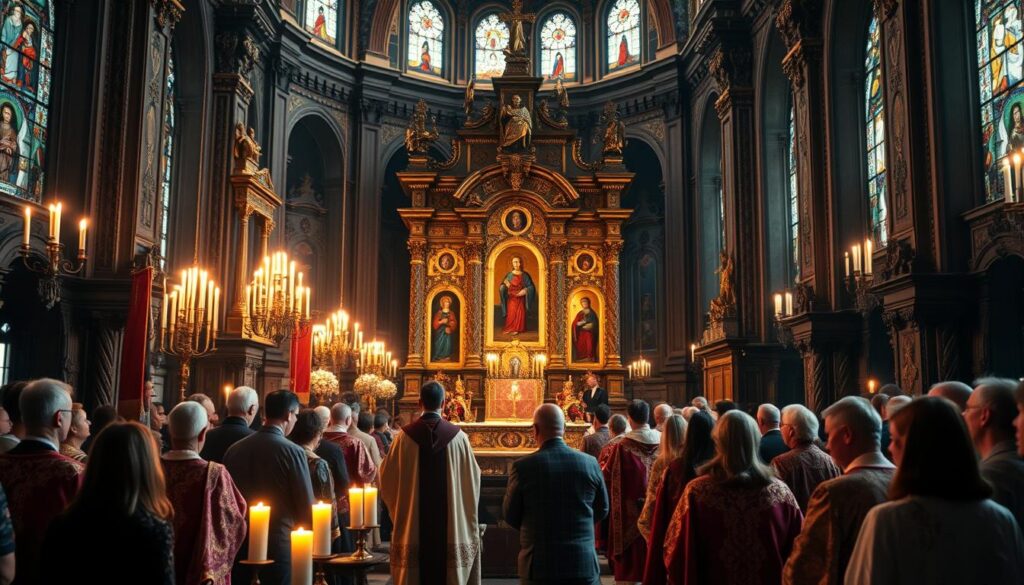
Light filters through stained glass in a Ukrainian Catholic church as incense swirls around golden icons. This vivid scene captures the living heritage of Eastern Catholic churches, which bridge ancient customs with modern communion with Rome. Their roots stretch back to early Christian communities that developed distinct worship styles while maintaining core beliefs.
Orthodox Distinctions Through History
The 431 Council of Ephesus sparked the first major split, creating divisions that still shape Christian churches today. Groups rejecting later councils formed what we now call Oriental Orthodox communities. These include Egypt’s Coptic Church and Armenia’s Apostolic Church, which preserve pre-Chalcedonian theological views.
| Tradition | Key Council | Modern Expression |
|---|---|---|
| Eastern Orthodox | Chalcedon (451) | Greek/Russian Churches |
| Oriental Orthodox | Ephesus (431) | Coptic/Ethiopian Churches |
| Eastern Catholic | Florence (1438) | Ukrainian/Byzantine Rite |
Eastern Catholic liturgy dazzles with sensory richness—chanting in Syriac, processions with ornate crosses, and clergy wearing elaborately embroidered vestments. Married priests serve in many communities, unlike Roman Catholic practice. Yet all recognize the Pope’s authority, creating a unique blend of autonomy and unity.
Recent dialogues have softened historical tensions. In 2016, Pope Francis and Coptic Pope Tawadros II agreed to recognize each other’s baptisms. Such steps show how ancient tradition adapts to foster reconciliation while preserving cultural identity.
Western Catholic Tradition and Its Influences
The clang of mission bells along California’s coast echoes the enduring legacy of Western Catholic tradition. This branch, led by the Roman Catholic Church, shaped global Christianity through its unique blend of structure and spirituality. At its core lies a balance between centralized authority and cultural adaptation.
Roman Catholicism’s distinct features emerged over centuries. Celibate clergy, Latin liturgy, and papal leadership became hallmarks after the Council of Trent (1545-63). These practices spread worldwide through colonization and missionary work, creating what theologian Richard McBrien called:
“A communion of churches bridging ancient roots and modern realities.”
Roman Catholic and Old Catholic Movements
While most Western churches aligned with Rome, some groups charted independent paths. The 1870 First Vatican Council sparked controversy by declaring papal infallibility. Dutch and German Catholics who rejected this formed the Old Catholic movement, preserving sacraments while operating outside Vatican authority.
| Tradition | Authority | Liturgy | Clergy |
|---|---|---|---|
| Roman Catholic | Papal primacy | Novus Ordo Mass | Celibate priests |
| Old Catholic | Local bishops | Traditional rites | Married priests allowed |
Today, Roman Catholicism remains the largest Christian denomination, influencing education, art, and social systems worldwide. Its Latin Church coexists with 23 Eastern Catholic communities under papal leadership—proof that unity thrives through diversity.
Impact of the Second Vatican Council on Church Practices
Picture this: 2,500 bishops streaming into St. Peter’s Basilica in 1962, launching the most transformative event in modern Catholic history. The Second Vatican Council reshaped the Catholic Church‘s relationship with the world through bold reforms. Over three years, leaders reimagined worship, governance, and interfaith dialogue for contemporary society.
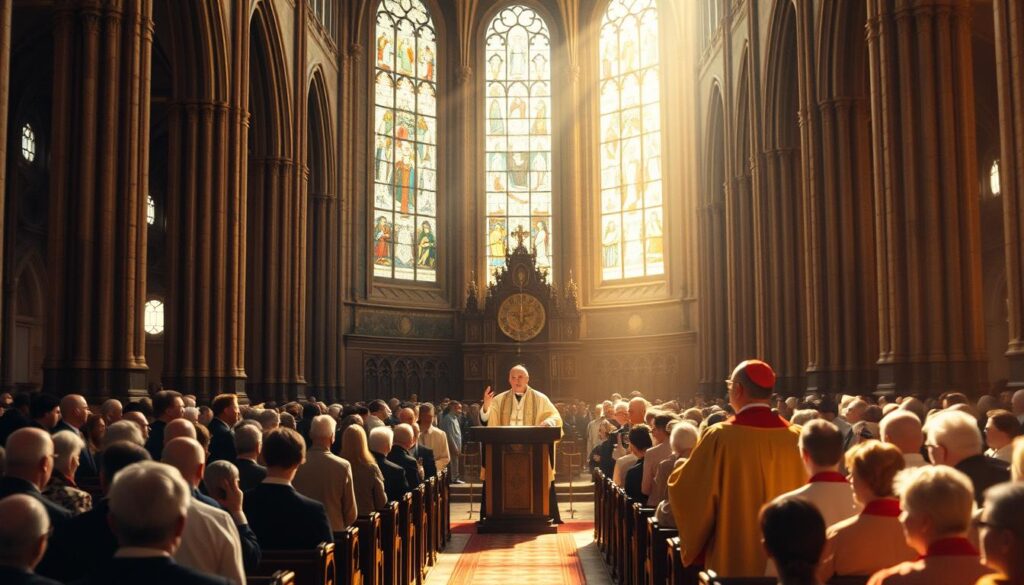
Gone were the days of Latin-only Masses. Vatican II’s Sacrosanctum Concilium decree let congregations pray in their native tongues. Parishioners suddenly heard the Lord’s Prayer in Swahili, Spanish, and Tagalog. Laypeople moved from silent observers to active participants—reading scriptures, distributing communion, and shaping parish life.
The council’s vision of the church as the “People of God” sparked global changes:
| Pre-Vatican II | Post-Vatican II |
|---|---|
| Priest facing altar | Celebrant facing congregation |
| Rigid Latin liturgy | Cultural adaptations encouraged |
| Limited ecumenism | Interfaith dialogues launched |
Not everyone embraced these shifts. Traditionalist groups like the Society of St. Pius X rejected changes, while others welcomed renewed engagement. As Pope Paul VI noted during the council:
“The Church must enter into dialogue with the world in which it lives.”
This spirit birthed groundbreaking interfaith partnerships. Catholics began working with Protestants on social justice issues and joined Jewish leaders in Holocaust remembrance. The Second Vatican reforms continue evolving today—from guitar Masses to climate change activism—proving ancient faith can thrive in modern skin.
Diverse Liturgy and Worship Styles in Catholic Practice
Sunlight dances through stained glass as a priest chants ancient Latin prayers. Across town, a gospel choir leads a congregation in rhythmic worship. These contrasting scenes reveal Catholicism’s liturgical richness—a living dialogue between tradition and innovation.
Roots and Renewal in Worship
Traditionalist Catholic communities safeguard rituals like the Tridentine Mass. Gold chalices, incense clouds, and Gregorian chants create an atmosphere of sacred mystery. Every gesture follows centuries-old rubrics, connecting worshippers to generations past.
Modern liturgy pulses with fresh energy. Vatican II reforms brought altars facing congregations and sermons in local dialects. Lay readers share scripture while guitars replace pipe organs in some parishes. These changes make rituals feel personal and immediate.
Both approaches share core elements:
- Water blessings and sign-of-the-cross gestures
- Sacred art enhancing spiritual focus
- Eucharist as the ritual climax
A Kenyan Mass might blend Swahili hymns with tribal drums. A Filipino fiesta procession could parade flower-decked saints through streets. Yet all celebrations affirm the same sacramental truth—visible signs conveying divine grace through shared practice.
FAQ
What does "Catholic" mean in historical context?
The term “Catholic” comes from the Greek word katholikos, meaning “universal.” It reflects the belief in a global, unified church founded by Jesus Christ. This idea is affirmed in the Nicene Creed, which describes the Church as “one, holy, catholic, and apostolic.”
How do Eastern Orthodox and Oriental Orthodox traditions differ?
Eastern Orthodox churches accept the Council of Chalcedon (451 AD), while Oriental Orthodox communities rejected its teachings. Both groups share ancient liturgies and sacraments but have distinct theological views on Christ’s divine and human natures.
What changes did the Second Vatican Council bring?
The Second Vatican Council (1962–1965) modernized practices like allowing Mass in local languages instead of Latin. It emphasized lay participation, interfaith dialogue, and renewed focus on Scripture, reshaping worship in many parishes worldwide.
Are Roman Catholic and Old Catholic groups connected?
Old Catholic movements split from the Roman Catholic Church after rejecting papal infallibility in 1870. They retain sacraments and bishops but allow married clergy and ordain women, reflecting more progressive stances on social issues.
Why do some parishes use traditional Latin Mass today?
Traditionalist Catholics preserve pre-Vatican II liturgy, valuing its solemnity and continuity with centuries-old practices. Groups like the Priestly Fraternity of St. Peter maintain this rite with approval from the Vatican under specific conditions.
How do Eastern Catholic Churches differ from Roman Catholicism?
Eastern Catholic Churches, like the Byzantine or Maronite rites, follow Eastern traditions but recognize the Pope’s authority. Their liturgies include icons, incense, and ancient chants, contrasting with Roman Catholic ceremonial styles.
Do all Catholic groups celebrate the same sacraments?
Yes—baptism, Eucharist, confirmation, and other sacraments are central across Catholic traditions. However, rituals like marriage or ordination may vary slightly based on cultural or liturgical customs within Eastern or Western rites.