Let’s uncover the story of one of Ireland’s most enduring religious institutions. With roots stretching back over 1,500 years, this faith community uniquely blends ancient traditions with Reformation-era reforms. Its influence spans the entire island, connecting modern worshippers to early Celtic Christianity while adapting to contemporary society.
This denomination stands as the second-largest Christian group across Ireland, serving over 380,000 members. Unlike many religious organizations, it operates independently while maintaining ties to Anglican traditions. Historical records show its leadership structure dates back to medieval monastic communities, creating a fascinating bridge between past and present.
Membership numbers reveal interesting patterns, with about 58,000 regular attendees reported in recent surveys. The institution’s presence remains significant in both urban centers and rural areas, particularly in Northern Ireland. Through centuries of political change, it has preserved its identity while fostering dialogue with other belief systems.
Today, this religious body contributes to education, charity work, and cultural preservation. Its ability to honor Celtic saints like Patrick while embracing modern governance makes it a unique case study. Join us as we explore how this organization continues shaping spiritual life across Ireland.
Key Takeaways
- Ireland’s second-largest Christian group operates across the entire island
- Blends ancient Celtic traditions with 16th-century Reformation principles
- Serves over 380,000 members with diverse worship practices
- Maintains historical ties to early medieval monastic communities
- Plays active roles in education and community services today
Historical Origins and Early Developments
Centuries before organized dioceses shaped religious life, Ireland’s spiritual landscape thrived through unconventional structures. Early Christian communities here developed a distinct identity, blending local customs with emerging faith practices.
Monastic Powerhouses of Knowledge
Irish spiritual centers operated unlike anywhere else in Europe. Instead of bishops controlling regions, abbots ruled self-sufficient communities that doubled as universities. These hubs became famous for:
- Preserving ancient texts during Europe’s “Dark Ages”
- Training missionaries who spread learning abroad
- Developing unique artistic styles in metalwork and manuscripts
“The Irish saved civilization while Rome burned.”
Viking Raids and Changing Tides
Norse invasions starting in 795 AD shattered this golden age. Raiders targeted monasteries for their wealth, causing:
| Before Norse Raids | After Norse Raids |
|---|---|
| Independent governance | Growing Roman influence |
| Local Easter calculations | Adoption of Roman calendar |
| Abbot-led communities | Bishop authority expansion |
By the 1100s, Ireland’s religious leaders faced tough choices. Pressure from English reformers and Rome finally led to adopting standardized practices. This pivot created foundations for future reforms while preserving Celtic spiritual roots.
The Reformation and Formation of the protestant church of ireland
A royal decree in 1536 reshaped Ireland’s spiritual identity forever. This period saw English monarchs extend their influence beyond politics into sacred spaces, creating lasting religious divisions.
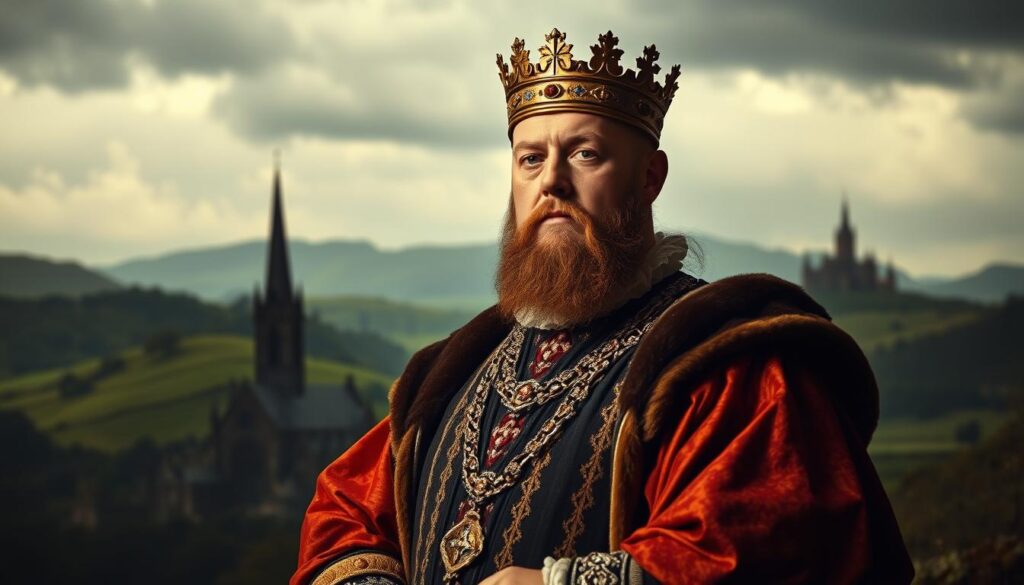
Henry VIII and the Irish Supremacy Act
Henry VIII of England needed allies to secure his break from Rome. In 1536, he pressured the Irish Parliament to pass legislation declaring him head of Ireland’s religious institutions. This move:
- Severed official ties with the Roman Catholic Church
- Established English monarchs as spiritual leaders
- Began partial monastery closures across the island
Unlike England’s rapid changes, Ireland’s transition proved messy. Gaelic-speaking regions resisted English-language services, creating what historians call “reformation without conversion.”
Shifts from Roman Catholic to Reformed Practices
The new state church faced unique challenges. Only 10% of Ireland’s population spoke English when reforms began, making Protestant teachings hard to spread. Key differences emerged:
| England’s Reformation | Ireland’s Experience |
|---|---|
| Complete monastery closures | Partial dismantling |
| Widespread English adoption | Local language barriers |
| Growing Protestant base | 90% Roman Catholic loyalty |
“Ireland became a land of two churches – one legally established, the other culturally dominant.”
This mismatch between official status and popular belief created tensions lasting centuries. The church of England’s structure became Ireland’s state church, though most citizens kept their Roman Catholic traditions alive in homes and secret gatherings.
Structural Evolution and Cultural Transformations
The 19th century brought seismic shifts to Ireland’s religious institutions. Political winds and social demands forced dramatic restructuring, reshaping centuries-old systems into modern frameworks.
Diocesan Reorganization and Church Governance
After merging with England’s religious body in 1800, Irish leaders faced new challenges. The 1870 convention became a turning point, creating:
- A General Synod combining bishops, clergy, and lay members
- Streamlined dioceses reduced from 30+ to 11
- Two provinces led by Armagh and Dublin archbishops
Political Impacts and the Disestablishment Era
The 1869 Irish Church Act severed state ties overnight. This “Great Separation” transformed operations:
| Before 1871 | After 1871 |
|---|---|
| State-funded salaries | Self-supported finances |
| Political influence | Independent governance |
“Disestablishment forced creativity – they built sustainability through community support.”
Modern Adaptations and Contemporary Worship
Today’s structure balances tradition with practicality. The General Synod meets annually, while local dioceses address regional needs. Modern services blend ancient liturgy with digital outreach, proving this centuries-old institution can evolve while honoring its roots.
Legacy, Beliefs, and Broader Impact in Ireland
Ireland’s spiritual tapestry gains depth through cross-denominational partnerships. While maintaining Anglican roots, this faith community actively bridges divides through creative collaborations. Its influence extends beyond worship spaces into classrooms and community centers nationwide.
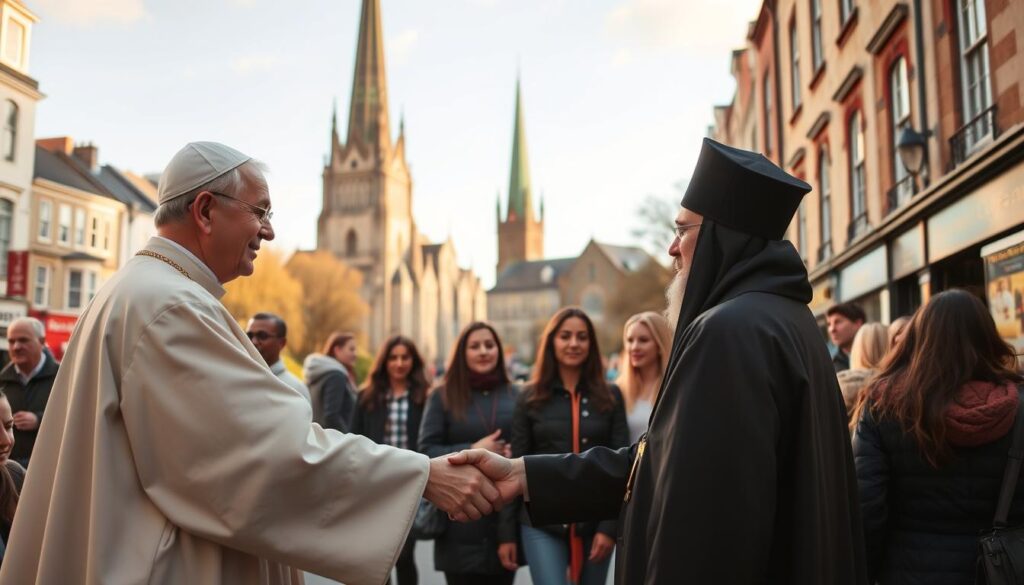
Relationship with Other Christian Traditions
This Anglican body connects globally through the 85-million-member Anglican Communion. Locally, it partners with the Roman Catholic Church and Presbyterian Church on social initiatives. Key partnerships include:
| Partnership | Scope | Impact |
|---|---|---|
| Porvoo Communion | European Lutheran-Anglican dialogue | Shared clergy training |
| Methodist Covenant | Joint worship since 2002 | Combined youth programs |
| Irish Council of Churches | All-island cooperation | Peacebuilding initiatives |
Role in Education and Social Services
Trinity College Dublin – founded in 1592 – remains a landmark of Protestant education. Over 60 primary schools nationwide blend academic rigor with inclusive values. Social programs focus on:
- Food banks serving all faiths
- Counseling for rural communities
- Heritage preservation grants
“Their schools became laboratories for religious coexistence long before it was fashionable.”
Public funding supports these efforts, reflecting trust across communities. Though representing under 3% of the Republic’s population, this tradition punches above its weight in shaping Ireland’s ethical landscape.
Conclusion
This article has explored how Ireland’s second-largest Christian group bridges ancient traditions with modern faith. Serving over 386,000 members, the Irish church maintains its distinct identity across political boundaries. Its structure spans eleven dioceses, uniting communities through shared heritage.
From state ties to self-governance, the institution demonstrates remarkable adaptability. Over five centuries, it preserved Celtic practices while adopting reformed principles. Educational initiatives and social programs continue impacting Irish society today.
The church’s journey reveals how faith communities evolve without losing core values. By honoring medieval roots and contemporary needs, it remains relevant in a changing world. This balance offers lessons in cultural preservation and innovation.
As challenges arise, the Irish church’s history provides a foundation for future growth. Its story underscores the power of tradition meeting transformation, inspiring both members and observers alike.
FAQ
How did Celtic Christianity shape early religious practices in Ireland?
Celtic Christianity blended local traditions with monastic life, emphasizing community-focused worship and scholarship. Monasteries became centers of learning and spirituality, distinct from Roman Catholic structures until the 12th century.
What role did Henry VIII play in forming the Protestant Church of Ireland?
Henry VIII’s 1536 Irish Supremacy Act declared him head of the Irish Church, breaking ties with Rome. This marked the start of Reformed practices, though widespread adoption took centuries due to resistance from Roman Catholics.
How did the Disestablishment Act of 1869 impact the Church?
The act ended its status as the state-sponsored institution, removing government funding and legal privileges. This forced structural reforms, shifting focus to voluntary membership and community engagement.
What is the Church’s relationship with other Christian groups today?
It collaborates with Roman Catholic and Presbyterian communities on social initiatives and interfaith dialogue. Shared efforts in education and charity reflect a commitment to unity despite theological differences.
How does the Church contribute to education in modern Ireland?
It supports primary and secondary schools nationwide, emphasizing values-based learning. Many historic institutions, like Trinity College Dublin, retain ties to its heritage while serving diverse populations.