With over 58 million followers globally, this Protestant tradition stands as one of Christianity’s most widespread movements. Originating in 16th-century Germany, its teachings have crossed oceans and cultures, creating vibrant communities from Tanzania to Minnesota. In the U.S., nearly 9 million members reflect remarkable diversity, with roots spanning multiple continents and languages.
At its heart, this belief system emphasizes grace-centered theology and accessible scripture interpretation. Distinctive practices like congregational singing and sacramental worship create meaningful connections during services. While maintaining historical foundations, modern congregations adapt to contemporary needs through community outreach and interfaith dialogue.
You’ll find varied expressions across different denominational branches, each sharing core principles while addressing local contexts. From urban megachurches to rural parishes, these communities prioritize education and social justice initiatives. Their global growth—particularly in Africa and Asia—shows how ancient traditions meet modern spiritual hunger.
Key Takeaways
- Global reach spanning six continents with diverse cultural expressions
- Historical foundation in Reformation-era theological principles
- Emphasis on grace and scripture as central to Christian life
- Active engagement with social issues and community service
- Multiple denominational branches with shared core values
- Growing membership in non-European regions since 2000
Introduction to the Lutheran Tradition
The roots of a major Christian movement trace back to a monk’s bold challenge in 1517. When Martin Luther questioned practices of the Catholic Church, he ignited a spiritual revolution that reshaped Europe’s religious landscape. His actions during the Protestant Reformation aimed to clarify teachings—not create division—but history had other plans.
Origins and the Impact of the Protestant Reformation
Luther’s 95 Theses criticized indulgences and church authority, arguing that scripture—not tradition—should guide believers. Though excommunicated in 1521, his ideas spread rapidly through pamphlets and public debates. German princes saw political advantages in supporting these reforms, accelerating the movement’s growth.
“I cannot and will not recant anything, for to go against conscience is neither right nor safe.”
Key Figures and Early Developments
Philip Melanchthon became Luther’s chief collaborator, crafting the Augsburg Confession to define their beliefs. Their team translated the Bible into German, letting ordinary people engage directly with scripture. This table shows how their reforms contrasted with existing practices:
| Aspect | Catholic Church (16th Century) | Lutheran Approach |
|---|---|---|
| Worship Language | Latin | Local Vernacular |
| Religious Authority | Pope & Tradition | Scripture Alone |
| Salvation | Faith + Works | Grace Through Faith |
Despite opposition, these changes laid groundwork for modern Protestantism. Luther’s followers eventually embraced the term “Lutheran,” though he preferred “evangelical” to emphasize their gospel-centered identity.
Understanding “lutheran church what is it” in Context
When exploring Christian denominations, many wonder about the origins and distinct beliefs of the tradition sparked by Martin Luther’s teachings. This curiosity often centers on how historical events shaped its identity and why its message remains relevant today.

Historical Background and Transformative Ideas
In 1525, Luther led the first worship service reflecting his reformed views—a milestone marking the movement’s practical beginnings. His emphasis on grace through faith challenged existing religious norms, declaring that divine acceptance comes freely rather than through rituals.
The tradition crossed the Atlantic in 1638 when Finnish settlers established North America’s first congregation in Delaware. By prioritizing scripture in everyday language, these communities made spiritual teachings accessible to farmers and scholars alike.
Core Identity Through Centuries
Central to this denomination’s DNA is Luther’s conviction: “Christ alone brings us to grace, not our efforts.” This principle fuels their focus on baptism and communion as tangible expressions of divine love.
Modern expressions balance time-honored liturgy with fresh approaches. Some congregations blend traditional hymns with multimedia, while others organize food drives alongside Bible studies. This adaptability helps maintain relevance across generations and cultures.
Core Beliefs and Teachings of Lutheranism
At the center of this faith tradition lies a revolutionary idea: divine acceptance comes freely, not through human effort. This principle shapes everything from personal spirituality to community practices, rooted in 16th-century reforms that redefined Christian thought.
Justification by Grace Through Faith and the Law-Gospel Distinction
Salvation through God’s grace alone forms the bedrock of Lutheran theology. Followers emphasize that forgiveness comes not from good deeds, but through trust in Jesus Christ’s sacrifice. As Luther famously declared, “Faith is a living, daring confidence in God’s grace.”
The Law-Gospel framework guides scripture interpretation. Biblical teachings reveal humanity’s shortcomings (Law) while celebrating redemption through divine mercy (Gospel). This dual lens helps believers navigate moral challenges without losing sight of grace.
The Role of the Augsburg Confession and Book of Concord
Philip Melanchthon’s 1530 Augsburg Confession remains essential for understanding core doctrines. It clarified differences with Catholic teachings while affirming shared Christian truths. Over 50 leaders later endorsed the Book of Concord, compiling key documents that still shape pastoral training.
These texts emphasize three pillars:
- Unearned forgiveness through faith
- Scripture as ultimate authority
- Sacraments as visible expressions of grace
Modern communities continue teaching these principles, blending ancient wisdom with fresh approaches to ministry. The focus stays on God’s unconditional love inspiring service, not demanding perfection.
Worship, Sacraments, and Community Life
Spiritual practices shape identity and connection in this tradition. Two sacred rituals anchor weekly gatherings, creating moments where ancient promises meet modern lives. Through structured rhythms and shared meals, members experience what they describe as “God’s tangible love.”
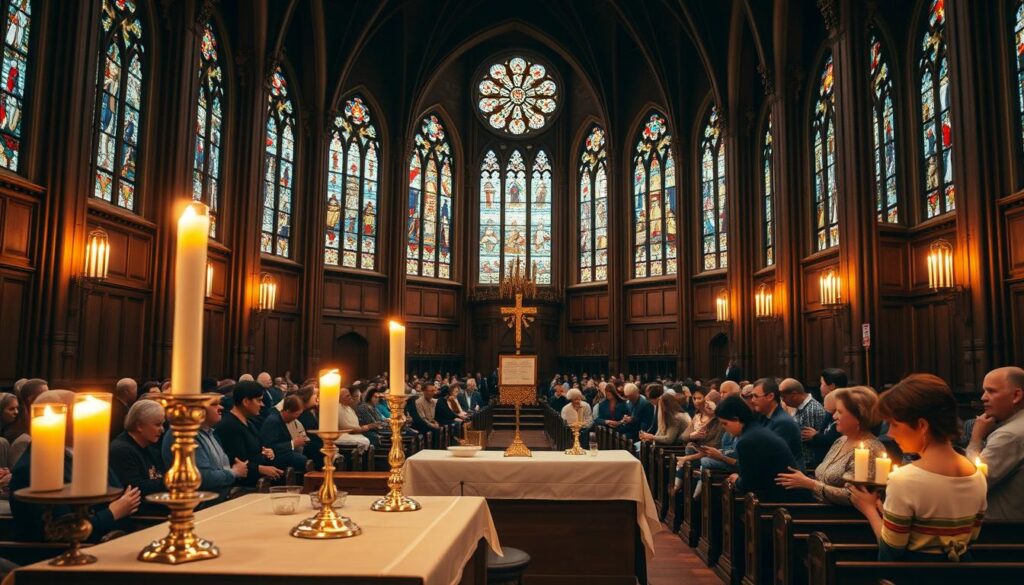
The Sacraments: Baptism and the Lord’s Supper
Water and meal rituals form spiritual foundations. Infants and adults receive baptism as God’s welcoming embrace. As one leader explains: “Grace isn’t earned—it’s poured out like water.” During holy communion, believers taste forgiveness through bread and wine. They affirm Christ’s real presence nourishing souls.
Liturgical Traditions and Contemporary Worship Services
Sunday services blend time-honored patterns with fresh expressions. Many follow this framework:
| Traditional Service | Modern Adaptation |
|---|---|
| Organ hymns | Praise bands |
| Liturgical robes | Casual attire |
| Printed hymnals | Digital screens |
Pastors preach God’s word while leading sacraments. After services, members gather for food pantries or youth programs. These efforts turn faith into action, proving worship continues beyond Sunday mornings.
Educational programs nurture children’s spiritual growth. Small groups explore scripture through book studies and service projects. This balance of ritual and relevance keeps communities thriving across generations.
Diverse Lutheran Traditions in the United States
America’s religious landscape hosts two prominent expressions of Lutheran Christianity, each interpreting Reformation principles through distinct lenses. These denominations share historical roots but navigate modern challenges differently, reflecting the dynamic nature of faith communities.
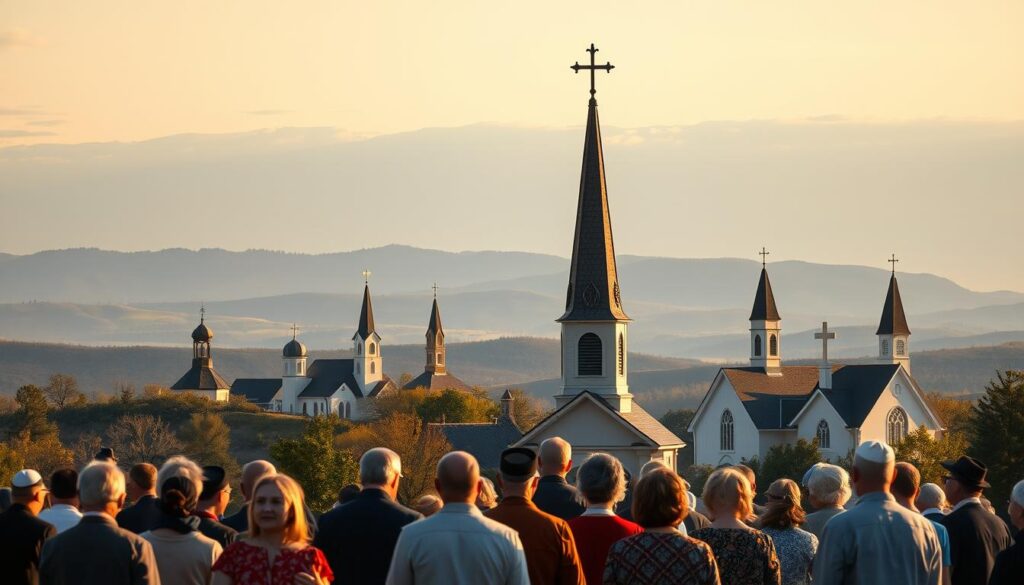
Comparing LCMS and ELCA Perspectives
The Lutheran Church—Missouri Synod (LCMS) champions biblical inerrancy, viewing scripture as God’s flawless word. With 2.6 million members across 6,100 congregations, it maintains strict fellowship rules—sharing communion only with like-minded groups. Pastors emphasize traditional teachings from confessional documents like the Book of Concord.
In contrast, the Evangelical Lutheran Church in America (ELCA) embraces broader partnerships. It shares full communion with seven Protestant denominations, including Methodists and Episcopalians. This approach stems from prioritizing the Augsburg Confession’s core message over strict doctrinal uniformity.
| Aspect | LCMS | ELCA |
|---|---|---|
| Scripture View | Inerrant Word | Authoritative Guide |
| Communion Partners | 4 Lutheran Bodies | 7 Denominations |
| Social Issues | Traditional Stances | Progressive Positions |
Adapting to Modern Culture and Multicultural Communities
Both traditions creatively engage North America’s shifting demographics. LCMS congregations often preserve German heritage while launching Spanish-language services. Their schools and food banks serve neighborhoods without compromising theological distinctiveness.
The ELCA frequently addresses social justice, supporting refugee resettlement and climate initiatives. Urban parishes might blend ancient hymns with gospel music, reflecting their communities’ diversity. As one pastor notes: “Our calling isn’t to change the good news, but to translate it for new generations.”
These adaptations show how 500-year-old convictions meet 21st-century realities. Through daycare programs and job training, both denominations prove Luther’s teaching that faith actively loves neighbors remains vital today.
Conclusion
Global communities embracing grace-centered teachings show renewed vitality while some regions face membership shifts. African congregations now lead in growth, with Ethiopian assemblies tripling since 2010. This contrasts with gradual U.S. declines, revealing cultural adaptability as key to sharing timeless truths.
Multilingual outreach proves essential for connecting across generations. Tanzanian choirs blend Swahili hymns with traditional liturgies, while Minneapolis youth groups host bilingual game nights. “Our message remains unchanged, but our methods can’t,” notes a Chicago pastor mentoring immigrant families.
Central to this movement’s future is proclaiming hope through actions and words. Food pantries in Jakarta and after-school programs in Houston demonstrate faith in motion. By prioritizing forgiveness over judgment, these groups embody Christ’s promise of unearned love.
As challenges evolve, the focus stays fixed on God’s grace as life’s foundation. From Nairobi to Nashville, members rediscover joy in serving neighbors without expectation. This living tradition continues transforming hearts through radical acceptance—one shared meal, one act of kindness at a time.
FAQ
How did the Protestant Reformation shape this Christian tradition?
The movement began in the 16th century when Martin Luther challenged certain practices of the Roman Catholic Church. His emphasis on God’s grace and scripture’s authority sparked reforms that reshaped European Christianity and led to new worship practices.
What makes this denomination distinct from others?
Central teachings include justification by faith alone and the Law-Gospel distinction. The Augsburg Confession and Book of Concord outline these beliefs, emphasizing salvation through Christ’s sacrifice rather than human effort.
Why are sacraments like Baptism important here?
Baptism and the Lord’s Supper are seen as sacred acts where God delivers forgiveness and strength. Unlike some traditions, these sacraments are viewed as tangible expressions of God’s promise, not just symbolic rituals.
How do worship services blend tradition and modernity?
Many congregations follow a structured liturgy rooted in centuries-old practices, while others incorporate contemporary music and technology. Both styles focus on proclaiming God’s Word and celebrating communion.
What’s the difference between groups like LCMS and ELCA?
The Lutheran Church—Missouri Synod (LCMS) often takes a conservative stance on scripture and social issues, while the Evangelical Lutheran Church in America (ELCA) tends toward more progressive interpretations. Both share core teachings but differ in cultural engagement.
How does this faith address today’s social challenges?
Teachings on human dignity and service drive many outreach efforts. Congregations often support food banks, immigrant communities, and global aid projects, reflecting Christ’s call to love neighbors in tangible ways.
Are children included in religious practices?
Yes! Families are encouraged to bring kids to services, and many churches offer youth programs. Early participation in sacraments, like infant baptism, highlights the belief that God’s grace extends to all ages.