Welcome to your friendly guide to one of Christianity’s most transformative movements. On November 10, 1517, a German monk named Martin Luther sparked a religious revolution that reshaped Europe. This event marked the birth of protestantismo, now practiced by 32% of Christians worldwide.
Why does this 16th-century movement matter today? Its ideas about faith, authority, and personal connection to God influenced modern democracy, education, and culture. We’ll explore how reformers challenged traditions while building new ways to practice religión.
This guide walks through key moments – from Luther’s 95 Theses to today’s diverse denominations. You’ll discover why some groups reject papal authority while others emphasize scripture alone. We’ll simplify complex terms like “sola fide” and show how these beliefs differ from Catholic or Orthodox traditions.
Key Takeaways
- Protestantism began in 1517 as a reform movement within Christianity
- Accounts for nearly 800 million believers across 300+ denominations
- Central ideas include scripture-based faith and rejection of papal authority
- Shaped modern concepts of individual liberty and religious diversity
- Continues evolving with new practices in the 21st century
By understanding this siglo-old tradition, you’ll better grasp its role in shaping Western thought. Let’s begin our journey through the heart of protestantismo – where history meets faith in surprising ways.
An Overview of Protestantism
Imagine a faith movement spanning continents yet united by shared ideals. With 680-800 million fieles worldwide, protestantismo forms Christianity’s second-largest branch. Unlike centralized Catholic structures, its iglesias operate independently – a hallmark since the Reformation.
Three features define this tradition:
- No single leader like the Pope
- Local control over worship styles
- Bible as ultimate authority
This decentralized approach birthed 300+ denominaciones. Lutherans, Baptists, and Methodists all share core beliefs but interpret scripture differently. The World Council of Churches and World Evangelical Alliance help coordinate efforts across borders without imposing rules.
From German chapels to Nigerian megachurches, protestantismo adapts to local cultures. Over 40% of adherents now live in Africa and Latin America. Yet all maintain key principles: salvation through faith alone and direct access to God.
Modern iglesias blend ancient traditions with contemporary practices. Some use electric guitars during worship; others stick to pipe organs. This flexibility explains its growth across the mundo – proving unity doesn’t require uniformity.
Historical Context and Origins of the Reformation
The 16th siglo transformed Europa like never before. Kings sought stronger rule, merchants grew wealthy, and thinkers rediscovered ancient wisdom. This perfect storm set the stage for the reforma protestante – a religious earthquake shaking foundations of power.
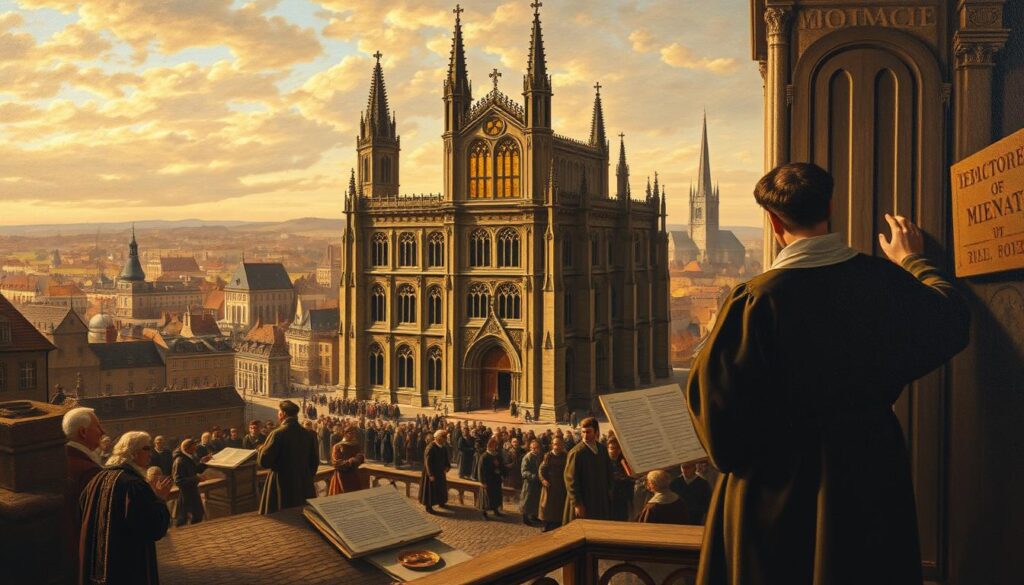
At the center stood the Iglesia Católica, controlling both souls and crowns. Its vast lands and taxes funded lavish projects while local parishes struggled. Critics whispered: “Should faith cost so much?”
Three forces collided to spark change:
| Political Shifts | Economic Pressures | Intellectual Revolutions |
|---|---|---|
| Nation-states resisting papal authority | Church selling forgiveness (indulgences) | Humanists studying original Bible texts |
| Kings wanting church lands | Wealthy merchants disliking tithes | Printing presses spreading new ideas |
| Local leaders seeking independence | Peasants burdened by fees | Universities training critical thinkers |
By the early 1500s, half of Germany could read. Bible translations fueled debates in taverns and town squares. As one scholar noted: “The siglo XVI wasn’t about losing faith – but finding it anew.”
These tensions made religious reform inevitable. When Martin Luther nailed his protests in 1517, he gave voice to centuries of quiet discontent. The reforma protestante didn’t start a fire – it lit the match where kindling already waited.
The Catalyst: Corruption in the Medieval Church
Picture a religious system where forgiveness became a commodity – this was the reality many Europeans faced in the early 1500s. The iglesia católica faced growing criticism as spiritual practices mixed with financial interests, creating a powder keg of discontent.
The Sale of Indulgences and Church Practices
Church leaders began treating salvation like a transaction. The venta de indulgencias – documents claiming to reduce punishment for sins – became a booming business. For a fee, believers could buy forgiveness for themselves or deceased relatives, a practice Martin Luther called “spiritual shopkeeping.”
Pope Leo X accelerated this trend to fund St. Peter’s Basilica. Peasants paid silver coins while nobles purchased entire forgiveness packages. Critics argued this system ignored core Christian values like repentance and grace. As one reformer wrote: “God’s mercy isn’t for sale – it’s given freely to those who believe.”
The Impact of the Printing Press on Dissemination
Johannes Gutenberg’s 1440 invention changed everything. Before presses, ideas moved at horse speed. Afterward, Luther’s critiques of the autoridad papa spread across Germany in weeks. Over 300,000 Reformation pamphlets circulated by 1520 – Europe’s first viral movement.
Three ways printing reshaped religion:
- Bible translations reached ordinary people
- Debates about indulgencias entered public squares
- Local languages weakened Latin’s control
Embargo attempts failed as printed texts crossed borders secretly. What began as church accounting disputes became a continent-wide conversation about faith’s true price.
The Role of Martín Lutero and the 95 Theses
A single hammer strike echoed through history on October 31, 1517. Martín Lutero, an anxious German monk, nailed 95 debate points to Wittenberg’s puerta iglesia. This act – normal for academic discussions – became the spark that lit the reforma protestante wildfire.
Key Themes Behind the 95 Theses
Luther’s tesis attacked two core issues:
- Church fundraising through forgiveness sales
- Questions about autoridad papal over souls
His 41st argument cut deep: “Popes have no power over purgatory – Christ alone holds those keys.” This challenged both church finances and leadership claims.
| Luther’s Argument | Church Teaching | Impact |
|---|---|---|
| Faith alone saves | Works + sacraments needed | Redefined Christianity |
| Bible over popes | Pope as final authority | Undermined hierarchy |
| All believers equal | Priests as mediators | Empowered laypeople |
The Catholic Church’s Reaction
Rome initially dismissed Luther as “a drunken German who’ll change his mind when sober.” But as his tesis spread via printing presses, containment failed. By 1521, Pope Leo X issued a final decree:
- Excommunicated Luther
- Banned his writings
- Ordered book burnings
This backfired spectacularly. Luther’s stand inspired thousands tired of corruption. His translation of scripture into German let ordinary people engage with faith directly – a radical idea that reshaped protestantismo forever.
Rise of protestantismo: Key Doctrines and Beliefs
At the heart of Protestant belief lies a revolutionary framework that redefined Christianity. This system rests on five Latin phrases called the Five Solas – principles that became the movement’s theological backbone. These doctrinas answer life’s biggest questions: How do we connect with God? What gives our faith meaning?
The Five Solas in Protestant Theology
Imagine building a house on five unshakable pillars. That’s how reformers viewed these core doctrina principles:
| Sola Principle | Core Belief | Catholic Contrast |
|---|---|---|
| Scriptura | Bible as sole authority | Church tradition equally valid |
| Fide | Salvación through faith alone | Works required for salvation |
| Gratia | Gracia Dios freely given | Grace earned through sacraments |
| Christus | Jesus as only mediator | Saints/Mary as intercessors |
| Deo Gloria | God deserves all praise | Veneration of religious figures |
These ideas flipped medieval spirituality upside down. A farmer could now read scripture without priestly help. Salvación became a gift, not a transaction. As one hymn proclaimed: “Nothing in my hand I bring – simply to Thy cross I cling.”
Emphasis on Scripture and Personal Faith
Protestant doctrinas put the Bible in everyone’s hands. Churches began printing native-language Bibles, trusting believers to interpret texts personally. This gracia Dios-centered approach created intimate faith experiences.
Modern followers still echo these values. Many memorize verses instead of praying to saints. Worship focuses on preaching rather than rituals. This direct connection remains Protestantism’s lasting legacy – proof that ancient doctrina can shape modern spirituality.
Notable Reformers: Juan Calvino, Thomas Cranmer and More
While Martin Luther ignited the reforma protestante, other thinkers shaped its global spread. Juan Calvino became Protestantism’s architect, crafting detailed doctrines still followed by millions. His 1536 book Institutes of the Christian Religion argued God predestines souls – a belief forming Calvinism’s core.
Across the Channel, Enrique VIII took a different path. Though driven by political needs, his 1534 split from Rome birthed the Church of England. Thomas Cranmer later refined this movimiento, creating the poetic Book of Common Prayer still used in Anglican services.
| Reformer | Contribution | Legacy |
|---|---|---|
| Ulrich Zwingli | Simplified worship in Zurich | Reformed Church tradition |
| John Knox | Scottish Reformation leader | Presbyterian Church founder |
| William Tyndale | English Bible translator | Martyred for scripture access |
Calvin’s Geneva experiment proved revolutionary. This 16th-siglo city became a Protestant blueprint, mixing strict morality with communal care. Visitors carried these ideas globally, planting seeds for future denominations.
Earlier voices like Jan Hus (burned in 1415) and John Wycliffe (called “Morning Star of Reformation”) paved the way. Their calls for change – silenced in their time – became rallying cries for later movimiento leaders. As one historian notes: “Reformers didn’t invent new ideas – they amplified whispers from centuries past.”
The Diversity of Protestant Denominations
From grand cathedrals to living room gatherings, Protestant communities wear many faces. This movimiento split into three main streams over five centuries, each adapting to local cultures while keeping core beliefs. Today’s 300+ denominaciones show how one faith can thrive in countless forms.
National Churches and Historical Movements
Some iglesias grew hand-in-hand with nations. England’s Anglican Church blended Catholic rituals with reformed theology. Scandinavian Lutherans kept ornate altars but rejected papal authority. The calvinismo anglicanismo traditions shaped governments too – Swiss Reformed churches helped create early democratic models.
Congregational, Evangelical and Pentecostal Branches
Other groups prioritized local control. Baptist iglesias let congregations choose leaders and interpret scripture. The 20th-century movimiento Pentecostal added lively worship styles, now followed by 25% of protestantes worldwide. These branches prove innovation thrives where communities guide their faith.
Whether through ancient liturgies or modern praise bands, protestantes continue redefining what denominaciones can be. This flexibility keeps the 500-year-old tradition vibrant in our changing world.
FAQ
What sparked the beginning of the Protestant Reformation?
The Reformation began in 1517 when Martin Luther challenged church practices like the sale of indulgences. His 95 Theses questioned the authority of the pope and emphasized faith over rituals.
How did the printing press influence the spread of Reformation ideas?
The printing press allowed reformers to share writings quickly. Luther’s works, like the 95 Theses, spread across Europe, fueling debates and inspiring others to join the movement.
What are the core beliefs of Protestant theology?
Central ideas include the “Five Solas”: faith alone (sola fide), grace alone (sola gratia), Christ alone (solus Christus), Scripture alone (sola scriptura), and glory to God alone (soli Deo gloria).
How did John Calvin shape Protestant thought?
Calvin’s teachings on predestination and church governance influenced denominations like Presbyterians. His book Institutes of the Christian Religion became a key theological text.
Why did Henry VIII create the Church of England?
Henry VIII broke from Rome in 1534 to annul his marriage. This led to the Anglican Church, blending Catholic traditions with reformed ideas under leaders like Thomas Cranmer.
What caused the split between Lutherans and Catholics?
Disagreements over authority, salvation, and practices like indulgences led to the divide. The Council of Trent later reaffirmed Catholic doctrines, deepening the separation.
How diverse are Protestant denominations today?
Denominations range from Lutherans and Baptists to Pentecostals. Differences in worship, governance, and beliefs reflect the movement’s emphasis on individual interpretation of Scripture.
Did the Reformation lead to political conflicts?
Yes! Wars like the Thirty Years’ War (1618–1648) erupted over religion and power. Rulers often backed reformers or Catholics to strengthen their own influence.