Let’s travel back to 16th-century Europe, where a single act of defiance sparked a spiritual revolution. On October 31, 1517, a German monk named Martin Luther nailed his 95 Theses to a church door in Wittenberg. This bold move questioned long-held religious practices and ignited debates that would reshape Christianity forever.
What started as a call for reform grew into a powerful movement. People across Europe began challenging traditional authority, demanding changes to how faith was practiced. The Reformation wasn’t just about theology—it became a cultural earthquake that shook politics, education, and daily life.
This period saw ordinary citizens gain unprecedented access to religious texts. New translations of the Bible empowered individuals to interpret scripture themselves. As these ideas spread, they created fractures in medieval society, leading to the rise of diverse Christian traditions.
Through this article, you’ll uncover how a humble protest evolved into a world-changing force. We’ll explore the social tensions, technological advancements (like the printing press), and courageous figures who made this transformation possible. Their legacy still influences modern discussions about faith, freedom, and community.
Key Takeaways
- Martin Luther’s 95 Theses in 1517 sparked a religious revolution across Europe
- The Reformation challenged both spiritual practices and political power structures
- Accessible Bible translations shifted religious authority to individuals
- Printing technology accelerated the spread of reformist ideas
- Lasting impacts include modern concepts of religious freedom and self-governance
Historical Context: The Late Medieval Church and Its Society
Europe’s spiritual landscape looked dramatically different before reform movements took root. Religious institutions wielded unmatched influence, blending sacred duties with earthly ambitions. This era set the foundation for seismic shifts in how communities practiced faith and governed themselves.
Faith Meets Politics
Spiritual leaders held court like royalty, advising monarchs and managing territories larger than some kingdoms. One cardinal’s diary from 1490 reveals: “We build cathedrals not just for prayer, but to remind princes who shapes their destiny.” This fusion of roles created tensions that simmered for generations.
Breaking Point for Believers
Public trust eroded as leaders prioritized luxury over spiritual guidance. Consider these comparisons:
| Aspect | Late Medieval Era | Early Reformation |
|---|---|---|
| Leadership Focus | Art commissions | Scripture access |
| Funding Priorities | Papal palaces | Local schools |
| Public Perception | Growing distrust | Grassroots movements |
Scandals like Pope Alexander VI’s public family life shocked worshippers. Records show Venetian merchants complaining about “golden roofs funded by peasant coins” in 1501. As literacy spread, more citizens questioned why their hardships funded lavish projects rather than community needs.
This climate of frustration created fertile ground for change. By 1510, over 60% of German towns had secret reading groups studying banned texts—a quiet rebellion before the storm.
Catalysts of Change: The Reformation’s Root Causes
Three powerful forces collided to create history’s most transformative spiritual shift. Money, power, and ideas combined in ways that made religious upheaval unavoidable.
Economic, Political, and Doctrinal Pressures
Peasants watched carts loaded with silver coins rumble toward Rome. One German farmer’s 1512 ledger shows “half our harvest tithe sent to build marble halls we’ll never see”. This wealth transfer fueled anger across Europe.
Kings grew tired of foreign interference. When Henry VII of England demanded control over local religious appointments, a bishop protested: “Your majesty treads where angels fear to govern.” Monarchs increasingly saw centralized authority as outdated.
| Pressure Type | Example | Impact |
|---|---|---|
| Economic | Papal taxes | Local resentment |
| Political | Royal decrees | Reduced Vatican influence |
| Doctrinal | Wycliffe’s teachings | Scripture-focused groups |
Thinkers like John Wycliffe lit intellectual fires. His radical claim that “Scripture alone guides salvation” bypassed traditional structures. These ideas spread through merchant networks and university circles.
By 1500, over 200 underground study groups met in England alone. People craved direct connections to their faith—a hunger institutions couldn’t satisfy. This convergence made reform not just likely, but essential for millions seeking spiritual renewal.
Martin Luther: Challenging the Catholic Doctrine
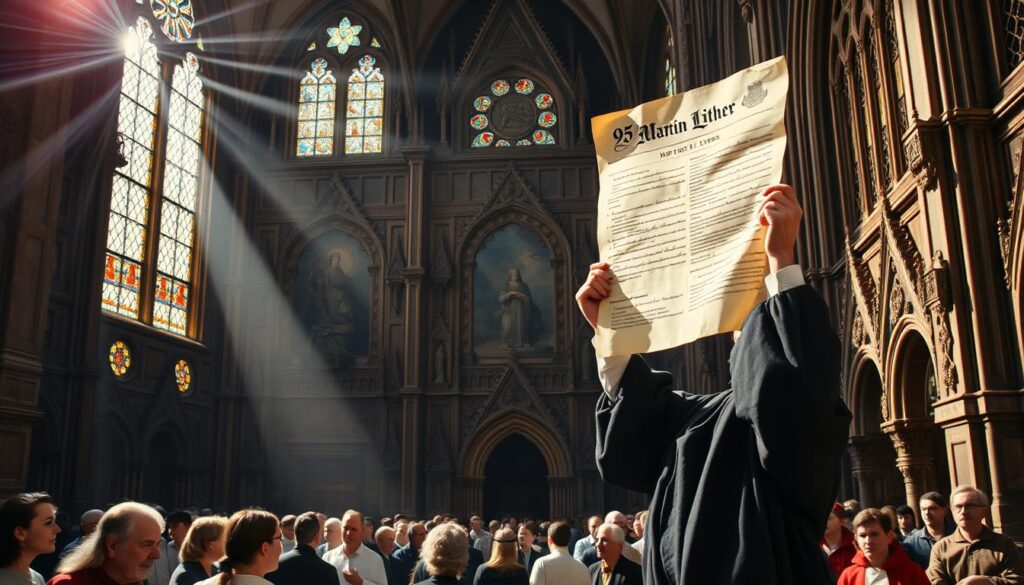
A single document changed the course of religious history forever. In 1517, Martin Luther crafted 95 arguments questioning common practices, aiming to spark discussion rather than rebellion. His actions would ripple across continents, redefining how millions approached spirituality.
The 95 Theses and Their Impact
Luther’s critique of indulgences struck at the heart of religious commerce. “Why does the pope’s wealth outshine Christ’s mercy?” he wrote, challenging the sale of divine forgiveness. This bold stance resonated with farmers and nobles alike—both tired of funding lavish projects through mandatory payments.
| Practice | Luther’s View | Public Reaction |
|---|---|---|
| Indulgence sales | Corrupt profit scheme | Widespread anger |
| Scripture access | Right for all believers | Growing literacy |
| Salvation process | Faith-based, not works | Personal empowerment |
Personal Faith Versus Institutional Authority
Luther’s ideas turned tradition upside down. He argued that salvation came through individual belief, not institutional rituals. Commoners began reading translated Bibles, discovering they didn’t need intermediaries to connect with the divine.
This shift created both hope and chaos. Local leaders embraced self-guided worship, while Rome scrambled to maintain control. What started as an academic debate became a blueprint for spiritual independence that still shapes modern faith practices.
Examining the protestant church beginning and Its Foundational Figures
The spiritual revolution of the 16th century wasn’t a solo performance—it was a chorus of voices demanding change. While this article focuses on key architects of reform, their collective efforts reshaped Europe’s religious landscape through bold ideas and grassroots action.
Influence of Early Reformers
Luther’s stand against indulgences became a rallying cry for thinkers like John Calvin and Huldrych Zwingli. Calvin’s teachings in France emphasized predestination, while Zwingli’s Swiss reforms questioned traditional communion practices. Their debates created distinct branches within the growing movement.
| Reformer | Key Contribution | Lasting Impact |
|---|---|---|
| John Calvin | Systematic theology | Presbyterian traditions |
| Huldrych Zwingli | Symbolic communion | Reformed worship styles |
| Anabaptists | Adult baptism | Mennonite/Amish roots |
Legacy of Pioneering Movements
Radical groups like the Anabaptists took reforms further. They rejected infant baptism, arguing that faith required conscious choice. “True belief cannot be forced through ceremony,” wrote one leader in 1525. These ideas spread rapidly, forming communities that valued personal conviction over institutional approval.
Over the years, these diverse approaches attracted members from all social classes. Local adaptations helped the movement thrive in different regions—from German city-states to English villages. What united them was a shared commitment to accessible scripture and individual spiritual responsibility.
Today, over 900 million Christians trace their roots to these early reformers. Their courage to question authority continues to inspire modern discussions about faith, community, and personal freedom.
The Role of John Calvin: Structure and Worship in the Reformation
While fiery debates shaped early reforms, John Calvin brought something new to the table—blueprints for lasting change. His genius lay in creating repeatable systems that turned scattered groups into organized communities of belief.

Development of Church Discipline and Governance
Calvin’s work in Meaux (1555) became a template for France’s growing network. He designed four leadership roles:
| Role | Function | Impact |
|---|---|---|
| Pastors | Teach scripture | Unified doctrine |
| Elders | Maintain discipline | Community standards |
| Deacons | Manage resources | Social support |
| Teachers | Educate members | Literacy growth |
This structure spread to Paris and southern regions within four years. Local groups adapted Calvin’s model while keeping core principles intact.
Synods, Confessions, and the Reformed Identity
Everything changed in 1559 when 72 representatives risked arrest to meet secretly in Paris. At this historic synod, they approved two groundbreaking documents:
- A confession of faith emphasizing personal devotion
- Articles of discipline outlining shared practices
One attendee wrote: “We emerged not as rebels, but as stewards of true religion.” These agreements helped diverse congregations feel part of something larger while preserving local flexibility.
Calvin’s systems proved so effective that by 1562, over 2,000 French communities had adopted his model. His blend of structure and spirituality continues to shape modern worship practices across denominations.
Reformation and Its Turbulent Political Landscape
The clash of faith and politics reshaped Europe’s power structures during this era. After King Henry II’s fatal jousting accident in 1559, his council members shocked the court by publicly supporting reformist groups. This bold move transformed religious debates into high-stakes power plays.
Political Power Struggles in Europe
France’s royal court became a battleground between rival factions. The Guise brothers—Duke Francis and Cardinal Charles—controlled young King Francis II like chess pieces. “Our faith serves the crown,” the Cardinal declared in 1560, though many saw their actions as self-serving.
| Faction | Goal | Tactic |
|---|---|---|
| Catholic Nobles | Maintain Vatican ties | Court influence |
| Reformist Lords | Limit papal power | Secret alliances |
The failed Amboise conspiracy revealed growing desperation. Protestant nobles planned to kidnap the king, hoping to free him from Catholic advisors. Though unsuccessful, this event exposed deep divisions that would spark violence in coming years.
Religious Wars and Shifting Alliances
What began as theological debates soon turned bloody. By 1562, over 2,000 French towns saw clashes between armed groups. Local disputes over worship rights escalated into regional conflicts.
- Catholic leaders formed the Holy League
- Protestant nobles created defensive pacts
- Neutral rulers played both sides
These shifting alliances turned religion into a political weapon. As one diplomat noted: “The cross and crown now share the same war chest.” The stage was set for decades of warfare that would redraw Europe’s map.
Impact on Society: Religion, Freedom, and Social Change
The Reformation reshaped daily life in ways still felt today. Ordinary individuals gained unprecedented control over their spiritual journeys, challenging centuries of tradition. This shift didn’t just alter religious practices—it rewrote the rules of community and personal identity.
Access to translated scriptures allowed believers to form direct spiritual relationships with divine teachings. Families began discussing faith around dinner tables rather than relying solely on institutions. This freedom sparked new forms of education and civic participation across Europe.
Social structures adapted to these changes. Local leaders emerged from lay communities, while shared interpretation of texts created bonds between neighbors. The reform movement’s emphasis on personal responsibility influenced early concepts of self-governance.
These transformations show how questioning authority can reshape entire societies. The push for spiritual independence planted seeds that grew into modern ideas about liberty and collective progress.
FAQ
What sparked the Reformation movement in Europe?
The Reformation grew from tensions like corruption in the Catholic Church, doctrinal disagreements, and political conflicts. Martin Luther’s 95 Theses in 1517 criticized practices like selling indulgences, igniting debates about faith and authority.
How did John Calvin shape Reformed churches?
Calvin introduced structured governance, emphasizing predestination and strict moral discipline. His teachings influenced synods and confessions, creating a distinct Reformed identity that prioritized scripture and community accountability.
Why did political leaders support the Reformation?
Rulers like German princes saw the movement as a chance to challenge papal authority and gain control over local churches. This shift often aligned with their goals for independence from the Holy Roman Empire.
What role did women play in early Reformed communities?
Women contributed through education, charity, and supporting reformers’ families. While leadership roles were limited, their activism in spreading ideas helped sustain the movement during persecution.
How did the Reformation impact social structures?
It challenged traditional hierarchies by promoting literacy and individual faith. Concepts like marriage reforms and addressing poverty reshaped communities, though conflicts like the Thirty Years’ War also caused upheaval.
What doctrines defined early Reformed theology?
Key ideas included salvation through faith alone, scripture as the ultimate authority, and predestination. These principles distanced Reformed groups from Catholic teachings on sacraments and clergy power.
How did Catholic dominance shape pre-Reformation society?
The Church influenced laws, education, and daily life. Criticisms of its wealth and practices, however, created fertile ground for reformers to demand accountability and simpler worship.