Imagine a single document sparking a revolution that reshaped Europe and beyond. In 1517, a bold critique of religious practices ignited a movement that challenged centuries of tradition. This pivotal moment birthed new ways of thinking about spirituality, authority, and personal connection with the divine.
A German monk’s 95 arguments against common rituals became the catalyst for sweeping change. His ideas spread like wildfire through newly invented printing presses, reaching far beyond monastery walls. Ordinary people began questioning established norms, creating ripples that would alter political landscapes and cultural values.
The effects of this transformation still echo today. From education systems to concepts of self-governance, its legacy lives in unexpected places. Even modern ideas about personal belief systems trace their roots to this era of upheaval.
Key Takeaways
- Began in 1517 with a public challenge to religious authority
- Martin Luther’s writings sparked widespread debate
- Created new branches of Christian practice
- Influenced political structures across Europe
- Paved the way for modern religious freedom concepts
This journey through the past reveals how bold ideas can reshape societies. As we explore these historical events, you’ll discover surprising connections to contemporary life in America and beyond.
Introduction to the Reformation Era
Centuries of turmoil set the stage for spiritual transformation. After the Black Death wiped out millions, survivors faced constant uncertainty about life and salvation. This climate of fear shaped how communities approached religion, with many seeking comfort in rituals promising divine protection.
Historical Context and Background
By 1500, Europe’s population hadn’t recovered from plagues and wars. People questioned traditional authorities as literacy rates rose and new ideas spread. The Renaissance encouraged critical thinking, creating fertile ground for challenging old beliefs.
Three key factors reshaped spiritual life:
- Growing distrust of institutional corruption
- Increased access to translated religious texts
- Political leaders seeking independence from Rome
Understanding the Shift in Christian Thought
Medieval practices emphasized collective rituals led by clergy. But changing times brought new perspectives. As one scholar noted: “The printed word became a weapon against ignorance, letting ordinary believers interpret scripture themselves.”
| Aspect | Medieval Era | Reformation Era |
|---|---|---|
| Salvation | Church-mediated | Personal faith |
| Authority | Papal decrees | Scripture study |
| Worship | Latin Mass | Local languages |
This seismic shift didn’t happen overnight. Economic changes, technological advances like Gutenberg’s press, and evolving social needs all contributed to redefining humanity’s relationship with the divine.
Causes and Catalysts of the Reformation
What made 16th-century Europe ripe for radical change? A collision of cultural shifts, economic tensions, and groundbreaking technology created unprecedented conditions for spiritual revolution.
Religious and Cultural Influences
Traditional practices faced growing scrutiny as literacy spread. Many grew uneasy with rituals that seemed disconnected from scriptural teachings. “When coin in the coffer rings, the soul from purgatory springs,” critics mocked the sale of forgiveness certificates.
Three seismic shifts reshaped public opinion:
- Urban merchants demanding transparency in spiritual matters
- Scholars translating ancient texts that challenged established views
- Local leaders resisting distant religious authority
The Role of the Printing Press in Spreading Ideas
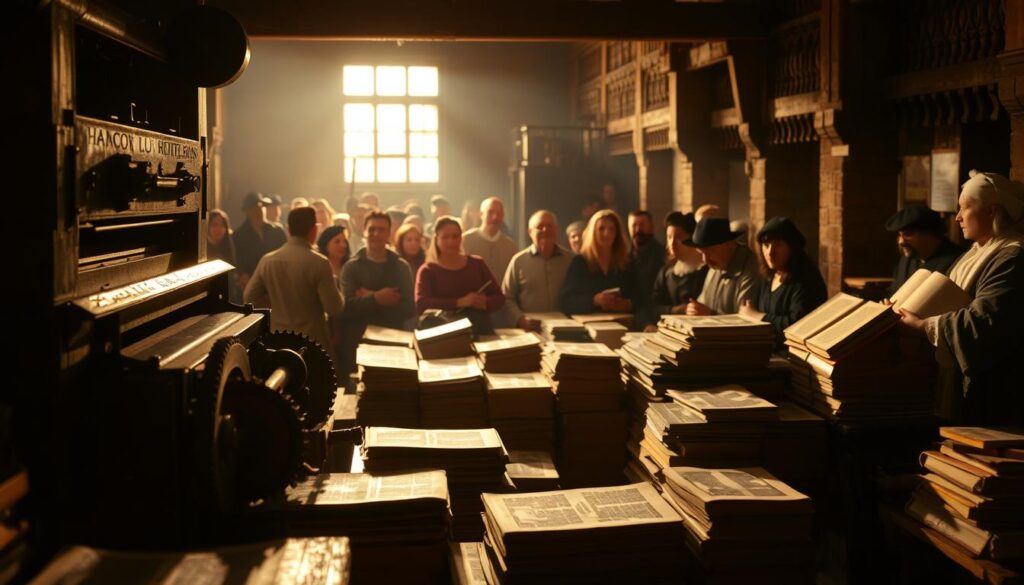
Gutenberg’s invention became history’s first viral content machine. Pamphlets explaining new interpretations of scripture reached towns faster than horse riders. One reformer’s writings outsold popular novels 5-to-1 during peak years.
| Aspect | Before Press | After Press |
|---|---|---|
| Book Production | 6 months per copy | 500 pages daily |
| Language | Latin only | Local dialects |
| Audience | Clergy | General public |
This communication revolution let ordinary people debate ideas once reserved for scholars. By 1525, over a million copies of reformist texts circulated—equivalent to 50 million TikTok videos today.
The protestant church reformation Movement
Three bold thinkers reshaped spiritual landscapes across Europe through groundbreaking ideas. Their collective efforts created new frameworks for understanding divinity and human purpose.
Martin Luther’s 95 Theses and Doctrinal Challenges
In 1517, a university professor nailed his arguments against religious corruption to a public bulletin board. Martin Luther’s 95 Theses questioned payment systems for spiritual favors, declaring: “True repentance seeks punishment, not payment.”
His radical views went viral through printed pamphlets. By 1521, he’d been branded a heretic but kept working. Luther’s German Bible translation let farmers read scripture themselves—a first in European history.
Influential Voices: Calvin, Zwingli and Others
While Luther sparked change in Germany, John Calvin built a theological system in Switzerland. His doctrine of predestination argued that divine choice, not human effort, determined salvation.
Huldrych Zwingli took parallel steps in Zurich. He banned religious images and simplified rituals, insisting worship focus solely on scriptural teachings.
| Reformer | Key Contribution | Lasting Impact |
|---|---|---|
| Luther | Salvation through faith | Personal Bible study |
| Calvin | Predestination doctrine | Reformed theology |
| Zwingli | Scripture-centered worship | Symbolic communion |
These pioneers agreed on core principles but debated details fiercely. Their disagreements shaped diverse traditions still seen in modern belief systems across America.
Reformation in England: A New Direction
When royal desires reshape a nation’s faith, history takes unexpected turns. England’s spiritual transformation began not with theologians, but a king’s personal crisis. This unique path blended political power plays with lasting religious changes.
Henry VIII and the Birth of the Church of England
Henry VIII’s marriage disputes sparked England’s break from Rome. After the Pope refused his 1534 annulment request, the monarch declared himself head of a new national institution. The Church of England kept ornate rituals but rejected papal authority, creating what one historian called “a Catholic structure with Protestant seasoning.
| Monarch | Reign Dates | Religious Shift |
|---|---|---|
| Henry VIII | 1509-1547 | Founded national church |
| Mary I | 1553-1558 | Restored Catholicism |
| Elizabeth I | 1558-1603 | Established Anglican compromise |
The Rise of Puritans and Early American Beginnings
Queen Elizabeth’s 44-year reign brought stability through the Book of Common Prayer. But some wanted deeper reforms. Puritans argued the church kept too many “popish” traditions, splitting into two camps:
- Separatists (Pilgrims) seeking complete independence
- Nonseparatists aiming to reform from within
Both groups eventually crossed the Atlantic. The Mayflower’s 1620 voyage and Massachusetts Bay Colony (1630) planted Church of England alternatives in the United States. Their ideals helped shape America’s approach to religious diversity centuries later.
Global Influence and Lasting Legacy
New ideas crossed oceans to shape a nation’s identity. As settlers arrived in America, they brought revolutionary views about personal faith and community structure. These principles would become threads in the fabric of U.S. culture, weaving through laws, education, and daily life.
The Spread of Protestant Ideas to the United States
Early colonists carried the belief that individual interpretation mattered more than institutional authority. This mindset birthed diverse groups like Baptists and Methodists, each claiming unique approaches to spiritual matters. One colonial leader noted: “Our towns thrive not by uniformity, but through respectful disagreement.”
By 1791, this philosophy reached its peak. The First Amendment guaranteed rights to worship freely, stating: “Congress shall make no law respecting an establishment of religion.” This legal shield protected the very diversity the Reformation had championed.
Impact on Modern Religious and Cultural Practices
Reformation values still pulse through American life. The concept of personal calling transformed into a cultural work ethic, linking effort with moral purpose. Schools emerged to teach reading, ensuring everyone could explore sacred texts independently.
Modern society reflects these roots in three key ways:
- Multi-denominational communities coexisting peacefully
- Emphasis on self-guided spiritual journeys
- Separation between governing bodies and belief systems
From town halls to tech startups, the idea that ordinary people shape their destiny continues to drive innovation. This legacy proves that challenges to old systems can plant seeds for lasting change.
Art, Culture, and Innovation During the Reformation
Cultural landscapes transformed as creative energies found new expressions. While theological debates dominated conversations, artists and thinkers reshaped how communities experienced spirituality. This period birthed fresh approaches to music, literature, and visual arts that still resonate in modern creative traditions.
Transformation in Music, Art, and Literature
Congregational singing became a powerful tool for sharing doctrinal ideas. Simple hymns replaced complex Latin chants, letting everyone participate. “A well-sung psalm teaches the heart twice,” remarked one composer, capturing the era’s shift toward accessible worship music.
Visual arts took divergent paths across Europe. Northern regions embraced minimalist designs in places of worship, focusing attention on spoken teachings. Meanwhile, southern artists like Pieter Paul Rubens created dramatic altarpieces that blended traditional themes with new techniques.
The printing revolution fueled literary explosions. For the first time, farmhands could read scripture in their native tongues. This accessibility sparked a boom in religious poetry and household devotional guides. Schools flourished as communities prioritized literacy to deepen personal faith practices.
Even scientific progress found roots in this era. The emphasis on individual inquiry laid groundwork for later discoveries. As one historian noted: “Questioning ancient authorities in religion made people wonder what else they’d been told to accept without proof.”
The Counter-Reformation and Its Repercussions
Religious transformations often spark unexpected chain reactions. As critiques of traditional practices grew louder, the Roman Catholic Church launched its own renewal efforts. This response reshaped both spiritual life and political alliances across continents.
The Council of Trent and the Catholic Response
Between 1545 and 1563, religious leaders convened at the Council of Trent to address growing concerns. They reaffirmed core doctrines while curbing financial abuses. “Scripture and tradition hold equal weight,” declared delegates, strengthening the pope’s authority against rising challenges.
Political and Social Ramifications in Europe
These reforms sparked new alliances between rulers and religious institutions. Nations like Spain doubled down on Catholic Church traditions, while others sought middle ground. Education systems expanded as both sides vied to shape public opinion through schools and printed materials.
The Council of Trent’s decisions created lasting ripples. From art celebrating spiritual themes to stricter clergy training, these changes became part of Europe’s cultural DNA. Their influence still surfaces in modern debates about belief and governance.
FAQ
How did Martin Luther’s actions change religious practices?
By posting his 95 Theses in 1517, Luther openly challenged doctrines like indulgences. His emphasis on scripture over tradition reshaped worship, encouraging believers to engage directly with the Bible.
Why did Henry VIII break from the Roman Catholic Church?
Henry sought to annul his marriage to Catherine of Aragon, which the Pope denied. This led him to establish the Church of England, granting himself authority over religious matters and redistributing power from Rome.
What role did the printing press play in spreading new ideas?
The invention accelerated communication, allowing texts like Luther’s writings and vernacular Bibles to circulate widely. This democratized access to theological debates, fueling grassroots support for reform.
How did John Calvin influence later religious movements?
Calvin’s Institutes of the Christian Religion systematized Reformed theology, stressing predestination and moral discipline. His ideas shaped Puritanism and inspired early American colonists seeking religious freedom.
What was the Catholic Church’s response to these changes?
Through the Council of Trent, the Church clarified doctrines, addressed corruption, and launched the Counter-Reformation. This reaffirmed papal authority while reforming practices to regain public trust.
How did the Peace of Augsburg impact Europe?
The 1555 treaty let German states choose between Lutheranism and Catholicism, reducing conflict. It acknowledged religious division politically, setting a precedent for coexistence amid ongoing tensions.
Why did Puritans migrate to the Americas?
Seeking to “purify” the Church of England from lingering Catholic rituals, many faced persecution. Colonies like Massachusetts became havens for their vision of a society rooted in Reformed principles.
How did art reflect changing beliefs during this period?
Protestant regions shifted from ornate religious imagery to simpler designs, focusing on scripture. Hymns in local languages, like Luther’s compositions, made worship more accessible to ordinary people.