For over 1,600 years, one statement of faith has shaped Christian worship and theological understanding. Born from intense debates about divine nature, this ancient text continues to guide millions of believers today. Its journey began in fourth-century councils that sought to clarify core Christian beliefs against rising controversies.
Church leaders first gathered in A.D. 325 to address challenges to traditional teachings. Their work created a foundation later expanded in A.D. 381, particularly regarding the Holy Spirit’s role. A significant addition emerged centuries later when Western churches emphasized the Spirit’s relationship to both Father and Son.
This enduring declaration does more than state doctrine—it unites diverse faith communities through shared convictions. By affirming the full divinity of Jesus Christ and the Trinity, it answers fundamental questions about God’s nature. Modern congregations still recite these words, connecting today’s worshippers with generations of believers.
Through this guide, you’ll uncover how historical conflicts shaped Christianity’s central teachings. We’ll examine why this text remains vital for Protestant churches and how its words bridge theological divides. Discover the living legacy of a creed that continues to define Christian identity worldwide.
Key Takeaways
- Originated from fourth-century church councils addressing theological disputes
- Established clear teachings about the Trinity and Christ’s divine nature
- Revised over centuries to deepen understanding of the Holy Spirit
- Serves as a unifying statement across Protestant denominations
- Maintains relevance in modern worship and doctrinal education
- Reflects early Christianity’s response to challenges like Arianism
Introduction to the Protestant Nicene Creed
Across countless Sunday services, a shared declaration unites diverse Christian communities in common belief. This ancient text serves as a spiritual anchor for 98.5% of Christians worldwide, cutting through denominational lines to affirm essential truths. From Roman Catholic cathedrals to Baptist chapels, its words echo through sanctuaries as a testament to unified faith.
What makes this statement remarkable is its balance of depth and clarity. It distills complex ideas about divine nature into phrases that resonate with both theologians and laypeople. As one pastor observed, “It gives us shared language to express mysteries bigger than our human understanding.”
The document’s strength lies in focusing on three pillars: the Trinity’s unity, Christ’s full divinity, and the Holy Spirit’s active role. These concepts form the bedrock of biblical teaching while avoiding sectarian debates. Churches value how it maintains doctrinal consistency without stifling denominational distinctives.
By reciting these words, modern believers join a 16-century conversation about God’s nature. The text’s enduring power comes from answering humanity’s deepest spiritual questions while inviting personal reflection. It remains not just a historical artifact, but a living bridge connecting generations of faithful hearts.
Historical Origins and Evolution of the Creed
How did early Christian leaders unite against divisive teachings? The answer lies in two pivotal meetings that shaped religious history. These gatherings addressed urgent questions about divine relationships while preserving unity across growing faith communities.
Council of Nicaea: The 325 Foundation
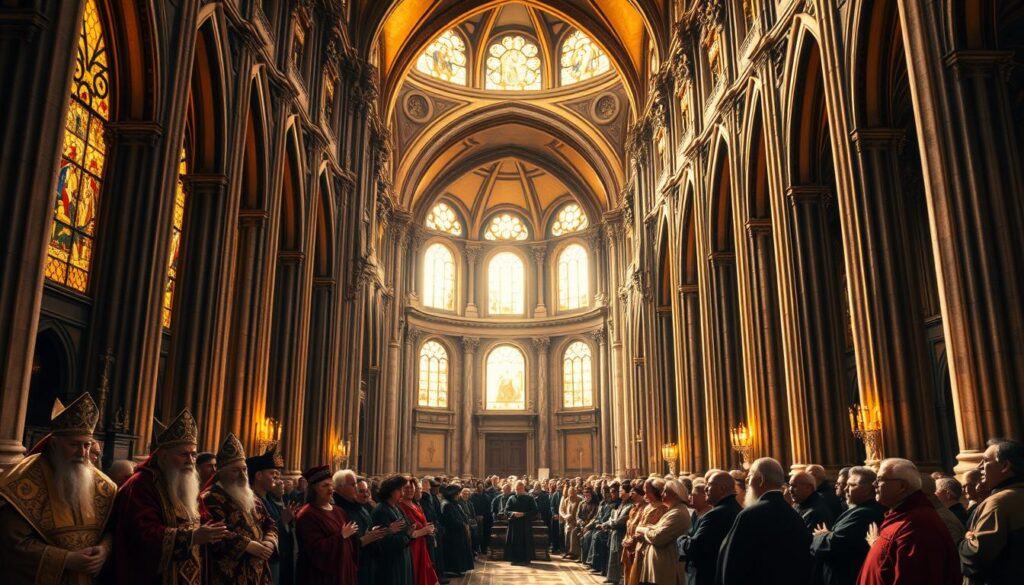
Roman Emperor Constantine summoned 300 bishops to modern-day Turkey in 325 AD. A fiery debate raged about whether Christ shared God’s eternal nature. Arius, a popular preacher, argued the Son was created later—a view many saw as undermining salvation’s power.
The council responded with bold clarity. They declared Father and Son “of one substance”, using the Greek term homoousios. This landmark decision became Christianity’s first universally accepted doctrine. One bishop noted, “We didn’t invent truth—we recognized what Scripture always taught.”
Council of Constantinople: Expansion in 381
New challenges emerged five decades later. While the 325 statement focused on Christ, believers needed clearer teachings about the holy spirit. The updated text affirmed the Spirit’s divinity and role in creation. It also strengthened language about Christ’s resurrection and eternal kingdom.
This revised version became standard across eastern and western churches. Remarkably, both councils occurred on sunny spring days—a practical choice allowing safe travel for delegates. Their collaborative spirit still inspires modern ecumenical efforts.
Defining the Creed’s Core Doctrines
At the heart of Christian theology lies a profound mystery expressed through precise language. This foundational text answers humanity’s oldest questions about divine relationships while maintaining doctrinal clarity. Its carefully chosen phrases create a theological framework embraced by diverse faith traditions.
Trinitarian Beliefs and the One God Concept
The text begins with a revolutionary idea: one God existing as three distinct persons. This concept avoids both mathematical confusion and oversimplification. As one scholar noted, “It’s like seeing sunlight split into colors through a prism—one source revealing multiple aspects.”
| Person | Divine Attribute | Scriptural Connection |
|---|---|---|
| Father | Almighty Creator | “In the beginning, God created…” |
| Son | Eternal Light | “The light shines in darkness” |
| Holy Spirit | Life-Giver | “Breathed into them the breath of life” |
Christological Statements and the Nature of the Son
Central to these teachings is Jesus’ dual nature—fully divine yet genuinely human. The phrase “begotten, not made” settled ancient debates about Christ’s origin. A fourth-century bishop explained, “A human father and son share the same nature—so do the divine Father and Son.”
This understanding shaped how believers view salvation. If Jesus weren’t fully God, his sacrifice couldn’t bridge heaven and earth. If he weren’t fully human, he couldn’t represent us. The text’s balanced approach continues guiding faith communities today.
Understanding the Protestant Nicene Creed in Contemporary Faith
Modern congregations find ancient words surprisingly relevant in today’s theological landscape. Over 85% of mainline denominations incorporate this historic text into their worship services, proving its adaptability across centuries. From urban megachurches to rural chapels, these time-tested phrases continue shaping spiritual identity.

Church leaders value how the text simplifies complex doctrines. “It’s like a theological GPS,” shares a Methodist educator. New believers gain clarity through its structured approach to the Trinity and salvation. Confirmation classes often use it to map core teachings about Christ’s role in human redemption.
While most traditional communities treat it as authoritative, some newer movements approach it differently. Non-denominational groups might call it “helpful but not binding,” prioritizing scripture alone. Yet even critics acknowledge its power to unite Christians across cultural divides.
The creed’s lasting strength lies in focusing on eternal truths rather than secondary issues. By connecting God’s nature to everyday life, it helps worshippers see divine fingerprints in ordinary moments. Sunday recitations become living bridges between ancient councils and modern spiritual journeys.
The Role of the Holy Spirit and the Filioque Controversy
One of the most pivotal developments in Christian theology unfolded through evolving descriptions of the divine breath that animates faith. The 381 Council of Constantinople transformed early understandings by giving the holy spirit equal standing with the Father and Son. This shift laid groundwork for both unity and future divisions.
Holy Spirit’s Position in the Creed
Church leaders in 381 crafted bold language to affirm the Spirit’s divinity. They declared him “the Lord and Giver of life”—a phrase elevating his role from vague force to distinct person. The text emphasizes shared worship, stating the Spirit is glorified with the Father and Son as one God.
This formulation answered practical concerns. Early believers needed clarity on whether to pray to the Spirit or merely through him. By linking the Spirit’s work to prophecy and creation, the statement became a compass for Christian experience.
The Debate Over the Filioque Clause
Centuries later, a single Latin word split churches. Western congregations added Filioque (“and the Son”) to describe the Spirit’s origin. A bishop from the time noted, “We seek to honor Christ’s words about sending the Spirit from the Father.”
Eastern churches saw this as overstepping scripture. The disagreement became symbolic of deeper tensions, contributing to the 1054 schism. Today, most Western denominations retain the phrase, believing it reflects biblical truths about divine relationships.
Understanding this debate helps modern believers appreciate how small details shape big beliefs. It reminds us that theological precision matters—not as wordplay, but as love letters to truth.
Comparative Analysis: 325 vs 381 Creed Versions
Two historic church gatherings produced distinct versions of Christianity’s most influential statement. The 56-year gap between these councils allowed theologians to refine teachings while addressing new questions about salvation’s mechanics.

Textual Differences and Additions
The 381 update made God’s creative work more tangible. Where the original text called Him “Maker of all things visible and invisible,” the revised version added “heaven and earth” for clarity. This change helped ordinary believers connect divine power to their daily lives.
Christ’s story gained vivid details in the later version. The 381 text specifies his birth “by the Holy Spirit and of the Virgin Mary”—a direct response to doubts about Jesus’ humanity. It also names Pontius Pilate, anchoring salvation history to real-world events.
| Element | 325 Version | 381 Version |
|---|---|---|
| Holy Spirit | Brief mention | “Lord and Giver of life” |
| Christ’s Death | General reference | Burial & crucifixion details |
| Creation | “All things” | “Heaven, earth, all things” |
The Inclusion of ‘and the Son’
A small phrase sparked big debates centuries later. Western churches added Filioque (“and the Son”) to describe the Spirit’s origin. This tweak aimed to honor Christ’s role in sending the Spirit, based on Gospel accounts.
Eastern churches saw this as changing sacred tradition. One monk protested, “We mustn’t edit what the fathers prayed!” Though intended to clarify relationships within the Trinity, this addition became symbolic of growing divisions.
These textual shifts show how faith statements evolve to meet believers’ needs. By balancing precision with accessibility, both versions continue guiding worship worldwide.
Influence on Church Liturgy and Worship Practices
Each Sunday, millions voice ancient truths that bridge centuries of belief. These words shape sacred moments from baptisms to communion services, creating rhythm in Christian worship. Their power lies in connecting modern believers to foundational teachings through shared recitation.
Liturgical Recitations Across Traditions
Traditional congregations often include these affirmations during Eucharist celebrations. Lutheran and Anglican services place them after scripture readings, while Catholic Masses position them before communion. “Reciting together reminds us we’re part of something bigger,” notes a Presbyterian minister.
Eastern Orthodox churches chant the text during morning prayers, emphasizing its musical qualities. The phrase “one baptism” resonates particularly during christening ceremonies, linking new members to historic faith practices.
Contemporary Adaptations
Modern congregations creatively weave these declarations into worship. Some project the words on screens with nature backdrops, while others use call-and-response formats. Non-denominational groups might simplify language but keep core ideas about holy unity.
Youth services often pair recitations with interactive discussions. A Methodist worship leader shares: “We ask teens to rewrite lines in their own words—it sparks amazing conversations about what we truly believe.” This approach keeps the apostolic church’s legacy alive while speaking to new generations.
FAQ
How does the Creed describe the relationship between the Father, Son, and Holy Spirit?
It emphasizes their unity as one God in three persons, co-equal and eternal. The Son is “begotten, not made,” sharing the Father’s divine nature, while the Holy Spirit proceeds from both, affirming their shared glory and authority.
Why is the phrase “and the Son” (Filioque) significant in some traditions?
Added later by Western churches, this clause states the Holy Spirit proceeds from the Father and the Son. It sparked debates about the Spirit’s role and authority, creating lasting divisions between certain Christian denominations.
What role does the Virgin Mary play in the Creed’s teachings?
The text highlights Jesus’ humanity by noting he was “born of the Virgin Mary.” This underscores his dual nature—fully divine yet fully human—essential for understanding salvation and his resurrection.
How do modern churches incorporate the Creed into worship?
Many recite it during liturgies to affirm shared beliefs. Its use connects congregations to ancient traditions while reinforcing core doctrines like Christ’s resurrection, the apostolic church, and the promise of eternal life.
What distinguishes the 325 and 381 versions of the Creed?
The 325 text focused on Jesus’ divinity against Arianism. The 381 update expanded the Holy Spirit’s role, clarified the Trinity, and added phrases like “maker of heaven and earth,” solidifying teachings on creation and judgment.
Why is the Creed’s reference to “one baptism” important?
It unites believers across denominations under a common sacrament, symbolizing forgiveness and entry into the church. This line reinforces unity amid diverse practices, pointing to a shared hope in the resurrection of the dead.