For centuries, religious traditions have shaped humanity’s understanding of the divine. Among these, one of the most enduring is the faith system rooted in ancient teachings that view the divine as both the origin and purpose of existence. This belief, deeply embedded in sacred texts and rituals, emphasizes a connection that spans creation itself.
The foundations of this tradition trace back to early teachings that describe the divine as the source of all life. Historical documents, like the Catechism, highlight how adherents see their creed as starting with the “First and the Last”—a reflection of timeless spiritual truths. Over generations, these ideas have evolved through theological debates, artistic expression, and communal practices.
Central to this journey is the interplay between scripture and lived experience. Followers engage with questions about existence through prayer, reflection, and service—a dynamic blend of intellectual inquiry and heartfelt devotion. Art, liturgy, and community gatherings further deepen this relationship, offering diverse pathways to connect with the sacred.
Today, interpretations of these teachings continue to adapt while honoring their roots. Whether through ancient hymns or modern social outreach, the core message remains: a call to recognize the sacred in everyday life. This guide will unpack how these beliefs took shape and what they mean for people today.
Key Takeaways
- Examines how foundational beliefs define the connection between faith and the divine.
- Explores the role of scripture and tradition in shaping spiritual understanding.
- Highlights practices like prayer and community as expressions of devotion.
- Connects historical teachings to modern interpretations of sacred principles.
- Addresses common questions about theological concepts in accessible terms.
Introduction to the Relationship Between Catholicism and God
How does a 2,000-year-old tradition maintain its relevance in addressing life’s biggest questions? At its center lies a dynamic bond that shapes how believers see themselves and their place in the world. This connection influences everything from morning prayers to community outreach, creating a living bridge between ancient wisdom and modern life.
Over centuries, this belief system has grown through scripture study, philosophical debates, and personal encounters. It answers fundamental questions about purpose while inviting followers to explore mystery through both reason and reverence. The result? A religion that feels equally at home in grand cathedrals and humble soup kitchens.
People engage with these teachings in diverse ways. Some find clarity through structured liturgies, while others connect via quiet meditation. Service projects often become acts of devotion, blending practical help with spiritual growth. As one theologian noted, “The divine speaks through every act of love.”
What makes this faith unique is its balance of awe and approachability. Followers celebrate sacred mysteries that surpass human understanding while believing in a caring presence that walks with them daily. This dual perspective fuels everything from art to social justice efforts.
Cultural traditions add colorful layers to these core ideas. Mexican Day of the Dead altars, Filipino Simbang Gabi masses, and Polish Wigilia dinners all show how communities adapt practices while keeping doctrinal roots intact. These examples prove that unity doesn’t require uniformity.
Through evolving times, one truth remains: this relationship thrives when teachings meet real human needs. Whether grappling with personal struggles or global crises, believers return to a simple yet profound idea—love as the ultimate answer.
Historical Foundations and the Nicene Creed
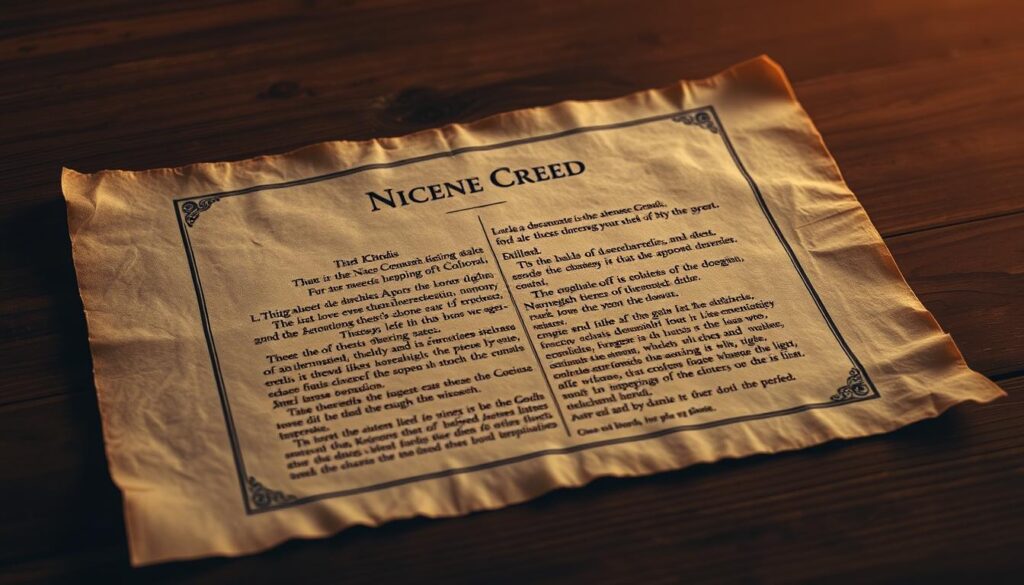
What unites believers across continents and centuries? The answer lies in a 325 AD document forged through intense debate. This ancient text became the bedrock for understanding divine relationships in Western Christianity.
Early Church Teachings and the Credo
The Nicene Creed emerged as Christianity’s first universal profession of faith. Church leaders gathered to counter claims denying Jesus’ divine nature. Their solution? A precise declaration: “True God from true God, begotten not made”.
This statement settled heated arguments about Christ’s role as both human and divine. By affirming he existed “before all ages”, the creed linked earthly stories to eternal truths. Every Sunday, millions still recite these words unchanged.
Evolution of Catholic Doctrinal Beliefs
Over time, teachings deepened without altering core ideas. The phrase “maker of heaven and earth” expanded to include invisible realities—angels, souls, and quantum physics mysteries. Scholars found new ways to explain how “all things were made” through Christ.
Modern thinkers still wrestle with phrases like “consubstantial with the Father”. Yet the creed’s structure remains vital. As one historian notes, “It’s like a theological compass—always pointing north even as cultures shift.”
From medieval universities to smartphone apps today, this ancient text keeps guiding seekers. Its balance of mystery and clarity shows how timeless truths adapt to every generation’s questions.
Evolution of Catholic Thought Over the Ages
How do ancient ideas stay fresh across generations? The answer lies in a dynamic dance between timeless truths and new questions. This religious tradition has refined its teachings through dialogue with philosophy, science, and shifting cultural landscapes.
Guiding Lights: Sacred Texts and Living Tradition
Sacred writings have always served as compasses for believers. Early monks pored over biblical texts, finding hidden meanings in familiar stories. Medieval scholars then built frameworks to connect scripture with Aristotle’s logic—a bold move that reshaped theological education.
https://www.youtube.com/watch?v=g-3CYNZNkVc
Take Thomas Aquinas’ work as an example. He blended faith with reason in a way that made complex ideas accessible. His Summa Theologica became a blueprint for balancing divine mystery with human understanding.
| Historical Period | Focus | Key Contribution |
|---|---|---|
| Early Church | Mystical prayer | Desert Fathers’ wisdom |
| Middle Ages | Systematic theology | Scholastic method development |
| Modern Era | Social teaching | Ethical frameworks for justice |
This evolution shows how tradition acts like a river—keeping its source pure while gaining new tributaries. Church councils addressed pressing issues while preserving core teachings about humanity’s place in the world.
Today’s thinkers continue this pattern. They explore how ancient texts speak to artificial intelligence or climate change. As one scholar notes, “Truth isn’t fragile—it grows brighter when tested by new light.”
Theological and Philosophical Perspectives on Divine Existence
How do thinkers balance logic and mystery when exploring ultimate truths? This question lies at the heart of theological debates. Scholars have long used rational inquiry alongside spiritual insights to map the contours of divine reality.

The tradition employs two complementary paths: philosophical analysis and lived faith. Take Thomas Aquinas as an example. His Five Ways argument uses observable patterns in nature—like movement and design—to point toward a first cause. Yet he also wrote, “To one who has faith, no explanation is necessary.”
This approach provides a way to address big questions without reducing mystery. Human reason offers one way to grasp truths about existence, but spiritual experience deepens understanding. As one modern theologian notes:
“We study divine footprints in creation while knowing the maker remains beyond full comprehension.”
| Philosophical Method | Focus Area | Key Contribution |
|---|---|---|
| Scholasticism | Logical proofs | Bridging faith/science divides |
| Mystical Theology | Contemplative practice | Direct encounter emphasis |
| Contemporary Philosophy | Existential questions | Relevance to modern life |
These perspectives acknowledge human limits while celebrating our capacity to recognize goodness and beauty as reflections of the sacred. Everyday experiences—like awe at a sunset—become touchpoints for deeper reflection.
Ultimately, the tradition invites exploration rather than final answers. It shows how intellectual rigor and humble wonder can coexist, offering a rich example of engaging life’s biggest mysteries.
Examining Theistic Proofs and Rational Inference
Can logic and faith walk hand in hand? For centuries, thinkers have crafted rational frameworks to explore divine truths. These efforts show how observation and deduction can illuminate spiritual realities without diminishing their mystery.
A Posteriori Arguments in Catholic Thought
St. Thomas Aquinas offered a way to connect daily experiences with eternal truths. His Five Ways use simple examples like falling leaves or crafted tools to show how the world points beyond itself. Take motion: since objects can’t move themselves infinitely, there must be an “unmoved mover.”
Another example examines causes. Every effect needs a prior cause—but tracing this chain backward leads to one uncaused source. This approach respects both human reason and the vastness of creation.
Deductive Reasoning and the Ontological Debate
Some philosophers start with concepts rather than observations. The ontological argument claims perfection implies existence—a way to deduce divine reality from pure logic. While intriguing, most theologians prefer grounding arguments in tangible evidence.
As one scholar notes, “The stars declare glory, but equations can’t contain it.” These proofs don’t erase mystery—they invite deeper questions about man‘s place in the cosmos. They remind us that every thing we see whispers of something unseen.
Ultimately, rational arguments serve as signposts, not destinations. They help curious minds recognize patterns in the world while leaving room for wonder at the heart of creation.
The Role of Sacred Scripture and Tradition in Shaping Faith
How do timeless writings and lived practices form a complete spiritual vision? The answer lies in two pillars working together: sacred texts and centuries of wisdom. These elements act like paired lenses—one focusing on divine revelation, the other on human application.
Ancient scriptures offer more than historical accounts. They’re seen as love letters from the divine, written through inspired authors yet requiring context. As one scholar notes, “You can’t read a 2,000-year-old letter without knowing the sender’s heart.” This is where tradition steps in, preserving interpretations passed down like family recipes.
The Church serves as a trusted guide, ensuring texts aren’t misunderstood. Imagine trying to solve a puzzle with missing pieces—tradition provides the edges. For example, early debates about Christ’s nature were settled by aligning scripture with apostolic teaching. This way of thinking prevents faith from becoming a solo project.
Here’s how these elements support each other:
- Scripture anchors core truths about man‘s purpose
- Tradition adapts these truths across cultures
- Both foster a living religion that breathes with time
Modern challenges like AI ethics or climate justice show why this balance matters. Ancient words gain new life when paired with evolving practices. As a 4th-century bishop wrote, “The Spirit still speaks—if we’re humble enough to listen.” This dynamic support system keeps faith fresh yet rooted.
Spiritual Symbolism: Metaphors, Analogies, and Divine Images
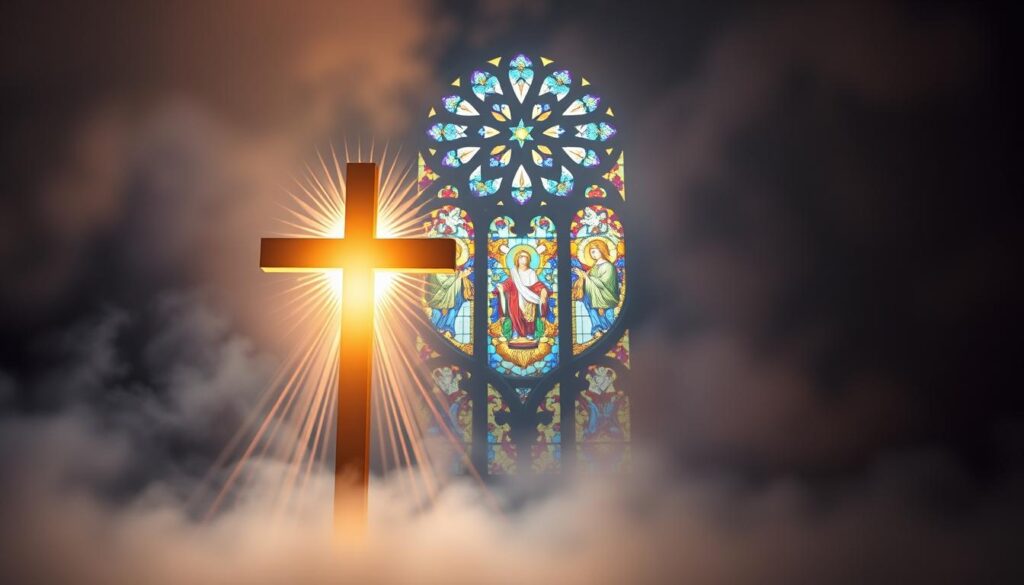
How can finite words describe the infinite? Religious traditions answer this puzzle through creative language that paints vivid pictures of the sacred. These tools—metaphors, analogies, and symbols—act as stepping stones, helping man grasp truths too vast for literal terms.
Understanding Biblical Symbols and Their Meanings
Take the metaphor “God is a rock” from Psalm 18. This comparison highlights strength and stability without suggesting divinity is geological. Similarly, calling divine love a “consuming fire” uses everyday experiences to hint at deeper realities.
Analogical language works differently. When we say “God is good,” we’re making a statement that shares meaning with human goodness but transcends it entirely. As one theologian explains: “Our words are signposts pointing beyond themselves.”
| Figurative Tool | Function | Example |
|---|---|---|
| Metaphor | Direct equivalence | “Light of the world” |
| Analogy | Partial similarity | “Fatherly care” |
| Symbol | Tangible representation | Dove for peace |
Symbols like bread or water take this way of thinking further. They connect physical objects to spiritual truths—nourishment becomes grace, thirst turns into longing for meaning. This approach avoids both rigid literalism and vague abstraction.
Guided by tradition, believers learn to interpret these images without losing their mystery. As a 5th-century monk wrote: “The map is not the territory, but it shows the path.” This balance lets sacred texts speak across ages while honoring their timeless source.
The Interplay Between Faith, Reason, and Revelation
Why do some see faith and science as rivals when they’re actually partners? This question sits at the heart of a rich tradition that views intellectual curiosity and spiritual devotion as allies. Like two wings lifting a bird, these forces work together to elevate humanity’s understanding of life’s deepest truths.
Revelation offers insights that pure logic can’t reach alone—think of concepts like divine goodness or sacrificial love. Yet reason gives man tools to explore and explain these mysteries. As St. Augustine noted, “Understanding is the reward of faith—seek not to understand that you may believe, but believe that you may understand.”
This balanced way of thinking shapes how believers approach modern challenges:
- Scientific discoveries become invitations to marvel at creation’s complexity
- Philosophical debates refine—rather than threaten—spiritual convictions
- Personal doubts transform into stepping stones for deeper trust
The Church’s historical engagement with thinkers like Aristotle and Einstein shows this principle in action. Truth isn’t divided into sacred and secular—it’s a single tapestry woven from many threads. This approach provides an answer to those who see religion as anti-intellectual, proving that faith thrives when paired with honest inquiry.
Ultimately, this interplay reminds us that wonder and wisdom aren’t opposites. They’re companions on the journey to grasp life’s grandest realities.
Engaging with “catholicism god” in Practice
In modern life, ancient traditions meet fresh expressions through personal journeys and shared actions. Many find their path by blending time-honored rituals with creative approaches to devotion. From quiet meditation apps to neighborhood food drives, these practices show how timeless truths adapt to contemporary needs.
Bridging Ancient Wisdom and Daily Life
People today often experience the sacred through personal encounters rather than formal structures. A teacher might reflect on spiritual truths during her commute, while a nurse sees caregiving as a way to honor human dignity. These moments reveal how belief becomes tangible in ordinary settings.
Digital tools now offer new avenues for connection. Online prayer groups and virtual retreats help busy individuals nurture their inner life. Yet face-to-face gatherings remain vital, whether through volunteer projects or intergenerational faith-sharing circles. As one organizer notes, “Service reminds us we’re part of something bigger.”
This balance between innovation and tradition keeps spiritual practices relevant. By grounding modern belief in enduring principles, communities create meaningful bridges between sacred teachings and today’s challenges. The result? A living faith that walks with people through every season of life.
FAQ
How does the Nicene Creed shape Catholic beliefs about the divine?
The Nicene Creed, formalized in 325 CE, outlines core teachings like the Trinity and Jesus’ divinity. It unifies believers by summarizing essential doctrines, serving as a foundation for worship and doctrinal clarity.
What role do tradition and sacred texts play in understanding the divine?
Scripture and apostolic tradition work together to guide interpretations. Texts like Genesis and the Psalms reveal insights into creation, justice, and God’s nature, while tradition preserves teachings passed down through generations.
How do Catholic teachings balance faith with rational inquiry?
Thinkers like Thomas Aquinas emphasized that reason and revelation complement each other. Arguments from design, morality, and existence—rooted in observation and logic—support belief while honoring mystery.
Are biblical symbols like "light" or "shepherd" meant to be taken literally?
These metaphors convey deeper truths about care, guidance, and holiness. For example, referring to the divine as a “shepherd” highlights protection and leadership, inviting personal reflection rather than literal interpretation.
How do modern Catholics engage with the concept of the divine today?
Through prayer, sacraments, and community, many believers nurture a lived relationship with the divine. Social justice, ecological stewardship, and personal spirituality also reflect contemporary applications of ancient teachings.
Why does the Church emphasize both Scripture and Tradition?
Together, they provide a holistic framework for faith. Scripture offers inspired writings, while Tradition ensures continuity in practices like the Eucharist and teachings on mercy, adapting wisdom across ages.
What’s the significance of describing God as "Creator" in Catholic thought?
This title underscores belief in a purposeful universe shaped by love. It also invites responsibility—viewing creation as sacred fosters care for people, nature, and ethical living.