For centuries, the Mother of God has held a special place in spiritual traditions worldwide. Within the Catholic Church, her role extends far beyond historical accounts, shaping theology and personal devotion. This article explores how her influence developed through Scripture, early Church teachings, and cultural practices.
Biblical references lay the groundwork for understanding her unique position. Early Christian communities honored her as a symbol of faithfulness, a theme that deepened over time. Church councils later formalized doctrines, emphasizing her connection to divine mysteries.
Many wonder why devotion to the Virgin Mary remains central today. The answer lies in her dual role as both heavenly intercessor and relatable human figure. From ancient catacomb art to modern prayer practices, this veneration reflects evolving spiritual needs.
In contemporary America, Marian traditions continue to inspire. Parishes celebrate feast days with processions, while families pass down prayers like the Rosary. These customs bridge generations, keeping her legacy alive in daily faith experiences.
Key Takeaways
- Mary’s title as “Mother of God” originated in early Church councils
- Biblical foundations support her unique role in Christian theology
- Devotional practices evolved naturally over 2,000 years
- Common misconceptions stem from misunderstandings of Church teachings
- Modern U.S. Catholics maintain vibrant Marian traditions
- Art and liturgy reflect her ongoing spiritual significance
Introduction: The Role of Mary in the Catholic Faith
Within Roman Catholic tradition, devotion to the Blessed Virgin Mary stands as a unique spiritual practice. Unlike ordinary saintly honors, her veneration—called hyperdulia—reflects her unparalleled role in salvation history. The Catholic Church teaches this special reverence never competes with worship reserved for God alone.
Popes have nurtured Marian devotion while guiding believers toward authentic expressions. As one Vatican document states:
“True honor flows from faith, not superstition—it magnifies Christ through his mother.”
This distinction preserves theological clarity while allowing diverse cultural practices.
Consider how Marian traditions differ from other Christian approaches:
| Veneration Type | Recipient | Purpose |
|---|---|---|
| Latria | God | Divine worship |
| Hyperdulia | Virgin Mary | Honor for her unique role |
| Dulia | Saints | Respect for holiness |
Over 1,000 titles like Mother of God and feast days reveal her enduring impact. From the Rosary to Michelangelo’s Pietà, these expressions help believers connect faith with daily life. They bridge ancient teachings and modern spirituality through tangible traditions.
Historical Roots of Marian Veneration
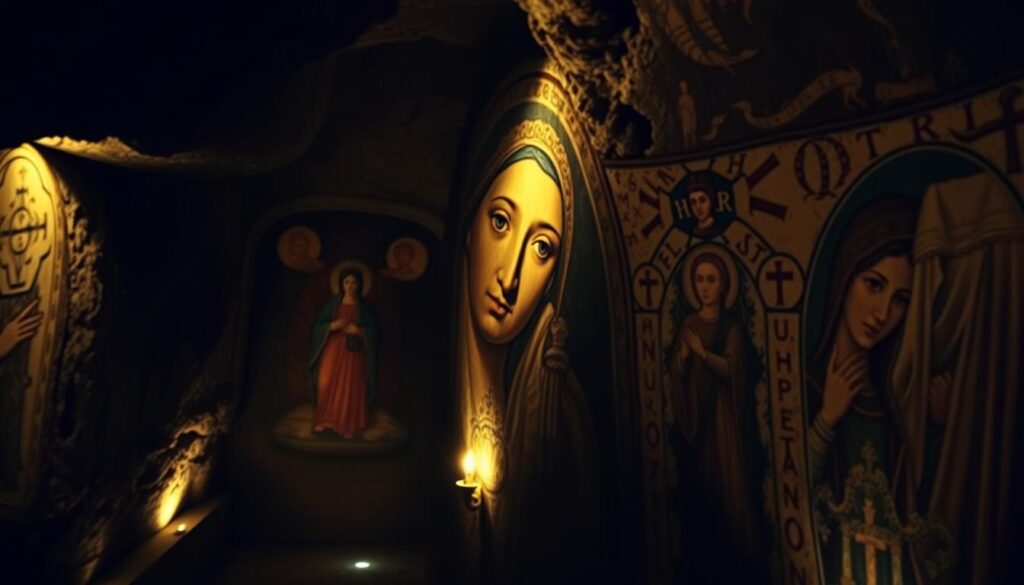
Long before grand cathedrals rose, humble underground spaces held clues to early Christian devotion. Hidden art and symbols in burial chambers reveal how believers honored the Mother of Jesus during times of persecution.
Early Catacomb Paintings and Symbols
The Priscilla catacombs in Rome showcase the oldest known image of the Blessed Virgin. Dating to 150 AD, this fresco depicts her holding the Christ Child while a prophet points to a star—a visual nod to messianic promises. Nearby, St. Peter’s Basilica excavations revealed another 2nd-century artwork linking Mary with apostolic figures.
These underground galleries served dual purposes. They provided burial sites while preserving faith expressions. Simple symbols like stars and scrolls accompanied Marian imagery, showing Roman Catholic ancestors understood her theological importance early on.
The Development of Marian Churches
After Emperor Constantine legalized Christianity in 313 AD, devotion moved above ground. The 5th century saw explosion of Marian churches following the Ephesus Council’s declaration. Three Roman landmarks still stand today:
| Church Name | Location | Century Built | Significance |
|---|---|---|---|
| Santa Maria Maggiore | Rome | 5th | First major Marian basilica |
| Santa Maria Antiqua | Roman Forum | 5th | Oldest Christian monument there |
| Santa Maria in Trastevere | Trastevere | 4th-6th | Claims earliest Marian title |
These sacred spaces became pilgrimage hubs, blending art with liturgy. Their mosaics often showed the Virgin Mary enthroned—a powerful reminder of her enduring role across time and cultures.
Biblical Foundations for Mary’s Significance
Scriptural connections between ancient symbols and New Testament events reveal profound layers of meaning. The mother of God emerges through patterns linking key figures across biblical history. These ties show how early believers saw divine plans unfolding through tangible signs.
Old Testament Echoes in New Testament Narratives
Elizabeth’s reaction to the Blessed Virgin Mary mirrors David’s awe before the Ark of the Covenant. Both exclaimed with reverence: “How can the ark/Lord’s mother come to me?” (2 Samuel 6:9, Luke 1:43). This parallel positions Mary as the living Ark carrying Christ—the ultimate covenant.
| Event | Old Testament | New Testament | Symbolic Meaning |
|---|---|---|---|
| Sacred Encounter | Ark brought to Jerusalem | Mary visits Elizabeth | Divine presence embodied |
| Joyful Response | David dances (2 Sam 6:14) | John leaps (Luke 1:44) | Celebration of salvation |
| Three-Month Stay | Ark dwells with Obed-edom | Mary remains with Elizabeth | Extended blessing period |
Other Old Testament symbols deepen this connection. The Burning Bush’s unconsumed flames prefigure the Virgin Mary bearing God without losing purity. Genesis 3:15’s “woman” battling the serpent finds fulfillment in her role as spiritual warrior.
These patterns weren’t later inventions. First-century Christians recognized them while reading Scripture through Christ’s life. As one scholar notes: “The Blessed Virgin Mary becomes the bridge joining ancient promises to their fulfillment.”
The Theological Dimensions Behind Mary’s Role
Early Christian thinkers unlocked profound truths about divine plans through careful study. Their insights reveal how the mother of God became central to spiritual understanding, shaping beliefs across generations.
New Eve and Spiritual Intercessor
Justin Martyr’s groundbreaking idea in the 2nd century framed the blessed virgin as the “New Eve.” Where Eve’s choice brought separation, Mary’s “yes” restored unity. Irenaeus expanded this, showing her obedience made Christ’s incarnation possible:
“As Eve was seduced by an angel’s word to flee God, Mary received angelic news to bear divine life.”
This theological foundation ties directly to Jesus Christ. Since he’s fully God and human, his mother’s role carries unique weight. Pope John Paul II captured this mystery beautifully:
“To the wonderment of nature you bore your Creator!”
Her intercessory role springs from Calvary’s foot. When Christ entrusted her to John, she became a spiritual mother to all. This faith tradition emphasizes collaboration—her prayers support but never replace Christ’s mediation.
Modern theologians explore how the blessed virgin models perfect grace response. Her story invites believers to mirror trust in God’s unfolding plans.
catholicism mary: Understanding the Title “Mother of God”
What does it truly mean to call someone the Mother of God? This ancient title hinges on a radical truth: Jesus Christ isn’t two separate beings. He’s one divine person with complete human and divine natures. The Council of Ephesus settled this in 431 AD to protect core Christian beliefs.
Church leaders faced a critical question: Could Mary’s motherhood apply only to Christ’s humanity? Their answer reshaped history. As the council declared:
“If anyone denies God became flesh through birth from the Holy Virgin… let them be condemned.”
This wasn’t about elevating a human figure. It confirmed Jesus’s unity as God-man. When Mary gave birth, she welcomed one person—not a mix of two identities. The Catechism of the Catholic Church clarifies: “What the faith professes about Mary flows from what it believes about Christ.
Some early Christians struggled with this concept. The Nestorian heresy claimed Christ had split personas. But the Council of Ephesus showed this broke salvation’s logic. If Jesus weren’t fully unified, his life couldn’t heal human nature.
Modern believers often find comfort here. Recognizing Mary as Mother of God reminds us Christmas celebrates God entering time—not just a holy teacher’s birth. This title remains a compass, pointing always to the miracle of divine love made touchable.
Doctrinal Development and Ecumenical Councils
How did ancient debates about divine mysteries shape today’s spiritual practices? Four key teachings about the Mother of God emerged through centuries of prayerful reflection. These doctrines—rooted in Scripture—were clarified at critical moments when faith needed clear guidance.
The Council of Ephesus and Theotokos
In 431 AD, bishops gathered to address a dangerous idea. Some claimed Christ existed as two separate persons—one human, one divine. The Council of Ephesus responded decisively:
“Mary gave birth not to a man later united with God, but to the Word made flesh.”
This declaration of Theotokos (“God-bearer”) protected core truths. It affirmed Jesus’ unified nature while honoring his mother’s unique role. The Catechism Catholic teachings later reinforced this, showing how her title points directly to Christ’s identity.
| Council | Year | Key Focus | Outcome |
|---|---|---|---|
| Ephesus | 431 | Christ’s unified nature | Theotokos definition |
| Vatican II | 1962-65 | Modern faith application | Mother of the Church title |
Second Vatican Council Insights
The 1960s brought fresh perspectives. The Second Vatican Council highlighted Mary as a model for all believers. Documents described her active participation in God’s plan—not just passive acceptance.
Pope John Paul II expanded these ideas in his 1987 letter Redemptoris Mater. He urged Catholics to see her as a companion in faith journeys. Her trust in uncertain times became a blueprint for modern discipleship.
These councils show a beautiful balance. They deepened understanding of holy mysteries while keeping Christ central. As the Second Vatican Council noted: “True devotion consists not in empty emotion, but in faith-filled action.”
Marian Devotion in Art, Music, and Literature
Artistic expressions have shaped spiritual connections for generations. From stained glass windows to sacred hymns, creative works offer unique ways to experience faith traditions. These forms not only honor the Blessed Virgin but also teach core beliefs through beauty and melody.
Iconography and Symbolism
Medieval artists filled cathedrals with symbols celebrating the Virgin Mary. Gothic arches framed rose windows depicting her as Queen of Heaven, while lilies represented purity. Landmarks like Notre-Dame de Paris became stone prayers, their spires pointing toward divine mysteries.
Devotional Songs and Prayers
Monks chanted Ave Maris Stella by candlelight, their voices weaving through ancient cloisters. These melodies later inspired global traditions—from Mexican mañanitas to Filipino flores de Mayo. Even today, the Rosary’s rhythmic prayers connect believers across time and cultures.
Through art and song, devotion to the Blessed Virgin remains vibrant. These creative expressions invite both reflection and celebration, keeping spiritual legacies alive in modern hearts.
FAQ
Why is the title "Mother of God" central to understanding Mary’s role?
The title “Mother of God” (Theotokos) was affirmed at the Council of Ephesus in 431 AD. It emphasizes that Jesus is fully divine and human, and Mary’s role in bearing Christ confirms her unique place in salvation history. This teaching safeguards the unity of Christ’s two natures.
How does the Old Testament foreshadow Mary’s significance?
Figures like Eve, the Ark of the Covenant, and prophecies such as Isaiah 7:14 are seen as symbolic parallels. These connections highlight Mary’s purity and her mission to bring forth the Messiah, fulfilling God’s promises to His people.
What does the Second Vatican Council say about devotion to Mary?
The Second Vatican Council reaffirmed Mary’s role as “Mother of the Church” and emphasized her example of faith. It encouraged honoring her while clarifying that worship belongs to God alone, balancing reverence with theological clarity.
How is Mary described as the “New Eve” in Catholic teaching?
Just as Eve’s disobedience brought sin, Mary’s “yes” to God (Luke 1:38) undoes this through obedience. This analogy, rooted in early Church writings, portrays her as a spiritual mother who cooperates in Christ’s redemptive work.
What role does art play in Marian devotion?
Art, such as icons of the Virgin and Child, visually communicates her humility and connection to Christ. From medieval hymns to Renaissance paintings, these works inspire prayer and reflect her enduring influence on culture.
Are prayers to Mary considered worship?
Catholics distinguish between veneration (honor) and worship. Prayers like the Rosary or Hail Mary ask for her intercession, trusting she brings needs to Jesus. Worship, however, is reserved for God alone.
How did early Christians honor Mary?
Catacomb paintings and symbols like the “Star of the Sea” date to the 2nd century. Churches dedicated to her, such as Santa Maria Maggiore in Rome, later became centers for pilgrimage and theological reflection.