Visual elements in religious spaces often carry stories deeper than their simple designs suggest. For many Christian traditions born from the Reformation, these emblems act as silent teachers of theology and history. They bridge the gap between abstract beliefs and everyday worship, offering clarity through imagery.
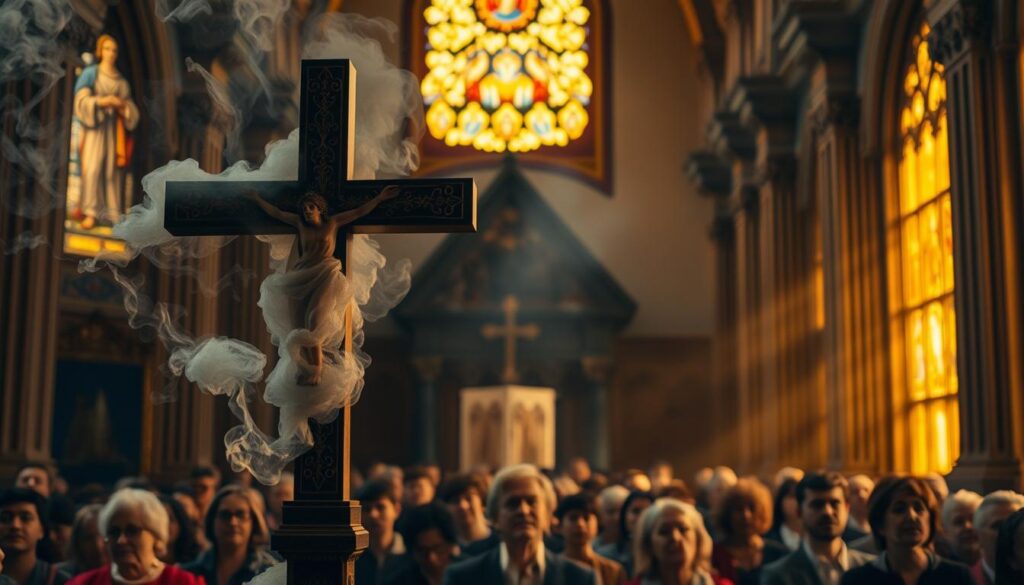
One of the most recognizable features in Reformation-era places of worship is the unadorned cross. Unlike some older Christian art, this empty design shifts focus from suffering to hope. It reminds believers of renewal rather than dwelling solely on sacrifice.
These visual choices didn’t emerge by accident. They reflect deliberate shifts during the 16th-century reforms, when communities sought to simplify worship. This approach contrasted sharply with more elaborate traditions, creating a distinct identity for congregations.
Today, these emblems continue to adapt while staying rooted in core values. Modern artists reimagine classic designs for new generations, proving that meaningful symbols never truly fade. They remain anchors of shared identity in an ever-changing world.
Key Takeaways
- Reformation-era symbols developed as a visual language to communicate core theological ideas
- The empty cross emphasizes resurrection hope over physical suffering
- Deliberate simplicity contrasts with other Christian artistic traditions
- Visual elements help define community identity across generations
- Modern adaptations maintain historical connections while embracing contemporary styles
Introduction to the Protestant Church Symbol
In faith communities, visual elements often bridge abstract beliefs with daily life. These icons act as silent teachers, guiding individuals through complex ideas with clarity. Far from mere decoration, they shape how congregations experience sacred moments.
Overview of the Symbol’s Role in Faith
In many churches, sacred imagery serves dual purposes. It focuses attention during services, helping believers center their thoughts. Simple designs like an empty cross or open Bible make theological concepts tangible. One minister describes them as “visual sermons that speak without words.”
Context in Today’s Worship
Modern church gatherings balance tradition with innovation. While some use digital projections, classic symbols remain vital. They anchor communities in shared history while allowing fresh interpretations. A worship leader recently noted:
“Our stained glass isn’t just art—it’s a language everyone understands.”
Updated designs maintain core meanings through contemporary materials. This approach keeps worship spaces dynamic yet rooted, proving ancient symbols can thrive in modern culture.
Historical Origins of the Protestant Church Symbol
Long before the 16th century, spiritual seekers questioned established religious practices. Groups like the Hussites in Bohemia and Waldensians in France laid groundwork by emphasizing Scripture over ornate rituals. Their resistance to centralized authority planted seeds for later reforms.

Proto-Protestant Movements and the Reformation
Early reformers faced fierce opposition for challenging medieval practices. Jan Hus, a Czech theologian, famously declared:
“The church’s true treasure is Christ’s gospel.”
His execution in 1415 didn’t stop his ideas from spreading. These movements valued simplicity, foreshadowing changes that would reshape Europe.
Martin Luther and the Birth of a New Tradition
When a German monk nailed ninety-five arguments to a church door in 1517, he ignited a cultural earthquake. Martin Luther’s bold stance against indulgences questioned centuries of tradition. His teachings on salvation through faith alone demanded new ways to express spiritual truths.
Artists and craftsmen responded by creating visual markers distinct from Catholic imagery. Empty crosses replaced crucifixion scenes, emphasizing resurrection over suffering. Open Bibles in sanctuaries highlighted Scripture’s central role—a direct challenge to hierarchical interpretations.
This shift wasn’t just about removing decorations. It forged a fresh identity for communities embracing reformed theology. Simple designs became powerful statements of belief, echoing through time to modern worship spaces.
Theological Foundations Behind the Symbol
At the heart of Christian renewal movements lay five revolutionary ideas. These principles shaped how communities expressed their convictions through visual language. Known as the Five Solae, they formed a theological compass guiding everything from sermons to sanctuary designs.
Sola Scriptura and Sola Fide Explained
Scripture alone became the rallying cry for reformers. This belief placed open Bibles front-and-center in worship spaces, visually declaring the text’s supreme authority. A 16th-century woodcut shows worshippers gathered around Scripture—no priests or rituals blocking access.
The companion principle of faith alone transformed spiritual imagery. Personal devotion replaced elaborate sacramental systems. As one reformer wrote:
“Trust in Christ’s promise, not human intermediaries.”
This shift birthed symbols emphasizing direct connection with the divine.
Grace, Faith Alone, and Justification
Unearned divine favor—grace alone—inspired stark contrasts in religious art. Simple communion cups replaced golden relics, showing God’s gifts require no human effort. Modern sanctuaries still use empty crosses to visualize free salvation through faith.
These ideas created a visual vocabulary of accessibility. Plain fonts on communion tables, unadorned walls—each choice whispers: “You’re welcomed as you are.” Through simplicity, theological beliefs about grace and redemption became tangible experiences for all.
Protestant Worship and the Use of Symbols
In spaces designed for spiritual reflection, every visual choice carries weight. Communities shaped by Reformation ideals developed distinct approaches to sacred art, prioritizing clarity over complexity. These decisions continue to shape modern worship experiences.

The Empty Cross as a Central Image
Many congregations avoid depicting Christ on the cross. This stems from strict interpretations of biblical warnings against crafted idols. As reformer John Calvin argued:
“The human mind is a perpetual forge of idols.”
The plain cross redirects attention to resurrection hope. It serves as a daily reminder of triumph rather than suffering. This visual shift reflects core beliefs about divine grace being complete through Christ’s victory.
| Feature | Empty Cross | Crucifix |
|---|---|---|
| Theological Emphasis | Resurrection | Suffering |
| Visual Elements | Minimalist | Figurative |
| Scriptural Connection | Romans 6:9 | Isaiah 53:5 |
| Worship Focus | Eternal hope | Sacrificial act |
Icons vs. the Emphasis on Scripture
Reformers removed statues and paintings to prevent distraction. They believed written words held greater power than carved figures. Open Bibles became focal points, inviting personal engagement with texts.
Modern sanctuaries maintain this focus through strategic simplicity. Unadorned walls and clear glass windows encourage looking beyond physical objects. As one architect notes: “Our designs help eyes rest on what matters most.”
Cultural Shifts in Protestant Symbolism
The Renaissance era’s lavish religious art sparked unexpected consequences. As painters perfected human forms and architects built grand cathedrals, some spiritual leaders grew uneasy. They worried artistic spectacle was replacing authentic devotion.
From Visual Elaborations to Minimalism
Reformers saw ornate decorations as barriers to true worship. John Calvin argued:
“When we seek God through carvings, we fashion idols with our hands.”
This conviction led many congregations to strip away statues and gilded altars. Simple wooden crosses and open Bibles became new focal points.
Different groups embraced this shift in unique ways. Lutheran communities kept some stained glass windows, blending old and new. Quaker meetinghouses removed all decorations, valuing pure silence. These choices reflected deeper beliefs about connecting with the divine.
Local cultures shaped these changes too. Scandinavian churches adopted clean Nordic designs, while American frontier congregations used rough-hewn materials. Each adaptation maintained core principles while speaking to community needs.
Today’s worship spaces continue this balancing act. Some use projection screens alongside ancient hymns, others preserve century-old pulpits. The challenge remains: creating environments that inspire without distracting. Through changing styles, the heart of worship stays rooted in timeless truths.
The Significance of the Empty Pulpit
Physical spaces shape how communities engage with sacred truths. During the Reformation, worship environments transformed to reflect new priorities. At the heart of this change stood an unadorned platform—the pulpit—designed to elevate Scripture above all else.
Simplicity in Worship Spaces
Reformers redesigned sanctuaries to emphasize clarity. Elevated pulpits became visual anchors, showing the authority of biblical teaching. As Martin Luther noted:
“When the Word is proclaimed purely, God Himself speaks through human lips.”
This design choice removed barriers between teachers and congregations. Plain wood replaced carved statues, shifting focus from artistry to message. Modern worship spaces continue this tradition, using clean lines to highlight the spoken word.
| Traditional Pulpit Features | Reformed Pulpit Features |
|---|---|
| Ornate carvings | Minimalist design |
| Saintly figures | Open Bible display |
| Central altar | Elevated platform |
| Decorative canopy | Natural lighting |
The empty pulpit’s power lies in what it removes. Without distractions, attention stays on Scripture’s transformative message. This approach reflects a core belief: divine truth needs no embellishment to change lives.
Scripture as a Visual Anchor in Protestant Churches
In many worship spaces, one object commands immediate attention—an open book resting at the heart of the room. This intentional placement transforms written words into living declarations. Centuries after reformers removed ornate decorations, the Bible remains the unchanging focal point of communal gatherings.
Role of the Open Bible on the Pulpit
Elevated platforms display sacred texts as if saying: “Listen closely—eternal truths await.” Modern congregations continue this tradition, placing Bibles where eyes naturally rest. A 17th-century minister captured this practice perfectly:
“Let the Word stand visible, that hearts might bow invisible.”
This visual strategy reinforces the belief that divine wisdom needs no intermediaries. Open pages invite personal engagement, symbolizing accessibility for all seekers.
Written Word: The Ultimate Guide
Reformers turned scripture into architecture. Where statues once stood, engraved verses now line walls. Worship leaders intentionally position lecterns to face audiences, creating dialogue rather than performance. These choices reflect a radical idea—truth belongs to everyone, not just religious elites.
Contemporary designs amplify this message. Backlit installations magnify key passages, while digital screens scroll translations side-by-side. Yet the core principle remains: when communities center on sacred texts, they anchor identity in enduring values rather than fleeting trends.
Understanding the protestant church symbol
Sacred imagery acts as a silent conversation partner across generations. In today’s diverse spiritual landscape, these visual anchors help communities navigate complex beliefs through simplicity. Their power lies in translating timeless truths into forms that resonate with modern seekers.
Defining Its Meaning in Contemporary Context
Modern believers encounter emblems that balance heritage with relevance. A worship leader in Chicago explains:
“Our stained glass isn’t frozen history—it’s a mirror reflecting today’s struggles and hopes.”
This adaptive approach maintains core messages while speaking to current realities like social justice or environmental care.
Three key roles define these visual elements today:
- Memory triggers: Simple designs recall foundational teachings during personal reflection
- Unity markers: Shared imagery connects diverse congregations across denominations
- Cultural bridges: Updated versions engage younger generations without losing historical roots
Communities now reimagine traditional forms through new mediums. Digital projections of ancient symbols appear beside tactile installations using recycled materials. This blend honors the past while embracing innovation.
| Traditional Expression | Modern Adaptation |
|---|---|
| Carved wooden cross | Laser-cut metal design |
| Stained glass biblical scenes | Interactive light displays |
| Embroidered altar cloths | Community-created textile art |
By studying these evolving practices, we uncover how visual language sustains belief systems through cultural shifts. The challenge remains: preserving essence while allowing fresh expressions that speak to contemporary hearts.
Communion Symbols in Protestant Worship
Shared meals have always held deep meaning across cultures. In certain traditions, they transcend nourishment to become sacred acts. The elements used in these rituals carry layers of spiritual significance that unite communities through shared memory.
The Chalice and Bread as Memorials
Simple vessels hold profound meaning during sacred meals. The cup recalls Christ’s words: “This is my blood of the covenant” (Matthew 26:28). Reformers like John Calvin described these elements as “visible words” that make divine promises tangible.
Communion tables often display open Bibles beside plain trays. This arrangement emphasizes Scripture’s role in shaping the practice. Unlike ornate altars, these unadorned surfaces invite participants to focus on spiritual nourishment rather than physical objects.
| Aspect | Protestant View | Catholic View |
|---|---|---|
| Elements’ Nature | Symbolic reminder | Literal transformation |
| Frequency | Varies (weekly to quarterly) | Daily Mass |
| Participation | All believers | Baptized members |
Comparing Protestant and Catholic Traditions
While both traditions share roots in the Last Supper, their practices diverged during the Reformation. The central difference lies in understanding presence. As one theologian notes:
“We remember a past event, but also anticipate future hope through these signs.”
This memorial approach contrasts with beliefs about miraculous change in the elements. The focus shifts from ritual repetition to personal reflection on redemption. Modern services often use common bread and grape juice instead of wine, emphasizing accessibility over ceremony.
Through these symbols, communities experience unity across generations. The meal becomes a living story—one that continues to shape identities and deepen faith journeys today.
The Lutheran Legacy: The Luther Rose
A 16th-century reformer’s personal emblem became an enduring icon of spiritual identity. Known as the Luther Rose, this intricate design encapsulates core beliefs through carefully chosen imagery. Created in 1530, Martin Luther’s seal serves as both personal statement and theological compass.
Symbolism and Historical Relevance
Each layer of the design reveals intentional meaning. The black cross at its center declares faith in Christ’s sacrifice, while the red heart beneath signifies love’s transformative power. Luther explained:
“The heart rests in a white rose to show faith gives joy, comfort, and peace.”
The golden ring framing these elements points to eternal life’s unbroken promise. This visual system reflects Luther’s methodical approach—translating complex ideas into accessible forms.
| Element | Meaning |
|---|---|
| Black Cross | Faith in Christ’s sacrifice |
| Red Heart | Love as faith’s foundation |
| White Rose | Joy and peace in belief |
| Golden Ring | Eternal life’s promise |
Enduring Impact in Modern Protestantism
Today, the Luther Rose appears in educational materials, jewelry, and worship spaces worldwide. A seminary professor notes: “It’s not just history—it’s a living conversation starter about grace.”
Modern adaptations include minimalist versions for digital media and community art projects. These iterations keep Reformation principles relevant while honoring their roots. The design’s longevity proves powerful symbols can bridge centuries, uniting believers across cultural divides.
The Dove as a Symbol of the Holy Spirit
Gentle wings spread in mid-flight carry more than air currents—they bear sacred meaning. This simple yet profound image connects believers to foundational spiritual truths. Its origins trace back to ancient texts describing divine encounters.
Embodying Peace, Purity, and Divine Presence
The dove’s white feathers mirror spiritual renewal, while its calm demeanor reflects inner transformation. A Minnesota pastor explains: “It’s not about the bird—it’s about what God’s power accomplishes through gentle means.” Biblical accounts link this creature to key moments, like Jesus’ baptism, where heavenly presence became visible.
Its Role in Visual and Liturgical Art
Modern worship spaces incorporate this emblem in creative ways. Stained glass designs show doves descending near baptismal fonts, linking ritual with sacred narrative. Some congregations use origami versions during Pentecost services, inviting participation.
Three key aspects define its liturgical use:
- Movement: Often shown mid-flight, suggesting active spiritual work
- Light: Gold-leaf accents symbolize divine grace
- Accessibility: Simple shapes allow universal recognition
Through these expressions, communities experience the holy spirit‘s work as both comfort and catalyst. The dove remains a timeless bridge between heaven’s promise and earthly practice.
FAQ
Why do many Protestant churches use an empty cross instead of a crucifix?
The empty cross emphasizes Christ’s resurrection and victory over death, reflecting a focus on redemption rather than suffering. Unlike crucifixes, it aligns with the belief in salvation through faith in a risen Savior.
How does Protestant symbolism differ from Catholic traditions?
Protestant practices often prioritize simplicity and scripture over ornate icons or statues. For example, communion bread and wine are seen as memorials, not the literal body and blood of Christ, contrasting with Catholic transubstantiation teachings.
What is the Luther Rose, and why is it significant?
Designed by Martin Luther, the Luther Rose features a cross, heart, and rose to symbolize faith, grace, and joy in Christ. It remains a visual anchor for Lutheran theology and the Reformation’s legacy.
Why is the Bible placed centrally in many worship spaces?
An open Bible on the pulpit underscores sola scriptura—scripture as the ultimate authority. It visually reinforces the belief that God’s Word guides teaching, worship, and daily life.
What does the dove represent in Protestant art and liturgy?
The dove symbolizes the Holy Spirit’s presence, drawing from Jesus’ baptism in the Gospels. It embodies peace, purity, and God’s active role in guiding believers.
How did the Reformation shift approaches to visual symbols?
Reformers like John Calvin rejected elaborate imagery to avoid idolatry, favoring minimalism. This led to plainer spaces where scripture and preaching took center stage.
What role does communion play in Protestant theology?
Communion serves as a remembrance of Christ’s sacrifice, affirming unity among believers. While practices vary, most reject the idea of physical transformation, focusing instead on spiritual nourishment.
Why are many worship spaces designed with simplicity?
Plain interiors reflect a focus on God’s Word and communal worship. The empty pulpit, for example, highlights the authority of scripture over human embellishment.