Welcome to your guide to one of history’s most enduring institutions. For nearly 2,000 years, the global community of Catholic believers has thrived under a carefully designed leadership model. This system connects parishes worldwide while preserving core traditions.
Many assume religious groups form through shared beliefs alone. But Jesus Christ himself established this faith with a clear organizational blueprint. From local priests to the Pope, each role serves specific purposes in maintaining unity and spiritual guidance.
The Church’s framework traces back to biblical times. Early leaders like Peter and the Apostles laid foundations for today’s governance through apostolic succession. Modern bishops and clergy continue this chain of responsibility.
You’ll discover how this structure balances earthly administration with sacred symbolism. Catholics view their community as both a practical organization and the living expression of Christ’s mission. This dual nature explains its resilience through centuries of change.
Key Takeaways
- The Church’s leadership model dates back to Jesus and the Apostles
- Roles range from parish priests to the Pope in Rome
- Apostolic succession validates modern leaders’ authority
- Over 1 billion members follow this unified system
- Balances practical governance with spiritual symbolism
- Maintains core traditions while adapting to modern needs
Overview of the Catholic Church Structure
What keeps 1.3 billion people connected across continents and centuries? The answer lies in two core concepts shaping Catholic identity: historical continuity and spiritual unity.
Roots in Early Christianity
Bishop Clement of Rome made a groundbreaking claim in 95 CE. He argued that local leaders directly inherited authority from Christ’s apostles. This idea of apostolic succession became the Church’s backbone. By the 2nd century, Irenaeus used this concept to defend against false teachings, showing how truth flows through ordained leaders.
Modern theologians like Marie-Joseph Le Guillou describe the Church as “God’s living sacrament.” This means every baptism and Eucharist ties members to Jesus’ original mission. The structure isn’t just administrative – it’s how divine life reaches believers today.
More Than an Organization
Pope Pius XII’s 1943 letter Mystici Corporis Christi revealed a stunning truth. The Church isn’t merely a human group – it’s Christ’s mystical body. Here’s what this means:
- Believers form interconnected parts like organs
- Jesus guides as the head through sacraments
- Service becomes spiritual nourishment
This vision transforms how Catholics see priests and bishops. Their roles aren’t just about management – they maintain vital connections in a living spiritual organism. Through this structure, ordinary people participate in something eternal.
The Catholicism Hierarchy: Understanding Key Roles
The Catholic Church’s leadership framework operates like a spiritual relay race. Each role passes sacred responsibilities through generations while addressing modern needs. Let’s explore how these positions work together to serve communities worldwide.
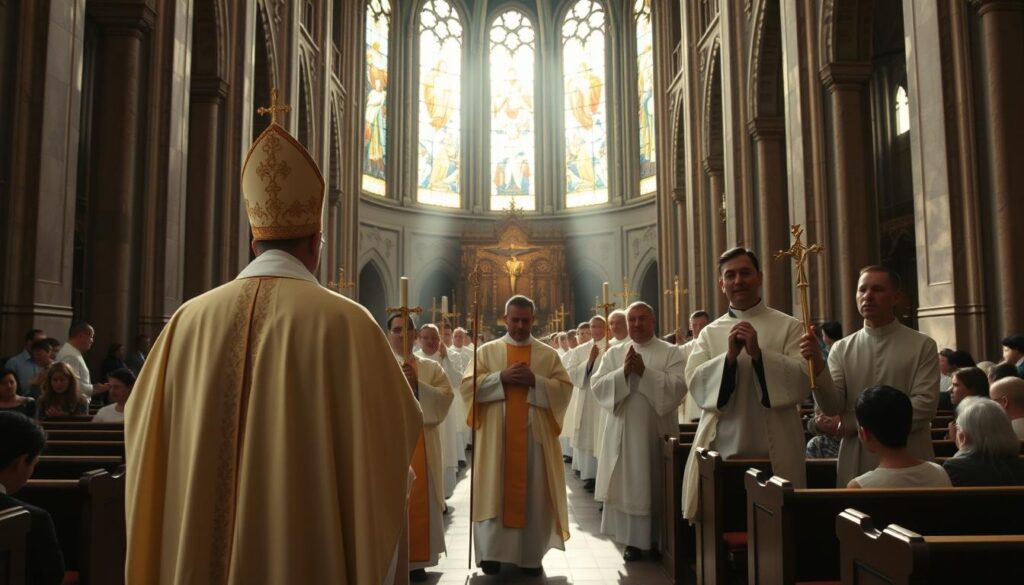
Roles of Deacons, Priests, and Bishops
Deacons form the foundation of clerical service. These transitional ministers spend twelve months preparing for priesthood. During this period, they perform baptisms, officiate weddings, and lead funeral rites. Their hands-on training keeps parishes running smoothly.
Priests gain expanded spiritual authority through the Rite of Ordination. This ceremony allows them to celebrate Mass, hear confessions, and administer sacraments. Most work directly with local communities, acting as spiritual guides and organizational leaders.
Bishops must meet rigorous standards:
- Minimum age of 35
- Five years of priestly experience
- Advanced theology degrees
These leaders oversee dioceses – geographic regions containing multiple parishes. Their role combines administrative oversight with teaching sacred traditions. When bishops retire at 75, new leaders continue their work.
| Role | Key Responsibilities | Special Requirements |
|---|---|---|
| Deacon | Baptisms, weddings, funerals | 12-month transitional period |
| Priest | Mass, confessions, sacraments | Rite of Ordination |
| Bishop | Diocese management, teachings | Doctorate in theology |
Archbishops manage larger regions called archdioceses. Cardinals – senior bishops under 80 – elect new Popes. The Pope serves dual roles as spiritual leader and head of Vatican City, blending ancient traditions with modern governance.
Roles and Responsibilities within the Catholic Church
Two paths shape Catholic ministry worldwide. While all priests share sacramental duties, their daily lives reveal striking contrasts. These differences help the church address both local needs and global missions.
Diocesan vs Religious Priests
Diocesan priests anchor community life. They lead individual parishes, focusing on specific neighborhoods or towns. Unlike their religious counterparts, they don’t take vows of poverty. Many drive regular cars and wear civilian clothes when not conducting services.
In the United States, 60% of priests follow this path. Their parishes provide housing and a modest salary. This setup helps them connect with modern families facing everyday challenges.
| Type | Vows | Lifestyle | Ministry Focus |
|---|---|---|---|
| Diocesan | Celibacy only | Independent living | Local community |
| Religious | Poverty, obedience | Communal housing | Specialized missions |
Religious priests join specific orders like Jesuits or Franciscans. They surrender personal possessions and live in group houses. Their work often involves education, scientific research, or global outreach programs.
Both roles maintain the body of Christ through different approaches. Diocesan priests offer stability, while religious orders pioneer new ways to serve. Together, they create a dynamic spiritual network spanning 6 continents.
The Evolution and Significance of Church Governance
Guiding 1.3 billion members requires balancing ancient traditions with contemporary needs. The Church’s framework draws strength from two pillars: sacred customs and structured legal systems. This blend allows communities to stay rooted while addressing modern challenges.
The Impact of Tradition on Modern Church Authority
Pius XII’s 1943 document Mystici Corporis reshaped how believers view leadership. It described the community as a “mystical body” with Christ as its head. This idea reinforces that authority flows from spiritual unity, not just administrative roles.
Ancient practices like apostolic succession still validate leaders today. When bishops retire, new ones continue unbroken chains of responsibility dating to St. Peter. This system maintains trust across generations.
Canon Law and the Papal Office
The Bishop of Rome oversees a legal code refined over 1,700 years. Canon Law governs everything from sacraments to property management. Updated regularly, it ensures consistency across 3,000 dioceses worldwide.
Papal decisions carry weight because they’re seen as extensions of early teachings. Modern leaders reference texts like Mystici Corporis Christi when addressing new issues. This approach keeps the nature of the Church both timeless and adaptable.
FAQ
What is the Mystical Body of Christ?
The Mystical Body of Christ refers to the belief that all baptized believers, united through faith and sacraments, form a spiritual community with Jesus as its head. This concept emphasizes unity, shared purpose, and the Church’s divine mission.
How does Apostolic Succession shape Church authority?
Apostolic Succession ensures that bishops, through an unbroken lineage tracing back to the original apostles, carry forward the teachings and sacramental authority of Jesus. This continuity preserves doctrinal integrity across generations.
What distinguishes deacons from priests and bishops?
Deacons assist in liturgy and charitable work but cannot celebrate Mass. Priests lead parishes and administer sacraments, while bishops oversee dioceses, ordain clergy, and uphold Church unity under the Pope.
How do diocesan priests differ from religious priests?
Diocesan priests serve specific geographic regions under a bishop, focusing on parish ministry. Religious priests take vows of poverty, chastity, and obedience within orders like the Jesuits, often prioritizing missions, education, or specialized ministries.
Why is Canon Law important in Church governance?
Canon Law provides a legal framework for sacraments, clergy conduct, and administrative processes. It ensures consistency in practices worldwide while aligning with spiritual teachings and papal directives.
How does tradition influence modern Catholic leadership?
Tradition, rooted in Scripture and centuries of ecumenical councils, guides decisions on liturgy, ethics, and doctrine. It balances historical wisdom with contemporary challenges, as seen in Vatican City’s global outreach under Pope Francis.