With over 224 million believers, faith plays a central role in American life. This guide helps you explore diverse worship experiences that reflect the heart of spiritual connection nationwide. Whether you prefer historic traditions or modern gatherings, there’s a place for everyone to grow.
From bustling cities to quiet towns, communities gather weekly to share hope and purpose. Many congregations focus on practical outreach, offering food pantries, youth programs, and support networks. Others emphasize deep biblical teaching or creative expressions of worship.
You’ll find options spanning various denominations and styles. Some groups meet in grand cathedrals, while others gather in coffee shops or parks. What unites them? A commitment to fostering belonging and making positive local impacts.
Key Takeaways
- America hosts over 210 million believers across countless congregations
- Worship styles range from traditional hymns to modern multimedia experiences
- Many groups prioritize community service and social justice initiatives
- Denominational diversity ensures options for personal preferences
- Churches often provide tailored programs for families and individuals
- Digital resources make exploring communities easier than ever
Overview of the U.S. Christian Church Landscape
America’s spiritual tapestry continues to evolve while maintaining deep roots. Recent studies reveal surprising patterns in how communities gather and grow. Let’s explore what shapes today’s worship environments.
Current Demographics and Trends
Nearly 224 million Americans still identify with faith groups, though participation rates show regional flavors. The South hosts 42% of evangelical congregations, while Catholic communities dominate coastal cities. Non-denominational groups now represent 13% of all worship centers – the fastest-growing segment.
| Region | Dominant Traditions | Worship Style |
|---|---|---|
| South | Evangelical | Contemporary music, casual attire |
| Northeast | Mainline Protestant | Traditional liturgy |
| West | Non-denominational | Multimedia experiences |
Digital innovation reshapes spiritual connections. Over 60% of congregations stream services, and 29% host virtual small groups. “Our online presence tripled youth participation,” shares a Texas pastor.
Cultural and Social Impact
Modern faith communities tackle pressing issues through food banks and counseling services. Many now offer financial literacy courses and support groups for anxiety. Bilingual services grew 18% since 2020, reflecting cultural shifts.
Creative outreach methods build bridges beyond Sunday gatherings. A Chicago congregation runs a popular podcast exploring faith through pop culture. Others partner with schools to provide weekend meal kits for students.
History of Christianity in the United States
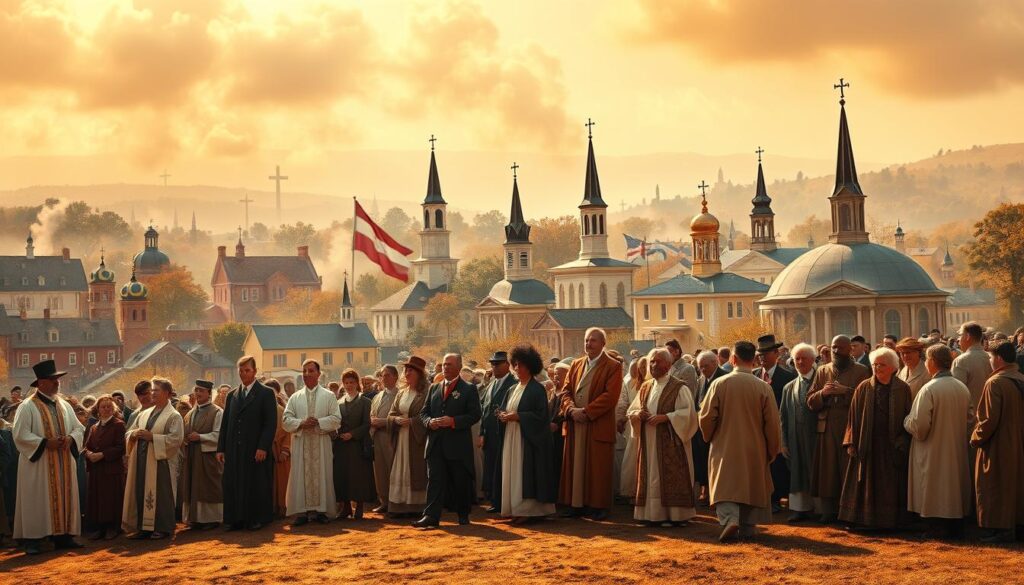
The story of faith communities in America begins with daring voyages across stormy seas. European settlers carried their beliefs to new shores in the 16th century, planting spiritual roots that would grow into a nationwide network of congregations.
Founding Influences and Early Settlers
English Dissenters like the Pilgrims arrived seeking more than freedom—they built societies guided by scriptural principles. By 1630, Puritans established the Massachusetts Bay Colony, creating “a city upon a hill” that inspired future generations.
Later immigrants enriched this foundation:
• German Lutherans in Pennsylvania (1740s)
• Irish Catholics fleeing famine (1840s)
• Scandinavian Lutherans in the Midwest (1880s)
Evolution Through the Centuries
Two seismic revival movements reshaped spiritual life. The First Great Awakening (1730s) emphasized personal faith, while the Second (1800s) sparked social reforms. Frontier preachers developed horseback ministries, adapting worship to rugged landscapes.
| Period | Development | Impact |
|---|---|---|
| 1607-1776 | Colonial settlements | Denominational diversity begins |
| 1800-1860 | Circuit riders | Western expansion of faith groups |
| 1890-1920 | Urban revivals | Social gospel movement emerges |
Twentieth-century immigration brought Eastern Orthodox and Pentecostal traditions, creating today’s vibrant mix. This historical journey shows how faith communities adapted while maintaining core values—a legacy visible in modern worship practices across the united states.
Major Denominations and Movements
American faith communities showcase a rich variety of traditions that shape spiritual practices nationwide. Let’s explore how different groups express their beliefs while maintaining shared values of service and connection.
Protestant, Catholic, and Other Traditions
Protestant groups form nearly half of all believers, with the Southern Baptist Convention leading as America’s largest Protestant denomination. These communities emphasize scripture-focused teaching and local outreach programs. The Evangelical Lutheran Church carries forward European heritage through liturgical services and educational initiatives.
Catholic traditions unite 22.7% of the population, blending ancient rituals with modern social justice efforts. Their global network supports everything from neighborhood food drives to international relief projects.
Smaller movements add unique flavors:
• Pentecostal groups like the Assemblies of God prioritize vibrant worship experiences
• Presbyterian and Reformed churches focus on theological scholarship
• Restorationist movements champion simplified biblical practices
Key Historical Milestones
The 18th-century Great Awakening sparked evangelical growth, while 19th-century revivals birthed Methodist and Baptist expansion. By 1900, urban immigration diversified worship styles across the united states.
Recent decades saw non-denominational groups surge, adapting to cultural shifts through multimedia services. “Our flexibility helps people connect faith to daily life,” notes a Chicago pastor leading a multi-site congregation.
Understanding Diverse Christian Denominations
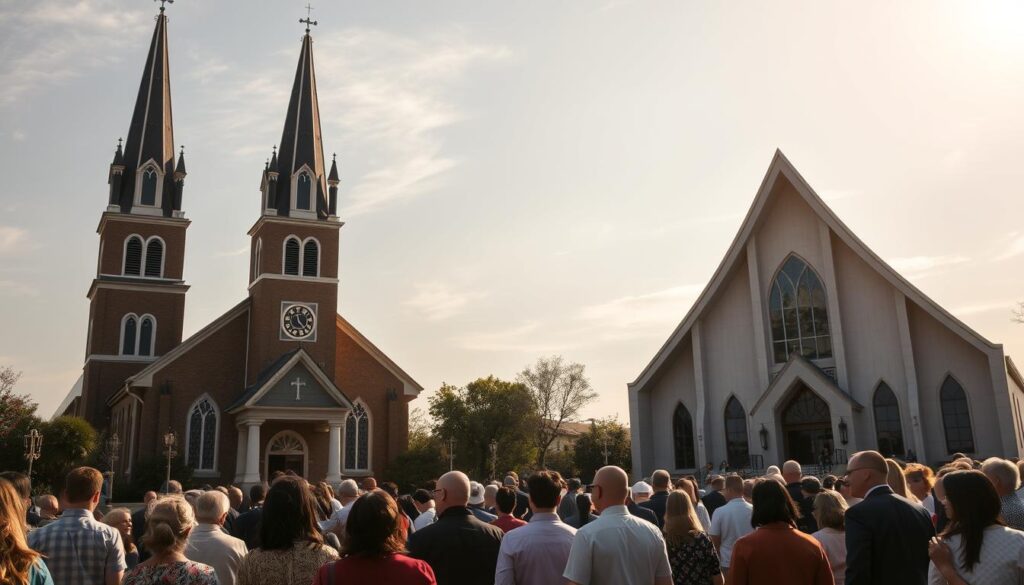
America’s faith communities showcase two distinct approaches to spiritual life. Recent data reveals 26 million members in mainline groups compared to 39 million in evangelical congregations. This shift reflects changing preferences in worship styles and community engagement.
Mainline Versus Evangelical Churches
Mainline denominations like the United Church of Christ and Presbyterian Church (USA) prioritize structured traditions. These groups often:
- Host intergenerational choirs and liturgical services
- Run food pantries and college scholarship programs
- Partner with global networks for humanitarian work
Evangelical communities lean into modern expressions of faith. A pastor in Ohio shares:
“We meet people where they are – whether that’s coffeehouse Bible studies or weekend service projects.”
| Aspect | Mainline | Evangelical |
|---|---|---|
| Worship Style | Traditional liturgy | Contemporary music |
| Community Focus | Social justice initiatives | Personal spiritual growth |
| Membership Trend | Steady/declining | Growing |
Both traditions contribute uniquely to spiritual life. Many modern congregations blend elements – think ancient communion rituals paired with podcast sermons. The United Church of Christ recently launched a popular app combining daily devotions with social activism tools.
Whether drawn to time-honored practices or innovative approaches, seekers find meaningful connections across these denominational lines. Over 60% of millennials report valuing both historical roots and relevant teaching in their faith journeys.
In-depth Look at Protestant Christianity
Diverse expressions of faith define Protestant Christianity’s evolving story in America. This tradition blends rich history with modern relevance, offering spiritual pathways for millions seeking connection.
The Rise of Evangelical Movements
The Second Great Awakening sparked a spiritual revolution that still shapes worship today. At its core lies four pillars: personal conversion experiences, active gospel sharing, deep trust in biblical teachings, and celebration of Jesus Christ’s resurrection. These principles fuel dynamic ministries from urban centers to rural towns.
Modern evangelical groups balance tradition with innovation. Many host interactive Bible studies alongside disaster relief efforts. “Our faith comes alive when we serve others,” explains a youth leader at a thriving evangelical Lutheran church in Minnesota.
Southern Baptist and Other Influences
With 14 million members, the Southern Baptist Convention leads as America’s largest Protestant group. Their focus on scripture and missionary work resonates nationwide. Smaller denominations add unique flavors:
Methodist churches blend structured worship with social justice initiatives. Presbyterian communities emphasize democratic decision-making rooted in Reformed theology. Pentecostal groups like the Assemblies of God attract younger crowds with expressive services.
From storefront chapels to mega-churches, these traditions prove faith remains vibrant across the United States. Their shared commitment to biblical values creates unity within diversity – a hallmark of Protestant Christianity’s enduring appeal.
FAQ
What are the largest Christian denominations in the U.S.?
The Southern Baptist Convention, United Methodist Church, and Roman Catholic Church rank among the largest. Evangelical movements like the Assemblies of God and nondenominational congregations have also grown significantly.
How do mainline and evangelical churches differ?
Mainline groups, such as the Evangelical Lutheran Church in America, often emphasize social justice and historical traditions. Evangelical churches, like many Baptist or Pentecostal congregations, typically prioritize personal faith experiences and biblical authority.
What role did early settlers play in shaping Christianity in America?
Colonists like the Puritans established congregations rooted in Reformed theology. Groups such as the Quakers and Anglicans also influenced regional practices, laying groundwork for religious diversity.
How has Protestantism evolved in modern times?
Movements like the National Association of Evangelicals (1942) and the rise of megachurches reflect shifts toward community-focused worship. Denominations such as the Presbyterian Church (USA) have also adapted to cultural changes.
What cultural impact do Christian churches have today?
Many engage in outreach programs, disaster relief, and advocacy. Organizations like Catholic Charities USA and the Salvation Army blend faith-based values with social services, impacting education and healthcare.
Are newer movements like the Latter-day Saints part of mainstream Christianity?
The Church of Jesus Christ of Latter-day Saints is distinct in doctrine but shares some cultural ties. Most Protestant and Catholic traditions classify it outside historic Christian orthodoxy due to theological differences.