Step into a vibrant spiritual landscape that has guided over 1.25 billion people worldwide. This ancient tradition thrives not through rigid rules, but through its adaptability and celebration of diverse paths to truth. From temple rituals to yoga philosophy, it weaves timeless wisdom into modern life.
What makes this faith unique? Unlike many belief systems, it embraces countless interpretations of the divine. Its teachings span millennia, blending rituals, art, and philosophy into a living tapestry of cultural expression. Followers find meaning in everything from sacred texts to everyday acts of devotion.
Today, this tradition flourishes across continents while maintaining its core principles. Its emphasis on personal spiritual growth creates space for both communal celebrations and individual exploration. Let’s uncover how these age-old practices remain relevant in our fast-paced world.
Key Takeaways
- Third-largest global belief system with over a billion followers
- Embraces diverse philosophies rather than a single doctrine
- Thrives through cultural adaptability across regions
- Integrates spirituality into daily life and decision-making
- Values personal experience over strict dogma
Introduction to Hinduism Religion
At the heart of this spiritual path lies a dazzling array of divine expressions. Brahman, the ultimate reality beyond form, manifests through countless deities that resonate with different aspects of life. From Vishnu’s protective embrace to Shiva’s transformative power, each figure offers unique ways to connect with the sacred.
Devotees might honor Lakshmi for prosperity while seeking Saraswati’s wisdom during exams. This flexibility stems from a core belief: all gods and goddesses reflect facets of one universal truth. Families often maintain home shrines with multiple deity images, celebrating diverse energies under one roof.
Central to daily practice is dharma – the ethical compass guiding actions that sustain cosmic harmony. A shopkeeper following fair pricing or a student studying diligently both live their dharma. This principle weaves spirituality into ordinary moments, making the divine accessible through conscious living.
The tradition encourages personal exploration, whether through chanting to Krishna or meditating on philosophical texts. This inclusive approach allows followers to craft spiritual journeys that align with their nature. As one practitioner notes: “My connection feels as unique as my fingerprint, yet part of something vast.”
Historical Overview of Hinduism
Journey through millennia to uncover how ancient traditions shaped modern spiritual practices. This belief system’s story unfolds across five pivotal periods, each adding distinct threads to its evolving tapestry. From Bronze Age cities to digital-age globalization, its survival through changing eras reveals unmatched adaptability.
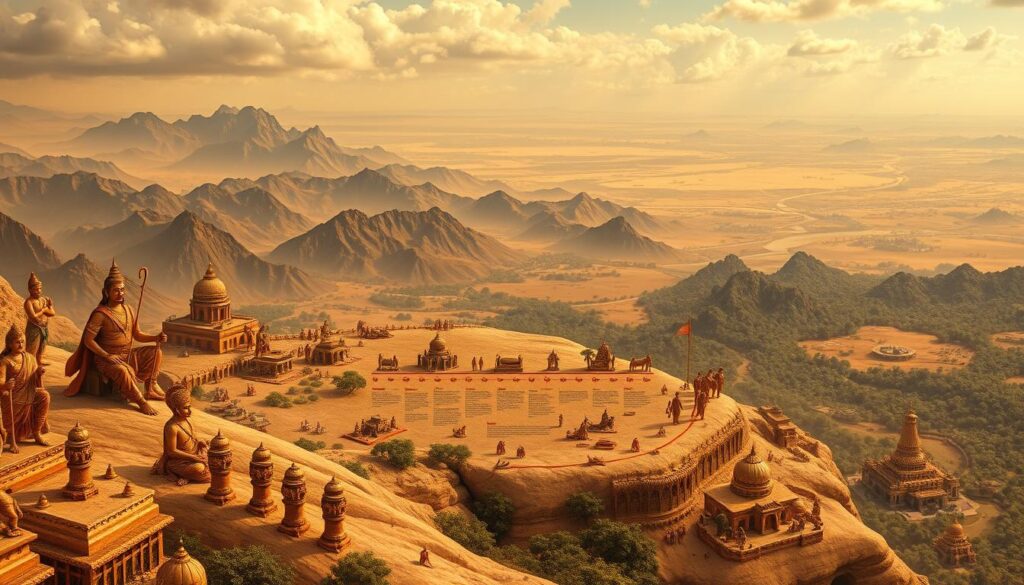
The Indus Valley Civilization (2500-1500 BCE) left mysterious seals suggesting early ritual practices. Over centuries, Vedic chants evolved into philosophical texts that still guide millions. Medieval temple builders and poet-saints created new forms of worship that thrive today.
Colonial rule brought challenges but also sparked creative reinvention. Post-1947, the tradition spread globally while maintaining roots in India. Scholar Dr. Meera Patel notes:
“What survives through time isn’t rigidity, but the art of absorbing ideas while keeping core truths intact.”
Modern practitioners connect with 4,000-year-old concepts through yoga studios and digital temples. This continuity stems from valuing personal experience over fixed doctrines. The history shows a living tradition that grows without losing its essence – like a river gaining tributaries while flowing toward the sea.
Ancient Foundations: The Indus Valley Civilization
Unearth the secrets of one of humanity’s first great urban experiments along the Indus River. Around 2500 BCE, bustling cities like Mohenjo-Daro showcased sophisticated water systems that would impress modern engineers. Multi-story homes featured indoor drains, while covered sewers snaked beneath streets – innovations unmatched for centuries.
Urban Culture and Ritual Bathing
The Great Bath of Mohenjo-Daro reveals ancient priorities. This carefully sealed pool, surrounded by rooms, likely hosted purification ceremonies. Archaeologist John Marshall noted: “The structure’s precision suggests bathing held deep spiritual meaning long before modern traditions.” Nearby wells and bathing platforms hint at daily cleanliness rituals.
Continuities with Later Practices
Terracotta figurines of women adorned with jewelry may represent early goddess worship. A famous seal depicts a cross-legged figure surrounded by animals – some scholars see Shiva’s predecessor. While direct links remain debated, the emphasis on ritual purity clearly echoes in contemporary spiritual practices.
From ceremonial baths to symbolic imagery, these 4,000-year-old discoveries show how ancient culture shaped enduring traditions. The Indus Valley people’s blend of practical urban planning and sacred rituals created foundations that still influence millions today.
The Vedic Period: Formation of Rituals and Texts
Imagine standing at the dawn of spiritual expression where poetic hymns became divine bridges. Between 1500-500 BCE, visionary thinkers crafted the Vedas – four foundational collections that transformed ancient practices. These works blended cosmic wonder with practical guidance, creating templates still used in modern ceremonies.
Composition of the Vedas
The Rig Veda shines as humanity’s oldest poetic masterpiece, with 1,028 hymns celebrating natural forces and cosmic order. Its verses inspired three companion texts: the melodic Sama Veda, the ritual-focused Yajur Veda, and the Atharva Veda’s protective charms. Together, they formed a spiritual toolkit addressing every aspect of life.
Aryan Influence and Migration Debates
Scholars puzzle over how these texts emerged. Some suggest migrating groups brought Sanskrit – an Indo-European language – while others argue for local cultural evolution. Dr. Anika Rao explains: “Whether through movement or mutation, this period reshaped spiritual thought across ancient society.”
Oral transmission preserved these works for 3,000 years before being written down. Families still chant Rig Veda verses at weddings, proving ancient words can carry timeless meaning. This era didn’t just create texts – it built living traditions that adapt while staying rooted.
The Vedic Religion: Sacrifice, Deities, and Cosmology
Fire crackled at the center of ancient rituals that connected earth to the heavens. Vedic practitioners maintained cosmic balance through yajna – sacred offerings poured into flames. These weren’t bloody ceremonies but thoughtful exchanges, with gifts like milk and ghee symbolizing gratitude to divine forces.
Three cosmic realms housed distinct deities governing natural phenomena. Earthly gods included Agni, the fiery messenger carrying prayers upward, and Soma, representing both a sacred plant and divine ecstasy. Above them swirled atmospheric powers like Indra, the thunder-wielding warrior, and Vayu, master of winds.
The highest celestial sphere held cosmic architects like Varuna, enforcer of universal order. Early forms of Vishnu appeared here as the all-pervading force. Scholar David Frawley observes: “This layered universe reflected humanity’s quest to understand life’s mysteries through symbolic relationships.”
Rituals became conversations with nature itself. By honoring different deities through specific offerings, people cultivated harmony between human actions and cosmic rhythms. This intricate system shaped spiritual practices across generations, blending philosophy with daily life.
Upanishads and Philosophical Evolution
Witness a pivotal shift where ancient thinkers traded ritual fires for cosmic inquiries. The Upanishads (1000-200 BCE) transformed spiritual understanding by asking bold questions about existence. These texts revealed a radical idea: the universal essence (Brahman) and individual soul (Atman) are one.
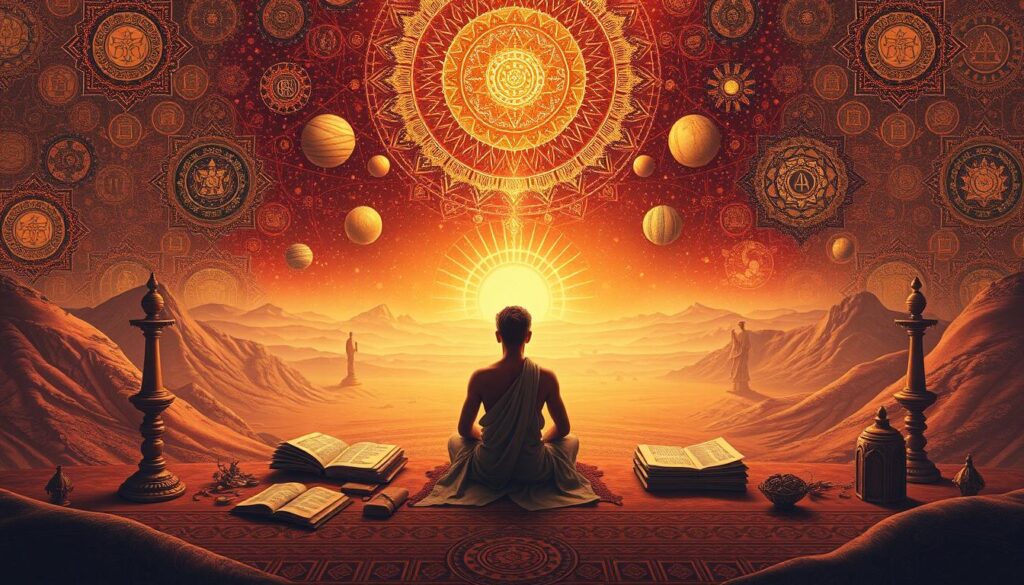
Early verses challenged conventional worship, urging seekers to look inward. A sage declares in the Chandogya Upanishad: “You are what your deep desire drives you to become.” This focus on self-realization reshaped spiritual tradition, blending philosophy with practical wisdom.
The texts introduced two paths: renouncing worldly ties or embracing devotion. Later Upanishads emphasized yoga and loving connection with divine forms. Scholar Dr. Rajesh Rao notes:
“These works don’t just explain reality—they offer tools to experience it.”
| Concept | Early Upanishads | Later Upanishads |
|---|---|---|
| Focus | Cosmic unity | Personal devotion |
| Practice | Meditation | Yoga disciplines |
| Goal | Self-knowledge | Divine connection |
These ideas made dharma more than rules—it became a journey toward truth. Farmers and kings alike found guidance in verses linking daily actions to eternal principles. The Upanishads’ legacy lives wherever seekers ask: “Who am I beyond my roles?”
Medieval Developments: Temples, Devotion, and Poet-Saints
Walls of stone rose to meet the heavens as spiritual energy took physical form. Between 500-1500 CE, communities transformed worship through monumental temple architecture and heartfelt poetic expressions. This era blended artistic genius with deep devotion, creating spaces where politics and spirituality danced together.
Rising Temple Architecture
Giant temples like Puri’s Jagannatha became cosmic diagrams in stone. The Chidambaram shrine celebrated Shiva’s dance, while Tanjavur’s towering vimana reached 216 feet skyward. These structures served dual purposes: homes for deities and symbols of royal power.
Bhakti Movement and Devotional Literature
Poet-saints revolutionized spiritual practice during this time. The Alvars sang ecstatic verses to Vishnu, while Nayanars composed fiery odes to Shiva. A 9th-century verse captures their passion: “I’ll melt into you like honey in milk, O Lord!” Their words made divine love accessible to all.
Chola artisans perfected bronze-casting techniques, creating portable temple icons that still awe viewers today. This period proves spiritual movement thrives when stone and song work together – a lesson etched in India’s cultural memory.
FAQ
How did the Indus Valley Civilization shape early traditions?
Archaeological finds like the Great Bath at Mohenjo-Daro suggest ritual bathing practices similar to modern purification rituals. Artifacts like seals with yogic postures hint at cultural continuities with later spiritual practices.
What role do the Vedas play in shaping beliefs?
The Vedas, especially the Rig Veda, form the foundation of ancient rituals and hymns. They introduced concepts like dharma (cosmic order) and rituals such as fire sacrifices, which remain influential in ceremonies today.
Why is the Bhakti movement significant?
The Bhakti movement, led by poet-saints like Mirabai and Kabir, emphasized personal devotion over rigid rituals. It democratized spirituality, allowing people from all castes to connect with deities through songs and prayers.
Are Indus Valley symbols linked to modern practices?
Symbols like the swastika and pipal tree, found on Indus seals, still hold sacred meaning. These motifs appear in festivals, temple art, and meditation practices, showing enduring cultural connections.
What sparked debates about Aryan migration?
Theories about Aryan influence stem from linguistic similarities between Sanskrit and European languages. However, recent genetic studies and archaeological evidence challenge earlier migration narratives, sparking ongoing discussions.
How did the Upanishads change philosophical thought?
The Upanishads shifted focus from external rituals to inner exploration. They introduced ideas like Brahman (universal soul) and moksha (liberation), shaping schools like Vedanta and influencing texts like the Bhagavad Gita.
Why did temple architecture flourish in medieval times?
Rising devotion to deities like Shiva and Vishnu led to grand temple construction. Sites like Khajuraho and Tanjore became spiritual hubs, blending art, music, and community rituals into sacred spaces.
Do followers worship multiple gods?
While many deities exist, they’re often seen as manifestations of a single divine force. This allows individuals to connect with the divine through forms that resonate personally, like Krishna or Durga.