India’s social fabric has long been shaped by a complex structure that organizes communities through inherited roles. While often simplified as a four-tier hierarchy, this framework actually includes thousands of subgroups with distinct customs. Its roots remain debated, with theories ranging from ancient rituals to colonial-era interpretations.
Scholars emphasize that the actual practice of this structure differs from early religious texts. Families within these groups traditionally shared occupations, marriage rules, and dietary practices. Over time, these distinctions became deeply tied to identity and social status.
What makes this system unique is its regional diversity. Local traditions and historical events created variations across communities. This complexity challenges common stereotypes, requiring a nuanced understanding of how it shaped daily life and cultural values.
Key Takeaways
- Contains over 3,000 subgroups, far more intricate than commonly described
- Origins debated among scholars, with no single agreed-upon theory
- Defined by hereditary roles, marriage rules, and occupational ties
- Varies significantly by region and community traditions
- Continues to influence modern social dynamics globally
Historical Origins and Evolution of the Caste System
Scholars trace complex social structures to early Vedic hymns and rituals. These ancient ideas organized communities through shared duties rather than rigid labels. Over centuries, this framework transformed into a mosaic of localized identities.
Vedic Foundations and the Varna Concept
The Rig Veda first described four broad social categories called varnas. Brahmins (teachers), Kshatriyas (protectors), Vaishyas (producers), and Shudras (supporters) each had distinct roles. Originally, these groups focused on skills, not ancestry—a farmer’s child could become a warrior if talented.
By 500 BCE, texts like the Manusmriti tied varnas to birth. Priests gained prominence through ritual authority, while others faced restrictions. Yet regional customs often overruled these rules, creating countless exceptions.
From Jatis to a Complex Social Structure
Thousands of jatis emerged as communities specialized in trades like weaving or pottery. These subgroups developed unique marriage rules and dietary habits. A blacksmith’s family, for example, might only wed within their occupational network.
Three factors deepened social divisions:
- Strict purity codes governing touch and food sharing
- Endogamy practices preserving family lineages
- Land ownership patterns favoring certain groups
Those labeled “untouchables” faced harshest limits, barred from temples and wells. Their struggles highlight the gap between religious ideals and lived realities.
Colonial Influence and European Misinterpretations
What we call the caste system today reflects colonial-era myths more than ancient realities. British administrators arrived with preconceived ideas about racial hierarchies, determined to fit India’s social diversity into neat boxes.

British Census and the Ethnographic Mapping of Castes
Starting in 1871, officials tried cataloging thousands of communities into four rigid categories. They ignored local identities tied to professions or regions. One frustrated officer noted: “Our classifications bear little relation to how natives describe themselves.”
The 1901 census recorded over 2,300 distinct groups – a number growing with each survey. Colonial rulers leaned on obscure texts like the Manusmriti, which few Indians had read. This created an artificial system unrecognizable to most communities.
Racial Theories and Their Lasting Impact
European scholars spread dangerous myths about “Aryan invaders” establishing a color-based hierarchy. These ideas later fueled Nazi propaganda about racial purity. By 1935, British laws labeled 50 million people as “Criminal Tribes” based on flawed theories.
Three colonial legacies still shape perceptions:
- Freezing fluid social networks into fixed categories
- Linking skin tone to social status through pseudoscience
- Treating ancient texts as rulebooks rather than philosophical works
Modern terms like “Scheduled Castes” originate from this era. Though meant to address inequality, they reinforce colonial influence on how we discuss social structures today.
Religious Beliefs, Dharma, and Social Order
Dharma, karma, and samsara aren’t just abstract ideas—they shape how communities organize roles and responsibilities. These principles form a cosmic blueprint, linking individual actions to societal harmony. As one ancient text states: “A person’s duties arise from their place in the web of existence.”
Karma, Ritual Purity, and the Role of Dharma
Traditional teachings suggest birth circumstances reflect past actions. A farmer’s child, for example, might inherit duties tied to land stewardship. This system enforces strict rules about food sharing and physical contact to maintain ritual purity.
Priests often cite temporary impurities—like mourning periods—to explain lasting social divisions. However, many scholars argue this comparison overlooks systemic inequality. “Comparing menstruation to inherited status ignores centuries of oppression,” notes sociologist Anika Patel.
Renunciation, Initiation, and Social Mobility
Renunciation offers a radical escape route. By symbolically “dying” to their identity, initiates join spiritual communities that ideally disregard birth status. Their rituals mimic funerals, burning possessions to mark rebirth.
In practice, some ascetic groups still observe dietary rules tied to regional customs. A 2018 study found 63% of renunciants in Gujarat avoided foods linked to their former life. This gap between ideals and reality shows how deeply social patterns endure.
Modern Perspectives on hinduism caste and Contemporary Society
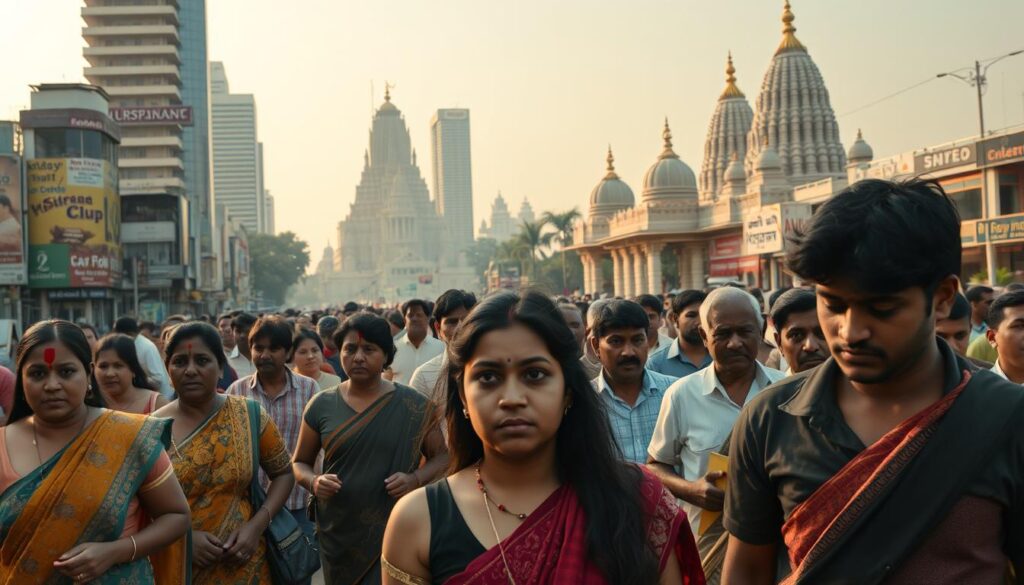
Post-independence India sought to dismantle inherited social barriers through bold legal reforms. The 1950 constitution banned untouchability and introduced reservation policies to uplift marginalized groups. Yet recent data reveals persistent gaps between law and lived experiences.
Legal Protections vs. Daily Struggles
Affirmative action programs opened doors in education and government jobs. Over 27% of parliamentary seats now belong to Scheduled Castes and Tribes. But a 2022 study found Dalit students face 3x higher dropout rates than upper-group peers.
Three key challenges remain:
- Underreporting of violence due to police bias
- Digital discrimination through coded language
- Economic boycotts against inter-caste marriages
Dalit women bear dual burdens—facing 23% wage gaps and higher assault risks. “Legal equality hasn’t erased centuries of stigma,” explains activist Meera Kulkarni.
Global Networks and Shifting Identities
South Asian diaspora communities show surprising patterns. A 2021 survey found:
| Aspect | India | Diaspora |
|---|---|---|
| Workplace Bias | Overt exclusion | Subtle networking favors |
| Marriage Choices | 70% endogamy rate | 45% on matrimonial sites |
| Youth Attitudes | 52% support reforms | 68% reject hierarchy |
While Silicon Valley tech workers rarely discuss lineage openly, community events often mirror regional hierarchies. Second-generation immigrants increasingly challenge these norms through inter-group alliances and social media activism.
Caste, Hindutva, and the Struggle for Reform
Centuries before hashtag activism, spiritual rebels challenged social hierarchies through poetry and radical equality. Their voices still echo in modern efforts to balance tradition with justice.
Revisiting Anti-Caste Movements and Scholarly Critiques
Bhakti poets like Kabir mocked rigid divisions with verses like: “If God lives in temples, who lives outside?” These mystics inspired communities like the Sikhs and Virashaivas to reject birth-based status. Their teachings created parallel spaces where farmers and kings shared meals.
Dr. B.R. Ambedkar’s 1956 conversion to Buddhism sparked mass departures from oppressive structures. Over 500,000 people joined him in a single day, seeking dignity beyond inherited labels. “You cannot build equality on rotten foundations,” he declared, advocating complete systemic overhaul.
| Movement | Approach | Modern Influence |
|---|---|---|
| Bhakti Saints | Poetic ridicule of rituals | Inspires Dalit literature |
| Sikhism | Langar (community meals) | Model for social kitchens |
| Ambedkarites | Mass conversions | Shapes reservation policies |
Recent Hindutva politics often sidesteps these reform roots. While promoting yoga globally, some groups minimize ongoing discrimination. Progressive organizations counter by redefining dharma as collective responsibility. “True spirituality dismantles walls, not builds them,” argues scholar Anjali Rao.
Young activists now blend digital campaigns with temple entry protests. Their work shows that challenging old systems requires both courage and fresh strategies. As caste debates enter global boardrooms and universities, the fight for equality keeps evolving.
Conclusion
Understanding social hierarchies requires peeling back layers of history and human interaction. This framework emerged from a blend of ancient principles and colonial-era classifications, creating divisions that still impact millions. Rather than a fixed structure, it’s a living system shaped by regional customs and power dynamics.
Modern efforts to address inequality show both progress and persistent gaps. Legal protections exist, yet many face daily barriers in education and employment. Women and marginalized groups often bear the heaviest burdens, facing layered discrimination in workplaces and communities.
Hope lies in grassroots movements redefining traditions through shared values. Younger generations increasingly challenge outdated practices while honoring cultural roots. As global conversations grow, the focus shifts from rigid labels to universal rights and dignity for all.
True change demands recognizing this complexity—honoring thousands of unique identities while building bridges across divides. The path forward balances respect for heritage with unwavering commitment to equality.
FAQ
How did ancient texts shape social hierarchy?
Early Vedic literature introduced the concept of varna, a framework that categorized roles based on duties. Over time, this evolved into jati, localized groups tied to occupations, creating a layered social structure.
What role did British policies play in reinforcing divisions?
Colonial administrators used censuses to categorize communities, often oversimplifying identities. This rigid classification, paired with racial theories, deepened societal divides and influenced modern perceptions of identity.
How do religious principles intersect with social roles?
Concepts like dharma emphasized fulfilling one’s duties, while karma linked actions to future outcomes. Ritual purity and initiation practices further defined roles, though movements like Bhakti challenged exclusivity.
Are legal measures addressing inequality effective today?
Affirmative action and anti-discrimination laws aim to uplift marginalized groups. However, biases persist in education and employment, sparking debates about fairness and representation in a rapidly changing society.
Does migration erase traditional divisions?
While global diasporas adapt to new cultures, some communities retain ties to ancestral identities. Intergenerational dialogues and activism continue to reshape these dynamics in multicultural settings.
What challenges do reform movements face?
Advocates push for equitable practices, but resistance from orthodox groups and political ideologies like Hindutva complicate progress. Grassroots efforts and scholarly critiques remain vital in driving systemic change.