Imagine a single event reshaping religion, politics, and daily life across continents. Between 1517 and 1648, Europe experienced exactly this kind of transformation. What began as theological debates evolved into a cultural earthquake that still echoes today.
This period saw ordinary people challenge powerful institutions. New ideas about faith spread like wildfire thanks to the printing press. Individuals began interpreting religious texts themselves rather than relying solely on clergy.
The changes went far beyond church walls. Rulers gained independence from papal authority, laying groundwork for modern nations. Concepts like religious freedom and education reform took root, influencing future democratic values.
Scholars still debate how to define this era. Was it one unified shift or several overlapping movements? How do its principles apply to today’s world? Our exploration will uncover these layers through key events and thinkers.
Key Takeaways
- Lasted from 1517 to 1648, reshaping European society
- Sparked mass literacy through vernacular Bible translations
- Weakened centralized religious authority
- Accelerated development of nation-states
- Influenced modern concepts of individual rights
- Connected to political conflicts like the Thirty Years’ War
Origins and the Medieval Church: Setting the Stage
Centuries before major religious shifts, medieval Europe’s spiritual landscape was tightly controlled by a single institution. The Catholic Church held unmatched sway over daily life, blending spiritual guidance with political muscle. Its hierarchy—from the pope to local bishops—grew wealthy while many ordinary people struggled spiritually.
The Church’s Authority and Medieval Influence
By the 11th century, the Church operated like a divine monarchy. Clergy members often prioritized land acquisitions and luxury over pastoral care. Latin scriptures and rituals created a knowledge gap, leaving laypeople dependent on priests for salvation.
Early Reform Movements and Heretical Voices
Dissenters like the Cathars and Bogomils rejected Church teachings as early as the 7th century. Their calls for simplicity were met with brutal suppression. Later figures took greater risks:
| Reformer | Action | Legacy |
|---|---|---|
| John Wycliffe | Translated Bible to English | Challenged clergy’s exclusive authority |
| Jan Hus | Denounced indulgence sales | Sparkd Hussite Wars after execution |
| Cathar Groups | Advocated poverty | Wiped out by 13th-century crusades |
Wycliffe’s Bible translations and Hus’s fiery sermons proved ideas couldn’t be extinguished. Their courage planted seeds for future transformations.
Martin Luther and the Spark of Change
When a German monk nailed 95 arguments to a church door in 1517, he unknowingly lit a fuse that would reshape Christianity. This act of defiance against church practices became the catalyst for sweeping religious and social transformations.

The Ninety-Five Theses and Diet of Worms
Martin Luther, a theology professor, took issue with Johann Tetzel’s infamous indulgence sales. His Ninety-Five Theses argued salvation came through faith, not payments. “When the coin in the coffer rings, the soul from purgatory springs,” mocked Luther, rejecting Tetzel’s slogan.
Printed copies of his arguments spread like wildfire across Germany. By 1521, church leaders demanded he retract his statements at the Diet of Worms. Luther’s legendary response:
“Unless I am convinced by Scripture… I cannot and will not recant.”
| Year | Event | Impact |
|---|---|---|
| 1517 | Theses Posted | Debate over indulgences begins |
| 1521 | Diet of Worms | Luther excommunicated |
| 1522 | German Bible | Scripture becomes accessible |
The Role of the Printing Press in Spreading Ideas
Gutenberg’s invention became Luther’s greatest ally. Over 200,000 copies of his works circulated by 1525. His German Bible translation sold faster than any previous book, letting ordinary people read scripture themselves.
Print shops worked overtime to meet demand. Pamphlets written in everyday language replaced Latin texts. This ideas revolution created Europe’s first information age, proving knowledge could challenge even the mightiest institutions.
Understanding Protestant Reformation Effects on Religion and Society
What happens when centuries of spiritual tradition get flipped upside down? The 16th-century religious revolution didn’t just alter church services—it rewired how people understood their relationship with divinity and each other.
New Foundations of Spiritual Understanding
Thinkers like Luther and Zwingli turned religious doctrine on its head. They argued sacred texts—not church leaders—held ultimate authority. This “Bible-first” approach let ordinary believers interpret scripture themselves.
Gone were complicated systems of earned forgiveness. Simple faith became the golden ticket. As one reformer put it:
“Grace isn’t something you buy—it’s freely given.”
Power Structures Turned Inside Out
Churches stopped looking like pyramids and started resembling circles. Local congregations gained voice through:
- Elected lay leaders
- Community decision-making
- Shared responsibility
Four main branches emerged from these changes:
| Tradition | Governance Style | Key Feature |
|---|---|---|
| Lutheran | State-linked | Emphasis on education |
| Reformed | Elder-led | Predestination focus |
| Anabaptist | Voluntary membership | Adult baptism |
| Anglican | Monarch-led | Blended traditions |
These shifts didn’t just change Sunday routines. They planted seeds for modern ideas about personal responsibility and group decision-making that would bloom centuries later.
Transformation in Church Practices and Theological Doctrines
Imagine walking into a service where every word feels like a secret code. For generations, this was reality for most Europeans. Religious leaders held exclusive rights to spiritual understanding through Latin rituals—until bold changes turned tradition upside down.
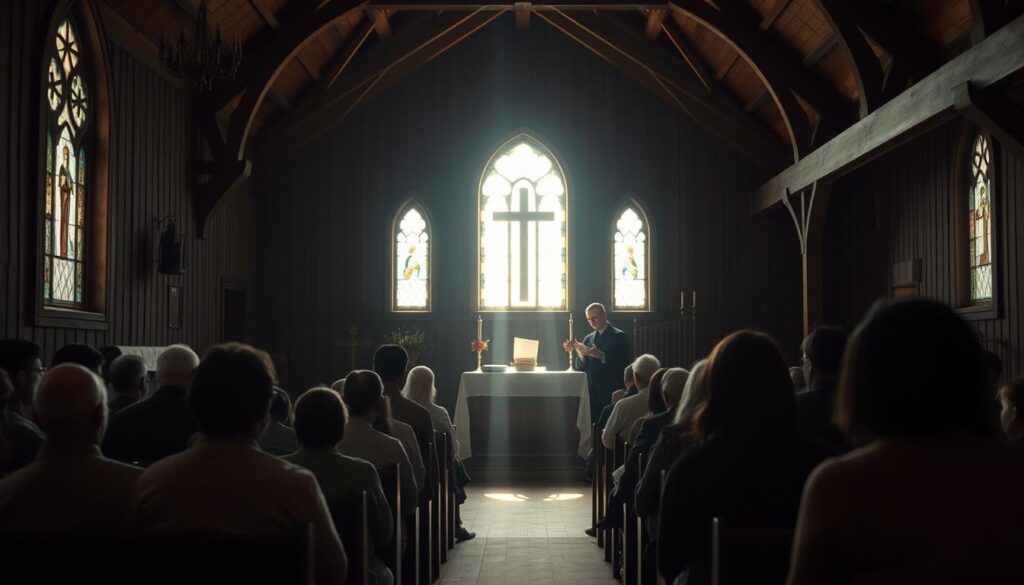
From Latin Mass to Vernacular Worship
The shift to local languages transformed how people connected with faith. Church walls once echoed with Latin phrases few understood. Now, farmers and merchants heard scripture in their mother tongues. A German baker recalled:
“For the first time, I felt God speaking directly to me—not through a priest’s foreign words.”
Communion became a shared experience rather than a divided ritual. Both bread and wine reached congregants’ hands, erasing old hierarchies. Leaders traded ornate robes for simple garments, visually declaring:
- No special status for clergy
- Equal access to sacred practices
- Active participation for all
The Priesthood of All Believers
This revolutionary idea reshaped spiritual relationships. Believers no longer needed mediators to reach divinity. Every person could:
| Old Practice | New Approach |
|---|---|
| Priests interpreting scripture | Personal Bible study |
| Saints as intermediaries | Direct prayers to God |
| Clergy-led rituals | Community-led worship |
The changes sparked debates but also empowered churches to evolve. Hymn singing replaced silent observation, while congregations gained voices in decision-making. These shifts didn’t just alter services—they redefined what it meant to belong to a faith community.
Cultural Shifts: Literacy, Education, and the Arts
Books became bridges between faith and daily life during this transformative time. For centuries, sacred texts remained locked in Latin—a language few understood. That changed when reformers prioritized making scripture accessible to everyone.
Breaking Barriers Through Shared Knowledge
Martin Luther’s German Bible and William Tyndale’s English translation gave ordinary people a direct connection to religious teachings. The printing press turned these works into bestsellers, with Luther’s version outselling all other books of the time.
Literacy rates soared as communities embraced reading. In regions influenced by the protestant reformation, schools taught children using catechisms and Bible stories. What began as religious instruction laid groundwork for public education systems—a lasting development in social progress.
This cultural shift created ripple effects beyond churches. Accessible texts empowered people to think critically and share ideas freely. The protestant reformation didn’t just change beliefs—it rewired how societies learned, creating tools for democracy that still shape our world today.
FAQ
How did the medieval church maintain authority before the 16th century?
The Roman Catholic Church held immense power through its control over religious doctrine, education, and political alliances. It acted as both a spiritual guide and a governing force, influencing laws, taxes, and daily life across Europe.
What role did Martin Luther play in challenging the church?
Luther’s Ninety-Five Theses criticized practices like indulgences, arguing salvation came through faith alone. His defiance at the Diet of Worms in 1521 rejected papal authority, sparking broader debates about religious truth and individual conscience.
Why was the printing press important during this period?
It allowed ideas to spread rapidly. Pamphlets, translations of the Bible (like Luther’s German version), and critiques of the church reached wider audiences, empowering ordinary people to engage with theological debates.
How did beliefs about salvation change after the Reformation?
Many reformers rejected the idea that good works guaranteed salvation. Instead, they emphasized personal faith and direct engagement with scripture, shifting focus from institutional rituals to individual spiritual relationships.
What changes occurred in how churches were governed?
Local rulers and congregations gained more control, reducing reliance on the pope. For example, Henry VIII established the Church of England, while Lutheran regions let princes oversee religious matters, decentralizing authority.
Why did worship services shift from Latin to local languages?
Using vernacular languages like German or English made rituals accessible to everyday believers. This change reinforced the idea that faith should be understood and practiced personally, not just through clergy.
What does “priesthood of all believers” mean?
This teaching suggested every individual could connect with God without needing a priest as an intermediary. It encouraged laypeople to read scripture and take active roles in their spiritual lives.
How did the Reformation influence education and literacy?
Translating the Bible into common languages motivated people to learn to read. Schools expanded to teach scripture, and literacy rates rose, particularly in regions adopting reformed teachings.
Did the Reformation lead to political conflicts?
Yes. Tensions between Catholic and Protestant states fueled wars like the Thirty Years’ War (1618–1648). These conflicts reshaped borders, power structures, and the relationship between religion and governance.