For nearly five centuries, one religious order has shaped global education, spirituality, and social justice. Founded in 1534 by St. Ignatius of Loyola, the Society of Jesus (S.J.) stands as a unique force within the Roman Catholic tradition. With papal approval granted in 1540, this community of clergy and brothers became renowned for blending deep spiritual practice with active engagement in the world.
What makes this group distinct? Members take a special fourth vow of obedience to the Pope alongside traditional commitments. Their approach emphasizes finding divine purpose in everyday life – a philosophy that fueled groundbreaking work in universities, scientific exploration, and cultural exchange. Over 17,000 members now serve across six continents, addressing modern challenges from environmental crises to educational inequality.
The order’s influence reached new heights in 2013 when Cardinal Jorge Mario Bergoglio became the first S.J. member elected as pontiff. Pope Francis’ leadership reflects core values like compassionate service and intellectual rigor. From 16th-century mission fields to today’s interfaith dialogues, this society continues evolving while maintaining its founding vision.
Key Takeaways
- Founded in 1534, the Society of Jesus gained papal approval as a Roman Catholic religious order in 1540
- Members take a unique fourth vow of obedience to the Pope in addition to traditional religious commitments
- Pioneered global education systems and contributed significantly to scientific and cultural development
- Current membership exceeds 17,000 worldwide, operating schools, charities, and social justice initiatives
- Pope Francis became the first Jesuit-elected pontiff in 2013, highlighting the order’s ongoing influence
- Balances spiritual contemplation with active problem-solving in modern societal challenges
Origins and Founding of the Jesuit Order
The story of the Jesuit Order begins with a cannonball and a broken leg. In 1521, Iñigo López – later known as St. Ignatius of Loyola – lay wounded during Spain’s battle for Pamplona. This soldier‘s shattered leg became the catalyst for one of history’s most remarkable spiritual transformations.
St. Ignatius of Loyola’s Transformation
During months of painful recovery, the once-ambitious nobleman discovered religious texts that sparked a profound conversion. His military mindset shifted to spiritual strategy, developing what would become the Spiritual Exercises – a four-week prayer program still used worldwide.
The Birth of the Spiritual Exercises
Ignatius’s journey led him to the University of Paris in 1528. There, he gathered six companions through shared vision and his groundbreaking retreat method. On August 15, 1534, these men vowed poverty, chastity, and pilgrimage in a small chapel – planting seeds for global impact.
When travel to Jerusalem proved impossible, the group pledged loyalty to the Pope. This flexibility became their superpower. Pope Paul III’s 1540 approval formalized their mission, turning seven idealists into what would grow into a 17,000-strong force for education and social justice.
Fundamentals of Jesuit Catholicism and Its Timeless Mission
At the heart of this religious community lies a unique blend of ancient traditions and modern adaptability. Members dedicate their lives to serving through three sacred promises while embracing a groundbreaking fourth commitment that fuels their global impact.
Core Values and Lifelong Vows
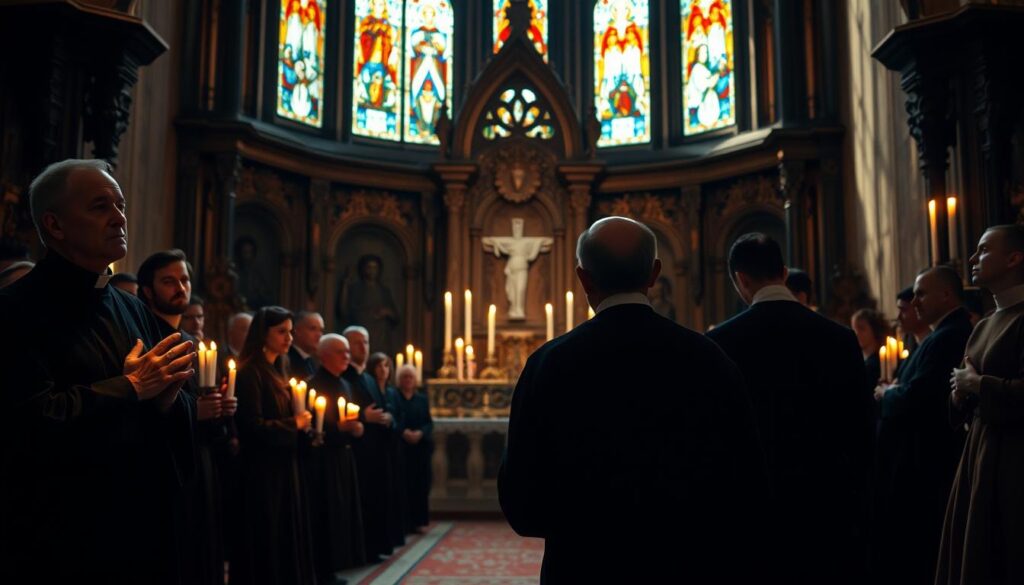
Every member takes three binding vows: poverty (sharing resources), chastity (emotional focus on service), and obedience (alignment with spiritual leaders). What makes them distinct? A special fourth promise to accept missions from the Pope without hesitation.
Commitment to Global and Apostolic Work
This structure allows rapid response to emerging needs. A Superior General oversees operations for life, maintaining unity across 83 countries. Members might teach physics in Chicago one year and establish clean water systems in Malawi the next.
| Traditional Vows | Jesuit Addition | Practical Impact |
|---|---|---|
| Poverty, Chastity, Obedience | Papal mission readiness | Immediate crisis response |
| Lifetime commitment | 10+ years of training | Expertise in multiple fields |
| Personal devotion | Community gradation system | Tailored team deployments |
Their formation process lasts longer than medical school – up to 15 years of study and service. This prepares members to address complex challenges through both prayer and practical skills. As one priest explains: “We don’t choose between faith and science – we use both to heal the world.”
Missionary Work and Educational Innovations
Within decades of its founding, a network of schools and missions spanned from Europe to Asia. This dual focus on spiritual outreach and intellectual growth created lasting impacts still felt today. Their approach blended cultural understanding with practical learning, setting a new standard for global engagement.
Expanding the Reach Across the Continents
Just months after the order’s establishment, St. Francis Xavier embarked on a historic journey to Asia. By 1556, over 1,000 members taught, preached, and built communities across three continents.
These early missionaries learned local languages and customs, earning trust through collaboration rather than conquest. In North America, Indigenous communities called them “Black Robes” – a term reflecting both their distinctive attire and respected status. Their work laid foundations for intercultural dialogue that continues in modern social justice efforts.
Pioneering Curriculum and School Networks
When most children lacked access to schooling, these educators built institutions emphasizing “the whole person.” Their revolutionary curriculum mixed classical studies with mathematics and science – unheard of in 16th-century Europe. One teacher noted: “We don’t just fill minds; we ignite curiosity that serves communities.”
Today, nearly 200 universities and 800 secondary schools worldwide continue this legacy. Alumni include 35 Nobel laureates and leaders like Canadian Prime Minister Pierre Trudeau. Modern programs stress ethical leadership, with 94% of U.S. Jesuit school graduates volunteering regularly – proof that centuries-old values still shape tomorrow’s problem-solvers.
Navigating Controversies and Modern Challenges
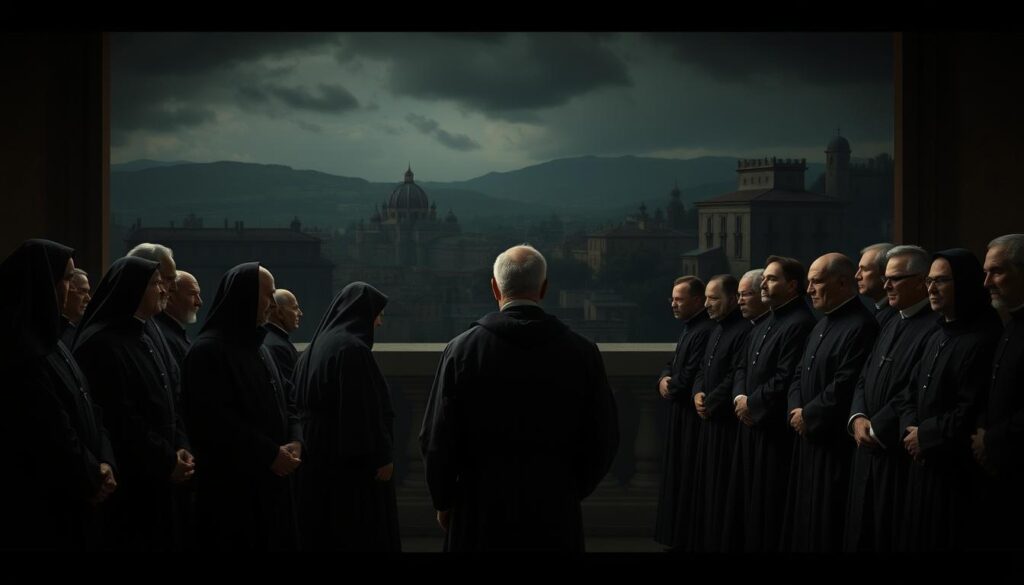
History often tests institutions through fire – and the Society of Jesus faced its trial by flames in the 18th century. Political tensions led European powers to expel members from their territories, starting with Portugal in 1759. France banned the order five years later, while Spain removed all members within 24 hours in 1767.
Historical Suppressions and the Re-establishment
In 1773, Pope Clement XIV dissolved the organization under royal pressure. Only Russia’s Catherine the Great defied the decree, sheltering priests who continued their work. This 41-year suppression – called “the dark time” – shuttered 800 schools and halted missionary efforts across continents.
The society rebounded in 1814 when Pope Pius VII restored it. Members rebuilt networks with remarkable speed. By 1900, they operated 500 colleges globally. One historian notes: “Their comeback reshaped modern education more than their initial founding.”
Addressing Controversial Legacies and Reconciliation Efforts
Recent research uncovered painful truths. Archives reveal some members enslaved over 200 people in 18th-century Maryland plantations. The order now partners with descendant communities through reparations and oral history projects.
Like other Catholic groups, they confront abuse allegations against some priests. Current leaders have implemented strict screening processes and victim compensation funds. A spokesperson states: “We’re repairing trust through transparency – it’s work measured in decades, not years.”
These efforts show how centuries-old institutions can acknowledge past harms while forging new paths. From classrooms to courtrooms, the order continues adapting its methods to serve modern needs.
Jesuit Contributions to the Arts, Sciences, and Community Service
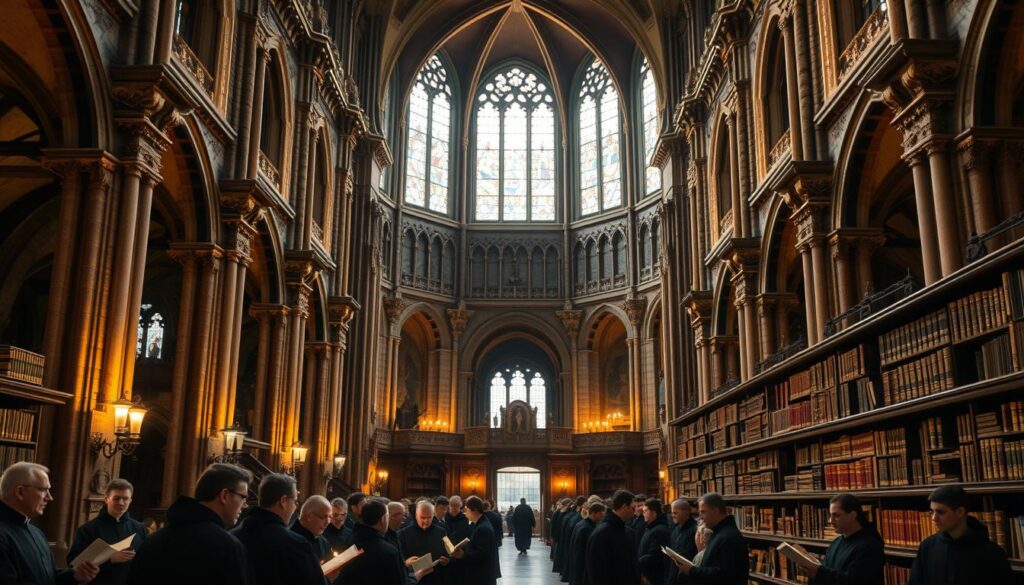
What do celestial maps and South American rivers have in common? Both bear marks of a society that’s shaped human knowledge for five centuries. Members of this order charted unknown lands while mapping stars above, blending spiritual purpose with scientific rigor.
Scientific Endeavors and Cultural Impact
Sixteen asteroids and 34 moon craters honor astronomers from the Society of Jesus – pioneers who tracked comets and measured planetary motion. Their works include the first detailed surveys of the Amazon River and locating the Blue Nile’s source. One 18th-century member quipped: “Our telescopes point upward, but our feet walk earthly paths.”
This dual focus thrives today. Modern scholars develop earthquake prediction models and preserve endangered languages. Their approach? Education that turns discoveries into tools for communities. Over 70% of their universities now offer environmental science programs tackling climate change.
| Scientific Field | Historic Contribution | Modern Impact |
|---|---|---|
| Astronomy | Lunar crater mapping | Space weather research |
| Geography | Amazon basin surveys | GIS disaster response |
| Community Service | Colonial-era hospitals | Refugee legal aid clinics |
Beyond labs and lecture halls, their students and mentors serve marginalized groups worldwide. Prison literacy programs in Chicago mirror typhoon relief efforts in Manila. A current volunteer shares: “We don’t ask who needs help – we ask how to walk beside them.”
From Baroque-era art studios to digital media traditions, creative expression remains vital. Alumni networks include Pulitzer winners and public policy leaders – proof that nurturing minds and hearts changes the world.
Jesuit Influence
Global impact often starts with small, dedicated groups creating ripples across societies. The Society of Jesus exemplifies this truth, shaping thought leaders and community builders for nearly 500 years. Their approach combines intellectual rigor with compassionate action – a formula that transforms classrooms and neighborhoods alike.
Modern universities bearing their legacy produce Nobel laureates and social entrepreneurs. Over 90% of their U.S. graduates report ongoing volunteer work, proving education’s power to inspire service. From climate change initiatives to refugee support programs, their institutions tackle pressing global issues.
Pope Francis’ leadership showcases their values in action. As the first pontiff from this tradition, he emphasizes mercy over judgment and dialogue over division. His environmental encyclicals mirror the order’s long-standing focus on ecological responsibility.
Recent projects bridge faiths and disciplines. Interreligious councils in Chicago partner with Muslim and Jewish leaders on housing solutions. Tech hubs in Silicon Valley explore ethical AI development, blending ancient wisdom with modern innovation. “True influence,” one educator notes, “isn’t about power – it’s about empowering others.”
FAQ
Who founded the Society of Jesus?
St. Ignatius of Loyola, a former soldier, established the order in 1540 after his spiritual awakening. His experiences during recovery from battle injuries inspired his lifelong dedication to faith and service.
What are the Spiritual Exercises?
Developed by St. Ignatius, these are structured meditations and prayers designed to deepen one’s relationship with God. They remain central to the order’s spiritual training and personal reflection practices.
How do members commit to their mission?
They take vows of poverty, chastity, and obedience, along with a special pledge to follow the pope’s directives. Their work prioritizes education, social justice, and addressing global inequalities.
Why are schools linked to this tradition?
Since the 16th century, the order has emphasized education as a tool for empowerment. Institutions like Georgetown University and Loyola schools blend academic rigor with ethical leadership development.
Was the order ever disbanded?
Yes, Pope Clement XIV suppressed it in 1773 due to political pressures. It was restored in 1814 by Pope Pius VII, allowing its global missions and educational projects to flourish again.
What scientific contributions are tied to their history?
Members advanced fields like astronomy, cartography, and linguistics. Figures like Matteo Ricci bridged European and Asian cultures, while others established observatories and universities worldwide.
How does the order address past controversies?
Leaders like Pope Francis have openly acknowledged historical missteps, particularly in colonial contexts. Efforts include dialogues, reparative justice, and prioritizing marginalized voices in modern ministries.
What role do they play in today’s world?
From refugee advocacy to climate action, the community focuses on contemporary challenges. Their institutions promote interfaith collaboration and innovative solutions grounded in ethical traditions.