Ready for a clear, friendly roadmap that lays out what unites Christians and where traditions diverge? This piece starts by naming shared anchors: belief in the Trinity, the virgin birth, the sinless life, and the resurrection of Jesus Christ.
Then we preview the main differences so readers can answer the common question of how to choose a spiritual home. Expect plain-language explanations of authority, worship, and weekly life in each community.
We will compare leadership lines and hierarchy, sacraments versus ordinances, prayer practices, and how people understand salvation and assurance. The aim is practical: show what you will encounter each week and why those practices matter in daily faith.
Fair, respectful, and helpful, the article lays out both sides without judging. By the end, you’ll see where traditions share core beliefs and where ritual, structure, and community life shape different paths of devotion.
Key Takeaways
- Both traditions affirm core Christian beliefs like the Trinity and the gospel.
- Leadership and authority differ: apostolic succession and hierarchy vs. congregational independence.
- Sacraments (Eucharist, confession) contrast with ordinances (baptism by immersion, symbolic Lord’s Supper).
- Prayer and saintly intercession versus direct prayer to God shape daily devotion.
- Practical focus helps people decide which side fits their beliefs and family needs.
Understanding the Debate: What People Mean by “catholic church vs baptist” Today
When people search the name of each tradition, they usually want practical answers: what happens on Sunday, who leads, and how the Bible shapes teaching. This question often comes from families deciding where to spend their free time and how to raise children in faith.
The debate centers on authority and weekly life. One side entrusts teaching to a formal hierarchy and a set liturgy with seven sacraments. The other emphasizes local leadership, two ordinances, and the Bible as the final rule.
Visitors notice differences in worship right away. One service follows scripted prayers, readings, and a set calendar. The other features expository preaching, congregational singing, and ordinances set by the local congregation.
Why compare now? People move, marry, or seek stronger discipleship. History matters in how each group preserves doctrine, but motivations are often practical and relational: family worship, pastoral care, and guidance during major life events.
- Teaching: homilies and catechesis tied to ritual vs sermons and local discipleship.
- Experience: scripted liturgy vs flexible service formats.
- Shared goal: both aim to help people follow Jesus in daily life.
Origins and Authority: From Apostolic Succession to Congregational Autonomy
How a faith traces its roots affects how people choose and trust their leaders today. Clear lines of authority shape worship, teaching, and how disputes get settled.
Roman leadership, centuries of continuity, and the pope’s role
The catholic church traces a line of leadership back to the apostles. For centuries bishops have carried authority, with the pope serving as a global head.
The hierarchy — pope, cardinals, archbishops, bishops, and parish priest — guides teaching through the Magisterium. This links tradition and the word to keep doctrine consistent across many churches.
17th‑century beginnings, local autonomy, and the priesthood of all believers
Baptist groups began in the 1600s with a focus on local congregational rule. Each congregation calls its leaders and governs its life without an outside hierarchy.
Pastors lead by preaching and pastoral care. The priesthood of all believers means members share spiritual responsibility and practical decision making.
Practical contrasts
- Authority flow: centralized hierarchy vs local voting and oversight.
- Leader selection: ordained sacramental orders vs congregational call and affirmation.
- Decision speed: diocesan guidance offers unity; autonomy allows quick local response.
| Feature | Central Model | Local Model |
|---|---|---|
| Historic roots | Apostolic succession across centuries | 17th‑century emergence and reform |
| Hierarchy | Pope → bishops → priests | Congregation → pastors → deacons |
| Teaching authority | Magisterium links tradition and Scripture | Local interpretation of the word by leaders and members |
| Decision making | Diocesan guidance shapes parishes | Churches vote on budgets and programs |
Both models aim to preserve apostolic faith, yet they organize leaders and accountability in different ways. Understanding these differences helps readers see why worship and governance feel distinct from one congregation to another.
How Salvation Is Understood: Faith, Works, Grace, and Assurance
At the center of many searches is a simple question: how does one enter eternal life?
Catholic view: sacraments, cooperation with grace, and purgatory
Salvation is described as a grace-filled journey that begins in baptism and continues through the sacraments. Catholics believe grace invites a person to respond with faith and loving works.
Confession, Eucharist, and anointing are seen as means that forgive sins and strengthen holiness. Purgatory is taught as merciful purification for those not fully ready for heaven at death.
Baptist view: salvation by faith alone and eternal security
Many Baptists teach that salvation arrives the moment a person trusts Christ. Assurance comes from the Spirit’s witness and God’s promise.
Good works follow as evidence, not the cause, of saving faith. Communion symbols like bread and wine are memorials, affirming Christ’s body given once for all.

| Topic | Grace & Means | Assurance |
|---|---|---|
| Baptism | Beginning of life in grace (sacramental) | Part of ongoing life in grace |
| Role of works | Cooperation with grace, evidence of holiness | Fruit of genuine faith, not a wage |
| Final state | Purgatory as purification; heaven and hell real | Immediate entrance to heaven if truly saved; heaven and hell real |
Both traditions agree all people are sinners, that Jesus the God‑man saves, and that prayer, repentance, and hope for heaven matter deeply.
Scripture, Tradition, and Teaching Authority
Where people turn for final answers—Bible, tradition, or leaders—matters for faith life.
Bible canon differences
One major historical difference is the canon. Many Catholic editions include seven Deuterocanonical books not found in most Protestant Bibles: 1–2 Maccabees, Tobit, Judith, Sirach, Wisdom, and Baruch.
Why it matters: those books shape devotional reading, liturgy, and some teaching about prayer for the dead and history.
Who interprets the word
Catholics believe doctrine flows from Scripture and Sacred Tradition together. Bishops in union with the pope serve as the Magisterium to interpret the word in line with church history.
In contrast, many Baptist churches hold to sola Scriptura: the Bible is the final rule and pastors equip believers to read and apply it.
| Feature | Authority Model | Practical effect |
|---|---|---|
| Canon | Includes Deuterocanonical books | Broader liturgical readings; influences doctrine |
| Interpretive body | Magisterium (bishops and pope) | Unified teaching, lectionary, catechism |
| Local practice | Guided by Tradition and clergy | Catechesis and priest-led study |
| Local governance | Sola Scriptura with pastors and elders | Expository preaching and congregational study |
Saints and early councils have weight within Tradition, while other churches value their insight without granting binding authority.
Bottom line: both models aim to preserve the gospel and shape unity, but they differ on who has the final interpretive responsibility. That choice changes preaching, catechesis, and how people study Scripture in daily life—affecting teaching about salvation and communal form.
Worship and Prayer: Directly to God, Intercession of Saints, and Use of Images
How congregations pray and display symbols reveals deep convictions about mediation and devotion.
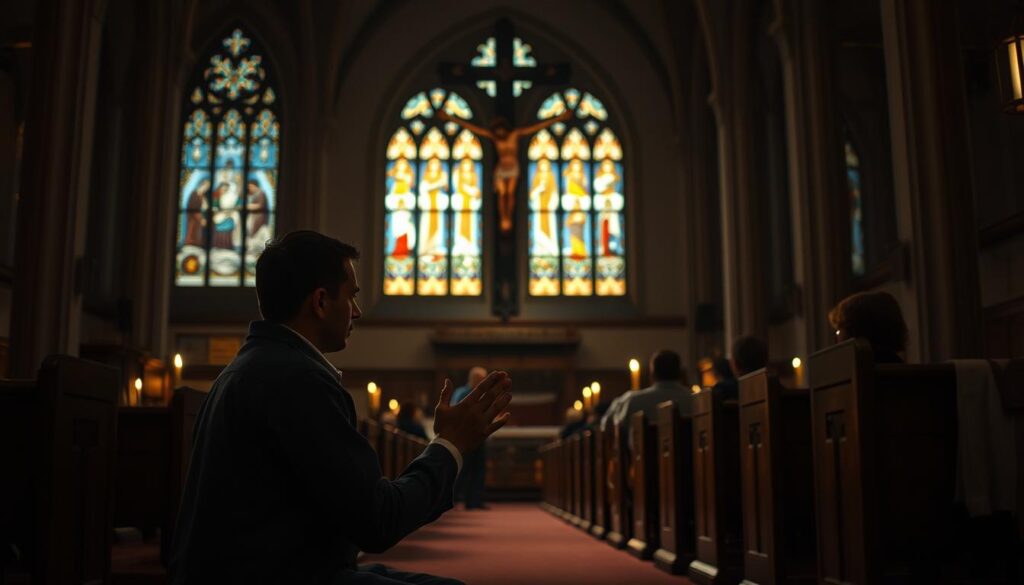
Confession and private prayer
One tradition encourages believers to bring their sins straight to God in personal prayer. Scripture passages like 1 Timothy 2:5 are often cited to support praying directly to God in Jesus’ name.
In contrast, another practice asks a person to confess to a priest who offers absolution and may set penance. Both aim to restore relationship and encourage daily repentance.
Mary, the saints, and intercession
Some members ask the saints to intercede as friends who pray for the living. Proponents say this multiplies prayer and connects believers with the holy.
Others object, stressing one mediator and urging that all prayers go directly to God. That difference shapes private devotions and family instruction.
Crosses, crucifixes, and sacred art
One group uses crucifixes and statues to focus the heart on Christ’s sacrifice; another favors an empty cross or no images to avoid confusion between honor and worship.
| Practice | Purpose | Common form |
|---|---|---|
| Confession | Restore relationship | Private prayer or confession to priest |
| Intercession of saints | Ask for support in prayer | Liturgical petitions and devotions or avoided |
| Images | Lift minds to heavenly realities | Crucifix/statues or plain symbols |
Pastoral note: both traditions guard the power of habit in worship, aiming to direct each person’s heart toward love of God and neighbor.
Rites and Ordinances: Eucharist/Communion, Baptism, and the Role of a Priest
Practices at the altar and at the font show deep theological differences and a shared desire to honor Christ. These rites shape weekly life, spiritual formation, and how communities call people to belong.
Transubstantiation versus symbolic remembrance
What happens at the altar: In one tradition, a priest consecrates bread and wine so that their inner reality becomes the body and blood of Christ while the outward form stays the same. This understanding ties Holy Communion to sanctifying grace and ongoing forgiveness of sins.
By contrast, many congregations treat the Lord’s Supper as a memorial. The bread and cup symbolize Christ’s body and blood and call the community to remember His once-for-all sacrifice. The elements remain unchanged in form.
Baptismal form and timing
Infant baptism typically uses pouring in the name of the Trinity to initiate a child into the church. This marks sacramental belonging and starts catechesis.
Other groups baptize only those who profess faith, by full immersion. This public act testifies to personal repentance and union with Christ.
| Rite | Practice | Spiritual effect |
|---|---|---|
| Communion | Consecrated by ordained priest; weekly celebration | Conveys grace; remembers Christ’s sacrifice |
| Lord’s Supper | Ordained pastor or elders lead; periodic memorial | Symbolic remembrance; community proclamation |
| Baptism | Infant pouring in Trinity’s name | Initiation into sacramental life |
| Believer’s Baptism | Full immersion after profession of faith | Public testimony and covenant membership |
Role of ordained men: A priest administers sacraments in one model, while pastors guide ordinances without claiming sacramental change. Pastoral preparation—First Communion catechesis or membership classes—prepares people for full participation.
Both traditions aim to honor Christ’s command to remember His body and His blood, even as they disagree about what the rites accomplish and how they form community over time.
Leadership, Liturgy, and Everyday Life in the Churches
Leadership, service patterns, and weekly routines shape what members expect and how they spend their time.
From structured hierarchy to congregational governance
In one model, parishes are led by a priest who reports to a bishop. That line of authority affects how decisions are made and how ministries are staffed.
In the other model, pastors lead alongside deacons with authority granted by the local congregation. Committees and votes set budgets and direction.
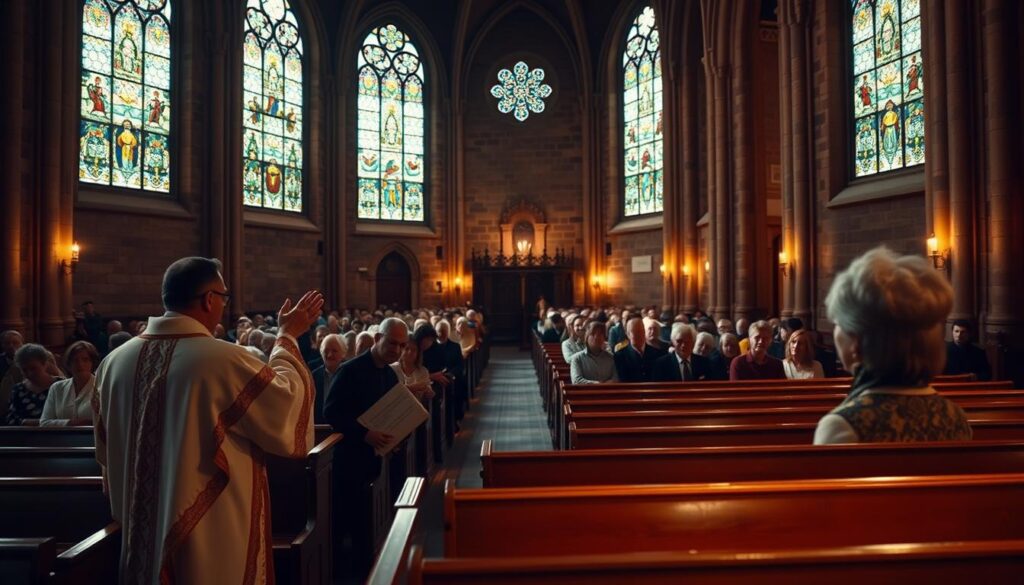
Weekly rhythms and member participation
Mass follows a global calendar with set readings, prayers, and sacraments. Music often centers on hymns, psalms, and choral settings.
Services in many congregations are shaped by sermon series, congregational singing, and locally scheduled ordinances. Music ranges from traditional hymns to gospel-influenced praise.
“Leaders shape the season; weekly habits form disciples.”
Discipleship, care, and accountability
Both models invest in formation across every age. Parishes run sacramental prep and catechesis for children and teens.
Local congregations offer children’s, student, and adult classes aimed at Bible study and mission. Pastoral care appears as anointing and visitation in one setting, and counseling and practical support in the other.
| Area | Structured Model | Congregational Model |
|---|---|---|
| Leaders | Priest under bishop | Pastor with deacons |
| Members | Participate in liturgy and sacraments | Vote, join Bible studies, serve locally |
| Weekly life | Mass with set prayers and readings | Service shaped by sermon and local needs |
| Prayer | Set liturgical prayers and fixed devotions | Spontaneous intercession and prayer meetings |
Bottom line: different structures change how people practice faith, but both aim to form mature disciples whose daily life reflects love and holiness.
catholic church vs baptist: Side‑by‑Side Differences That Matter Most
This side‑by‑side snapshot highlights the practical choices people face when picking a faith community. The goal is to show clear contrasts so a person can make an informed decision about belonging.
Authority and leaders
Hierarchy model: a pope, bishops, and priests provide unified teaching and oversight across centuries of history.
Local model: pastors, deacons, and voting members govern each congregation with local accountability and faster decisions.
Identity and tradition
One side often speaks of a single visible body claiming unity and continuity. The other sees itself as part of a family of churches that share beliefs but keep autonomy.
Worship forms and seasons
Traditional practice keeps Lent, sacramental confession, weekly Eucharist, the use of crucifixes, and veneration of saints.
Simple forms center on preaching, ordinances, an empty cross, and sermon‑driven services. Views on salvation, purgatory, the body and wine at communion differ accordingly.
| Feature | Central Model | Local Model |
|---|---|---|
| Leaders | Pope → bishops → priests | Pastors → deacons; members vote |
| Identity | One universal body with long history | Network of denominations and local churches |
| Worship | Liturgy, sacraments, seasons | Sermon, ordinances, flexible form |
| Scripture & Tradition | Includes Deuterocanonical books; Magisterium guides | Sola Scriptura; congregational interpretation |
| Salvation & devotion | Process with sacraments; may include purgatory | Faith moment with ongoing discipleship |
“These differences shape weekly life more than they change shared belief in Christ.”
Conclusion
Choosing where to belong matters. Many people want a place where jesus christ is central, sin is named, and salvation is offered as hope. Both traditions call men and women to repent from sins and trust Jesus for new life.
Think about how your faith grows in practice: through sacramental rhythms in the catholic church or Scripture‑centered preaching in a baptist church. Both teach that heaven and hell are real and urge a present response to the gospel.
Visit services, read the Gospels, study the word, and talk with pastors or priests. Prayer, honest questions, and time will help you find a community that strengthens your trust in jesus christ, shapes daily life, and points you to God’s power for change.
FAQ
What are the main differences between the two traditions in authority and leadership?
One tradition emphasizes a centralized hierarchy with the pope, bishops, and ordained priests who teach and govern. The other stresses local congregation autonomy, with pastors and deacons chosen by members and a stronger emphasis on the priesthood of all believers.
How do their views on salvation and assurance differ?
One body teaches that grace operates through sacraments and good works, with a concept of purification after death in some teachings. The other tradition typically holds that salvation comes by faith alone in Jesus Christ, often with an emphasis on assurance of eternal life for true believers.
Do both recognize the same books of the Bible?
No. One tradition includes additional Deuterocanonical books in its Old Testament canon, while the other follows the Protestant canon without those extra books.
Who interprets Scripture and settles doctrinal disputes?
In one system, a teaching authority grounded in tradition and magisterial interpretation guides belief. The other leans on sola Scriptura—Scripture as the final authority—with interpretation often happening at the congregational or denominational level.
How do prayer and intercession practices compare?
One practice includes confession to ordained ministers and seeking the intercession of saints and Mary, alongside personal prayer to God. The other emphasizes direct prayer to God, discouraging prayer to saints and promoting personal confession and repentance.
What about images, crosses, and religious art in worship spaces?
One tradition commonly uses crucifixes, statues, and icons as aids to devotion and teaching. The other prefers simpler symbols like a plain cross and avoids statuary or images that might distract from direct worship.
How do they differ on the Lord’s Supper and the nature of Communion?
One teaching holds that the elements become the real presence of Christ by sacramental action. The other views the meal primarily as a symbolic remembrance of Christ’s sacrifice, focusing on memorial and proclamation.
What are the contrasting practices for baptism?
One tradition practices infant baptism by pouring or sprinkling and sees it as initiation into the faith community. The other reserves baptism for professing believers, typically by full immersion, as a public testimony of personal faith.
How does daily and seasonal worship life differ?
One pattern includes liturgical seasons—Advent, Lent, and sacraments regularly celebrated within a set liturgy. The other often favors less formal services, with variable worship styles and fewer prescribed seasons.
Are there shared beliefs despite these differences?
Yes. Both affirm belief in Jesus Christ, the need for repentance from sin, the authority of Scripture in core matters, prayer, and the goal of life transformed by faith. Many moral teachings and central doctrines overlap even where practice and emphasis diverge.
How do these groups view saints and historical tradition?
One honors saints, uses their lives as models, and integrates centuries of tradition into teaching. The other respects historical figures but generally rejects praying to saints and prioritizes direct relationship with God and Scripture-centered tradition.
What should someone consider when choosing between them?
Consider how you view authority, sacramental life, liturgy, the role of tradition, and personal assurance in faith. Attend services, speak with leaders, and read both teachings to see which aligns with your convictions and spiritual needs.