Welcome to your guide to one of Christianity’s most influential traditions. Born during the 16th-century Reformation, this faith grew from humble German roots into a global church with over 80 million followers. Today, it stands as the third-largest Protestant movement worldwide, shaping spiritual practices and communities across cultures.
At its core, this tradition emphasizes grace through faith as the foundation of salvation. Unlike other denominations, its teachings focus on Scripture as the ultimate authority while valuing sacraments like baptism and communion. These principles unite people across continents, creating a shared identity rooted in 500 years of theological heritage.
From education to social ethics, its impact stretches far beyond Sunday services. Many American universities and charities trace their origins to its values. Whether you’re exploring your faith or simply curious, understanding these basics offers insight into a belief system that continues to shape modern Christianity.
Key Takeaways
- Originated during the Protestant Reformation in 16th-century Germany
- Third-largest Protestant group globally with 80 million members
- Teaches salvation through grace and faith, not deeds
- Scripture and sacraments form central worship practices
- Influenced Western education, culture, and social systems
Overview of Lutheranism in the Modern World
Exploring the modern landscape of this Protestant tradition reveals surprising shifts. While members in Europe and North America decrease, vibrant communities thrive elsewhere. Over 80 million people worldwide now identify with these teachings, reshaping its global footprint.
Global Membership and Growth Trends
Africa leads the charge with 15 million followers – more than Germany’s 13 million. Asia’s 7.4 million members nearly match North America’s 8.1 million. This table shows key regional differences:
| Region | Members | Trend |
|---|---|---|
| Africa | 15 million | Rapid growth |
| Germany | 13 million | Steady decline |
| North America | 8.1 million | Slow decrease |
| Asia/Middle East | 7.4 million | Expanding |
| Northern Europe | 20+ million | Cultural anchor |
Lutheranism as a State Religion
Five nations still recognize this faith officially. In Iceland and Norway, church ceremonies mark major life events. Denmark’s constitution ties the monarchy to these churches. This unique status helps preserve traditions while adapting to modern values.
Fun fact: Greenland’s ice-covered landscape hosts more polar bears than people, yet its small population maintains strong ties to these religious roots. The movement’s flexibility allows both Arctic communities and African cities to practice in culturally relevant ways.
Historical Foundations and the Reformation
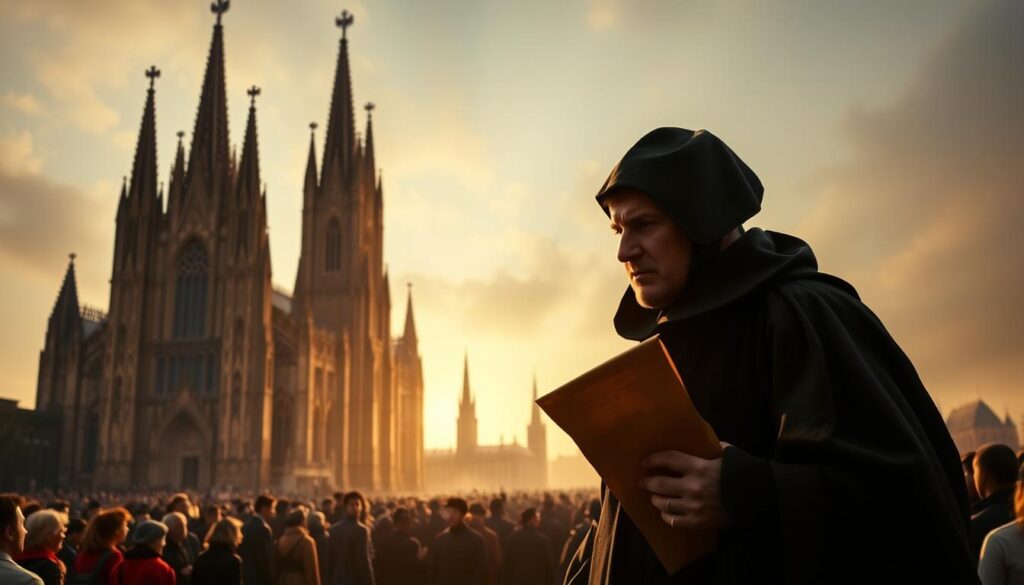
A single monk’s protest ignited a religious revolution that changed Christianity forever. In 1517, Martin Luther, a German theology professor, questioned the Roman Catholic Church’s practices through his famous 95 Theses. What began as an academic debate became the spark for the Protestant Reformation.
Martin Luther’s Church Transformation
Luther aimed to fix the church he loved, not create a new one. He taught that faith alone – not payments or rituals – connected people to God. This idea clashed with the Catholic Church’s teachings, leading to his excommunication in 1521.
The nickname “Lutheran” started as a joke by critics in 1519. Luther disliked the label, preferring “evangelical” to highlight his focus on scripture. By 1525, he’d led the first Lutheran service and trained ministers, creating a new worship style.
16th-Century Turning Points
The Reformation spread quickly through Germany and beyond. Local rulers saw a chance to break from Rome while keeping Christian values. Check out key events that shaped this movement:
| Year | Event | Impact |
|---|---|---|
| 1517 | 95 Theses Posted | Started public debate |
| 1521 | Luther Excommunicated | Formal church split |
| 1525 | First Lutheran Service | New worship model |
| 1530 | Augsburg Confession | Official beliefs stated |
| 1555 | Peace of Augsburg | Legal recognition |
By Luther’s death in 1546, his ideas had reached millions. The 16th century ended with Lutheran churches in Scandinavia and parts of Europe – proof that one person’s courage could reshape history.
lutheranism facts – Core Doctrines and Beliefs
At the heart of this Protestant tradition lies a radical idea that reshaped Christianity. Its teachings center on God’s grace as the ultimate source of spiritual freedom, offering a fresh perspective on ancient biblical truths.
Justification by Grace Through Faith
Imagine receiving a priceless gift you didn’t earn. That’s how this tradition views salvation – a free offer from God through faith alone. The famous Augsburg Confession calls this concept “the article by which the church stands or falls.”
Martin Luther redefined faith as active trust rather than mental agreement. It’s like leaning your full weight on a sturdy bridge – not just admiring its engineering. This approach removes human effort from the salvation equation, emphasizing divine generosity over personal achievements.
Understanding Law and Gospel
Lutherans read scripture through two lenses. The first shows our shortcomings, while the second reveals God’s solution. As Luther explained:
“The law says, ‘do this,’ and it is never done. Grace says, ‘believe in this,’ and everything is already done.”
This framework helps believers navigate life’s challenges. The law guides moral decisions, but the gospel offers comfort when human efforts fall short. Together, they create balance between responsibility and redemption.
The Significance of the Augsburg Confession and Book of Concord
Imagine holding a 500-year-old document that still shapes millions of worship services today. The Augsburg Confession does exactly that. Crafted as a peace offering during religious turmoil, this text became the cornerstone of Protestant identity.
Defining Statements of Faith
Philip Melanchthon, Martin Luther’s sharp-minded collaborator, wrote the confession in 1530. He presented it to Emperor Charles V during a high-stakes meeting in the Holy Roman Empire. Unlike fiery debates, its tone aimed to show harmony with Christian tradition while clarifying key beliefs.
The table below highlights core documents in the Book of Concord:
| Document | Year | Purpose |
|---|---|---|
| Augsburg Confession | 1530 | Foundation of Lutheran theology |
| Apology of the Augsburg Confession | 1531 | Defended original text |
| Smalcald Articles | 1537 | Luther’s final reforms list |
| Formula of Concord | 1577 | Settled internal disputes |
When leaders compiled these texts into the Book of Concord in 1580, 86 governing bodies endorsed it. This unified scattered congregations under shared teachings. Today, these writings remain essential for understanding Protestant theology’s roots.
Melanchthon’s careful wording still matters. His confession avoided harsh language, hoping to mend church divisions. Though reconciliation failed, his work created a lasting blueprint for faith communities worldwide.
Evolution of Worship and Liturgy
Sunday mornings looked different after 1521. For centuries, church services flowed in Latin – a language few understood. Martin Luther changed this by making worship accessible through local dialects. His reforms turned silent observers into active participants.
Breaking the Language Barrier
Luther translated the New Testament into German in just 11 weeks. This 1522 work became a bestseller, spreading scripture to homes and markets. Worship materials soon followed, replacing Latin with everyday speech.
Check out how translations spread across Europe:
| Language | Region | Year Translated |
|---|---|---|
| German | Holy Roman Empire | 1522-1534 |
| Swedish | Scandinavia | 1526 |
| Danish | Denmark | 1524 |
| Norwegian | Norway | 1537 |
| Finnish | Finland | 1548 |
Building Community Through Understanding
Vernacular worship created stronger church bonds. Families now discussed sermons over meals. Farmers sang hymns while working fields. Luther’s Small Catechism became dinner-table reading in Swedish homes.
This shift sparked new traditions. Congregational singing replaced choir-only performances. Prayer books appeared in pockets rather than priestly hands. As Luther noted:
“When people grasp God’s word, faith grows like wheat in good soil.”
Today’s services still reflect this legacy. Responsive readings and shared hymns trace back to making worship a community conversation, not a foreign ritual.
Distinctive Lutheran Practices and Sacraments
Two sacred rituals stand at the heart of spiritual life for millions. These time-honored practices connect believers to divine promises through tangible elements, blending ancient tradition with personal meaning.
Baptism’s Transformative Power
Water becomes a spiritual gateway in this cherished rite. Followers believe God uses this simple act to awaken faith and grant salvation, even for infants. Unlike some Christian groups, they see it as more than symbolism – it’s where divine grace meets human need.
Parents bring babies to the font trusting God’s promise. “The water does the work,” Luther wrote, emphasizing divine action over human effort. This practice reflects their core belief: grace comes first, not earned through deeds.
Communion’s Sacred Mystery
At the altar, ordinary bread wine become extraordinary. Believers receive Jesus Christ’s presence “in, with, and under” the elements. This differs from Catholic teachings but maintains deep reverence for the meal’s spiritual reality.
Monthly or weekly celebrations keep this ritual fresh. As one pastor explains: “We taste mercy here.” The shared cup and loaf unite modern worshippers with 500 years of tradition – and a promise that nourishes both body and soul.
FAQ
What’s the central belief of Lutheran teachings?
At its core, Lutheran doctrine emphasizes justification by grace through faith. This means salvation is seen as a gift from God, not earned by good deeds. Martin Luther stressed that trust in Jesus Christ, not human effort, brings redemption.
How did Martin Luther challenge the Catholic Church?
Luther famously protested practices like selling indulgences and questioned the authority of the Pope. His 95 Theses, posted in 1517, sparked the Reformation by calling for reforms based on Scripture alone. His translation of the Bible into German also made faith accessible to everyday people.
Why is the Augsburg Confession important?
Written by Philipp Melanchthon in 1530, the Augsburg Confession outlined core Lutheran beliefs to defend them before the Holy Roman Emperor. It remains a foundational document, uniting churches around shared doctrines like worship practices and sacraments.
Do Lutherans still use Latin in services?
After the Reformation, worship shifted to local languages to help congregations engage deeply. Today, services are held in vernacular tongues, though some traditional hymns or liturgies might retain Latin elements for historical reverence.
What’s unique about Lutheran baptism and communion?
Lutherans view baptism as a sacrament that initiates people into God’s grace. For communion, they teach the Real Presence—that Christ is truly in the bread and wine, though not in the same way Catholics describe transubstantiation.
Where is Lutheranism most influential today?
While global membership has spread, Northern European countries like Sweden and Denmark still recognize it as a state religion. However, growth in Africa and Asia reflects its expanding diversity and modern relevance.
How do Lutherans interpret the Bible compared to Catholics?
Lutherans prioritize Scripture as the ultimate authority (sola Scriptura), while Catholics also rely on church tradition. Luther’s focus on individual interpretation encouraged believers to engage directly with God’s Word.