What began as one man’s call for change reshaped Christianity forever. In 1517, Martin Luther sparked a religious transformation that created a new branch of faith. His ideas spread rapidly, challenging traditions and inspiring millions to rethink their spiritual path.
Today, this movement spans the globe, uniting nearly 90 million people through shared beliefs. At its core lies the principle of “grace through faith alone”—a revolutionary concept during its time. Communities gather in churches worldwide to practice traditions blending ancient wisdom with modern relevance.
From its German roots to vibrant congregations across America, this faith emphasizes accessibility. Worship services often feature hymns, scripture readings, and communal rituals designed to connect members with core teachings. Beyond Sunday gatherings, many churches prioritize education and social outreach, reflecting their commitment to practical faith.
Key Takeaways
- Originated from Martin Luther’s 16th-century reforms
- Third-largest Protestant tradition globally
- Focuses on salvation through faith rather than works
- Blends traditional worship with community engagement
- Maintains strong presence in the United States
- Uses liturgy and sacraments as central practices
Understanding Lutheranism Religion
You might be surprised by the origins of the name “Lutheran.” Critics first used it mockingly to describe those who supported Martin Luther’s reforms. Though the label stuck, Luther urged followers to focus on Christ rather than his name, saying, “The church should be called evangelical, not mine.
Defining Lutheran Identity
Modern Lutheran church communities build their identity on one foundation: God’s free gift of grace. This contrasts with stereotypes about cultural foods or festivals. At its heart, being Lutheran means trusting Jesus’ promises more than human traditions.
Early Lutherans faced a funny twist. Their opponents coined the term as an insult, but reformers reclaimed it with pride. Today, many still prefer “evangelical” to highlight their focus on scripture’s core message.
The Role of the Gospel in Lutheran Thought
Every sermon, song, and sacrament in Lutheran church life points to one truth: Christ’s sacrifice redeems humanity. This faith shapes how believers read the Bible and serve their neighbors.
Lutherans see the gospel as God’s power in action. It’s not just ancient history—it transforms lives today. This perspective unites global congregations while allowing local church customs to flourish.
Through this lens, even challenging Bible passages reveal hope. As one member shared, “The gospel isn’t a rulebook—it’s a love letter that changes how we live.”
Historical Background and the Reformation
Imagine living in a time when spiritual questions shook entire nations. The 16th century brought exactly that—a powder keg of ideas about faith, authority, and salvation. At the center stood Martin Luther, whose bold actions would redefine Christianity’s landscape.
Martin Luther’s 1517 Challenge
Picture a crisp October day in Wittenberg. A young monk nails 95 arguments to a church door, sparking debates across Europe. Luther’s main gripe? The Catholic Church‘s practice of selling forgiveness through indulgences. “Why should gold coins decide God’s mercy?” he essentially asked.
Luther’s writings spread like wildfire thanks to the new printing press. He insisted scripture—not church leaders—held ultimate authority. “A simple shoemaker deserves God’s truth as much as any bishop,” he declared, making faith accessible to ordinary people.
The Division from the Catholic Church
By 1521, tensions reached boiling point. At the Diet of Worms, leaders demanded Luther recant. His legendary reply: “I cannot and will not. Here I stand.” The resulting edict branded him an outlaw, cementing the split.
Two key issues divided the camps:
- Whether salvation came through faith alone or good deeds
- If the Bible or church tradition held final authority
Though Luther never planned to start a new movement, his reforms birthed lasting change. What began as theological debates reshaped worship, education, and society itself.
Core Doctrines: Justification, Law and Gospel
At the heart of this tradition lies a radical idea that reshaped Christianity: God’s love isn’t earned—it’s freely given. This truth anchors every teaching about human worth and divine mercy.

Justification by Grace Through Faith
Martin Luther called it “the article by which the church stands or falls.” The Augsburg Confession spells it out clearly: we’re made right with God through grace alone, received by faith in Jesus Christ. No rituals, donations, or perfect behavior required.
This isn’t about checking belief boxes. True faith means trusting God like a child trusts a parent—leaning entirely on His promises. As one pastor explains, “Grace turns ‘I should’ into ‘I get to’—a relationship, not a transaction.”
Balancing the Law and the Gospel
Scripture reveals God’s voice in two modes. The law acts like a mirror, showing our imperfections. The gospel hands us a clean slate through Christ’s sacrifice.
Here’s how it works:
- The law guides moral choices but can’t grant salvation
- The gospel offers forgiveness while inspiring grateful action
This balance stops two extremes: pride in good deeds or ignoring God’s standards. Churches use this framework to shape sermons, counseling, and community projects—always pointing to God’s grace as the starting line.
Foundational Documents: Augsburg Confession & Book of Concord
How do 500-year-old texts still shape modern faith communities? Two landmark works answer this question—the Augsburg Confession and Book of Concord. These documents remain living guides rather than historical relics, actively shaping beliefs and practices.
Importance of the Augsburg Confession
Picture a tense meeting in 1530: Reformers hand Emperor Charles V a bold confession of faith. Crafted by Philipp Melanchthon, the Augsburg Confession outlined core beliefs using clear biblical references. Seven rulers and two cities endorsed it, blending spiritual conviction with political courage.
This document did more than explain theology—it proved reformers weren’t rebels. As Melanchthon noted, “We seek unity, not division, in Christ’s church.” Today, churches worldwide use it as their doctrinal GPS.
The Role of the Book of Concord
Fifty years later, leaders faced a new challenge: preserving Luther’s legacy after his death. The solution? A definitive collection of ten documents called the Book of Concord. It included:
- Ancient creeds like the Apostles’ and Nicene
- Luther’s catechisms for teaching fundamentals
- Key writings defending the Augsburg Confession
With 86 official signatories, this book became the ultimate reference for resolving disputes. Pastors still promise to teach its contents, ensuring continuity across generations.
| Document | Year | Key Purpose | Signatories |
|---|---|---|---|
| Augsburg Confession | 1530 | Define core beliefs | 7 rulers + 2 cities |
| Book of Concord | 1580 | Unify teachings | 51 rulers + 35 cities |
These works form a theological anchor. As one modern leader explains, “Subscribing to these confessions isn’t about the past—it’s our promise to future believers.”
Key Figures and Influences in Lutheranism
Great movements often begin with a single spark but grow through collective effort. While Martin Luther ignited the Reformation, his teaching and work flourished through partnerships with scholars, civic leaders, and devoted pastors. Together, they built a lasting legacy that extended far beyond Luther’s lifetime.
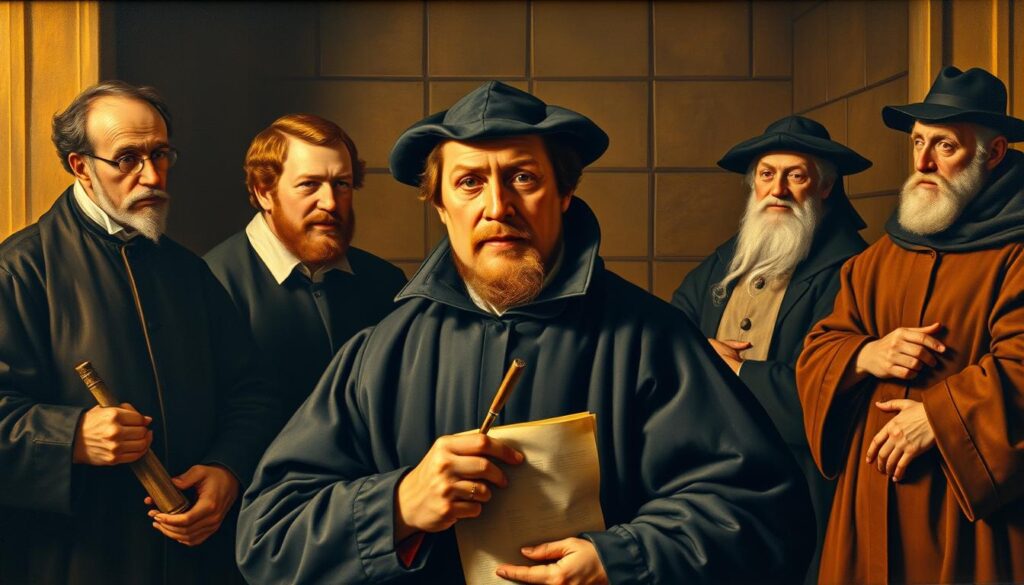
Martin Luther and His Collaborators
Luther’s inner circle included brilliant minds like Philip Melanchthon. Known as the “Teacher of Germany,” Melanchthon crafted the Augsburg Confession and designed schools to spread Reformation ideas. Another key ally, Johannes Bugenhagen, organized churches across Northern Europe while mentoring new leaders.
After Luther’s death in 1546, Martin Chemnitz stepped up. His writings defended Lutheran beliefs against critics, earning him the nickname “Second Martin.” Meanwhile, Swedish brothers Olaus and Laurentius Petri translated essential texts, proving the movement’s adaptability across cultures.
Notable Theologians and Reformers
Later thinkers deepened Lutheran teaching during challenging times. Johann Gerhard and Abraham Calovius systematized theology during the 1600s, creating clear guides for congregations. Their work balanced intellectual rigor with heartfelt faith.
Modern figures like Dietrich Bonhoeffer showed how these teachings apply to real-world crises. His resistance to Nazi tyranny demonstrated faith in action. Today, scholars like Robert Jenson continue refining Lutheran thought while honoring its roots.
As one historian notes, “Lutheranism thrives when its people unite wisdom with courage—just like its founders.” This collaborative spirit remains its greatest strength.
Sacraments and Worship Practices
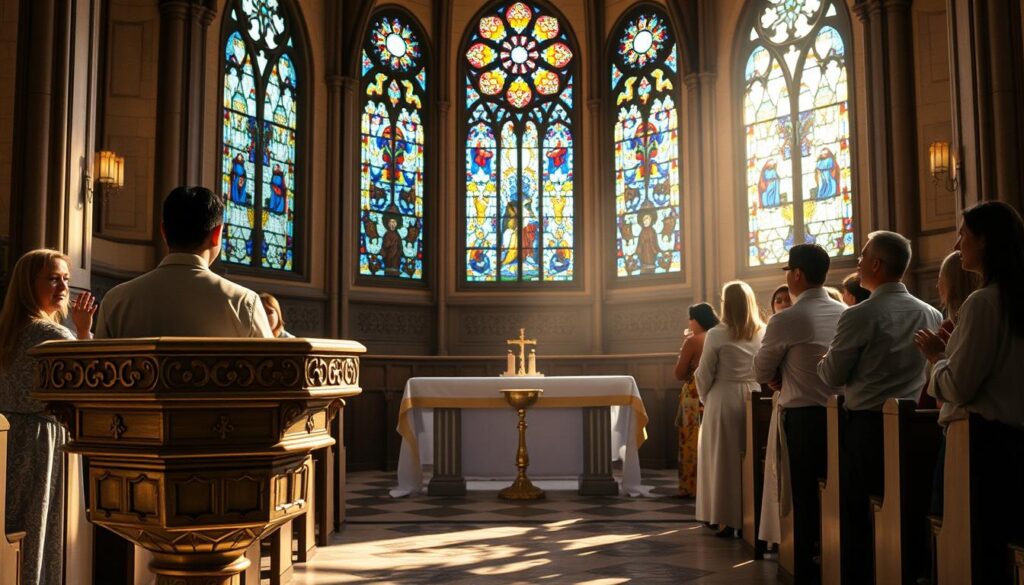
Imagine a sacred space where simple elements—water, bread, and wine—become bridges to divine grace. For many believers, these tangible acts form the heartbeat of spiritual life. While three practices are recognized, two stand central: baptism and the Lord’s Supper.
Baptism and Baptismal Regeneration
Water becomes more than H₂O in this ancient ritual. Baptism marks entry into God’s family, washing away sin through Christ’s promise. Unlike symbolic traditions, this act creates faith rather than reflecting it.
Infants often receive this gift, countering the idea that understanding precedes grace. As one parent shared, “It’s not our choice—it’s God claiming our child first.” The Holy Spirit works through water and word to spark spiritual rebirth.
The Real Presence in the Eucharist
Communion tables hold mystery alongside bread and wine. Lutherans teach Christ’s body and blood exist “in, with, and under” these elements—a concept called sacramental union. This differs from both Catholic transubstantiation and Protestant symbolism.
Weekly celebrations of the Lord’s Supper nourish faith communities. Members describe it as “a meal where heaven meets earth.” The table becomes a place of forgiveness and renewal, reinforcing bonds between believers.
| Practice | Elements | Key Belief |
|---|---|---|
| Baptism | Water | Creates faith through grace |
| Lord’s Supper | Bread & Wine | Christ truly present |
These worship practices anchor spiritual life, offering visible signs of invisible grace. Through them, many find assurance of salvation and strength for daily living.
Lutheran Church Organization and Synods
Picture a network of communities working together yet maintaining local flavor. The Lutheran church operates through a unique synod system—a Greek term meaning “walking together.” This structure balances independence with shared mission, allowing congregations to address regional needs while upholding core teachings.
Structure and Governance
Most congregations belong to a synod or regional body. These groups pool resources for education, disaster relief, and global outreach. Unlike top-down hierarchies, decisions emerge through dialogue between pastors and laypeople.
In the United States, major bodies like the ELCA and LCMS showcase different approaches. Some emphasize collaborative governance, while others maintain stricter doctrinal unity. All share a commitment to Christ-centered service and scriptural authority.
Modern synod structures adapt to new challenges. Digital tools now connect rural churches with urban partners. Youth initiatives and social justice projects often cross regional lines, proving this centuries-old model remains vital today.
FAQ
What makes the Lutheran Church different from other Protestant denominations?
The Lutheran Church emphasizes justification by grace through faith alone, a teaching rooted in Martin Luther’s reforms. Unlike some denominations, Lutherans affirm the Real Presence of Christ in Communion and prioritize foundational documents like the Augsburg Confession.
Why did Martin Luther challenge the Catholic Church in 1517?
Luther opposed practices like selling indulgences, which he believed distorted the Gospel’s message of forgiveness. His 95 Theses sparked the Reformation, advocating salvation through faith rather than works.
Do Lutherans believe in baptismal regeneration?
Yes, Lutherans teach that baptism is a sacrament where God’s grace actively creates or strengthens faith. This contrasts with groups viewing baptism as solely symbolic.
How is the Book of Concord used in Lutheran teachings?
The Book of Concord unites Lutherans by compiling key texts like the Small Catechism and Augsburg Confession. It serves as a doctrinal standard for interpreting Scripture and addressing theological disputes.
What role do synods play in Lutheran church governance?
Lutheran synods are regional or national bodies that provide structure, support shared missions, and maintain doctrinal unity. They allow congregations to collaborate while retaining local decision-making.
How do Lutherans view the relationship between Law and Gospel?
Lutherans see the Law as revealing human sinfulness and the Gospel as proclaiming God’s forgiveness through Christ. This balance shapes preaching, teaching, and personal spiritual growth.
Are Lutheran worship services similar to Catholic Mass?
Some elements, like liturgical structure and Communion, overlap. However, Lutheran services focus more on Scripture reading and congregational singing, with less emphasis on rituals like veneration of saints.