What began as one man’s quest to reform religious practices sparked a movement that reshaped Christianity. In the 1500s, Martin Luther challenged long-standing church traditions, emphasizing direct engagement with scripture and personal faith. His ideas spread like wildfire across Europe, thanks to new technologies like the printing press and growing public demand for change.
This movement became a cornerstone of Protestant Christianity. Unlike other reforms of the time, it focused on salvation through grace rather than rituals. By the 21st century, over 77 million people globally identified with these teachings—a testament to their enduring appeal.
Interestingly, the name “Lutheran” wasn’t chosen by its followers. Critics first used the term to describe those who supported Luther’s views. The tradition’s real strength lies in its adaptability, thriving in diverse cultures while maintaining core principles about scripture and community.
Key Takeaways
- Originated from Martin Luther’s 16th-century efforts to reform Christian practices
- Grew rapidly due to technological advances and social changes during the Renaissance
- Now includes over 150 independent church groups worldwide
- Term “Lutheran” was originally used by critics, not supporters
- Focuses on scripture-based faith rather than institutional rituals
- Second-largest Protestant tradition after Baptist churches today
Introduction: The Emergence of Lutheranism
Amidst Europe’s recovery from plague and political shifts, a new religious perspective emerged. The 15th century brought seismic changes—cities grew, literacy spread, and old social hierarchies wobbled. When Martin Luther posted his critiques in 1517, he tapped into a society already questioning traditions.
Setting the Context
The Black Death (1347-1351) had reshaped Europe. With fewer workers, commoners gained bargaining power. New universities sprouted, and the 1455 Gutenberg Bible let people read scripture themselves. Luther, a Bible professor, saw how Roman Catholic practices like selling forgiveness clashed with scriptural teachings.
Overview of Lutheranism’s Impact
Luther’s 95 Theses sparked debates that became the Protestant Reformation. His ideas about personal faith and scriptural authority spread through pamphlets—early social media. Local rulers used these teachings to challenge papal power, reshaping Europe’s political map.
| Aspect | Pre-Reformation | Post-Reformation |
|---|---|---|
| Religious Authority | Pope-centered | Scripture-focused |
| Education | Latin-only | Vernacular schools |
| Economic Practices | Indulgences common | Tithing reformed |
These changes still matter today. Modern churches balance 16th-century theology with contemporary issues—proof that good doctrine adapts without losing its core.
Historical Roots and the Protestant Reformation
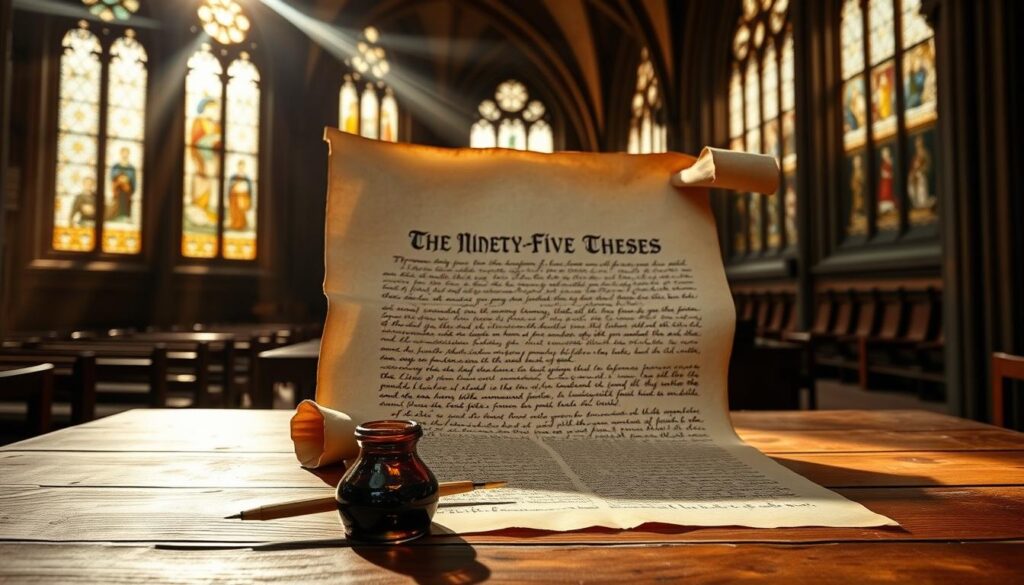
One autumn day in 1517 changed religious history forever. A monk named Martin Luther nailed a list of arguments to a church door in Wittenberg, not knowing his act would ignite a continental firestorm. This wasn’t a call for rebellion—it began as an invitation for academic debate about indulgences, certificates sold by the Roman Catholic Church to reduce punishment for sins.
From Local Protest to Continental Debate
Luther’s main target was preacher Johann Tetzel, who claimed buying indulgences could free souls from purgatory. “When coins clink in the chest, souls escape their test,” Tetzel declared. Luther countered that true forgiveness came through faith, not payments. His 95 Theses spread faster than wildfire—German translations reached every major city in weeks.
Crossing Oceans and Cultures
By the 1530s, Scandinavian kings adopted Luther’s teachings to strengthen their rule. German immigrants later brought these ideas to America, founding early churches in Delaware. Political leaders everywhere saw value in challenging papal power, creating alliances that helped the movement thrive.
| Region | Time Period | Key Driver |
|---|---|---|
| Germany | 1517-1520s | Printing press distribution |
| Scandinavia | 1530s-1600s | Royal decrees |
| North America | 1638 onward | Immigrant communities |
The speed of this spread shocked everyone. What started as a local debate became a blueprint for religious freedom—proving ideas can outpace armies when given wings.
Exploring lutheranism definition world history
Between 1510 and 1520, a quiet revolution brewed in Martin Luther’s study. As he taught biblical texts like Psalms and Galatians, patterns emerged that challenged centuries of tradition. His students witnessed firsthand how scripture contradicted common church practices around confession and forgiveness.
From Scholar to Reformer
Luther’s lectures revealed a radical truth: salvation came through divine grace alone, not rituals. This clashed with the Catholic Church’s emphasis on sacraments and priestly mediation. By 1519, he openly questioned whether papal decrees held more weight than biblical teachings.
A turning point arrived in June 1520. Pope Leo X issued Exsurge Domine, demanding Luther retract 41 statements. The document gave him sixty days to submit—or face expulsion from the church. Instead of backing down, Luther burned the papal bull publicly that December, declaring:
“Unless I’m convinced by Scripture, my conscience is captive to God’s Word.”
| Year | Event | Significance |
|---|---|---|
| 1510-1520 | Scripture study period | Developed justification by faith doctrine |
| June 1520 | Papal ultimatum issued | First formal break attempt |
| Dec 1520 | Bull burning | Symbolic rejection of authority |
| Jan 1521 | Excommunication | Official separation from Rome |
These events created a new blueprint for Christian practice. Where the Catholic Church required sacraments and works, Luther taught that faith alone connected believers to God. This shift reshaped everything from personal spirituality to community worship structures.
Modern Christians still feel these changes. The idea that grace comes through divine love—not human effort—remains central to Protestant thought. As Luther himself wrote, true freedom springs from trusting God’s promises more than institutional rules.
Doctrinal Foundations and Core Beliefs
At the heart of Lutheran teaching lies a radical idea: divine grace trumps human effort. This principle reshaped Christian thought, offering believers direct access to salvation through trust rather than rituals. Let’s unpack the ideas that still guide millions today.
Justification by Faith and the Three Solas
Lutherans see faith as a lifeboat, not a ladder. Their famous slogan—“faith alone”—means God’s forgiveness comes freely, not through good works. This ties into three core principles:
| Principle | Meaning | Impact |
|---|---|---|
| Sola Scriptura | Bible as ultimate authority | Replaced church traditions |
| Sola Gratia | Grace as unearned gift | Ended indulgences |
| Sola Fide | Faith as key to salvation | Simplified worship |
As Luther wrote in 1520:
“Faith is a living, daring confidence in God’s grace.”
This confidence became the movement’s engine.
The Rejection of Papal Authority
Lutherans traded hierarchy for hands-on spirituality. They kept just two sacraments—baptism and communion—seeing others as human inventions. Original sin explains why this matters: everyone needs grace, since Adam’s disobedience tainted humanity.
Unlike Catholic teachings, Lutheran doctrine says faith isn’t something you earn. It’s a gift that lets you receive what God already offers. This shift created simpler, scripture-focused churches where everyone reads the Bible themselves.
Evolution of Lutheran Worship and Practices
The rhythm of hymns and the structure of prayer define Lutheran communal practice. Unlike many Protestant groups, these services retain medieval liturgical elements while emphasizing congregational participation. This balance reflects Martin Luther’s vision: reforming traditions without abandoning their spiritual roots.
Liturgical Traditions and Musical Heritage
Sunday services often mirror Catholic Mass formats—readings, sermons, and communion. But Luther added a revolutionary twist: music for everyone. He composed hymns like A Mighty Fortress so worshippers could sing their faith. Today, choirs and pipe organs remain central to Lutheran worship, blending ancient chants with Reformation-era energy.
Distinctive Sacramental Practices
At the communion table, Lutherans experience what they call Real Presence. They believe Christ joins them through bread and wine—not by magic, but divine promise. This sacramental focus extends to baptism, seen as God’s gift rather than human ritual. Confession sometimes appears too, though simpler than in Catholic practice.
These worship patterns show how Luther’s reforms valued continuity. By keeping liturgy accessible yet profound, they invite modern believers to participate in a 500-year conversation about grace.
FAQ
How did Martin Luther’s teachings challenge the Roman Catholic Church?
Martin Luther emphasized salvation through faith alone, rejecting practices like indulgences. His Ninety-Five Theses sparked debates about papal authority, leading to the Protestant Reformation and the creation of Lutheran churches.
What distinguishes Lutheran beliefs about grace and good works?
Lutherans teach that grace is a free gift from God, not earned by good works. While actions matter, they believe salvation comes solely through faith in Jesus Christ, a core idea called “justification by faith.”
Why is the Augsburg Confession important to Lutheran theology?
Written in 1530, the Augsburg Confession outlined key Lutheran doctrines, such as the role of sacraments and the authority of Scripture. It remains a foundational text for many Lutheran churches worldwide.
How does Lutheran worship differ from other Christian traditions?
Lutheran services often blend traditional liturgy with hymns, reflecting their musical heritage. They emphasize sacraments like baptism and communion, viewing them as means of receiving God’s grace.
What role did the Formula of Concord play in Lutheran history?
The Formula of Concord (1577) resolved theological disputes among Luther’s followers. It clarified teachings on topics like free will and Christ’s presence in communion, uniting Lutheran churches under shared beliefs.
How do modern Lutheran denominations like the Missouri Synod operate?
Groups like the Lutheran Church—Missouri Synod maintain traditional practices and doctrines, such as biblical inerrancy. Others, like the Evangelical Lutheran Church in America, adopt more progressive stances on social issues.
Why is the Lutheran emphasis on Scripture called “sola Scriptura”?
“Sola Scriptura” means “Scripture alone.” Lutherans believe the Bible is the ultimate authority for faith, rejecting additional sources of religious authority promoted by the Roman Catholic Church during the 16th century.