Welcome to the Ultimate Guide that gently explains what the Hail Mary is and why it matters. This short intro sets the stage for a friendly, practical look at the prayer’s biblical roots in Luke and its Christ-centered focus on Jesus Christ.
This guide shows how the Hail Mary fits into daily life and parish rhythms. You will learn the exact wording, the historical origin, and how it appears in the Rosary alongside the Our Father, Glory Be, and the Creeds.
Expect clear, actionable help—from learning the words to using the prayer in home, school, and communal devotion. We also clarify the difference between honoring Mary and worship reserved for God.
Whether you are new or experienced, this United States-focused guide offers respectful, scripture-rooted insights to help you grow in faith and daily devotion.
Key Takeaways
- Learn the prayer’s text and biblical origin in Luke.
- See how it centers on Jesus Christ within devotional life.
- Understand its role in the Rosary and companion prayers.
- Get practical tips for home and parish practice.
- Find clarity on honoring Mary versus worship of God.
What is the Hail Mary? Quick answer and why it matters today
The hail mary is a short, scripture-rooted prayer that combines Gabriel’s greeting and Elizabeth’s blessing from Luke.
Its basic meaning is simple: it addresses the virgin mary with biblical words and asks her to pray for us. The form centers on Jesus’ name while honoring God’s work through Mary.
The devotion matters now because it ties believers to the Incarnation and to the steady flow of grace God offers across every age. It is easy to memorize, so beginners often start here.
People pray it privately, in families, and in groups—sometimes many times a day. Across different time zones, millions use this short text to steady faith during busy days.
- Quick to learn and repeat
- Scripture-based and Christ-centered
- Used for asking intercession and strength
| Setting | Use | Benefit | Frequency |
|---|---|---|---|
| Private devotion | Personal intent | Comfort, focus | Daily |
| Family | Shared prayer | Formation, unity | Often |
| Community | Group recitation | Tradition, support | Regular |
The exact Hail Mary prayer text used in the Catholic Church
Below is the standard English wording used across U.S. parish life and printed prayer books. It is short, memorable, and rooted in Scripture, which helps when praying alone or with others.
“Hail Mary, Full of Grace, The Lord is with thee. Blessed art thou among women, and blessed is the fruit of thy womb, Jesus. Holy Mary, Mother of God, pray for us sinners now, and at the hour of our death.”
Key biblical lines come from Luke: “Hail Mary, full of grace” (Luke 1:28) and “Blessed art thou among women” (Luke 1:42). Notice the clear Christ focus in “blessed is the fruit of thy womb, Jesus.”
The second half is an intercessory petition: “Holy Mary, Mother of God, pray for us sinners now and at the hour of our death.” Its steady rhythm makes the text ideal for group recitation and for repeating in the Rosary.
Traditional words like “thee” and “thy” reflect older English and remain familiar to many. Minor regional wording exists, but the core text is consistent—learn it word-for-word to pray confidently in home and parish settings.
Origin and history: From Gabriel and Elizabeth to the Church’s prayer
Roots of this brief devotion reach back to two Gospel moments in Luke where God’s plan touches everyday life. The first half of the text is lifted directly from Scripture: Gabriel’s greeting (Luke 1:28) and Elizabeth’s Spirit-filled acclamation (Luke 1:42).
Over medieval time, Christians began to set those lines together as a single invocation. By the 11th century, communities repeated the words in devotion. Later generations added the intercessory second half so the full form could ask for help in daily need.
Saints, theologians, and popes commented on and promoted the text across centuries. Its steady use in the Rosary put it at the heart of common practice and family life.
God’s grace was at work in this development: biblical phrases, liturgical shaping, and pastoral use merged to keep the focus on Jesus Christ while inviting the faithful to seek aid in trouble and thanksgiving in joy.
| Source | Content | Role over time |
|---|---|---|
| Luke 1:28 | Angel’s greeting | Scriptural foundation |
| Luke 1:42 | Elizabeth’s blessing | Confirmation in testimony |
| Medieval devotion | Added petition for intercession | Liturgical and family use |
Scriptural roots explained: “Full of grace” and “Blessed art thou among women”
Scripture anchors the key phrases, linking angelic greeting and Spirit-led blessing. These lines from Luke shape meaning and help readers enter the Gospel events.
Annunciation: “The Lord is with thee” (Luke 1:28)
Gabriel’s words — including full grace and lord thee — point to God’s favor and presence at the Annunciation.
They signal that God acts, not human effort. This greeting invites quiet listening and trust.
Visitation: “Blessed is the fruit of thy womb” (Luke 1:42)
Elizabeth’s voice declares the blessed fruit and affirms the gift in faith.
Her phrase about fruit thy and the child makes the moment public and joyful.
Why Jesus’ holy name is central to the prayer
Calling the son by name keeps the focus on the Savior. Saying thy womb stresses the real Incarnation: the eternal virgin mary bore God made flesh.
- Scripture first: words come from Luke.
- Devotional bridge: they move private faith into public prayer.
- Practice tip: pray these phrases slowly to let their meaning sink in.

Line-by-line meaning: Heart, theology, and devotion
A close look at each phrase reveals layers of faith, theology, and personal comfort. Read slowly so the meaning can sink in and shape daily devotion.
Hail Mary, full of grace
“Hail” is a greeting that honors God’s work in one person’s life. It points to a receptive heart shaped by God’s favor.
“Full of grace” recognizes a gift, not human merit. It invites us to see vocation as a divine calling that models humility and openness.
Blessed art thou among women
This phrase honors a unique role in salvation history without overshadowing God’s glory. It says someone is set apart to play a key part in God’s plan.
Blessed is the fruit of thy womb, Jesus
The focus lands squarely on the fruit—Jesus. The line magnifies Christ as the source of salvation and keeps attention on him as the center.
Holy Mary, Mother of God
Calling her Mother of God confesses Jesus’ divinity and the real human birth that brought God into our world.
Pray for us sinners now and at the hour of our death
Asking a holy friend to intercede shows how community and mercy work together. The plea covers present needs and final trust before death.
- Pray slowly, one line at a time to let theology become lived faith.
- Journal short reflections or pair lines with Scripture for ongoing growth.
- Use the phrases as prompts for quiet meditation and real-life intention.
The hail mary prayer catholic church
Many families and parish groups lean on this brief devotion as a steady practice across life’s changes.
In daily life, people use it before meals, at bedside, during commutes, and at moments of need. It sits alongside the Our Father and Glory Be as a familiar line in both private meditation and public devotions.
Beginners and lifelong believers often learn the text in childhood and return to it in times of grief, joy, and decision. The short form helps keep the Incarnation before the heart throughout each day.
In communal settings—rosary groups, parish gatherings, and processions—the shared recitation builds unity. It also pairs well with Scripture study to create a balanced spiritual life.
Parishes can integrate this devotion into catechesis and sacramental prep by offering simple routines: morning, midday, and evening recitations to anchor one’s day in focused devotion.
“Used in Mass devotions, family routines, and private meditation, this short text supports both new learners and seasoned faithful.”
| Setting | Typical Use | Benefit | Who |
|---|---|---|---|
| Home | Before meals, bedtime | Comfort, habit formation | Families, children |
| Parish | Rosary groups, processions | Community, unity | All ages |
| Private | Meditation, commutes | Focus, calm | Beginners, long-time faithful |
How to pray the Hail Mary: Step-by-step for beginners
For beginners, a short, steady routine helps turn words into real devotion. Start with the Sign of the Cross and breathe slowly for a few seconds to steady the heart.
Posture, reverence, and focus of the heart
Choose a calm posture: sit or kneel where you can be still. Keep hands folded or hold a rosary to anchor attention.
Let reverence shape your breath—short pauses help you listen instead of rushing through the lines.
Adding intentions and praying with Scripture
Before each repetition, name a simple intention: family, a friend, the sick, or a private need. This keeps the words connected to life.
Link the words to Luke 1:26–56. Read those verses slowly, then pray to enter the Annunciation and Visitation with a listening heart.
- Step 1: Sign of the Cross.
- Step 2: Pray the text slowly and clearly.
- Step 3: Finish with a brief silent reflection.
Tips for beginners: try three each morning and evening, pair each with an Our Father and Glory Be for a short set, and bring a pocket rosary or card for on-the-go devotion mary.
| Practice | When | Benefit |
|---|---|---|
| Three short sets | Morning / Evening | Build habit |
| Pair with Scripture | Weekly reading | Deeper meaning |
| Carry a card | Commute / Breaks | Easy access |
The Hail Mary in the Rosary: Mysteries, decades, and rhythm
A single decade creates a small, focused space for reflection on a mystery of jesus christ. This pattern helps prayer become listening, not just saying words.
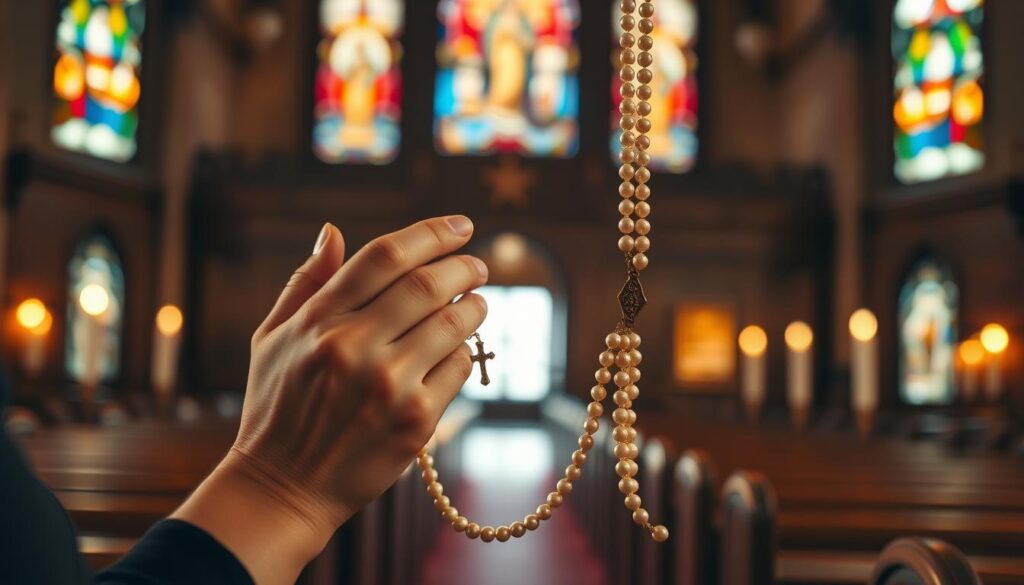
Structure of a decade
Each decade begins with one Our Father, then ten hail mary recitations, and ends with one Glory Be. Many people add the Fatima Prayer after the Glory Be.
Why repetition aids meditation
Saying the same short line sets a steady pace. That rhythm frees the mind to imagine Gospel scenes and to enter them with the heart.
From “full of grace” to the Salve Regina
The phrase full of grace frames the mysteries—Joyful, Sorrowful, Glorious, and Luminous—so each bead points back to Christ. After five decades, pray the holy queen (Salve Regina) as a loving appeal to Mary as mother.
Beginners can start with one decade and grow to five. A single decade also marks a calm pause in the hour of a busy day. Praying together in family or parish groups brings added encouragement and unity.
Beyond the Rosary: Angelus, Magnificat, and other Marian devotions
Brief devotions beyond the Rosary help keep Gospel moments close through the day. They offer quick, scripture-based pauses that families and individuals can adopt.
The Angelus: Remembering the Incarnation with short versicles
The Angelus is prayed morning, noon, and evening to recall the Incarnation. It uses three short versicles, each followed by a Hail line, which ties the Gospel mystery into daily timekeeping.
Many parishes ring bells at the appointed hours. Those chimes invite a communal pause and gentle focus on jesus christ and the gift of grace.
The Magnificat: “All generations will call me blessed”
The Magnificat is Mary’s canticle from Luke 1:46–55. It praises God’s mercy and faithfulness across generations and fits naturally at evening prayer or after a Rosary set.
“My soul proclaims the greatness of the Lord; my spirit rejoices in God my Savior.”
Practical tips: post the Angelus and Magnificat texts at home for quick reference. Pick set moments for the Angelus to build a family habit. Add a short mary prayer or hymn after the Magnificat to close gently.
| Devotion | When | Primary focus | How it links to the Rosary |
|---|---|---|---|
| Angelus | Morning, Noon, Evening | Incarnation, Gospel verses | Includes three Hail lines; keeps Gospel close |
| Magnificat | Evening / After Rosary | God’s mercy, praise | Scriptural canticle that deepens reflection |
| Marian hymns & litanies | Any time | Devotional praise | Complements Rosary themes and fosters memory |
- Invite family members to choose a bell or clock cue for the Angelus.
- Keep printed texts handy to encourage regular use at home.
- Explore additional hymns and litanies that honor the virgin mary with biblical depth.
More Marian devotions that amplify the Hail Mary
Small sacramentals and set meditations offer practical ways to grow in trust and discipleship.
Scapular of Our Lady of Mount Carmel is a visible sign of Marian devotion and a daily reminder to live the Gospel under Mary’s protection. Wearing it prompts simple acts of faith and attention throughout the day.
Miraculous Medal came from a 19th-century apparition and encourages the faithful to ask for graces through Mary’s intercession. A blessed medal can be a gentle prompt to pause and offer a short intention.
Seven Sorrows devotion invites meditation on moments of the mother’s grief united to her Son’s saving work. This set of seven short reflections helps people enter the mystery of redemption with compassion.
Consecration to Jesus through Mary
Consecration—often prepared over 33 days—is a structured way to entrust one’s life and discipleship to Christ with Mary’s help. Many find a spiritual director or parish program helpful when discerning this step.
Start simply: wear a blessed medal, read a five-minute daily reflection, or add one short devotional line to family routines before deepening practice.
- Goal: growth in love for Christ, holiness of life, and service of neighbor.
- Pair these devotions with the Rosary line to reinforce a Christ-centered relationship with the holy mother of believers.
- Ask parish resources or a spiritual director for guidance when considering full consecration.
Every authentic Marian devotion leads to deeper union with Jesus and fidelity to the Church.
“Hour of our death”: Hope, mercy, and the Christian finish line
Facing the final hour, many find words that name both present need and the hope of a holy ending. The phrase that reaches from now to the decisive moment links everyday choices with trust in God’s mercy.
Living ‘now’ well means simple habits: regular prayer, frequent sacraments, acts of charity, and quick steps to forgive. These practices shape the heart so the last hour can be met in peace.
Why ask for intercession at death? It is a plea for help to persevere in grace. Countless saints and ordinary faithful prayed this line through life and into their final hours, finding courage and calm.
Practical steps include a short daily intention for the dying, periodic examinations of conscience, and regular reconciliation. These small routines help orient life toward eternal hope.
“Align your heart with hope; live each day as a gift oriented toward eternal life.”
Do Catholics worship Mary? Veneration, intercession, and Jesus at the center
Many readers wonder whether honoring Mary ever becomes worship. Clear, simple terms help answer that concern and reduce confusion.
Honor versus worship in Catholic teaching
The tradition distinguishes worship (latria) given to God alone from honor given to the saints (dulia). Mary receives a higher form of honor (hyperdulia), but not worship. This difference protects the praise due only to the one true God.
“Holy Mary, Mother of God” and the glory of her Son
Calling her Mother of God safeguards the truth about Jesus Christ’s divinity. The title points directly to the Son, not away from him. Saying “art thou” in older translations echoes Scripture and keeps the focus on Jesus.
Asking Mary to pray for sinners is like asking a close friend to intercede. The request points to God’s mercy and to Christ’s saving work.

“Authentic devotion to Mary leads believers deeper into love for Jesus Christ and faithful obedience to the Gospel.”
- Scripture and teaching: the Bible and church tradition guide the distinction.
- Pastoral effect: Marian devotion strengthens prayer life and charity.
- Examples: many saints honored the mother of God while centering their lives on Jesus.
In short: honoring the holy mother supports worship of God by pointing hearts to Christ, not replacing him.
Praying with the Church: Core Catholic prayers that accompany the Hail Mary
Praying with the wider community brings familiar, time-tested texts into everyday life. These short, scripted pieces shape private devotion and group worship alike.
Our Father and Glory Be
The Our Father begins each decade and names our shared trust in God. The Glory Be closes a decade, offering brief praise. Together they frame ten repetitions and give rhythm to a set of beads.
Apostles’ Creed and Nicene Creed in daily life
The Creeds state core beliefs about jesus christ, the son, and salvation. Saying them roots short devotion in firm doctrine. Start with the simpler Creed, then add the longer one as understanding grows.
End a Rosary with the holy queen to ask the mother’s aid in a loving way. Use small cards or a parish booklet to learn exact wording and build confidence.
- Memorize the Our Father and Glory Be first.
- Add the Creeds when ready to deepen belief.
- Pray these together as a brief daily rule for praise, petition, and thanks.
“Praying with the Church unites believers across time and place.”
Language notes, style, and variations you may hear
Different regional editions and hymnals preserve older wording that some find both poetic and reverent. These variants affect pronouns and small word choices, but not the core meaning.
Traditional pronouns: Words like thee, thou, and thy come from older English used in many hymnals and prayer cards. They give a formal, rhythmic tone that many communities still treasure.
Among vs. amongst: Some editions say among, others amongst women. Both mean the same. “Blessed art thou” mirrors older style and keeps a reverent cadence.
The Lord is with thee is faithful to longstanding translations that many memorize early in life. Modern versions may simplify pronouns for ease of speech.
- Stick with one form first to aid memorization.
- Listen with charity when you hear variants.
- Compare versions side-by-side to notice stylistic nuance.
“The unity of the text lies in its meaning and purpose, not in minor stylistic differences.”
Everyday practice in the United States: Home, parish, and community
Everyday moments—meals, bedtime, and brief pauses—are ideal for introducing the text to children. Start small so routines stick and faith becomes part of daily life.
Teaching children the Hail Mary
Begin with the Sign of the Cross and one short line. Use a colorful card or a simple rosary bead set to make learning tactile and fun.
Repeat the line each evening and add one more phrase as kids grow. Invite grandparents or godparents to join so children link the memory to loving faces.
Many parishes host groups that meet before Mass or on weeknights. These gatherings welcome newcomers and model how to pray rosary in community.
Teens and young adults can form monthly groups or use simple apps to keep a steady habit. Parish events—May crownings, processions, and retreats—offer natural chances to join others in devotion.
“Small, shared practices shape a resilient, Christ-centered rhythm that comforts families in joy and sorrow.”
Practical tips: pray one decade together at evening time, start kids with one line, and use apps or beads for on-the-go focus. Over time, these small steps strengthen bonds and help a family live its faith well.
Common intentions with the Hail Mary: Life, family, work, and sinners
A brief set of intentions helps move words from memory into real care for others. Use simple, concrete aims so each repetition connects to daily life.
Praying for grace, protection, and deeper devotion
Sample intentions: personal conversion, family unity, growth in virtue, healing for the sick, and needs of the wider community.
Ask for grace in small decisions at home and at work. Name one choice before you begin so your heart focuses on action, not just words.
Remember to pray sinners gently: include the lonely, the poor, and anyone facing addiction or anxiety. Offer a decade for those most in need.
- Dedicate a week to parenting, exams, or a new job.
- Entrust children and loved ones to the mother’s care, asking her to draw them closer to the Son.
- Keep a short intentions journal to sharpen focus before each session.
| Intention | When | Suggested focus |
|---|---|---|
| Personal conversion | Daily | Humility, small changes |
| Family unity | Weekly | Patience, listening |
| Work and decisions | Morning | Wisdom, integrity |
| The sick & sinners | Any time | Healing, mercy |
Offer a Rosary for parish projects and community needs. Steady intercession builds hope, charity, and a stronger bond with Christ the Son.
Conclusion
Here we bring together Scripture, history, and practice so you can begin a steady habit of devotion. The guide showed how short Gospel lines grew into a lasting text that points to Jesus Christ and shapes daily life.
Remember the core phrases: full grace and blessed art thou anchor the words in Luke. Asking the holy mother to pray for us “now and at the hour of our death” names both need and hope.
Learn the hail mary slowly. Memorize a line, add a decade on a commute, or join a parish rosary group. Today, pray one hail mary prayer slowly and let God’s grace work in your heart and home.
FAQ
What is the short answer about the Hail Mary and why does it still matter?
The Hail Mary is a traditional Catholic invocation to the Virgin Mary built from Gospel greetings and later liturgical additions. It remains relevant because it centers Christians on Christ through Mary’s role, invites reflection on salvation history, and offers a simple, repeatable prayer for daily needs, intentions, and spiritual focus.
What is the exact traditional text used in liturgy?
The commonly used English version begins with the words “Hail Mary, full of grace,” continues with Elizabeth’s greeting and the blessing of Jesus, and ends asking Mary to pray for us sinners now and at the hour of our death. This form preserves phrases like “full of grace” and “fruit of thy womb, Jesus,” which link the prayer to Luke’s Gospel passages.
Where did the prayer originate?
Its roots are scriptural: the angel Gabriel’s greeting (Luke 1:28) and Elizabeth’s acclamation (Luke 1:42). Over centuries the medieval Church added devotional phrases, shaping the complete prayer used today. The development blended biblical language with pastoral petitions.
What do key phrases mean, such as “full of grace” and “blessed among women”?
“Full of grace” signals God’s favor given to Mary in the Annunciation. “Blessed among women” acknowledges Elizabeth’s proclamation that Mary holds a unique role in salvation history. Both phrases point to God’s action in Mary and the centrality of Jesus, the fruit of her womb.
How should a beginner pray this devotion? Any simple steps?
Begin with a quiet posture, breathe, and recall the Gospel scene. Speak the words slowly, focusing on Jesus and the intention you bring. You can add a short personal intention after the petition and finish with a moment of silence or an Our Father to center your prayer.
How does this prayer fit into the Rosary?
Each decade of the Rosary includes ten repetitions of this prayer, framed by an Our Father and followed by the Glory Be. Its repetitive rhythm supports meditation on the Mysteries—events in the lives of Jesus and Mary—making reflection more accessible.
Are there other devotions that use the same phrases?
Yes. The Angelus and the Magnificat echo similar language about the Incarnation and Mary’s role. Marian devotions like the scapular, Miraculous Medal practices, and consecration prayers often incorporate or build around these biblical phrases.
What does “at the hour of our death” mean?
That phrase asks for Mary’s intercession at life’s end, a moment Christians view with hope and reliance on God’s mercy. It expresses trust that Mary will pray for a peaceful passage and for closeness to Christ in final moments.
Do people worship Mary when they pray this?
No. Catholic teaching distinguishes veneration (honor) from worship, which belongs to God alone. Saying this prayer asks Mary to intercede with her Son; the focus remains on Christ and his saving work.
Why do some versions use “among” or “amongst,” and why “thee/thou” appears?
Differences reflect translation choices, historical English usage, and liturgical tradition. “Amongst” and archaic pronouns come from older translations. Modern translations often use contemporary language to aid understanding while keeping theological meaning intact.
How can families and parishes use this devotion in everyday life?
Families teach children by short, consistent practice—bedtime or mealtime prayer, simple explanations, and repetition. Parishes support rosary groups, brief community recitations before Mass, and educational sessions that explain the prayer’s biblical roots and spiritual purpose.
What common intentions do people bring when they say it?
People typically pray for family, life decisions, work, healing, forgiveness for sinners, and deeper spiritual growth. It’s often offered for specific needs or as a daily habit to seek grace, protection, and closer relationship with Jesus through Mary’s intercession.