Nestled along Ireland’s Blackwater River lies a town steeped in spiritual history. Its roots trace back to a 7th-century monastery founded by Saint Finnchua, followed by the grand Cistercian Abbey of Sancta Maria de Castro Dei in 1170. The Irish name Mainistir Fhear Maí—”Monastery of the Welcome Plain”—hints at this enduring legacy of faith.
Modern Fermoy took shape in 1791 when Scottish entrepreneur John Anderson transformed the area into a thriving hub. His vision included creating spaces for worship, ensuring both Protestant and Catholic communities had places to gather. This forward-thinking approach helped shape the town’s unique blend of commerce and spirituality.
Today, visitors uncover layers of religious heritage through striking architecture and vibrant traditions. From medieval stonework to 18th-century planning, every corner tells a story of resilience and unity. The area’s spiritual sites remain central to daily life, fostering connections across generations.
Key Takeaways
- Fermoy’s religious history spans over 1,300 years, beginning with early monastic settlements
- John Anderson’s 18th-century development prioritized inclusive worship spaces
- Architectural landmarks reveal evolving spiritual practices through the ages
- Planned town layout integrated faith communities with economic growth
- Multiple denominations coexist, reflecting centuries of cultural adaptation
Historical Legacy and Community Foundations
At the heart of Fermoy’s spiritual landscape stands a limestone marvel that reshaped local worship. Christ Church emerged as both a cultural anchor and architectural triumph, blending medieval roots with 19th-century innovation.
Early Beginnings and Religious Significance
Visionary leaders Sir John Anderson and John Hyde invested £3,282—a fortune in 1802—to create a worship space serving civilians and soldiers. Architect Abraham Hargrave designed soaring entrances for military parades, ensuring regimental colors never touched the ground during ceremonies.
The structure’s strategic location bridged eras. Built where Cistercian monks once prayed, its Gothic Revival tower became a new landmark. Local limestone walls echoed ancient traditions while embracing modern needs.
Evolution Through the Centuries
When Bishop William Bennett consecrated the building in 1809, 150 worshippers celebrated Christmas within its walls. The space adapted through decades, hosting regimental services and community events alike.
| Year | Milestone | Impact |
|---|---|---|
| 1802 | Construction begins | Hargrave’s final project starts shaping Fermoy’s skyline |
| 1809 | Consecration ceremony | Formal opening establishes active worship community |
| 1810s | Military integration | Tall doorways accommodate garrison flag ceremonies |
Today, visitors admire how locally quarried limestone still showcases original craftsmanship. The tower’s enduring presence reminds us how visionary planning built more than structures—it forged lasting connections.
Understanding protestant church fermoy: Faith and Architecture
Fermoy’s skyline tells silent stories through soaring stonework. Two neighboring structures reveal how 19th-century builders translated faith into physical form. Their spires point skyward like stone prayers, each bearing unique fingerprints of spiritual expression.
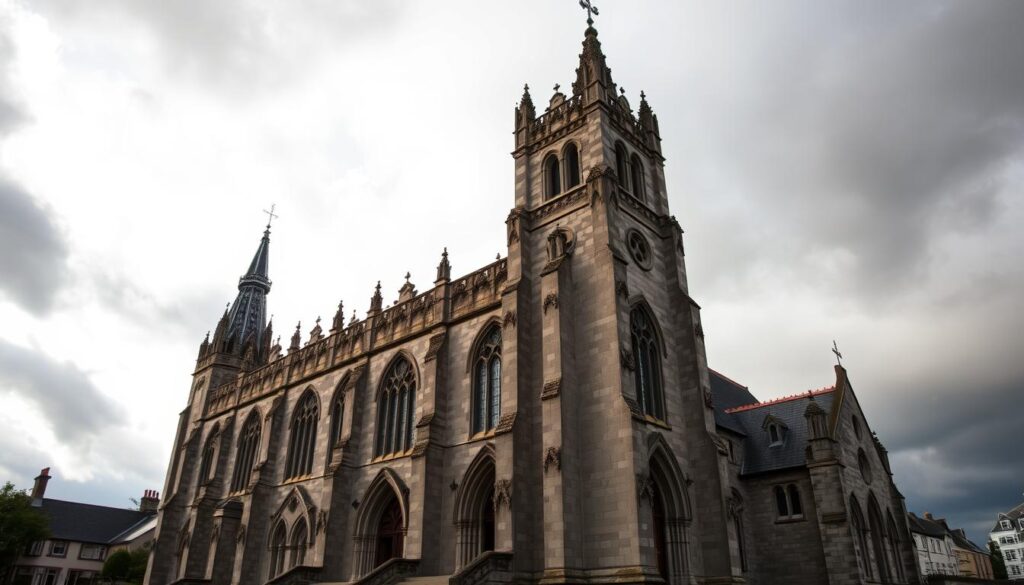
Comparative Insights from Local Landmarks
Christ Church’s west-facing tower welcomes visitors with intricate tracery windows. Its 1809 design prioritizes verticality – a visual sermon on heavenly aspirations. The three-bay nave draws eyes toward the bowed chancel, where morning light floods through colored glass.
Just south, the 1839 Presbyterian building takes a grounded approach. Square-plan towers anchor the structure, while pointed arch doorways frame communal gatherings. Carved limestone pinnacles crown the roofline, their floral patterns whispering of creation’s beauty.
Both designs share Gothic DNA but express distinct personalities:
- Vertical vs horizontal emphasis: Spires reaching upward vs. wide nave spaces
- Material mastery: Matching local limestone used differently – smooth ashlar vs. rugged quarry-face
- Light play: Stained glass narratives vs. clear panes highlighting simple arches
These choices reflect theological nuances. The chancel’s curve in Christ Church guides collective focus, while the Presbyterian altar’s western placement invites personal reflection. Yet both spaces unite communities through shared awe of craftsmanship that’s lasted centuries.
Architectural Details and Technical Preservation
The stonework of Fermoy’s historic buildings reveals masterful artistry in every groove and joint. Skilled hands transformed local limestone into intricate patterns that withstand centuries of Irish weather. From delicate pinnacles to rugged rubble walls, these structures showcase carved limestone details that blur the line between construction and sculpture.
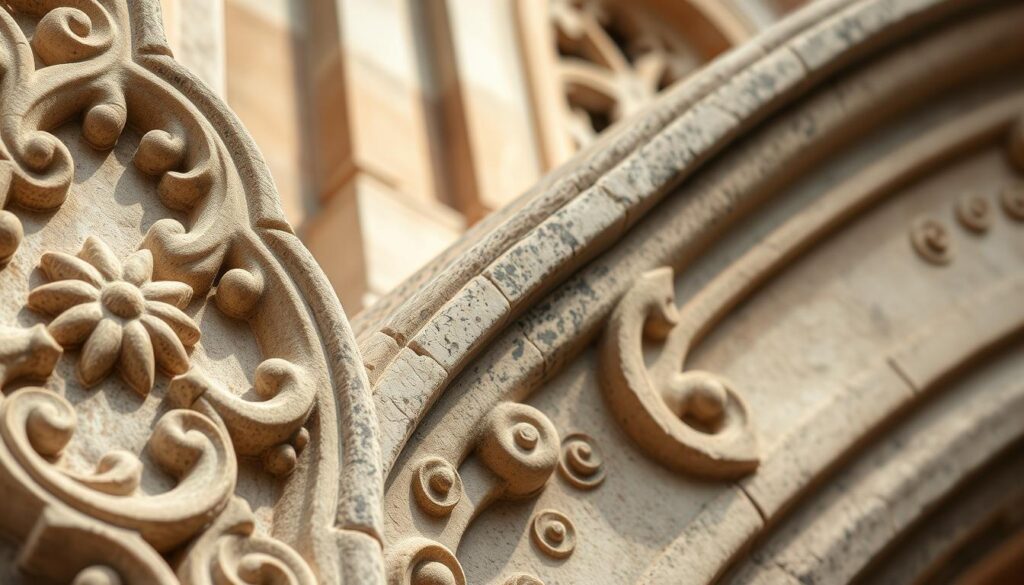
Craftsmanship in Carved and Dressed Limestone
Stonemasons treated each block like a canvas. The Presbyterian building’s crenellated parapet features corner pinnacles carved with floral motifs – a testament to patient craftsmanship. Across town, dressed limestone walls display precise ashlar work, their smooth surfaces contrasting with textured rubble sections.
Builders strategically chose materials based on location. North-facing walls used durable rubble limestone for weather resistance, while decorative south sides featured finely tooled blocks. This smart material selection explains why moldings around windows and arches remain crisp after 200 years.
Technical Storage Access and Preservation Methods
Modern conservation blends tradition with technology. Specialists use 3D scanning to create digital twins of moulded limestone string courses and cornices. “We’re not just preserving stone – we’re safeguarding centuries of architectural knowledge,” notes a preservation architect working on recent projects.
Data management plays a crucial role. Detailed records of technical storage access protocols ensure only authorized personnel handle sensitive structural information. These systems balance public interest with the necessary legitimate purpose of protecting historical data.
| Preservation Technique | Application | Outcome |
|---|---|---|
| Laser Cleaning | Removes pollution from carved surfaces | Reveals original tool marks |
| Moisture Sensors | Embedded in rubble walls | Prevents frost damage |
| UV-Filtering Glass | Protects stained windows | Reduces light degradation |
Through these methods, Fermoy’s architectural legacy remains both physically intact and digitally accessible. The fusion of traditional stonework with modern storage access technologies ensures future generations can study and appreciate these marvels.
Conclusion
Standing as a bridge between eras, Christ Church continues to watch over Fermoy with quiet dignity. Its hilltop position near the river crossing remains a visual anchor, just as architect Abraham Hargrave envisioned. This landmark proves sacred spaces can evolve while honoring their roots.
From humble beginnings to architectural marvel, the structure embodies community vision. Early planners understood that spiritual gathering places fuel civic strength. Today, visitors marvel at carved limestone details that showcase 19th-century craftsmanship, preserved through modern conservation efforts.
These buildings serve dual roles as worship centers and historical classrooms. Their arched windows and stonework teach silent lessons about faith expressed through form. Whether drawn to architectural beauty or spiritual heritage, all find inspiration here.
Ready to explore living history? Discover more about these landmarks where past and present unite. Walk through doorways that welcomed generations, and experience how stone and spirit shape enduring legacies.
FAQ
What makes this site historically significant?
The building’s roots trace back to early community-building efforts, blending spiritual traditions with local heritage. Its evolution reflects shifts in worship practices and social roles over centuries.
Are there unique architectural highlights?
Yes! The structure features carved and dressed limestone details, including a striking south side tower and an east window with moulded limestone surrounds. These elements showcase skilled craftsmanship.
How is technical storage access managed here?
Preservation methods prioritize security and functionality. Storage systems are designed for legitimate purposes like maintenance, ensuring historical materials remain protected while supporting daily operations.
How does it compare to nearby landmarks?
Like Christ Church and other local sites, it blends Gothic Revival influences with regional materials. However, its chancel arch and nave layout offer distinct design choices worth exploring.
Can visitors explore interior features?
Absolutely! The timber roof beams, rubble stone walls, and north entrance doorway are accessible during guided tours. Check local schedules for availability.
What role does the tower play in preservation?
The west-facing tower houses original structural elements, including a spiral staircase. Its dressed limestone walls help maintain climate control, aiding long-term conservation efforts.