Exploring faith traditions becomes richer when we understand their terminology in different languages. This guide helps bridge cultural gaps by explaining specific Christian concepts within Hindi-speaking communities. Whether you’re studying world religions or connecting with diverse traditions, clarity matters.
We focus on making complex ideas simple. Our approach combines linguistic insights with cultural context, showing how certain terms take shape in India’s vibrant spiritual landscape. You’ll learn not just translations, but also how ideas adapt across regions.
This resource acts like a specialized reference tool. It goes beyond basic definitions to explore historical roots and modern usage. You’ll gain practical knowledge for conversations, studies, or personal growth.
Key Takeaways
- Clarifies religious terminology between English and Hindi
- Explores cultural adaptation of faith concepts
- Provides context for India’s Christian communities
- Simplifies complex theological ideas
- Supports academic and personal research
Our friendly breakdown avoids technical jargon. We emphasize real-world understanding over textbook definitions. By the end, you’ll confidently grasp how spiritual ideas cross linguistic boundaries.
Overview of Protestant Churches
The way a faith community organizes itself can reveal much about its beliefs. This branch of Christianity emphasizes direct engagement with sacred texts and personal faith. Its practices reflect core ideas developed during a transformative period in religious history.
https://www.youtube.com/watch?v=GccWLK_Xfrs
Definition and Key Terms
Central to this tradition are three Latin phrases: sola scriptura (scripture alone), sola fide (faith alone), and sola gratia (grace alone). These principles shape worship styles and community structures. Unlike some other Christian groups, services often focus on preaching and congregational singing.
Religious vocabulary adapts interestingly across cultures. Missionaries and translators have carefully reworked key terms into local dialects worldwide. This linguistic flexibility helps maintain core ideas while respecting regional communication patterns.
Historical Context and Evolution
The 1500s Reformation sparked major changes in Western Christianity. Leaders like Martin Luther questioned established religious authority, advocating for accessible scripture and simplified rituals. These reforms gradually created distinct worship communities across Europe.
Over centuries, these groups developed unique traditions while sharing foundational beliefs. Modern gatherings might range from formal liturgical services to contemporary worship styles. This diversity stems from the original emphasis on individual conscience and biblical interpretation.
Understanding these roots explains why certain phrases and practices remain vital today. The movement’s growth across continents shows how spiritual ideas evolve within different cultural frameworks.
Protestant Church Meaning in Hindi
Language bridges gaps between cultures, especially when exploring spiritual concepts. Translators face unique challenges in conveying theological ideas across linguistic boundaries. Let’s examine how specific terms resonate within India’s diverse linguistic landscape.
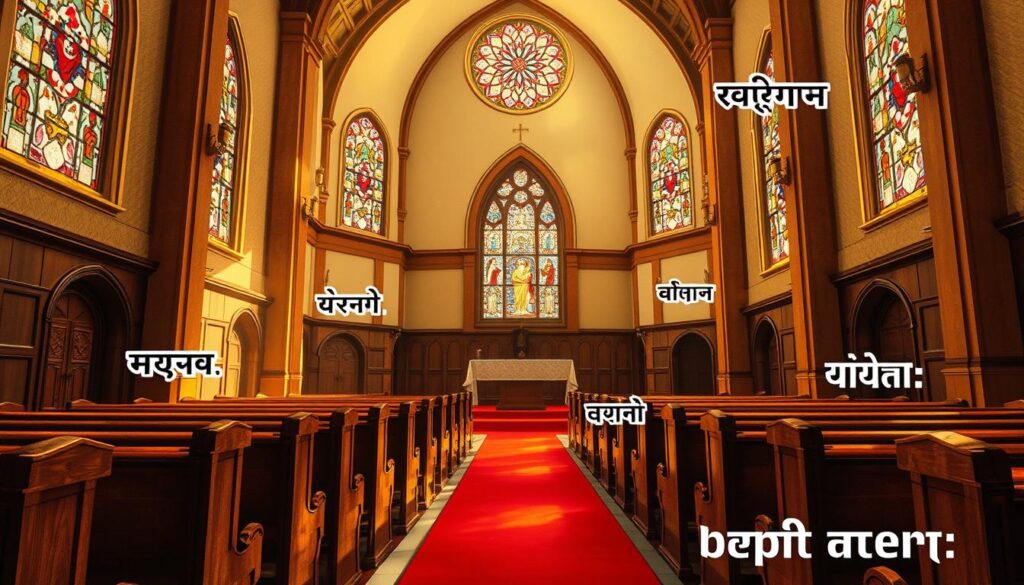
Hindi Translation and Spiritual Nuances
Two primary translations exist for this term in Hindi. The direct phonetic version प्रोटेस्टेंट चर्च preserves the original sound. Alternatively, धर्मसुधारवादी गिरजाघर emphasizes historical reformation aspects.
| Hindi Term | Translation | Usage Context |
|---|---|---|
| प्रोटेस्टेंट | Phonetic adaptation | Urban communities, younger speakers |
| धर्मसुधारवादी | Religious reformer | Academic discussions, historical texts |
Many Indian Christian communities prefer the English term for daily use. This practice reflects globalized religious vocabulary while maintaining local identity. Dictionaries show evolving usage patterns over generations.
Cultural adaptation plays a crucial role. Translators consider regional dialects and existing spiritual vocabulary. For example, गिरजाघर (church building) differs subtly from सभा (assembly) in certain contexts.
Effective communication requires understanding these subtle distinctions. Resources like bilingual glossaries help preserve core beliefs while fostering cross-cultural dialogue. This approach ensures theological ideas remain accessible yet authentic.
Denominations and Their Cultural Impact
India’s spiritual mosaic gains depth through varied expressions of Christian traditions. Groups like Baptists, Methodists, and Pentecostals maintain distinct identities while sharing core principles. This diversity sparks vibrant exchanges between global beliefs and regional customs.
Diverse Denominations in Practice
Major groups differ in worship styles and community rules. Lutherans often use structured liturgies, while Pentecostals embrace spontaneous prayer. Presbyterians value group leadership, contrasting with Baptist emphasis on local autonomy.
| Denomination | Key Practices | Community Impact |
|---|---|---|
| Methodist | Social outreach programs | Healthcare initiatives |
| Pentecostal | Spiritual healing services | Youth empowerment projects |
These groups adapt traditions to local needs. Some incorporate Indian instruments into hymns, blending cultural elements with spiritual practices. Language flexibility helps teachings resonate across states.
Shaping Communities Through Faith
Collectively, denominations drive social change. Many run schools in rural areas, offering education where government systems lag. Others focus on vocational training, helping artisans market traditional crafts.
Urban centers see interdenominational collaborations addressing homelessness. “Our food drives unite different groups under shared values,” notes a Mumbai community organizer. Such efforts strengthen both faith networks and neighborhood bonds.
From Kerala’s coastal towns to Delhi’s suburbs, these spiritual families shape India’s religious landscape. Their ability to balance tradition with innovation keeps their message relevant across generations.
Language, Grammar, and Learning Tips
Mastering religious terminology involves more than memorizing translations—it requires navigating intricate language patterns. Let’s explore strategies to build confidence in discussing spiritual ideas across languages.
Understanding Complex Sentence Structures
Complex sentences often layer multiple ideas. For example, theological discussions might combine historical context with doctrinal explanations. Break these into smaller chunks:
- Identify main clauses and supporting phrases
- Note connecting words like “because” or “although”
- Practice rewriting lengthy statements

Religious texts frequently use descriptive language. Pay attention to metaphors comparing spiritual concepts to everyday objects. This helps decode abstract ideas.
Tips for Learning Grammar and Vocabulary
Create a liked words journal for terms you want to remember. Include:
- English/Hindi translations
- Example sentences
- Related phrases
Use flashcards for tricky grammar rules. Group similar concepts, like verb conjugations for spiritual actions. Apps with spaced repetition boost retention.
Engage with bilingual speakers to test your sentence structure skills. Ask them to highlight natural phrasing choices. Over time, you’ll develop an ear for faith-related dialogues.
Utilizing Church Definitions in Indian Languages
Words become bridges when conveying spiritual ideas between cultures. India’s linguistic diversity offers unique ways to express faith concepts, blending global beliefs with regional flavors. Let’s explore how translation choices shape understanding.

Comparing English and Hindi Terminology
English terms often carry historical baggage missing in Hindi equivalents. For example, “assembly” translates to सभा (community gathering), while “church building” becomes गिरजाघर. These distinctions matter in interfaith dialogues.
| English Term | Hindi Equivalent | Cultural Association |
|---|---|---|
| Reformist Groups | धर्मसुधार समुदाय | Historical movements |
| Worship Space | प्रार्थना स्थल | Multipurpose venues |
Three key reasons drive careful translation:
- Preventing misunderstandings in intercommunity projects
- Maintaining doctrinal precision in regional literature
- Honoring local storytelling traditions
Hindi articles about faith groups often use loanwords for global concepts. Younger generations prefer terms like प्रोटेस्टेंट, while older texts use सुधारवादी. This evolution reflects changing cultural connections.
Accurate word choices in multilingual articles help preserve theological intent. As one translator notes: “We’re not just swapping words—we’re rebuilding ideas.” This approach strengthens bonds between diverse language groups.
Conclusion
Translating religious concepts requires balancing accuracy with cultural sensitivity. Our journey through faith terminology shows how words become tools for connection, not just labels. By studying grammar patterns and sentence structures, we unlock deeper understanding across languages.
Practical tips shared here—like analyzing phrases or practicing with native speakers—make learning sustainable. These skills help readers engage thoughtfully with articles and conversations about global belief systems.
Exploring Protestant communities through Hindi reveals compelling reasons to value linguistic diversity. Each translated term carries history and hope, blending universal truths with local expressions.
Remember: Meaningful dialogue thrives when we honor both language rules and cultural context. Whether discussing sacred texts or community practices, clarity and respect build bridges that transcend borders.
FAQ
How is the term "Protestant Church" translated into Hindi?
The phrase is commonly translated as “प्रोटेस्टेंट चर्च”, but its spiritual context emphasizes faith in scripture over rituals. Cultural adaptations sometimes use terms like “धर्मसुधार आंदोलन” to reflect historical roots.
What distinguishes different denominations within these religious groups?
Denominations vary in practices, leadership styles, and interpretations of the Bible. For example, Baptists focus on adult baptism, while Lutherans follow Martin Luther’s teachings. Local communities often blend traditions with regional customs.
Why is understanding grammar important when studying religious texts in Hindi?
Grammar helps decode complex sentences and cultural nuances. Learning prefixes, suffixes, and verb conjugations improves clarity when comparing terms like “पवित्र” (holy) or “उपासना” (worship) with English equivalents.
How do Indian languages adapt English religious terminology?
Words are often phonetically adapted or paired with native terms. For instance, “प्रार्थना सभा” (prayer assembly) might replace “congregation.” This blending preserves meaning while respecting linguistic traditions.
What tips help beginners learn vocabulary related to faith groups?
Start with high-frequency words like “विश्वास” (faith) or “कृपा” (grace). Use flashcards, listen to hymns, and practice forming simple sentences. Apps like Duolingo or regional language courses offer structured guidance.
How have these groups influenced local cultures in India?
They’ve contributed to education, social reforms, and interfaith dialogues. Schools like St. Stephen’s College and charities run by groups such as the Salvation Army reflect their community-focused ethos.