Imagine walking into a 16th-century worship space where every voice matters. This was the vision of Reformation leaders who reshaped sacred soundscapes forever. Their goal? To replace exclusive Latin chants with melodies everyone could sing—a radical idea that still echoes in modern faith communities.
The shift wasn’t just about language. It created rhythmic poetry rooted in scripture, designed for group participation. Simple tunes replaced complex arrangements, letting ordinary people express devotion without formal training. This change turned passive listeners into active contributors, forging deeper spiritual connections.
Beyond worship halls, these melodies influenced cultures worldwide. From classical composers to folk traditions, the legacy of this musical revolution remains vibrant. Its emphasis on accessibility laid groundwork for community choirs, gospel music, and even modern congregational singing styles.
Key Takeaways
- Originated during the 16th-century Reformation to involve all worshippers
- Replaced Latin chants with vernacular lyrics based on Psalms
- Prioritized simple melodies over complex professional performances
- Empowered everyday people to participate actively in worship
- Influenced both religious practices and global musical traditions
Historical Roots and the Reformation’s Impact on Church Music
Everyday voices rose as sacred songs became their own. Before the 1500s, worship melodies flowed exclusively from trained choirs in unfamiliar Latin phrases. This changed when religious leaders demanded audible lyrics that ordinary people could grasp and sing.
Transition from Latin to the Vernacular
The move to local dialects transformed spiritual experiences. As one reformer noted: “If prayer is the soul’s dialogue with God, shouldn’t both parties understand the conversation?” Congregations suddenly heard scripture-based lyrics in their mother tongues—a radical shift empowering personal devotion.
| Aspect | Pre-Reformation | Post-Reformation |
|---|---|---|
| Language | Latin-only | Local dialects |
| Participants | Professional choirs | Entire congregations |
| Complexity | Multi-layered polyphony | Unison melodies |
| Purpose | Artistic display | Collective worship |
Early Changes Promoted by Reformers
Religious leaders prioritized clarity over musical complexity. They replaced intricate vocal arrangements with four-part harmonies still used today. This simplification allowed farmers, merchants, and families to join hymns without formal training.
Three core principles guided these changes:
- Lyrics must educate listeners
- Melodies should unite communities
- Every voice deserves inclusion
These innovations turned worship into participatory storytelling. What began as doctrinal debates reshaped how millions expressed faith through song for centuries.
The Development of Protestant Church Music
Two distinct approaches emerged as faith communities reimagined their relationship with melody. While both sought to deepen spiritual engagement, their methods created lasting musical legacies that still shape worship today.
Lutheran Chorales and Musical Innovation
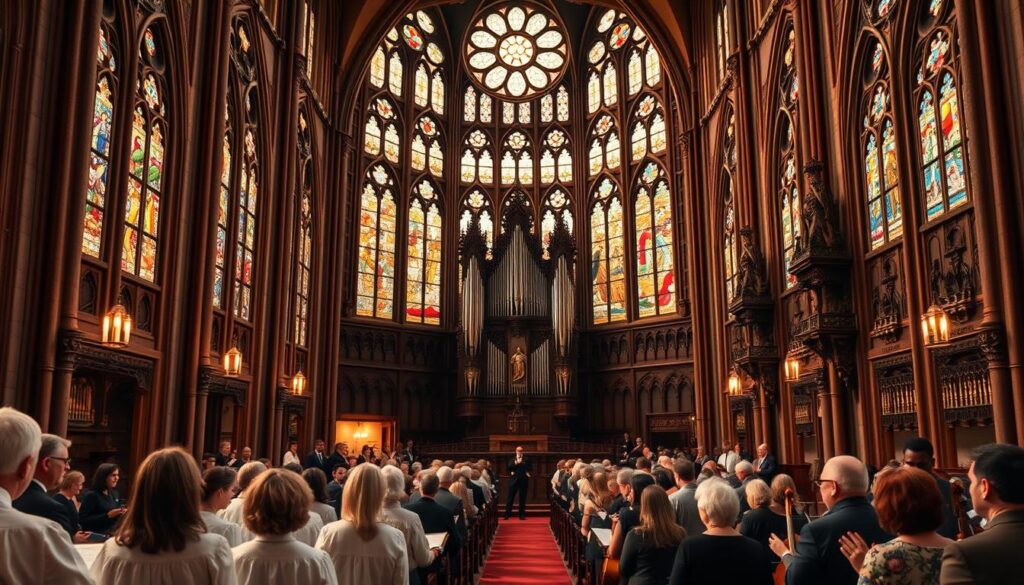
Martin Luther saw harmonies as divine tools, declaring: “Notes make scripture leap from pages into hearts.” He personally crafted hymns like “Ein feste Burg”, blending bold theology with catchy tunes. These chorales used repetitive stanzas, letting entire congregations join easily—first in unison, later in rich four-part arrangements.
By the 1700s, over 5,000 such hymns existed. This creative freedom allowed composers like Bach to transform simple chorales into complex masterpieces. Organs and choirs remained central, creating spaces where artistry and devotion intertwined.
Reformed Psalters and Congregational Singing
John Calvin’s vision took a different path. His followers sang only biblical Psalms, believing human-made lyrics couldn’t match God’s own words. The Geneva Psalter became their musical blueprint—poetic translations set to unaccompanied melodies.
Cantors like Loys Bourgeois trained communities to sing these Psalms a capella. Without instruments or harmonies, the focus stayed on collective voices. This stripped-down style aimed to eliminate distractions, making every service a pure expression of scriptural truth.
| Tradition | Musical Features | Key Figures |
|---|---|---|
| Lutheran | Four-part harmony, organs | Martin Luther, J.S. Bach |
| Reformed | A capella Psalms | John Calvin, Loys Bourgeois |
Cultural Resonance and Lasting Legacy of Protestant Church Music
Printed notes carried faith beyond stone walls into homes and hearts. By 1640, over a million psalm books circulated through England and Scotland—a staggering number for the era. This explosion of accessible lyrics transformed how communities engaged with spiritual ideas.
Music Printing and the Spread of Hymns
Movable type became a spiritual megaphone. For the first time, families could own songbooks featuring rhythmic psalms set to memorable tunes. A Scottish farmer might sing the same battle-ready hymn used during Mary Queen of Scots’ downfall—“Judge and revenge my cause, Oh Lord”—while working his fields.
These printed melodies served dual purposes. They taught theology through repetition and created cultural solidarity. Non-readers memorized scriptures by humming tunes during daily tasks, turning doctrine into muscle memory.
Sacred Music as a Unifying Force in Worship
Shared songs dissolved barriers between public worship and private life. What began as Sunday gatherings spilled into kitchens and workshops. Families sang psalms during meals, embedding faith into everyday routines.
This musical glue helped communities navigate seismic changes. When traditional comforts like Purgatory vanished from theology, collective singing provided emotional grounding. Harmonized voices reminded participants they weren’t alone—in their towns or across continents.
Conclusion
This melodic revolution stands as history’s great democratization movement for spiritual expression. What began with reformers handing songbooks to farmers now echoes in modern gatherings where entire communities raise their voices together. By replacing exclusive performances with collective participation, they gave every person a role in shaping sacred moments.
Printing presses amplified this cultural shift, turning localized traditions into global movements. Accessible lyrics traveled across continents, blending with folk melodies and inspiring new creative forms. The same principles that unified 16th-century believers now fuel diverse worship styles—from gospel choirs to contemporary praise bands.
Today’s gatherings still honor that original vision. Whether through ancient hymns or modern beats, the focus remains on inclusive participation. When voices merge across generations, they carry forward a 500-year legacy proving that shared song builds stronger communities—both inside sacred spaces and beyond.
FAQ
How did worship language change during the Reformation?
Before the Reformation, Latin dominated services. Reformers shifted to local languages, making texts accessible. This allowed congregations to engage directly with spiritual messages.
What role did hymns play in early Protestant traditions?
Hymns became central to communal singing. Leaders like Luther crafted chorales with memorable melodies. These tunes united people and simplified complex theology through poetry.
Why were psalters important in Reformed communities?
Psalters provided translated, metrical versions of biblical psalms. They encouraged congregational participation. Singing these texts fostered collective identity and deepened personal faith.
How did music printing shape religious practices?
Printing technology spread hymns rapidly. Affordable songbooks let households practice faith at home. This innovation blurred lines between formal worship and daily spiritual life.
Did reformers approve of complex musical arrangements?
Some leaders distrusted elaborate polyphony, fearing it obscured lyrics. Others balanced artistry with clarity. Simpler harmonies eventually dominated to prioritize textual understanding.
How did sacred melodies influence broader culture?
Hymn tunes crossed into folk traditions and classical works. Composers like Bach transformed chorales into art forms. This fusion kept theological themes relevant across generations.