When exploring Europe’s spiritual tapestry, few threads shine as brightly as Germany’s faith communities. At the heart of this tradition stands the Evangelical Church in Germany (EKD), a collaborative network uniting millions under shared values. With nearly 20 million members today, its influence stretches far beyond Sunday services.
The EKD’s structure reflects centuries of evolution. It blends three historic Christian traditions—Lutheran, Reformed, and United—into a vibrant modern framework. This diversity creates a spiritual mosaic where ancient rituals meet contemporary social engagement.
Geography plays a key role in understanding these communities. Northern and eastern regions often show stronger ties to this heritage, while southern areas lean toward other traditions. Cities like Hanover, home to the EKD’s headquarters, serve as hubs for theological innovation and community outreach.
What makes these groups stand out? Their ability to balance deep-rooted customs with modern challenges. From preserving historic cathedrals to addressing climate change, they remain active players in shaping society. Their story isn’t just about religion—it’s about identity, culture, and resilience.
Key Takeaways
- The EKD unites over 19 million members across 20 regional faith groups
- Three core traditions—Lutheran, Reformed, and United—shape its practices
- Northern and eastern Germany show the strongest cultural connections
- Modern priorities include social justice and environmental stewardship
- Historic sites coexist with forward-thinking community programs
Overview of Protestant Churches in Germany
Nearly one in four Germans identifies with the country’s largest Christian network, shaping regional identities and social initiatives. These faith groups operate over 20,000 worship centers, blending spiritual guidance with practical support for local neighborhoods.
The Scope of German Protestantism
With 20.2 million members, this tradition influences education, healthcare, and cultural preservation. Its footprint spans from Baltic Sea coastlines to the Black Forest, creating a living heritage visible in town festivals and historic landmarks.
Understanding Denominational Diversity
Three main branches form the theological backbone:
| Tradition | Core Regions | Distinct Practices |
|---|---|---|
| Lutheran | North/South | Traditional liturgy |
| Reformed | Northwest | Simplified worship |
| United | Central/West | Blended approaches |
This variety allows communities to adapt while maintaining shared values. Coastal towns might host fish-themed harvest festivals, while urban centers run tech-friendly youth programs.
Beyond Sunday services, these groups manage 1,200 kindergartens and 300 senior care facilities. Their ability to evolve keeps them relevant in modern society—proving faith and progress can walk hand in hand.
Historical Roots and the Reformation Movement
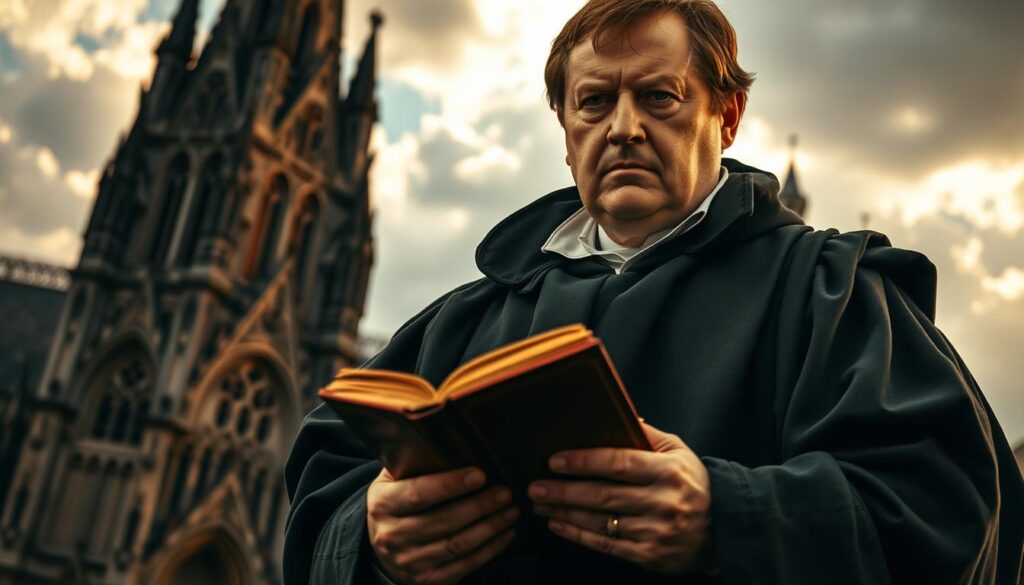
A single act of defiance in 1517 reshaped Europe’s spiritual landscape forever. When Martin Luther nailed his Ninety-five Theses to a church door, he sparked debates that would redefine Christianity’s future.
Breaking With Centuries of Tradition
Luther’s bold move challenged religious authorities to their core. His sola scriptura principle shifted focus from papal decrees to personal Bible study. This idea spread like wildfire through German-speaking regions, empowering ordinary people to question established norms.
| Aspect | Pre-Reformation | Post-Reformation |
|---|---|---|
| Language | Latin liturgy | Vernacular services |
| Sacraments | Seven rituals | Two core practices |
| Leadership | Clergy-dominated | Congregational input |
Lasting Cultural Shifts
The changes went far beyond Sunday rituals. Luther’s German Bible translation standardized the language, while new schools made education accessible. Musical traditions flourished through congregational hymns that everyone could sing.
These reforms created ripple effects still felt today. Modern social programs and democratic values trace part of their origins to this revolutionary period. As one historian noted: “The Reformation didn’t just alter church structures—it rewired how societies function.”
Evolution of Protestant Churches Through Centuries
Spiritual organizations often become mirrors of a nation’s journey, reflecting political shifts and cultural values. The story of Germany’s faith communities reveals how centuries of change shaped their identity—and reshaped entire societies.
Early Efforts at Church Unification
Prussia’s 1817 royal decree sparked a quiet revolution. By merging Lutheran and Reformed traditions, it created a blueprint for cooperation that spread across German territories. “Unity in diversity” became more than a slogan—it fueled practical collaborations in education and community care.
The 1922 German Protestant Church Confederation marked a bold leap forward. This first national alliance connected 28 regional groups, serving 40 million members. Though short-lived, it proved shared governance could work without erasing local traditions.
Impact of the Peace of Augsburg to Modern Times
That 1555 agreement did more than end wars—it planted seeds of religious coexistence. By letting rulers choose their territory’s faith, it created a framework that still influences church-state relationships today.
Modern structures like the EKD grew from these roots. As one historian observed: “What began as political compromise became a model for balancing spiritual使命 with societal needs.” From state-controlled institutions to independent entities, these adaptations show how faith communities can evolve while staying grounded in their core values.
Impact of the World Wars and Political Changes
The 20th century tested religious institutions like never before. Global conflicts and shifting ideologies forced faith communities to navigate treacherous political waters while maintaining their core values.
Churches Under Nazi Influence and the Confessing Church
When authoritarian rule emerged in 1933, religious groups faced intense pressure to align with state agendas. A bold resistance movement formed, challenging attempts to distort spiritual teachings for political gain. This clash created deep fractures within congregations nationwide.
| Group | Leadership | Position |
|---|---|---|
| Reichskirche | Pro-government clergy | Supported racial policies |
| Confessing Church | Dietrich Bonhoeffer | Rejected Nazi ideology |
Brave theologians risked their lives to protect religious independence. Their underground networks became safe spaces for dissent during dark times. This legacy continues to inspire modern social justice efforts.
The Role During the German Democratic Republic
Post-war divisions created new challenges. Communities in East Germany operated under strict surveillance from 1949-1990. Despite communist pressures, they maintained youth programs and public dialogues that subtly challenged state narratives.
Key developments included:
- 1969 separation from western counterparts
- 1991 reunification after national unity
- Ongoing reconciliation efforts post-1990
These groups proved faith could thrive even under oppressive regimes. Their meeting halls often doubled as hubs for peaceful political change, showing how spiritual spaces can foster societal transformation.
Organizational Structure and Governance
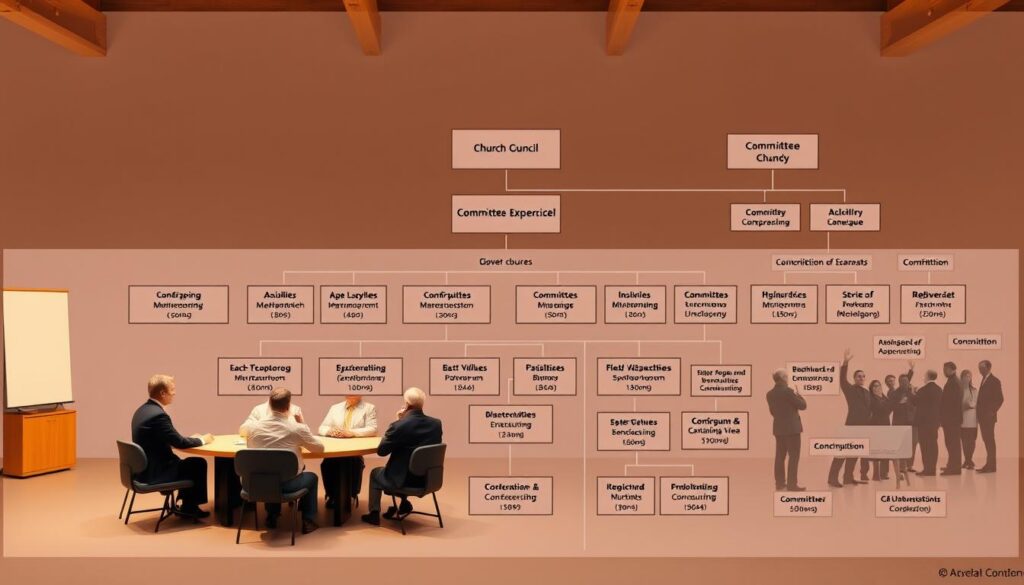
Modern religious organizations thrive on clear frameworks that balance unity with local needs. The Evangelical Church in Germany operates like a well-oiled machine, combining regional autonomy with national coordination through three key bodies.
The Role of the EKD and Regional Churches
At the heart of operations sits the 126-member Synod – 106 elected locally and 20 specialists appointed for expertise. This legislative group works alongside a 15-member Council handling executive decisions for six-year terms. “Our strength lies in shared responsibility,” notes a recent EKD report, highlighting their federal approach.
Leadership styles vary across regions:
| Tradition | Structure | Key Leader |
|---|---|---|
| Lutheran | Episcopal | State Bishop |
| Reformed | Presbyterian | Moderator |
| United | Mixed | Synod President |
Significant Church Figures and Leadership
Groundbreaking leaders have shaped modern operations. Margot Käßmann made history as the first female Council chair, while Heinrich Bedford-Strohm gained recognition for bridging faith and social issues. Their work continues through Hanover’s Church Office, where 200 staff coordinate nationwide programs.
This unique system proves that ancient traditions can adapt to 21st-century needs. By respecting local customs while maintaining national cohesion, the structure fosters both innovation and continuity.
protestant churches in germany: Membership, Traditions, and Demographics
Germany’s faith communities present a fascinating study in contrasts between formal affiliation and active engagement. While over 19 million people claim membership, only 1.2% regularly attend services. This gap highlights changing attitudes toward organized religion in modern society.
Regional patterns reveal deep cultural roots. Northern states like Schleswig-Holstein (55.7%) and Lower Saxony (51.5%) show stronger connections to this heritage. Southern areas maintain different religious majorities, creating a distinctive spiritual map.
| Tradition | Key Feature | Modern Adaptation |
|---|---|---|
| Lutheran | Historical liturgy | Youth mentorship programs |
| Reformed | Simplified worship | Digital outreach initiatives |
| United | Blended practices | Interfaith partnerships |
Age demographics tell another story. Only 11% of regular attendees are under 30, pushing communities to rethink engagement strategies. Many now blend traditional hymns with contemporary music during services.
The Evangelical-Lutheran Church and other groups maintain unity through shared principles. Members can participate fully in any congregation nationwide, thanks to mutual recognition agreements. This flexibility helps preserve relevance despite membership shifts.
Beyond Sunday services, these communities operate food banks, refugee support networks, and environmental projects. As one volunteer notes: “Our work isn’t just about belief—it’s about being present where life happens.”
Cultural Influence and Social Impact in Modern Society
Cultural landscapes are often shaped by silent forces. Among them stands a tradition of spiritual creativity and social conscience that continues to mold Germany’s identity. This enduring legacy manifests in concert halls, community centers, and ethical debates alike.
Religious Contributions to Art and Music
The Lutheran church revolutionized visual storytelling during the Reformation. Artists like Lucas Cranach translated theological ideas into vivid altarpieces, while architects reimagined sacred spaces for congregational participation. Modern structures like Essen’s Church of the Resurrection prove this creative spirit remains alive.
Music became faith’s universal language through pioneers like Bach. His compositions still echo in cathedrals today, blending mathematical precision with emotional depth. Contemporary musicians build on this heritage, crafting new worship songs that resonate with digital-age audiences.
Contemporary Social Engagement and Community Welfare
Today’s Protestant churches tackle global challenges through initiatives like Brot für die Welt. This program combats hunger in 90 countries while promoting sustainable farming. Locally, food banks and refugee shelters operate alongside historic parishes.
The evangelical reformed church leads environmental campaigns, advocating for climate policies and green energy. Their efforts show how ancient values can address modern crises. As one volunteer shared: “We’re not just preserving traditions—we’re building bridges to tomorrow.”
From bioethics debates to interfaith dialogues, these communities prove faith institutions can evolve without losing their soul. Their story isn’t confined to history books—it’s written in every mural restored, every meal shared, and every voice raised for justice.
FAQ
How did Martin Luther influence religious life in Germany?
Martin Luther’s Ninety-five Theses in 1517 sparked the Reformation, challenging Catholic practices and shaping new traditions. His teachings led to the rise of Lutheran and Reformed branches, creating lasting changes in worship and theology.
What role did churches play during the Nazi regime?
Many regional bodies faced pressure to align with Nazi policies, but the Confessing Church resisted. Leaders like Dietrich Bonhoeffer openly opposed state control, defending independent faith practices despite persecution.
How is the Evangelical Church in Germany (EKD) structured?
The EKD unites 20 Lutheran, Reformed, and United regional bodies. Each maintains autonomy over governance and traditions while collaborating on national initiatives like social programs or interfaith dialogue.
What traditions distinguish Lutheran worship today?
Services often emphasize liturgy, hymn singing, and communal sacraments like altar communion. Many congregations blend historic practices with modern outreach, such as community welfare projects or digital ministries.
How did political shifts in East Germany affect membership?
After World War II, state atheism in the German Democratic Republic led to declining participation. Post-reunification, many in eastern regions identify as non-religious, contrasting with higher engagement in western areas.
Do members pay taxes to support their church?
Yes, registered adherents contribute through a “church tax” collected by the government. This funds clergy salaries, building maintenance, and social services like hospitals or disaster relief.
Are evangelical reformed congregations common in Germany?
Reformed traditions are smaller compared to Lutheran groups but thrive in regions like Lippe. They emphasize scripture-centered preaching and simpler worship styles, often collaborating with other denominations.
How do churches address modern social issues?
Many advocate for refugee support, climate action, and equality. Initiatives like the “Church for Democracy” program counter extremism, reflecting a commitment to societal well-being beyond traditional roles.