Visual identity for faith communities carries deep historical roots. The movement that began in 1517 with Martin Luther’s bold stance reshaped Christian theology, emphasizing faith, grace, and scripture as core principles. These ideas didn’t just stay in churches—they inspired art, culture, and even modern design practices.
Designers today face a unique challenge: translating centuries-old beliefs into clean, meaningful visuals. Think of Wittenberg’s All Saints’ Church, where Luther’s actions sparked change. Modern emblems often nod to this heritage through subtle shapes or colors while avoiding Catholic symbolism like saints or elaborate icons.
The Five Solas—central to Protestant theology—serve as a blueprint. Concepts like “grace alone” or “Christ-centered faith” become abstract patterns or minimalist symbols. This balance ensures logos feel timeless yet relevant to diverse congregations.
Key Takeaways
- Historical events from 1517 continue to shape modern religious symbolism
- The Five Solas provide a framework for meaningful design choices
- Effective logos honor tradition while appealing to contemporary audiences
- Designers must navigate distinct visual boundaries between Christian denominations
- Every color, shape, and line carries theological significance
Introduction to Protestant Logo Design and Its Significance
Creating symbols for religious communities bridges ancient teachings with modern aesthetics. Every curve and hue in these designs carries weight, reflecting scripture as ultimate authority and the belief that grace comes through faith. Unlike other Christian traditions, this design philosophy avoids ornate imagery, focusing instead on simplicity that honors reformation ideals.
Why does this matter? Visual identity acts as a silent teacher for faith communities. A well-crafted emblem can convey “Christ-centered truth” faster than words. It becomes a shared language for believers across cultures, transcending barriers through universal shapes and meaningful colors.
Designers face a sacred task. They must distill complex doctrines into clean marks that resonate today. Think open Bibles symbolized by abstract lines or crosses stripped of decoration. These choices support the core message without distraction.
The best creations balance heritage with freshness. They nod to 16th-century roots while feeling at home on websites and signage. This dual purpose makes them powerful tools for outreach—visual invitations to explore deeper truths behind the design.
Historical Context of Protestantism
A single document reshaped Christianity’s visual language five centuries ago. In 1517, Martin Luther’s Ninety-five Theses challenged church authority and sparked a movement that still influences symbols of faith today. This bold critique of indulgences—payments for forgiveness—shifted focus to grace as a divine gift rather than a transaction.
Martin Luther and the Ninety-five Theses
Luther’s writings at Wittenberg’s All Saints’ Church rejected the idea that salvation could be bought. His emphasis on “faith alone” became a cornerstone for reformers. This theological pivot inspired visual simplicity in religious art, contrasting with ornate Catholic imagery of the time.

Wittenberg: The Cradle of Protestantism
The church door where Luther shared his ideas remains a powerful symbol. Modern designers often reference its arched shape or ironwork patterns to honor this heritage. Wittenberg’s architecture—like its castle church spire—appears abstracted in emblems as a nod to Reformation roots.
Color palettes also reflect this history. Earthy tones evoke parchment and quills, while stark contrasts mirror Luther’s clear stance on scripture. These choices create timeless visuals that bridge past teachings with present-day communities.
The Role of Religion in Logo Symbolism
Sacred texts shape visual identity in unexpected ways. When crafting emblems for faith groups, designers mine biblical stories and teachings to create symbols that whisper ancient truths through modern lines. This approach roots designs in theological foundations while speaking to today’s seekers.
Biblical Inspirations Behind Design Elements
The open Bible remains the ultimate visual shorthand for Sola Scriptura. Designers simplify its form into horizontal lines suggesting pages, or use radiating light to symbolize divine revelation. Scroll motifs nod to ancient manuscripts while avoiding ornate decoration.
Common scriptural symbols carry layered meanings:
| Symbol | Biblical Reference | Modern Interpretation |
|---|---|---|
| Dove | Matthew 3:16 (Holy Spirit) | Minimalist outline with upward motion |
| Wheat Sheaf | John 12:24 (Sacrifice) | Abstract geometric patterns |
| Flame | Acts 2:3 (Pentecost) | Gradient colors suggesting movement |
Color choices whisper scriptural truths. Deep purple recalls Christ’s royalty, while crimson echoes sacrifice. Designers pair these hues with clean typography to emphasize textual focus over imagery.
The challenge lies in honoring scripture without creating visual idols. Many emblems use negative space to suggest open books or crosses, inviting viewers to “fill in” meaning through personal reflection. This mirrors the Reformation’s push for individual engagement with sacred texts.
Light metaphors from Psalms and Gospels often appear as radiating lines or glowing accents. These elements visually affirm that “Your word is a lamp for my feet” while maintaining modern simplicity.
Visual Elements in Protestant Logos
Designs for faith communities speak through shapes and shades. After 16th-century reforms removed statues and paintings, creative solutions emerged. Words became art, and simple objects turned into powerful messengers of belief.

Common Symbols and Iconography
Modern emblems use everyday items with spiritual meanings. Open books symbolize scripture’s central role, often shown through stacked lines suggesting pages. Lamps appear as minimalist outlines, nodding to “Your word is a light” from Psalms.
Three frequent motifs carry layered significance:
- Paths or arrows: Represent spiritual journeys
- Bread and cup outlines: Suggest communion without detailed imagery
- Abstract trees: Connect to growth described in Galatians
Color, Typography, and Imagery
Deep blues and crimsons dominate modern designs. Azure conveys trust in divine promises, while scarlet recalls sacrifice. Gold accents highlight eternal truths without appearing lavish.
Font choices matter as much as symbols. Clean sans-serif styles reflect clarity of message, while subtle serifs hint at historical roots. Designers often enlarge initial letters to draw attention to key scriptural concepts.
Negative space plays a clever role. Blank areas might form cross shapes or open books, inviting viewers to complete the picture mentally. This technique honors Reformation ideals about personal engagement with truth.
Key Features of the Protestant Logo
Distinctive markers unite diverse faith groups through shared visual language. From Lutheran to Baptist traditions, emblems balance theological diversity with core principles. These designs act as silent ambassadors, conveying beliefs through shapes and words rather than elaborate decoration.
Clean layouts dominate, reflecting Reformation-era rejection of excess. Text takes center stage—scripture snippets or denominational names appear in bold fonts. This approach mirrors the emphasis on accessible teachings over ritualistic symbols.
| Design Element | Denominational Use | Symbolic Meaning |
|---|---|---|
| Open Bible | Baptists, Presbyterians | Scripture as ultimate authority |
| Flame | Methodists, Charismatics | Holy Spirit’s presence |
| Empty Cross | Lutherans, Non-denominational | Resurrection hope |
Light motifs shine through many emblems. Flames or sunbursts represent spiritual awakening, while simplified crosses focus on resurrection. Unlike ornate Catholic crucifixes, these empty crosses emphasize victory over death.
These visual markers help identify community values at a glance. A Methodist church’s emblem might feature a flame and cross, signaling both tradition and renewal. Such designs create instant recognition while inviting deeper exploration of beliefs.
Symbolism Behind the Design Elements
Every mark tells a story when rooted in theological conviction. The Five Solas—cornerstones of Reformation thought—shape visual language through deliberate design choices. These principles transform abstract beliefs into tangible symbols that communicate across generations.
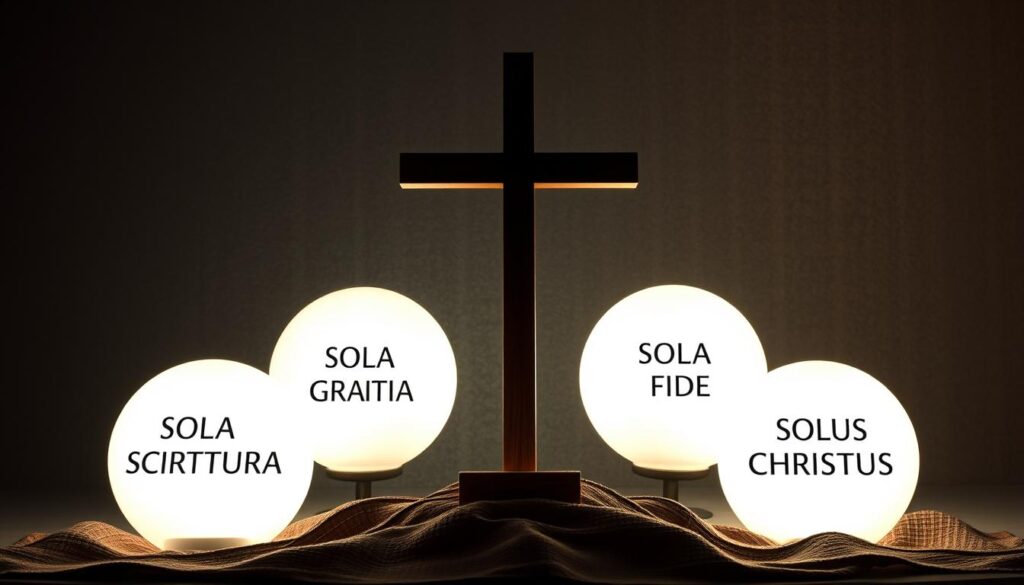
Sola Scriptura appears as open books or stacked parchment shapes. Clean lines suggest pages ready for study, while light rays above symbolize divine revelation. As Luther noted: “Scripture is its own interpreter”—a truth mirrored in text-centric layouts.
Trust symbols like upward palms or anchors embody Sola Fide. These elements avoid literal representations, using negative space to imply spiritual reliance. Circular motifs often surround them, suggesting wholeness through faith alone.
| Sola Principle | Visual Element | Symbolic Meaning |
|---|---|---|
| Solus Christus | Empty throne | Christ’s unique mediation |
| Sola Gratia | Flowing water lines | Unearned divine favor |
| Soli Deo Gloria | Sunburst patterns | God-centered purpose |
Grace-focused designs use soft curves and gradient purples. These elements mirror the unexpected nature of spiritual gifts. Upward arrows or mountain peaks in compositions direct attention heavenward, embodying Soli Deo Gloria.
Understanding these layers reveals how simple shapes carry profound meaning. A single emblem can encapsulate centuries of belief while inviting modern engagement—proof that great design speaks louder than ornate decoration.
Religious Art and Protestant Iconography
Artistic expression underwent radical transformation during the 16th-century reforms. When John Calvin arrived in Geneva in 1536, he encountered a medieval world saturated with religious statues and pilgrimage sites. His theological vision sparked iconoclastic movements that replaced physical representations with bold textual displays.
Impact of the Reformation on Visual Arts
The 1566 iconoclastic wave reshaped European sacred spaces. Stained glass saints made way for engraved psalms, and altar paintings surrendered to carved Bible verses. This shift birthed “text images”—creative arrangements of scripture that served as both decoration and doctrine.
Three key changes emerged:
- Churches became galleries of words, with walls featuring oversized Ten Commandments
- Printing presses produced elaborate biblical typography for home devotion
- Geometric patterns replaced figurative art in communal spaces
| Medieval Art | Reformation-Era Art | Modern Influence |
|---|---|---|
| Saints in stained glass | Engraved scripture panels | Minimalist text-based designs |
| Carved crucifixion scenes | Abstract communion symbols | Negative space techniques |
| Gilded reliquaries | Ornate Bible covers | Metallic typography accents |
This visual revolution prioritized accessible truth over mysterious symbolism. Calligraphers became theological artists, transforming Psalms into circular patterns and Proverbs into architectural borders. Their work laid foundations for today’s emphasis on clean, meaningful design in faith communities.
Modern creators echo these principles through:
- Bold sans-serif fonts quoting scripture
- Interlocking shapes suggesting unity
- Monochromatic schemes focusing attention
Influence of the Five Solas in Design Concepts
Design principles rooted in 16th-century theology continue shaping modern visual identities. The Five Solas—those revolutionary Reformation ideas—act as silent guides for creators. They transform complex beliefs into clear visuals that speak across generations.
Sola Scriptura and Visual Messaging
Scripture-first designs shout without words. Open book symbols dominate, using stacked lines instead of detailed illustrations. Light rays above abstract pages support the idea of divine revelation through text alone.
Modern emblems often pair these elements with crisp typography. Bible verses appear in bold fonts, mirroring reformers’ focus on accessible truth. This approach turns ancient words into visual anchors for communities.
Sola Fide and the Use of Emblematic Elements
Faith-centered symbols lean on simplicity. Empty crosses and upward arrows replace ornate decorations. These clean marks invite personal reflection—a nod to individual spiritual journeys.
Color choices deepen the message. Warm golds suggest enduring trust, while deep blues echo heavenly promises. Together, they create emblems that feel both ancient and fresh, much like the beliefs they represent.
FAQ
How do historical events shape modern religious logo designs?
Historical moments like the Reformation and figures such as Martin Luther influenced visual storytelling in designs. Modern logos often reflect themes of faith, scripture, and community rooted in these events.
What symbols are commonly used in Reformation-inspired designs?
Crosses, open Bibles, doves, and flames symbolize faith, truth, the Holy Spirit, and spiritual renewal. Colors like deep blues, golds, and reds convey reverence, divinity, and sacrifice.
Why is typography important in faith-based branding?
Fonts like serif or classical styles evoke tradition and authority, aligning with doctrinal values. Clean, bold lettering ensures clarity while reflecting strength and timelessness.
How do the Five Solas impact design concepts?
Principles like Sola Scriptura (Scripture alone) emphasize simplicity and focus on biblical imagery. Designs might feature open books or scrolls to highlight scriptural centrality.
What role does Wittenberg play in religious iconography?
As the birthplace of the Reformation, Wittenberg inspires imagery like castle churches or Luther’s rose. These elements connect designs to historical roots and theological breakthroughs.
Are there guidelines for using sacred symbols in branding?
Respectful representation is key. Designers often consult faith leaders or historical sources to ensure symbols align with doctrinal meanings and avoid misinterpretation.
How did the Reformation change religious art styles?
The shift toward simplicity and accessibility reduced ornate decorations. Art focused on teaching core beliefs, which still influences minimalist, message-driven designs today.