Let’s step back in time to explore a pivotal era that reshaped Europe’s spiritual landscape. The 17th century saw dramatic shifts in faith practices, building on ideas sparked decades earlier. Though Martin Luther’s 1517 protests ignited change, the ripple effects lasted well into the 1600s, creating lasting impacts still felt today.
This period wasn’t just about theology—it transformed politics, culture, and daily life. Historians often mark its conclusion with the 1648 Treaty of Westphalia, which ended decades of conflict. At the heart of these changes lay a simple yet revolutionary idea: Scripture, not tradition, should guide spiritual truth.
You’ll discover how communities reimagined worship and governance during this age of reform. From England’s growing Anglican identity to Calvinist movements in Switzerland, new interpretations of faith took root. These developments didn’t just shape churches—they influenced laws, education, and even international relations.
Key Takeaways
- The Reformation’s impact stretched far beyond its 1517 origins, defining the 17th century
- Major treaties like Westphalia (1648) helped stabilize religious tensions
- Biblical authority became central to evolving faith practices
- Religious changes sparked political and social transformations
- Distinct denominations emerged, each with unique traditions
Historical Context and the Foundations of the Reformation
Long before Luther’s famous theses, seeds of religious change were sprouting across Europe. Visionary thinkers challenged the church’s authority, paving the way for sweeping reforms. Their ideas would later fuel movements that reshaped entire nations.
Pre-Reformation Pioneers and Their Legacy
John Wycliffe sparked debates in 14th-century England by translating Scripture into English. His work gave ordinary people direct access to biblical teachings. This bold move weakened the clergy’s control over religious interpretation.
Jan Hus took up the reform torch in Bohemia. At Prague University, he criticized church corruption and championed Czech nationalism. His 1415 execution made him a martyr, inspiring future reformers to question traditional doctrines.
| Reformer | Contribution | Impact |
|---|---|---|
| John Wycliffe | English Bible translation | Empowered lay readers |
| Jan Hus | Church corruption critiques | Fueled nationalist reforms |
| Early Printers | Mass-produced texts | Spread ideas rapidly |
The Information Revolution of Faith
Gutenberg’s printing press changed everything. By 1525, Luther had published over 100 works – more than 17 other reformers combined. Vernacular Bibles reached common people, creating a spiritual awakening.
This technology let reformers bypass traditional church channels. Printed pamphlets spread new doctrines to princes and peasants alike. For the first time, religious debates reached the entire population.
These developments created fertile ground for lasting change. Centuries of simmering discontent met revolutionary communication tools. The stage was set for Europe’s great religious transformation.
The Evolution of Protestantism in Europe
While Luther challenged Rome, Swiss thinkers crafted their own path to reform. These parallel movements transformed how communities practiced faith and governed themselves. Their distinct approaches created lasting traditions that still shape Christian worship today.
Germany, Lutheranism, and Revolutionary Change
Martin Luther‘s bold stand in 1517 began quietly—nailing debates about indulgences to a Wittenberg church door. By 1521, his refusal to recant at the Diet of Worms made him Europe’s most famous heretic. “Here I stand,” he declared, sparking a spiritual revolution.

Protected by Saxon princes, Luther translated the Bible into German—a radical act that let ordinary people interpret Scripture. Local rulers soon adopted Lutheranism as their state religion, blending spiritual authority with political power. This partnership fueled rapid growth across northern Europe.
Switzerland and the Rise of Calvinism
Zurich’s Ulrich Zwingli launched Switzerland’s reformation in 1519, emphasizing scriptural purity. But Geneva became Calvinism’s powerhouse after 1541. John Calvin’s strict doctrine taught that God predestined souls before birth—a concept that shaped daily life through moral codes.
Exiled reformers flocked to Geneva, turning it into a training hub for Protestant leaders. Calvin’s ideas spread like wildfire through pamphlets and trained missionaries. By 1600, his teachings influenced Scotland’s kirk, French Huguenots, and Dutch Reformed communities.
Both movements proved that new interpretations of faith could reshape societies. Luther’s focus on personal faith and Calvin’s structured theology created competing visions—each leaving deep marks on European culture.
Protestant Religions 1600: Key Figures and Doctrinal Shifts
At the heart of Europe’s spiritual revolution stood bold thinkers who reshaped Christianity’s future. Their debates about authority and truth sparked movements that still influence modern faith. Let’s uncover how ideas clashed and merged during this defining era.
Influential Reformers and Their Historical Impact
When German princes protested at the 1529 Diet of Speyer, they coined the term “Protestant” by declaring loyalty to God over rulers. This moment crystallized two major camps: Lutherans focused on grace through faith, while Reformed groups emphasized God’s sovereignty. Leaders like Martin Bucer bridged these views, crafting compromises that united communities.
“Scripture alone lights our path—not popes or councils,” argued theologian Theodore Beza, capturing the reformers’ core belief.
| Tradition | Core Doctrine | Geographic Reach |
|---|---|---|
| Lutheran | Justification by faith | Northern Germany, Scandinavia |
| Reformed | Predestination | Switzerland, Scotland, Netherlands |
| Anglican | Via media (middle way) | England, American colonies |
Doctrinal Debates and Religious Publications
The 17th century saw clergy publish thousands of articles debating baptism, communion, and church structure. Printed works like the Westminster Confession (1646) became doctrinal guidebooks. These texts shaped worship practices, from sermon styles to hymn singing.
Reformers also clashed over Catholicism’s legacy. Some sought complete separation, while others preserved rituals like liturgical calendars. These disputes birthed new denominations—each claiming biblical authority for their doctrines.
Through pamphlets and sermons, ideas spread faster than ever. Ordinary people gained access to theological debates once reserved for scholars. This shift forever changed how communities practiced faith.
The English Reformation: Politics, Power, and Religion
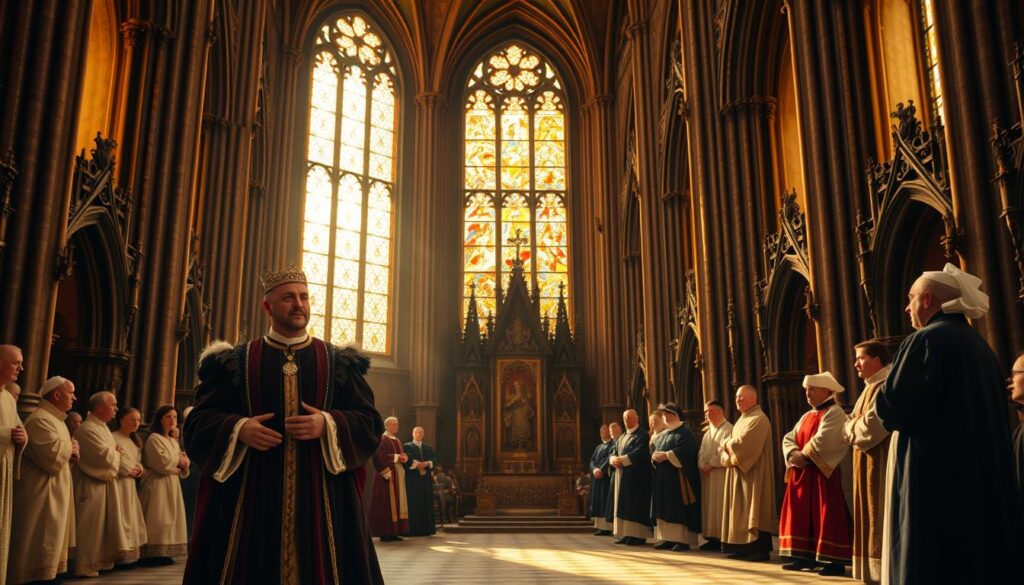
England’s religious landscape changed forever when a king’s personal crisis sparked a national transformation. What began as Henry VIII’s desperate bid for a male heir evolved into a complete overhaul of spiritual authority.
Breaking Ties with Rome
In 1527, Henry VIII faced a dilemma. His marriage to Catherine of Aragon produced no surviving sons. When the Pope refused an annulment, the king took radical action. The 1534 Act of Supremacy declared him “Supreme Head of the Church of England“—a title merging royal and religious power.
Crafting a Spiritual Compromise
Henry’s new church walked a careful line. It kept Catholic rituals but rejected papal control. Monasteries were dissolved, their wealth funding royal coffers. English Bibles appeared in parishes, letting people read Scripture firsthand.
This “middle way” created lasting change. By placing the throne above foreign religious authority, it shaped England’s identity for centuries. The Church of England became both a spiritual institution and a tool of statecraft.
Socio-Political Transformations and Shifts in Church Authority
England’s landscape shifted dramatically as spiritual and earthly authority merged under royal control. This fusion reshaped everything from land ownership to how ordinary people experienced faith. Let’s explore how these changes rippled through society.
Monarchy, Authority, and Dissolution of Monasteries
Henry VIII made history by seizing church lands starting in 1536. Nearly a third of England’s territory changed hands, filling the Crown’s empty treasury. New landowners emerged while monasteries vanished, erasing centuries of tradition.
Parishes now needed English Bibles by royal decree. For the first time, common people could read Scripture themselves. This power shift from clergy to king redefined spiritual access.
Impact on Marriage, Power, and National Identity
After Henry’s death, Edward VI accelerated reforms. Latin mass ended in 1549, replaced by Thomas Cranmer’s Book of Common Prayer. English liturgy became law, not choice.
Elizabeth I perfected the balance when she took the throne in 1558. Her Church of England blended old rituals with new ideas. This “middle way” crafted a unique national identity still felt today.
FAQ
Why did Henry VIII break from the Catholic Church?
Henry VIII sought to annul his marriage to Catherine of Aragon to marry Anne Boleyn, hoping for a male heir. When the Pope refused, Henry rejected papal authority, declared himself head of the Church of England, and dissolved monasteries to consolidate power.
What made the Church of England’s “Middle Way” unique?
The “Middle Way” blended Catholic traditions—like rituals—with Protestant ideas, such as vernacular worship. This approach aimed to ease tensions between reformers and traditionalists while maintaining royal control over doctrine.
How did Martin Luther’s theses spark change in Germany?
Luther’s 95 Theses criticized indulgences and clerical corruption, spreading rapidly due to the printing press. His ideas challenged papal authority, leading to Lutheran reforms and empowering local rulers to reject Catholic dominance.
What role did Calvinism play in Switzerland?
John Calvin emphasized predestination and strict moral codes in Geneva. His teachings influenced governance, education, and social norms, making Switzerland a hub for Reformed theology that spread across Europe.
How did the dissolution of monasteries affect England?
Henry VIII seized monastic lands and wealth, redistributing them to nobles. This weakened Catholic influence, enriched the crown, and shifted economic and political power to the monarchy and loyal elites.
Why was the Book of Common Prayer significant?
Introduced under Edward VI, it standardized Anglican worship in English instead of Latin. It reflected Protestant doctrines while retaining familiar rituals, shaping the Church of England’s identity and unifying practices.
How did marriage laws shift during the Reformation?
The Church of England allowed royal divorces and emphasized marriage as a civil contract. This contrasted with Catholic sacramental views, reinforcing the monarchy’s control over personal and religious matters.