Welcome to an exploration of one of Christianity’s most influential branches. Born from the Protestant Reformation in 16th-century Europe, this religious movement reshaped the Christian church by prioritizing personal faith and scriptural authority. What began as a call for reform grew into a global community of over 833 million believers, each united by core principles that continue to inspire.
At its heart, protestantes emphasize salvation through grace alone, accessible to all without intermediaries. This belief fueled innovations in education, governance, and art, shaping modern democracies and literacy movements. From Lutheranism to Pentecostalism, denominational diversity reflects adaptability while maintaining foundational truths.
Today, these traditions address contemporary issues like social justice and ethical dilemmas. Whether through vibrant worship or community outreach, Protestantism remains a living faith—rooted in history yet engaged with today’s challenges.
Key Takeaways
- Originated during the 16th-century Protestant Reformation
- Core beliefs include salvation by faith and biblical authority
- Global community spans 833 million adherents
- Shaped Western education, politics, and culture
- Includes diverse denominations like Lutheran and Pentecostal
- Relevant to modern ethical and spiritual questions
Introduction to Protestantes
What does it mean to protest with your faith? The answer began in 1529 when German princes stood against empire-wide religious rules. At the Diet of Speyer, leaders rejected demands from the Roman Catholic emperor, declaring: “We must obey God rather than men.” This act birthed the term “Protestant”—literally meaning “to declare publicly.”
Unlike other Christian traditions, protestantes focus on direct access to God through scripture. They reject church hierarchy in favor of personal Bible study. This idea sparked a spiritual revolution—one where farmers and kings alike could interpret faith.
Three pillars define Protestant identity:
| Denomination | Founded | Key Belief | Global Reach |
|---|---|---|---|
| Lutheran | 1517 | Salvation by faith alone | 70 million |
| Baptist | 1609 | Adult baptism | 47 million |
| Pentecostal | 1906 | Holy Spirit gifts | 280 million |
From six German states in 1529, the movement now spans 200+ denominations. The 20th century saw explosive growth in Africa and Asia. Yet all share core ideas: Bible authority, grace-based salvation, and every believer’s right to worship freely.
Today’s protestantes honor their rebellious roots while adapting to modern life. Whether through gospel music or social justice work, they prove faith can both challenge power and build communities.
Historical Foundations and Proto-Protestantism
Long before Luther’s hammer struck the church door, brave voices challenged religious power. The middle ages simmered with reformers like Jan Hus, a fiery Czech preacher. As rector of Prague University, he demanded clergy accountability and full communion rights for all believers. His ideas sparked outrage—and a death sentence at the 1415 Council of Constance.
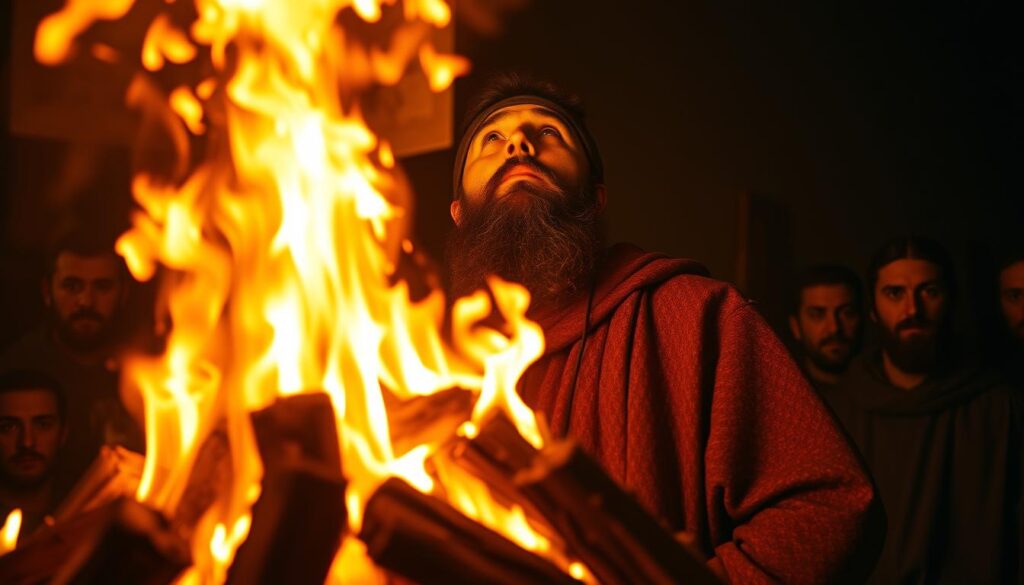
Hus’s burning didn’t silence his message. Followers across Europe sang hymns as they fought for his vision. Meanwhile, Italian scholar Lorenzo Valla exposed church forgeries using ancient texts. His proof that the “Donation of Constantine” was fake shook papal authority to its core.
Florence’s Girolamo Savonarola took reform further. He rallied citizens against corruption through bonfires of vanity items. Though executed in 1498, his mix of moral zeal and political action inspired future rebels.
| Reformer | Contribution | Impact |
|---|---|---|
| Jan Hus | Laicized communion | Inspired Hussite Wars |
| Lorenzo Valla | Exposed forged documents | Undermined papal claims |
| Girolamo Savonarola | Moral-political reforms | Prefigured Calvinism |
These trailblazers proved truth could outlive fire. Their courage laid tracks for the Reformation train—a movement that would forever change how people worshiped and governed.
The Protestant Reformation: A Turning Point
October 31, 1517, changed religious history forever. A German monk named Martin Luther nailed ninety-five arguments to a church door in Wittenberg, sparking the 16th-century movement we now call the Protestant Reformation. His bold act challenged the Catholic Church’s sale of indulgences—payments claimed to reduce punishment for sins. “Why does the pope not empty purgatory for love rather than money?” Luther famously asked.
Wittenberg quickly became the Reformation’s heartbeat. Luther’s ideas spread like wildfire thanks to Gutenberg’s printing press. Within months, his critiques reached commoners and scholars across Europe. People began questioning not just indulgences but the entire church hierarchy.
The conflict turned political at the 1529 Diet of Speyer. German princes defended their right to follow reformed teachings, shouting “We protest!” against imperial orders. This defiance gave the movement its name—Protestantism—and marked a permanent split in Western Christianity.
Three lasting impacts emerged from this era:
- Bible translations into everyday languages
- Emphasis on personal faith over rituals
- Questioning of political and religious authority
More than a theological debate, the Protestant Reformation reshaped education, art, and governance. Its focus on individual conscience still influences modern discussions about faith and freedom.
Key Figures in Protestant History
History remembers those who dare to rewrite it. The Protestant movement flourished through bold thinkers who transformed personal convictions into global change. Let’s meet the architects who built new spiritual frameworks brick by brick.
Martin Luther and the Ninety-Five Theses
A thunderstorm changed everything. In 1505, young Martin Luther vowed to become a monk after surviving lightning strikes. His spiritual journey led to a greater shock in 1517 when he challenged church practices with ninety-five arguments. “The true treasure of the church is the gospel of the glory of God,” he declared, sparking debates across Europe.
Luther’s translation of the Bible into German let ordinary people read scripture. His marriage to Katharina von Bora showed clergy could have families. These actions made faith personal and practical.
John Calvin and Reformed Theology
While Luther sparked the fire, John Calvin built the furnace. His 1536 Institutes of the Christian Religion became Protestantism’s textbook. Calvin taught that God’s plan predestines souls—a idea that shaped Puritan colonies in America.
Geneva became his laboratory for reform. The city banned dancing but promoted education. By 1555, Calvin’s followers spread his ideas to Scotland and the Netherlands.
Other reformers added unique threads:
- Huldrych Zwingli – Saw communion as symbolic, not magical
- Thomas Cranmer – Crafted England’s Book of Common Prayer
- John Knox – Turned Scotland Presbyterian with fiery sermons
Together, these leaders proved that one person’s courage could inspire millions. Their legacy lives in churches, schools, and governments worldwide.
The Five Solas: Core Doctrines of Protestantes
What unites Baptists, Lutherans, and Methodists worldwide? Five Latin phrases forged during the Reformation still define Protestant identity. These Five Solas—meaning “alone” or “only”—reject medieval church practices while affirming biblical truths.
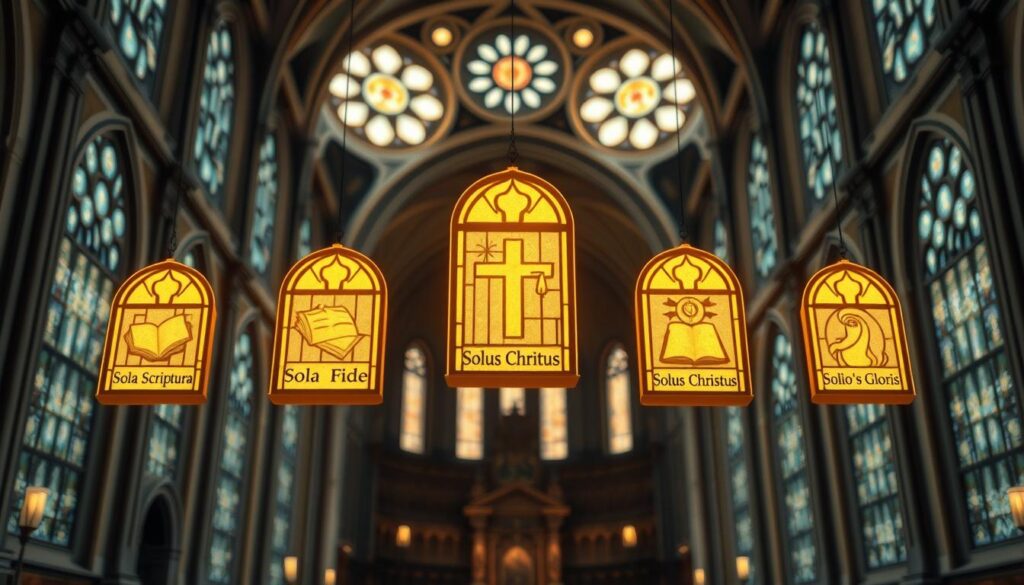
Sola Scriptura and Sola Fide
Sola Scriptura declares the Bible as Christianity’s supreme authority. “Scripture interprets itself,” Luther argued, challenging apostolic succession claims. This principle let farmers read God’s Word without priestly mediation.
Sola Fide reshaped salvation itself. Protestant reformers taught that faith—not good deeds—connects believers to divine grace. As Paul wrote: “A person is justified by faith apart from works of the law.”
Sola Gratia and Solus Christus
Sola Gratia insists grace flows from God’s kindness, not human effort. Imagine a gift you can’t earn—that’s salvation through grace alone.
Solus Christus makes Jesus the sole bridge to God. No saints, popes, or rituals needed. This doctrine simplified worship while empowering ordinary believers.
Together with Soli Deo Gloria (glory to God alone), these principles form a theological compass. They remind protestantes that faith begins and ends with divine love—accessible to all.
Doctrinal Developments and Theological Debates
Protestant theology thrives on lively debates that shape beliefs across generations. From 16th-century reformers to modern scholars, these discussions keep traditions vibrant while addressing new questions.
Universal Priesthood and the Trinity
The revolutionary concept of universal priesthood turned church power structures upside down. Martin Luther declared, “All Christians are priests, and all priests are Christians.” This idea gave ordinary believers authority to interpret scripture and lead worship—no special ordination required.
This doctrine sparked tension with traditional hierarchies. Laypeople began preaching, translating Bibles, and making decisions once reserved for clergy. By the 1540s, congregational governance models emerged in Lutheran reformed communities.
Regarding the Trinity, most Protestants affirm the Nicene Creed’s three-in-one God. Yet interpretations vary. Some groups emphasize Christ’s divinity, while others focus on the Holy Spirit’s role. These differences highlight Protestantism’s balance between core beliefs and schools of thought.
Key theological divides include:
- Predestination vs. free will debates between Calvinists and Arminians
- Sacrament meanings in Anglican vs. Baptist traditions
- Modern ecumenical movement efforts to find common ground
Today’s believers continue these conversations through interdenominational partnerships. As one pastor notes: “Our unity lies in Christ, not in perfect agreement.” This approach keeps the Protestant Reformation spirit alive—always reforming, always seeking deeper truth.
Liturgy and Worship in Protestantism
From whispered prayers to jubilant hymns, Protestant worship practices mirror the movement’s core conviction—faith expressed through both structure and spirit. Unlike uniform Catholic rituals, these traditions range from the Church of England’s formal liturgies to Pentecostal services bursting with spontaneous praise. This diversity stems from reformers’ 16th-century rejection of rigid hierarchies, prioritizing personal connection over prescribed ceremonies.
Sacramental Practices and the Eucharist
Communion became a battleground of meaning during the Reformation. Lutherans broke from Catholic transubstantiation, teaching Christ’s presence exists “in, with, and under” bread and wine. Reformed churches took a symbolic approach, viewing the meal as a spiritual reminder rather than physical transformation.
The 17th century saw Reformed thinkers expand this concept. They emphasized faith as the key to receiving Christ’s benefits during communion. This shift made sacraments less about mystery and more about personal reflection.
Contemporary Service Trends
Modern Protestant worship balances tradition with innovation. The Great Awakening of the 18th century, spearheaded by figures like John Wesley, injected new energy through emotive hymns and open-air sermons. Today’s services might blend ancient creeds with electric guitars.
Many Church of England congregations now offer both traditional prayer books and casual café-style gatherings. Later Great Awakening revivals inspired megachurches to use lights and screens, proving Protestant liturgy remains as dynamic as its people.
FAQ
What sparked the Protestant Reformation in the 16th century?
The Protestant Reformation began with Martin Luther’s Ninety-Five Theses in 1517, challenging Roman Catholic practices like indulgences. His ideas spread rapidly due to the printing press and growing discontent with church corruption.
How did proto-Protestants like Jan Hus influence later reformers?
Figures like Jan Hus (1369–1415) critiqued church authority and emphasized Scripture over tradition, foreshadowing Reformation themes. Hus’s execution inspired later reformers, including Luther, who referenced his writings.
What distinguishes Reformed Theology under John Calvin?
Calvin’s theology emphasized God’s sovereignty, predestination, and a structured church model. His work Institutes of the Christian Religion became foundational for Presbyterian and Reformed traditions.
Why are the Five Solas central to Protestant belief?
The Solas—Sola Scriptura (Scripture alone), Sola Fide (faith alone), Sola Gratia (grace alone), Solus Christus (Christ alone), and Soli Deo Gloria (glory to God alone)—define core doctrines that reject Catholic traditions not rooted in the Bible.
How do Protestant views on sacraments differ from Catholicism?
Most Protestants recognize only baptism and communion as sacraments, viewing them as symbolic acts of faith rather than channels of grace. This contrasts with Catholicism’s seven sacraments tied to apostolic succession.
What role does “universal priesthood” play in Protestantism?
Luther’s concept of universal priesthood asserts all believers can approach God directly without needing clergy as mediators. This democratized faith and influenced congregational worship styles.
How has Protestant liturgy evolved in modern times?
Many churches blend traditional hymns with contemporary music, multimedia, and informal services. Movements like the 20th-century Ecumenical Movement also fostered interdenominational collaboration in worship practices.
Did the Protestant Reformation impact politics in Europe?
Yes! The Reformation fractured the Holy Roman Empire’s religious unity, leading to wars like the Thirty Years’ War. It also spurred the rise of nation-states and influenced legal systems, as seen in England’s break with Rome.