In the early 1500s, a religious transformation swept through Europe. Reformers challenged traditional church teachings, sparking a movement that reshaped spiritual life across continents. This shift began as a push for change within Christianity, emphasizing personal faith and direct engagement with scripture.
The label now used for this movement traces back to 1529. At a pivotal meeting in Speyer, Germany, leaders formally opposed restrictions on religious freedom. Their bold stance gave birth to a name that would endure for centuries.
Today, this branch of Christianity stands alongside Catholicism and Eastern Orthodoxy as one of the faith’s major expressions. Its influence extends far beyond Sunday services, affecting education, art, and even forms of government. From small European towns to bustling global cities, its teachings have taken root in diverse cultures.
With nearly a billion followers worldwide, this tradition continues to evolve. Modern communities blend ancient practices with contemporary values, proving ideas born in the Reformation remain relevant. Let’s explore how a 16th-century protest grew into a worldwide spiritual force.
Key Takeaways
- Began in 16th-century Europe as a reform movement within Christianity
- Name originated from 1529 protest against religious restrictions
- One of three primary branches of Christian tradition today
- Shaped social systems and cultural development globally
- Current followers represent about 30% of all Christians
Origins and Early History of Protestantism
Europe’s medieval spiritual landscape simmered with tension long before Luther’s famous protests. The Roman Catholic Church held immense power, but cracks began showing in its moral authority. Ordinary people grew frustrated with leaders who preached humility while living like royalty.
Seeds of Change Before Luther
By the 15th century, brave voices challenged church practices. English scholar John Wycliffe argued Scripture should be available in common languages. Czech reformer Jan Hus condemned the clergy‘s wealth gap, declaring: “Ecclesiastics must surrender worldly possessions!”
These early critics faced harsh consequences. Hus was burned at the stake in 1415, becoming a martyr for religious reform. Their ideas survived through handwritten pamphlets and secret meetings.
When Popes Sparked Outrage
The Catholic Church‘s leadership crisis reached new heights under Pope Alexander VI. His 1492 election involved bribes worth modern millions. Romans whispered about his lavish parties and children born out of wedlock.
Three troubling practices eroded trust:
- Church positions sold to highest bidders
- Forgiveness certificates (indulgences) marketed like tickets to heaven
- Taxes funding papal palaces instead of helping the poor
Kings grew tired of Roman Catholic influence in their lands. German princes particularly resented sending money to Rome. This mix of spiritual concerns and political friction created perfect conditions for revolution.
protestantism definition world history: Key Concepts and Doctrines
Five revolutionary ideas transformed how people approached spirituality during the Reformation. These guiding principles, called the Five Solae, became pillars of theological thought. They answered fundamental questions about spiritual authority and personal connection with the divine.
The Framework of Faith
The Solae form a cohesive system of beliefs:
| Principle | Meaning | Impact |
|---|---|---|
| Sola Scriptura | Bible as ultimate authority | Reduced reliance on church hierarchy |
| Sola Fide | Salvation through faith alone | Changed views on good works |
| Sola Gratia | Grace as divine gift | Emphasized God’s role in salvation |
| Solus Christus | Christ as sole mediator | Removed saints from worship focus |
| Soli Deo Gloria | Glory belongs to God | Shifted emphasis from human achievement |
Personal Connection Over Protocol
This theology sparked a radical idea: every believer could approach God directly. As historian Philip Schaff noted, “The Protestant goes to the Word first” rather than through clergy. This “priesthood of all believers” concept:
- Allowed personal Bible interpretation
- Removed mandatory confession to priests
- Empowered laypeople in spiritual matters
These teachings created lasting changes. Where Catholic practices emphasized rituals, Protestant doctrines focused on individual relationships with scripture. This shift still influences worship styles and church structures today.
Key Figures in the Protestant Reformation
Imagine hammering ideas to a church door and changing spiritual history forever. This bold act by a German monk ignited fires of change across Europe. Three pioneering thinkers shaped the movement’s direction through their writings and actions.

Martin Luther and the 95 Theses
On October 31, 1517, Martin Luther nailed his famous arguments to Wittenberg’s Castle Church. These 95 points criticized church fundraising through forgiveness certificates. “Why does the pope’s wealth exceed that of any rich man?” Luther asked in Thesis 86.
His academic challenge became a rallying cry. Printed on new Gutenberg presses, Luther’s ideas spread faster than church officials could contain them. By 1521, the former priest faced excommunication but refused to recant.
John Calvin, Zwingli, and Other Reformers
While Luther sparked change in Germany, John Calvin built systems in Switzerland. His 1536 Institutes outlined predestination – the belief God chooses who receives salvation. This theology shaped Presbyterian and Reformed churches.
Huldrych Zwingli took different approaches in Zurich:
| Reformer | Key Contribution | Region |
|---|---|---|
| Zwingli | Symbolic communion | Switzerland |
| Calvin | Predestination doctrine | France/Switzerland |
| Luther | Salvation through faith | Germany |
These reformers proved the movement wasn’t monolithic. From England’s Tyndale to Scotland’s Knox, each leader adapted ideas to local needs. Their collective efforts created lasting branches within Christian tradition.
Political and Social Impacts of the Reformation
A single protest in 1529 changed Europe’s political map forever. When German princes and city leaders stood against Roman Catholic demands, they sparked a chain reaction. Their defiance at the Diet of Speyer became the first domino in a series of changes reshaping societies.
The Role of the Diet of Speyer and European Politics
Emperor Charles V tried to silence reformers in 1529. His decision backfired when six princes and 14 cities declared: “In matters concerning God’s honor, we must obey God rather than men.” This bold stance:
- Created the term “Protestant”
- Strengthened local rulers’ authority
- Inspired other groups to challenge Rome
| Event | Political Impact | Social Consequence |
|---|---|---|
| 1529 Protest | German autonomy grew | Religious freedom debates began |
| 1555 Peace of Augsburg | Rulers chose faith for territories | Mixed communities faced tension |
Nationalism, Religious Wars, and Social Change
The Reformation became a tool for national identity. Swedish and Dutch people used it to break from foreign rule. But clashes between groups turned violent. The Thirty Years’ War (1618-1648) killed millions and redrew borders.
Lasting changes emerged from the chaos:
- Northern Europe leaned Protestant
- Southern regions stayed Roman Catholic
- Schools spread as people sought Bible literacy
By the 17th century, the movement had reshaped daily life. Local languages replaced Latin in churches. Ordinary citizens gained voice in spiritual matters—a shift that later influenced democratic movements worldwide.
The Spread and Evolution of Protestantism in the United States
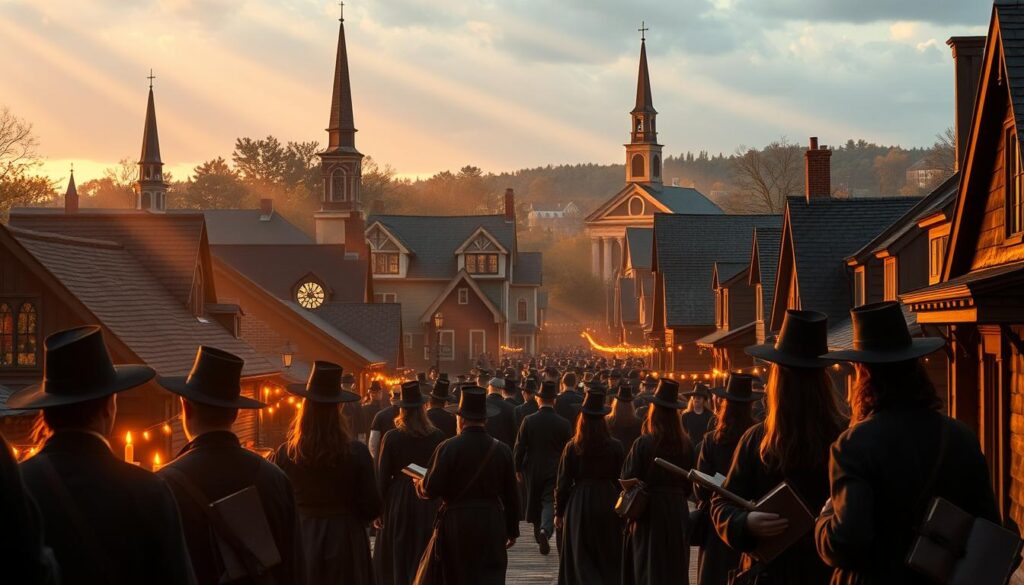
Religious freedom found fertile ground when European ideas crossed the Atlantic. English reformers seeking purity in worship laid foundations for America’s spiritual landscape. Their journey began with royal drama that reshaped a nation’s faith.
Puritan Beginnings and Early American Colonies
Henry VIII’s 1534 break from Rome created the Church of England, but not everyone approved. “We must cleanse God’s house from popish remnants!” declared Puritan leaders. These reformers split into two groups:
- Separatists (Pilgrims) founded Plymouth in 1620
- Nonseparatists established Massachusetts Bay Colony by 1630
Colonists carried Bibles instead of bishops, creating self-governing churches. By 1691, 75% of New England’s 90,000 settlers identified with Puritan ideals. Their strict practices shaped early American life.
Modern Denominational Diversity and Influence
Today’s religious map shows over 200 Protestant denominations. This variety stems from colonial experiments in spiritual freedom. Early Baptists in Rhode Island and Quakers in Pennsylvania proved different groups could coexist.
The First Amendment later mirrored this legacy. As historian Sydney Ahlstrom noted, “America became a greenhouse for growing new forms of Christianity.” From megachurches to storefront churches, this diversity remains a defining feature of American religious life.
Diverse Interpretations Among Protestant Denominations

A rainbow of beliefs colors Protestant Christianity, with each denomination painting scripture through its own lens. While all share core Reformation principles, distinct teachings about sacraments and church leadership created unique spiritual families.
From Evangelicals to Reformed Traditions
Lutherans preserved Martin Luther’s original emphasis on faith alone. Reformed denominations adopted Calvin’s focus on God’s sovereignty. Baptists broke new ground by insisting on adult baptism – a practice first championed by 16th-century Anabaptists.
These differences often turned fiery. “Believer’s baptism isn’t just symbolic – it’s obedience to Christ’s command,” argued early Baptist leader Thomas Helwys. This stance directly challenged Roman Catholic Church traditions and even some Protestant denominations.
Modern groups demonstrate surprising variety:
- Methodists blend personal holiness with social action
- Presbyterians use elected elder governance
- Pentecostals emphasize spiritual gifts
The term “Evangelical” often causes confusion. Unlike the Catholic Church‘s unified structure, this movement spans multiple denominations. It prioritizes scripture study and sharing faith through missions – practices seen in Baptist megachurches and Lutheran outreach programs alike.
Church leadership models reveal deeper differences. Some groups mirror Roman Catholic Church hierarchy with bishops. Others, like Congregationalists, let each church self-govern. This freedom to interpret Christian beliefs remains Protestantism’s defining trait – and its greatest challenge.
Historical Reflections on Protestant Teachings and Practices
New communication tools sparked a revolution in spiritual thinking during the 16th century. Martin Luther‘s ideas traveled faster than ever before, thanks to Johannes Gutenberg’s movable-type press. This innovation let ordinary people access scripture in their own languages for the first time.
The Role of the Printing Press and Scriptural Authority
Gutenberg’s invention became the Reformation’s megaphone. Over 200,000 copies of Luther’s writings circulated by 1520 – a viral spread for its time. The Roman Catholic Church had controlled Latin texts for centuries, but now German farmers could read Paul’s letters themselves.
This shift created lasting changes in religious practice:
- Personal Bibles replaced priestly explanations
- Debates about church teachings spread through pamphlets
- Local languages became sacred through translation
Legacy of Protestant Reformation in Shaping Faith
Luther’s emphasis on personal faith still echoes in modern spirituality. “Why should we pay for God’s grace?” he challenged, reshaping how people viewed salvation. This focus on individual connection transformed worship styles across the Catholic Church and emerging Protestant groups alike.
Three enduring marks of the Reformation:
- Direct access to scripture without mediators
- Emphasis on inner conviction over rituals
- Local control of religious institutions
Today’s diverse expressions of faith owe much to these 16th-century changes. From Bible study groups to online sermons, the Reformation’s core idea – that every believer matters – continues shaping spiritual practice worldwide.
FAQ
What sparked the Protestant Reformation?
Frustration with corruption in the Roman Catholic Church, like the sale of indulgences, led reformers like Martin Luther to challenge traditional practices. His 95 Theses in 1517 became a catalyst for widespread religious and social change.
How did Protestant beliefs differ from Catholic teachings?
Reformers emphasized salvation through faith alone (sola fide) and scripture as the ultimate authority (sola scriptura). They rejected papal supremacy and practices not directly supported by the Bible, such as praying to saints.
Why did the Diet of Speyer matter for Protestants?
In 1526, this assembly allowed German princes to choose their territories’ religion, creating space for Lutheran teachings to spread. A later meeting in 1529 condemned these reforms, leading to formal protests—hence the term “Protestant.”
How did the printing press help the Reformation?
A> Johannes Gutenberg’s invention enabled mass production of Bibles and reformist writings. Luther’s ideas spread rapidly, empowering ordinary people to engage with scripture and fueling debates across Europe.
What role did John Calvin play in shaping Protestantism?
Calvin’s teachings on predestination and church governance influenced Reformed traditions. His work in Geneva created a model for community-based worship and strict moral codes, impacting denominations like Presbyterians and Puritans.
How did the Reformation affect American religious culture?
Early colonists, such as the Pilgrims, sought to practice reformed faith freely. This laid the groundwork for diverse groups like Baptists and Methodists, shaping America’s emphasis on religious liberty and denominational pluralism.
Do all Protestant groups share the same practices?
No—denominations vary widely. For example, Evangelicals focus on personal conversion, while Anglicans retain liturgical elements. Baptism methods and church leadership structures also differ across communities.
What lasting impacts did the Reformation have globally?
It challenged centralized religious authority, promoted literacy through Bible translation, and influenced democracy by encouraging individual interpretation. These shifts reshaped Christianity and sparked movements for social and political reform.