The word heresy traces back to ancient Greek, where it simply meant “choice” or “school of thought.” Over time, its meaning shifted to describe divisions within religious groups. By the first century, it became linked to disagreements over core teachings—a label often used to define boundaries of belief.
For centuries, the Catholic Church viewed movements like the Reformation as challenges to its authority. Leaders argued these groups strayed from traditions passed down through apostolic succession. This tension sparked debates about what defines true Christian practice.
At the heart of the discussion lies a critical question: Are reform efforts a return to original teachings or a break from them? Some see these movements as renewing faith, while others claim they disrupt unity. These differing views still shape how churches interact today.
Understanding this history helps explain modern theological divides. We’ll explore early church writings and historical records to shed light on why this debate matters. Let’s uncover how past conflicts influence current conversations about truth and tradition.
Key Takeaways
- The term “heresy” evolved from meaning “choice” to describing religious disagreements.
- The Catholic Church historically saw Reformation ideas as conflicting with its teachings.
- Debates focus on whether reforms align with early Christian practices.
- Historical documents and church leaders shaped views on theological differences.
- Modern interfaith relations still reflect these centuries-old discussions.
Introduction to the Heresy Debate in Christianity
The journey to unify core beliefs in Christianity wasn’t smooth. Early followers often clashed over interpretations of sacred texts. This tension birthed a dynamic process where correct doctrine took shape through disagreement as much as agreement.
Understanding the roots of doctrinal disputes
Orthodox teachings didn’t emerge overnight. They grew from centuries of councils, creeds, and heated debates. Leaders used tools like the Nicene Creed to draw lines between accepted truth and rejected ideas. As one bishop noted, “Unity requires knowing what we stand against as much as what we stand for.”
Three factors shaped these boundaries:
- Community needs for clear guidelines
- Political pressures from ruling powers
- Efforts to preserve Jesus’ original message
Groups questioning mainstream views often faced pushback. Yet their challenges forced clearer definitions of the christian faith. This back-and-forth shows how doctrine evolves through dialogue—and sometimes conflict.
Today, these historical struggles remind us why people value both tradition and thoughtful questioning. The past teaches that even sharp divisions can lead to deeper understanding.
Historical Roots of Heresy in Early Christianity
The first three centuries after Christ’s death witnessed explosive growth—and division—within Christian communities. Diverse groups emerged, each claiming to hold the “true” interpretation of Scripture. This era became a forge where core doctrine was hammered out through fiery debates.
Insights from the Ante-Nicene period
Between the 2nd and 3rd century, movements like Gnosticism and Marcionism reshaped religious landscapes. Gnostics taught salvation through secret knowledge, while Marcionists rejected the Old Testament entirely. These beliefs clashed with mainstream views, sparking intense confrontations.
Three key groups challenged orthodoxy:
- Montanists: Emphasized prophetic revelations over church authority
- Adoptionists: Viewed Jesus as human “adopted” by God
- Docetists: Denied Christ’s physical suffering
The shifting definition of orthodoxy
Early church leaders faced a dilemma: How to unify communities without stifling spiritual exploration? Irenaeus, a 2nd-century bishop, argued: “Truth remains identical, though languages and cultures differ.” His writings helped crystallize concepts like apostolic succession.
By labeling rival groups as heretics, the church sharpened its theological boundaries. Councils began formalizing creeds, transforming fluid ideas into fixed doctrines. What started as grassroots movements became structured systems of belief—a pattern still visible in modern faith traditions.
Formation of Christian Doctrine and Ecclesiastical Authority
As early Christian communities grew, leaders needed a reliable way to preserve core beliefs. This led to developing structured systems for passing down authentic teachings across generations. The solution emerged through a concept still central to many churches today.
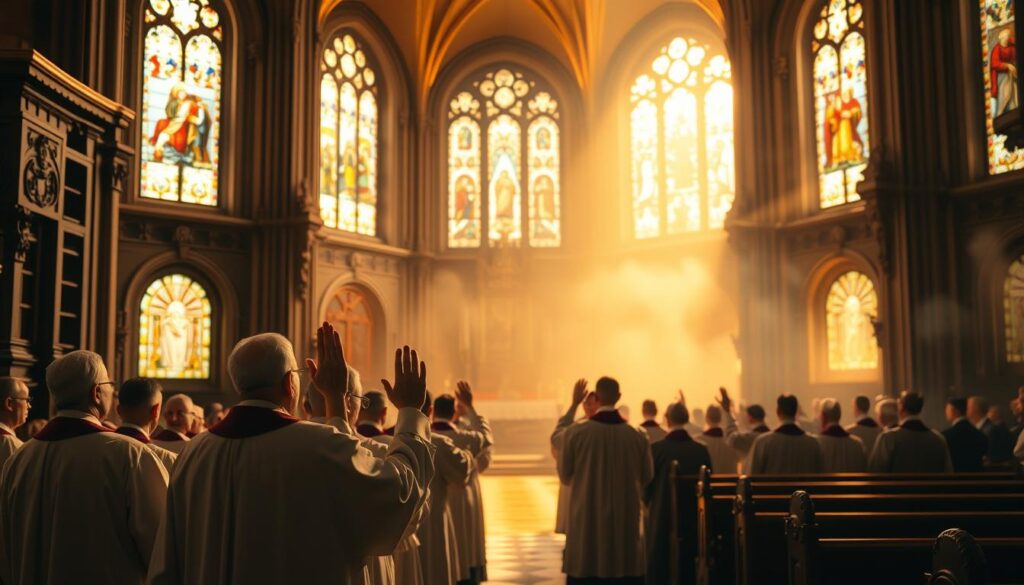
The role of apostolic succession
Irenaeus, a 2nd-century bishop, championed the idea that true teaching flowed through an unbroken chain. He argued: “What the apostles preached, their successors preserved.” This authority supposedly linked modern leaders directly to Jesus’ original followers.
Three key elements defined this system:
- Public records tracing bishop appointments
- Standardized interpretations of Scripture
- Shared rituals across communities
The Catholic Church used this framework to counter unorthodox ideas. Bishops became living bridges between past and present—their role wasn’t just administrative but spiritual. They guarded traditions while addressing new challenges.
This approach contrasted sharply with movements valuing personal Bible interpretation. By rooting apostolic succession in historical continuity, leaders claimed unique legitimacy. It became their answer to preserving unity in a faith spanning continents and cultures.
protestantism heresy: A Closer Look at the Debate
Modern debates about Christian identity often revisit arguments first heard in ancient church councils. The Catholic Church maintains that certain theological patterns—like rejecting apostolic succession or redefining sacraments—align with behaviors early leaders labeled divisive. Converts like Joshua Charles highlight this tension, noting: “Reading the Church Fathers felt like looking into a mirror. Their critiques of ancient groups matched my former Protestant views perfectly.”
Charles identified six methods used by historical dissenters that he recognized in his prior faith community. These include prioritizing personal interpretation over tradition and reshaping core beliefs to fit modern contexts. Such approaches, critics argue, mirror tactics used by groups the early church excluded as threats to unity.
Central to this debate is how people understand authority. Early Christians relied on bishops to preserve truth, while many Protestant traditions emphasize individual conscience. This clash echoes ancient disputes where communities split over who could define doctrine.
Those who join the Catholic Church often describe a startling realization: their former practices align with what past leaders called dangerous innovations. As one convert noted, “We claimed to restore original Christianity but repeated errors the church already addressed centuries ago.” This perspective challenges assumptions about reform movements’ role in Christian history—and what truly unites believers across time.
Iconic Heretical Movements and Their Legacy
Ancient debates over spiritual truth left deep marks on Christian thought. Groups questioning mainstream views often sparked creative tension—and sharp pushback. Their ideas still help us understand how beliefs take shape through disagreement.

Secret Knowledge and Divided Revelations
Second-century heretics like the Gnostics built complex systems around hidden truths. Valentinus, a key teacher, claimed salvation came through mystical insights into an unknowable God. This clashed with leaders who stressed open teachings for all believers.
Marcion took a different path. He split the Old and New Testament Gods, calling them opposites. His followers created their own scriptures—a radical move that reshaped how early church leaders defended biblical unity.
Human or Divine? The Christ Question
Other groups challenged Jesus’ nature. Docetists saw his physical form as an illusion, saying: “True divinity cannot suffer.” Adoptionists argued he became God’s son later in life. Both views forced clearer definitions of Christ’s identity.
Montanists added another layer. They claimed new prophecies surpassed apostolic teachings, unsettling established authority. These heresies weren’t just ancient errors—they set patterns still debated centuries later.
The Role of Ecclesiastical Hierarchy and Church Fathers
Leadership structures in early Christianity weren’t just about organization—they shaped what believers considered essential truth. Figures like Ignatius of Antioch left blueprints showing how authority and unity became cornerstones of the Catholic Church.

Building Blocks of Belief
Ignatius, writing around 110 AD, described a three-tier system: “Be subject to the bishop as to Christ, and the presbytery as to the apostles.” His letters reveal three key priorities:
- Clear leadership through bishops as successors to apostles
- Shared Eucharistic practices as identity markers
- Recognition of Rome’s unique role among churches
He famously told the Roman church: “I don’t issue orders to you because I’m not Peter and Paul.” This humble stance highlighted Rome’s growing authority while showcasing early respect for apostolic foundations.
Denial of Christ’s physical presence in communion became a red flag for Ignatius. He saw this rejection as proof groups had strayed from the church fathers’ teachings. His writings became measuring sticks later leaders used to evaluate doctrinal claims.
These patterns—visible in Clement of Rome’s appeals for order—show how early church fathers linked structure to spiritual authenticity. Their work created templates still shaping debates about Christian identity today.
Impact of Heresy on the Catholic and Christian Faith
Controversies over core beliefs became catalysts for clarity in the Catholic tradition. Early debates about Jesus’ divinity and humanity pushed leaders to refine their teachings. This process turned theological conflicts into tools for strengthening doctrinal foundations.
How challenges forged clarity
The Catholic Church often responded to disputes by organizing councils. Emperor Constantine’s legalization of Christianity in 313 AD allowed bishops to address divisions systematically. The Council of Nicaea (325 AD), for example, produced the Nicene Creed to counter claims denying Christ’s eternal divinity.
Three patterns emerged from these conflicts:
- Detailed definitions of the Trinity
- Standardized sacramental practices
- Centralized decision-making through councils
| Controversy | Catholic Response | Lasting Impact |
|---|---|---|
| Arianism (denied Christ’s divinity) | Nicene Creed formulation | Clear Trinitarian doctrine |
| Nestorianism (separated Christ’s natures) | Council of Ephesus (431 AD) | Affirmed Mary as “God-bearer” |
| Monophysitism (one divine nature) | Council of Chalcedon (451 AD) | Defined dual nature of Christ |
This way of resolving disputes shaped the Catholic faith’s identity. Each council didn’t just reject opposing views—it deepened understanding of shared beliefs. As one bishop noted, “Iron sharpens iron; so conflict hones truth.”
Today, these historical patterns influence how the Church addresses modern theological questions. The process shows how defending doctrine can unify communities while preserving essential teachings.
Debating Sacramental Practices: Baptism and the Eucharist
Few topics reveal deeper divides in Christian faith than disagreements about sacred rituals. The sacraments of baptism and communion serve as spiritual anchors for believers—but interpretations vary dramatically across traditions.
The significance of the real presence in the Eucharist
Early Christians like Ignatius of Antioch left no doubt about their worship practices. He wrote: “They abstain from the Eucharist because they do not confess it to be the flesh of our Savior.” This conviction shaped how the Catholic Church developed its Eucharistic theology.
Modern Catholic teaching holds that Christ’s real presence transforms bread and wine into his body and blood. This belief fuels practices like Eucharistic adoration—actions some Christian groups view as excessive. The stakes couldn’t be higher: if the doctrine is wrong, critics argue, Catholics risk idolizing mere symbols.
| Practice | Catholic View | Common Protestant View |
|---|---|---|
| Eucharist | Literal transformation | Symbolic remembrance |
| Baptism | Sacramental grace | Public declaration |
| Adoration | Divine worship | Unnecessary ritual |
These differences aren’t just technical—they shape how communities experience God. While Catholics see sacraments as channels of grace, others prioritize personal faith over ritual. This divide echoes ancient debates about where truth resides: in tradition or individual conscience.
As one modern scholar notes: “How we break bread reveals what we believe about brokenness—and redemption.” These enduring questions remind us that shared rituals can both connect and separate believers across centuries.
A Timeline of Controversial Doctrines in Christianity
Christian history unfolds through pivotal moments where beliefs were tested and defined. Seven major councils between 325 and 787 AD shaped core teachings still upheld today. The church fathers used these gatherings to address rising questions about God’s nature and human salvation.
The First Council of Nicaea (325 AD) rejected Arian claims denying Christ’s divinity. Later meetings tackled new challenges—like Constantinople’s defense of the Holy Spirit’s role (381 AD) and Ephesus declaring Mary as Theotokos (431 AD). Each decision aimed to preserve unity while clarifying doctrine.
By the 5th century, Chalcedon’s dual-nature declaration settled debates about Jesus’ humanity and divinity. Later councils confronted fresh heresies, from monothelitism’s single-will theory to disputes over religious icons. These decisions show how the early church balanced ancient traditions with evolving spiritual needs.
Though centuries passed, these councils remind us that faith grows through dialogue—and sometimes disagreement. Their legacy lives on wherever communities seek truth while honoring shared roots.
FAQ
Why do some label Protestantism as heresy?
Certain groups view disagreements over doctrines like apostolic succession or the real presence in the Eucharist as breaks from historical Christian teachings. The Catholic Church emphasizes unity under ecclesiastical authority, while other traditions prioritize scriptural interpretation.
How did early doctrinal disputes shape Christianity?
Early debates, such as those over Christ’s divinity or the Trinity, forced leaders like Ignatius of Antioch to clarify beliefs. Councils like Nicaea formalized doctrines to preserve unity and counter movements like Arianism.
What role did apostolic succession play in doctrine formation?
Leaders such as Clement of Rome argued that authority passed from apostles to bishops ensured doctrinal purity. This became a cornerstone for establishing orthodox teachings and rejecting rival claims.
How did sacramental practices become a point of conflict?
Differences in interpreting rituals like baptism or the Eucharist split communities. For example, Catholics affirm Christ’s physical presence in communion, while others see it as symbolic.
What defined movements like Gnosticism or Montanism?
A: Gnosticism emphasized secret knowledge, while Montanism advocated strict spiritual renewal. Both challenged mainstream views on salvation and church structure, leading to their rejection as heterodox.
How did heresies strengthen the Catholic Church’s response?
Controversies spurred clearer definitions of faith, such as the Nicene Creed. The Church refined teachings, excommunicated dissenters, and reinforced hierarchical authority to maintain cohesion.
Why is the real presence in the Eucharist significant?
Catholics believe communion embodies Christ’s sacrifice, a doctrine rooted in early writings like those of Justin Martyr. Disputes over this symbolize deeper divides about tradition versus scripture.
What recurring themes emerge in Christian doctrinal controversies?
Debates often center on Christ’s nature, grace versus works, and institutional authority. These tensions reflect ongoing efforts to balance unity with diverse interpretations of the faith.