Welcome to a journey through one of history’s most influential belief systems. What began as a 16th-century religious movement reshaped nations, sparked revolutions, and continues to shape modern values. At its heart lies a passionate quest to connect with the divine—a story filled with bold ideas and lasting change.
This movement’s origins trace back to pivotal moments in Europe, where thinkers challenged established norms. Their ideas spread like wildfire, crossing oceans and cultures. Today, its impact appears everywhere—from education systems to social justice movements.
Core principles like personal faith and scripture-focused practice created new ways of worship. These ideas didn’t just stay in churches. They inspired art, fueled political reforms, and even shaped how societies approach human rights.
From Martin Luther’s bold actions to modern-day megachurches, this tradition keeps evolving. Its story includes both triumphs and tensions—proof that spiritual journeys often spark unexpected consequences. Ready to explore how ancient debates still shape our world?
Key Takeaways
- Originated in 16th-century Europe through religious reforms
- Emphasizes personal relationship with scripture over tradition
- Influenced modern education, democracy, and social movements
- Spread globally with diverse practices across continents
- Martin Luther’s actions ignited widespread religious changes
- Shaped cultural values beyond strictly religious contexts
Introduction to Protestantism
Imagine a spiritual earthquake shaking Europe’s foundations. That’s what happened when centuries of religious unity cracked open. For over 1,500 years, the Catholic Church guided Western Christianity. Then came thinkers who dared to ask bold questions.
Setting the Historical Context
The 16th-century revolution began as ink met paper. Reformers challenged church hierarchy, arguing scripture held ultimate authority. This wasn’t just theological debate—it reshaped nations. Royal courts buzzed with arguments about salvation and power.
Economic changes and new printing technology spread reform ideas like wildfire. People started reading the Bible themselves instead of relying on priests. The Catholic Church’s response? A mix of reforms and fierce opposition.
An Overview of Protestant Beliefs and Practices
At its core, this movement emphasized direct connection with God. Congregations sang hymns in local languages instead of Latin. Personal prayer replaced elaborate rituals for many believers.
Three key differences emerged:
- Scripture over church tradition
- Faith as personal journey
- Simpler worship styles
These ideas didn’t stay in churches. They influenced education systems and sparked debates about freedom that still echo today. The revolution’s legacy? A vibrant mosaic of beliefs under one spiritual umbrella.
Essential protestantism facts
History remembers pivotal moments when words sparked revolutions. In 1529, German princes stood against Emperor Charles V’s religious restrictions. Their formal protest gave this movement its name—a blend of defiance and conviction.
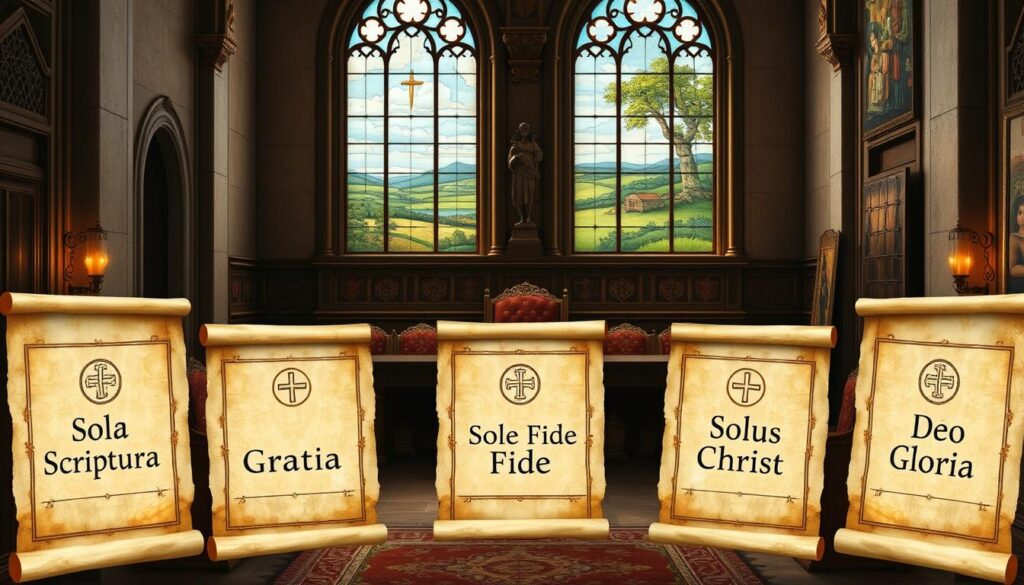
- Sola Fide: Salvation through faith alone
- Sola Christus: Christ as sole mediator
- Sola Gratia: Grace as divine gift, not earned
- Sola Scriptura: Scripture over tradition
- Soli Deo Gloria: All glory to God
| Catholic Teaching | Protestant Belief |
|---|---|
| Scripture + Tradition | Sola Scriptura (Scripture alone) |
| Faith + Works | Sola Fide (Faith alone) |
| Priestly mediation | Direct relationship with God |
“Scripture is the cradle in which Christ is laid.”
This shift let ordinary people interpret sacred texts themselves. Churches replaced Latin services with local languages. Education surged as believers sought to read the Bible firsthand.
The movement’s rise reshaped societies. Literacy rates climbed, and debates about authority spilled into politics. What began as theological arguments became seeds for modern ideas about individual rights.
Understanding the Protestant Reformation
Long before Martin Luther’s famous stand, brave voices demanded change. Jan Hus, John Wycliffe, and Peter Waldo challenged church practices centuries earlier. They pushed for Scripture in common languages and criticized papal authority—but paid with their lives.
Flames of Rebellion
Three powder kegs ignited the 16th-century explosion:
- Indulgence sales: Paying for forgiveness angered many
- Western Schism: Competing popes weakened trust
- Renaissance thinking: Questioning became a virtue
The printing press spread these ideas faster than ever. Suddenly, farmers could read Jesus’ words without priests translating. This changed everything.
From Tradition to Transformation
Imagine swapping royal decrees for DIY rulebooks. That’s what happened when reformers shifted authority:
| Catholic Approach | Reformation Shift |
|---|---|
| Latin-only services | Worship in local languages |
| Priestly interpretation | Personal Bible study |
| Salvation through rituals | Faith as direct connection |
Schools popped up to teach reading—within 50 years, some regions saw literacy double. Catechisms turned kitchen tables into classrooms. What began as religious debate reshaped how societies learn and think.
This revolution wasn’t just about church doors. It rewired how people saw themselves—capable, curious, and free to question. The echoes still shape our world today.
Martin Luther’s Impact on Faith and Freedom
A single hammer strike echoed through Europe on October 31, 1517. Martin Luther, an Augustinian friar, nailed his 95 Theses to Wittenberg’s church door. This act challenged the Catholic Church’s power to sell forgiveness through indulgences. His message? Salvation comes through faith, not financial transactions.
The 95 Theses: A Turning Point
Luther’s document spread like wildfire thanks to new printing technology. Common people began questioning religious authority. His bold claim—”Scripture alone”—empowered individuals to interpret the Bible themselves.
Controversial Decisions and Their Fallout
Protecting his reforms required political allies. When a German prince demanded approval for a second marriage, Luther faced a brutal choice:
| Luther’s Teachings | Political Reality |
|---|---|
| Marriage as sacred union | Approved bigamy to keep prince’s support |
| Transparency in faith | Attempted secrecy about the decision |
| Moral consistency | Pragmatism over principles |
The scandal revealed reform’s messy side. As Luther later admitted:
“Peace if possible, truth at all costs.”
This compromise haunted his legacy but showed how religious change required navigating earthly power structures. His story reminds us that even revolutionaries face impossible choices.
Freedom of Conscience and the Limits of Toleration
How far does true tolerance stretch? Early reformers championed a radical notion—that individuals deserved space to follow their spiritual compass. This groundbreaking concept of conscience reshaped societies, though its application proved messy in practice.
The Evolution of Beliefs and Ideas
Reformers drew a critical line: freedom from forced belief didn’t mean approving all ideas. As Luther argued, “Heretics shouldn’t be burned—but their books?” Authorities still banned teachings seen as threats. Catholic practices and atheist views often faced harsh restrictions.

| Early Freedom Concepts | Modern Understanding |
|---|---|
| No physical punishment for belief | Legal protection for diverse views |
| Scripture-based truth | Pluralistic truth coexistence |
| State-regulated religion | Church-state separation |
One nation broke new ground. The Netherlands became Europe’s first region to stop executing people over faith differences by the 1600s. Merchants found peace boosted trade—practical tolerance proved profitable.
This imperfect progress laid groundwork for later rights movements. As one Dutch leader noted: “We’ll argue doctrine till sunset, but share bread at supper.” The journey from controlled belief to true liberty remains ongoing—a testament to humanity’s slow march toward understanding.
Political Alliances and the Role of Princes
When faith collides with politics, who holds the reins? In 16th-century Europe, reformers faced this dilemma head-on. German princes became unexpected partners in challenging the Catholic Church’s dominance. Without their support, religious changes might have died in the cradle.
The survival of reform efforts depended on shrewd partnerships. Preachers needed protection from emperors and popes, while rulers saw opportunities to boost their influence. This mutual need created an uneven dynamic—reformers risked exile or execution without princely backing.
Three critical factors shaped these alliances:
- Princes controlled armies and legal systems
- Reformers offered new religious legitimacy
- Shared opposition to centralized church power
The movement’s very name reveals this political foundation. In 1529, German leaders formally protested Charles V’s restrictions—an act that birthed the term “Protestant.” Their defiance allowed new ideas to take root in protected territories.
| Reformers Needed | Princes Gained |
|---|---|
| Safe preaching spaces | Local church control |
| Legal protection | Tax revenue from seized lands |
| Public support | Political independence |
These partnerships came at a cost. Some reformers compromised principles to keep powerful friends. Yet this messy collaboration shaped modern church-state relations, proving spiritual revolutions need earthly allies.
Diverse Global Expressions and Modern Adaptations
Across bustling Asian cities and quiet rural towns, this faith movement keeps reinventing itself. New interpretations blend ancient teachings with contemporary concerns, creating vibrant spiritual tapestries.
South Korea’s Apocalyptic Lens
In Seoul’s neon-lit streets, a unique perspective thrives. South Korea hosts the world’s largest single congregation—750,000 members gathering under one roof. Their faith pulses with urgency, focusing intensely on Revelation’s prophecies.
This apocalyptic outlook took root during Japan’s harsh occupation. Believers found hope in visions of ultimate salvation, transforming national trauma into spiritual purpose. Today, 20,000 Korean missionaries carry this message worldwide—second only to American efforts.
New Directions in Spiritual Practice
Modern believers reinterpret tradition through fresh lenses. Some communities emphasize environmental stewardship as sacred duty. Others blend ancient rituals with digital outreach, streaming prayers globally.
Three key shifts stand out:
- Focus on personal life transformation over dogma
- Grassroots movements addressing social inequality
- Youth-led worship styles bridging generational gaps
These adaptations prove the movement’s enduring vitality. From megachurches to living room gatherings, people continue reshaping their spiritual place in an ever-changing world.
FAQ
What sparked the Protestant Reformation?
The Reformation began in 1517 when Martin Luther challenged the Catholic Church’s practices, like selling indulgences. His 95 Theses argued for salvation through faith alone (sola fide), not rituals or payments.
How did princes influence the spread of Protestant ideas?
Many German princes supported Luther’s reforms to gain independence from the Church and the Holy Roman Empire. Their political backing helped establish Lutheran churches and fueled the Thirty Years’ War over religious freedom.
What distinguishes Protestant beliefs from Catholic traditions?
Protestants emphasize sola fide (faith alone) and Scripture as the sole authority. They reject papal power and prioritize personal faith over sacraments or intermediaries like priests.
Why was the Thirty Years’ War significant for Protestantism?
This war (1618–1648) reshaped Europe’s religious landscape. The Peace of Westphalia ended Catholic dominance, allowing rulers to choose their realm’s faith and granting limited tolerance to minority beliefs.
How has Protestantism adapted globally in modern times?
Movements like South Korea’s megachurches blend traditional teachings with apocalyptic themes. Others focus on social justice or reinterpret Scripture to address contemporary issues like gender equality.
Did the Catholic Church respond to the Reformation?
Yes. The Counter-Reformation addressed corruption and reaffirmed doctrines at the Council of Trent (1545–1563). However, it also hardened divisions, leading to centuries of conflict between Catholics and Protestants.
What role does freedom of conscience play in Protestant thought?
Early reformers like Luther stressed individual interpretation of Scripture. This idea later influenced democratic principles, though debates over toleration’s limits persisted, especially during wars of religion.