Ireland’s story weaves together faith, power, and identity in ways few nations have experienced. For over 500 years, religious movements reshaped the island’s culture and politics. Settlers arriving during the 16th and 17th centuries brought new traditions that would redefine communities and governance.
These changes created a lasting divide between groups with different beliefs. Political power often aligned with religious identity, sparking conflicts that echoed through generations. Towns like Derry and Belfast became symbols of this cultural clash, their streets bearing witness to centuries of tension.
Northern regions, especially Ulster, saw significant shifts as newcomers established farms, churches, and trade networks. Their influence extended beyond faith—economic systems, land ownership patterns, and legal frameworks all bore their mark. Over time, these developments laid the groundwork for modern divisions still felt today.
Understanding this history helps explain Northern Ireland’s unique role within the UK. From medieval roots to contemporary debates, religion remains a powerful force shaping identities and alliances.
Key Takeaways
- Religious movements transformed Ireland’s cultural landscape over five centuries
- Political loyalty became deeply tied to faith, fueling long-standing divisions
- Ulster’s development was heavily influenced by new settlers and their traditions
- Economic systems and land ownership patterns reflected religious affiliations
- Modern Northern Ireland’s identity stems from these historical foundations
Historical Origins and Colonial Influences
Centuries of foreign intervention shaped the island’s destiny long before modern borders existed. British involvement began with armored knights and stone castles, not religious reformers or politicians. This early chapter laid the groundwork for cultural divides still visible today.
Early Incursions and the Anglo-Norman Legacy
Anglo-Norman warriors arrived in 1169, bringing feudal systems and fortified towns. Their descendants—later called the “Old English”—controlled key regions for 400 years. Though they adopted some local customs, their loyalty to England’s crown never wavered.
These settlers formed the first permanent bridge between Britain and the island. Their stone towers dotted the landscape, symbols of power that outlasted generations. By the 1500s, their influence stretched from Dublin’s streets to remote farmlands.
The Plantations in Ulster and Their Lasting Impact
Everything changed when King James I launched the Ulster Plantations in 1609. Thousands of Scottish and English families replaced displaced Irish landowners. This wasn’t random migration—it was organized colonization.
The new arrivals built towns modeled on British designs. They farmed flax, raised cattle, and traded wool. Unlike earlier settlers, they kept their traditions intact, creating a cultural barrier that hardened over time.
| Period | Settlers | Key Impact |
|---|---|---|
| 12th-16th C. | Anglo-Normans | Established feudal governance |
| 17th C. Onward | Scottish/English | Created Protestant majority regions |
| Post-1609 | Plantation colonists | Redefined land ownership patterns |
These changes made the north distinct. When Ireland gained independence in 1922, six Ulster counties chose to remain part of the United Kingdom. Their decision traced back to those 17th-century fields and fortifications.
Evolution and Trends of Protestantism in Irish Society
The 1920s brought a seismic shift to the island’s political landscape as new borders reshaped lives and loyalties. Northern Ireland emerged as a self-governing region in 1922, with a two-thirds Protestant majority wielding outsized influence. This demographic reality shaped everything from government policies to access to jobs and education.
Industries like linen production and shipbuilding became economic powerhouses, but opportunities weren’t equal. “The best jobs went to our community—that’s just how things worked,” recalled a Belfast dockworker’s memoir from the 1950s. While Catholics found work in these sectors, leadership roles and skilled positions largely remained with Protestants.
The Ulster Unionist Party dominated politics for decades, using their numbers to control local councils. Gerrymandering tactics concentrated Catholic voters into fewer districts, weakening their representation. This system created a self-reinforcing cycle of political and economic power.
Distinct social structures emerged over the years. Separate schools, churches, and cultural groups deepened divisions. A thriving Protestant middle class developed strong ties to British identity, viewing the UK as both a protector and a source of prosperity. These patterns would define Northern Irish society long after partition.
The Troubles and Their Impact on Protestant Communities
Northern Ireland’s streets became battlegrounds in the late 1960s as decades of tension exploded into violence. What began as civil rights marches quickly turned into a 30-year conflict that reshaped communities and institutions.
Breaking Points: Violence Escalates
October 1968 changed everything. When police clubbed marchers in Derry demanding equal voting rights, cameras captured the brutality for the world to see. “They swung batons like we were enemies, not citizens,” one survivor later recounted.
The New Year’s Day attack at Burntollet Bridge proved more shocking. Loyalist mobs ambushed activists while officers watched passively. This pattern repeated in 1972 during Bloody Sunday, when British soldiers shot 26 unarmed protesters.
Security Forces Under Scrutiny
Royal Ulster Constabulary officers faced growing criticism for perceived bias. Many Protestant communities saw them as protectors, while nationalists viewed them as occupiers. This divide deepened when paramilitary groups formed.
| Group Type | Main Actions | Community Impact |
|---|---|---|
| Loyalist Paramilitaries | Retaliatory bombings | Increased fear cycles |
| Security Forces | House raids | Eroded trust |
| Civil Rights Activists | Peaceful protests | International attention |
By the 1990s, over 3,600 lives had been lost. Protestant neighborhoods faced bomb threats and economic decline, while many young men joined defense groups. The violence left scars that still affect community relations today.
Analyzing protestantism in ireland: Politics, Peace, and the Good Friday Agreement
The 1990s brought unexpected opportunities for reconciliation after decades of conflict. Ceasefires from opposing paramilitary groups created space for dialogue, with international mediators stepping in to bridge divides. This fragile momentum led to one of modern Europe’s most significant peace efforts.
Political Shifts and Peace Talks
Major changes began when armed groups halted hostilities in 1994. Protestant leaders faced a new challenge: negotiating with former rivals. U.S. Senator George Mitchell’s involvement proved crucial, helping parties find common ground through months of tense discussions.
Talks involved complex compromises on governance and security. British and Irish officials worked behind the scenes to address constitutional concerns. For many communities, trust-building became as vital as policy changes.
Influence of the Good Friday Agreement
April 1998’s landmark deal reshaped Northern Ireland’s future. The Good Friday Agreement established shared leadership between unionist and nationalist parties. Key sectors like healthcare and education shifted to local control while maintaining UK ties.
Weapons decommissioning requirements eased fears of renewed violence. Power-sharing forced cooperation that seemed impossible years earlier. As one negotiator noted: “We didn’t erase history—we built over it.”
The accord’s effects continue shaping governance today. While challenges remain, its framework provides tools for resolving disputes peacefully. This historic pivot shows how entrenched conflicts can yield to persistent diplomacy.
Social and Cultural Ramifications in Northern Ireland
Daily life in the north still bears the marks of generations-old divisions. Even after peace agreements, invisible lines shape where people live, learn, and work. These patterns influence how communities interact—or avoid interaction—across cultural lines.
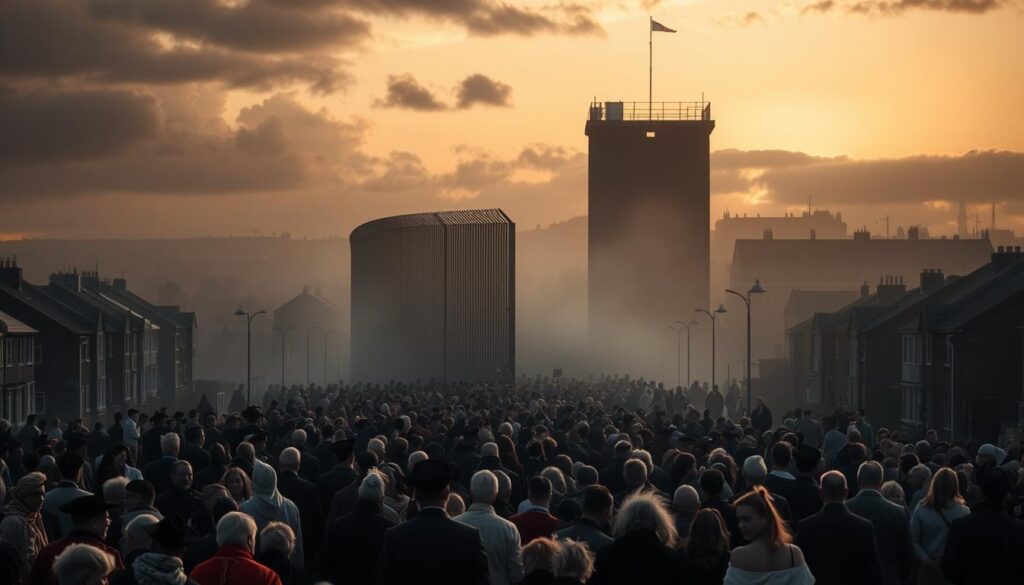
Segregation, Education, and Cultural Identity
Schools remain one of the clearest dividers. Over 90% of children attend religiously segregated classrooms. Separate textbooks, sports teams, and holidays reinforce distinct identities from childhood. A Belfast teacher noted: “Kids grow up knowing ‘us’ and ‘them’ before they understand why.”
Housing, Employment, and Community Dynamics
Neighborhoods often cluster by background. Nearly 100 physical barriers still slice through Belfast streets. Housing allocation once favored certain groups—a legacy that lingers. Catholic nationalists faced exclusion from public homes in Protestant-dominated areas during the 20th century.
| Issue | Impact | Current Status |
|---|---|---|
| Education | Limited cross-community contact | 90% segregated schools |
| Housing | Divided neighborhoods | 100+ peace walls |
| Employment | Economic disparities | Improved but uneven |
| Voting Rights | Political imbalance | Universal suffrage since 1969 |
The civil rights movement fought property-based voting systems that disadvantaged larger Catholic families. Though reforms came, community trust remains fragile. Jobs and investments still spark debates about fairness decades after reforms.
Contemporary Reflections and Post-Conflict Challenges
Modern Northern Ireland grapples with visible and invisible divides that outlasted official peace agreements. While violence has largely ended, communities still navigate complex social legacies shaped by decades of tension.
Peace Walls and Ongoing Social Divides
Belfast now has more physical barriers between neighborhoods than during the Troubles, with nearly 100 walls separating Catholics and Protestants. These structures symbolize lingering distrust—46% of adults know someone harmed in past conflicts, per 2011 studies. Mental health challenges persist, with the region showing the world’s highest PTSD rates.
Modern Political Realignments and Brexit Implications
The 2016 Brexit vote tested Northern Ireland’s stability as 56% of voters opposed leaving the EU. Fears of renewed border checks with the Republic of Ireland prompted creative solutions. A special trade arrangement now keeps the region aligned with EU customs while remaining part of the United Kingdom.
Progress remains fragile. New generations seek reconciliation through shared schools and cultural projects, yet old divisions still influence housing and politics. The path forward requires balancing historical wounds with hopeful innovations.
FAQ
How did colonization shape Protestant communities in Ireland?
Colonial efforts like the 16th- and 17th-century Plantations of Ulster brought English and Scottish settlers, creating a Protestant majority in the north. This reshaped land ownership, culture, and political power, leading to centuries of tension with the Catholic majority.
What role did the Good Friday Agreement play in Northern Ireland?
Signed in 1998, the Good Friday Agreement ended most violence by establishing power-sharing between unionists and nationalists. It allowed Northern Ireland to remain part of the United Kingdom unless a majority votes otherwise, while fostering cross-border cooperation with the Republic of Ireland.
How did The Troubles affect daily life in Northern Ireland?
From the late 1960s to 1998, bombings, discrimination, and clashes over civil rights divided communities. Security forces like the Royal Ulster Constabulary and paramilitary groups deepened distrust. Segregation in housing, schools, and jobs still impacts social dynamics today.
Why do peace walls still exist in Belfast?
Built during The Troubles to separate Catholic and Protestant neighborhoods, over 100 barriers remain. Many residents feel safer with them due to lingering tensions, though efforts to remove these physical divides continue as part of post-conflict reconciliation.
How did Brexit impact Northern Ireland’s political stability?
Brexit reignited debates over borders and identity. The Northern Ireland Protocol, designed to avoid a hard border with the Republic, strained unionist ties to the UK. This has fueled recent political gridlock and calls for renewed dialogue to protect the peace process.
What were the Burntollet Bridge and Bogside incidents?
In 1969, a civil rights march at Burntollet Bridge was attacked by loyalists, escalating sectarian violence. Weeks later, the Battle of the Bogside in Derry led to British troops deploying in Catholic areas, marking a turning point in the conflict.