What happens when everyday believers challenge centuries of religious tradition? In 16th-century Europe, a spiritual revolution began that would reshape Christianity forever. This bold shift started as a call for renewal within the church, driven by thinkers who sought to return faith to its foundational roots.
The movement spread like wildfire across nations, fueled by groundbreaking ideas about personal faith and direct connection to scripture. From humble beginnings in small towns, it grew into a global phenomenon that altered political systems, inspired new art forms, and transformed education. Leaders emerged who dared to question established norms, creating space for diverse interpretations of sacred texts.
This wasn’t just about theology—it changed how people lived. The ripple effects reached every corner of society, from royal courts to village markets. As these ideas crossed oceans, they laid the groundwork for modern concepts of individual liberty and community values that still shape our world today.
Key Takeaways
- Began as a 16th-century renewal effort within European Christianity
- Impacted politics, education, and culture beyond religious practice
- Empowered individuals through accessible scripture and personal faith
- Spread globally through migration and missionary work
- Shaped modern values of religious freedom and social responsibility
Origins and Early Reform Movements
Centuries before Luther’s stand, bold thinkers began questioning sacred institutions. Across Europe, sparks of change flickered as scholars challenged church authority and exposed questionable practices. These early reformers risked everything to align religious teachings with scriptural truths.
Medieval Precursors to Reform
William of Ockham shook foundations in the 1300s by accusing Pope John XXII of heresy. His radical claim? Church leaders should live simply like Jesus. John Wycliffe went further, translating the Bible into English and arguing kings held spiritual power equal to clergy.
Jan Hus paid the ultimate price in 1415. His fiery sermons against corrupt priests led to execution. “Truth conquers all,” he declared before burning. These martyrs proved reform wasn’t new – just suppressed.
Intellectual Awakening in the Late Middle Ages
Scholars like Lorenzo Valla used new tools to expose fakes. His work proved the “Donation of Constantine” – used to justify papal rule – was forged. Erasmus mocked church excesses through satire, writing “In Praise of Folly” to highlight hypocrisy.
| Reformer | Contribution | Impact | Legacy |
|---|---|---|---|
| William of Ockham | Challenged papal authority | Inspired later reformers | Established limits on church power |
| John Wycliffe | Bible translation | Empowered lay believers | Called “Morning Star of Reformation” |
| Jan Hus | Moral reforms | National identity boost | Czech national hero |
| Erasmus | Humanist scholarship | Exposed church abuses | Paved way for Luther |
These pioneers created a blueprint for change. Their courage showed that questioning tradition could reshape faith – and society itself.
Martin Luther and the 95 Theses
On a crisp autumn day in 1517, a humble monk‘s hammer strikes echoed through history. Martin Luther, an Augustinian scholar in Wittenberg, nailed ninety-five debate questions to a church door. This act—meant to spark academic discussion—ignited the Protestant Reformation instead.
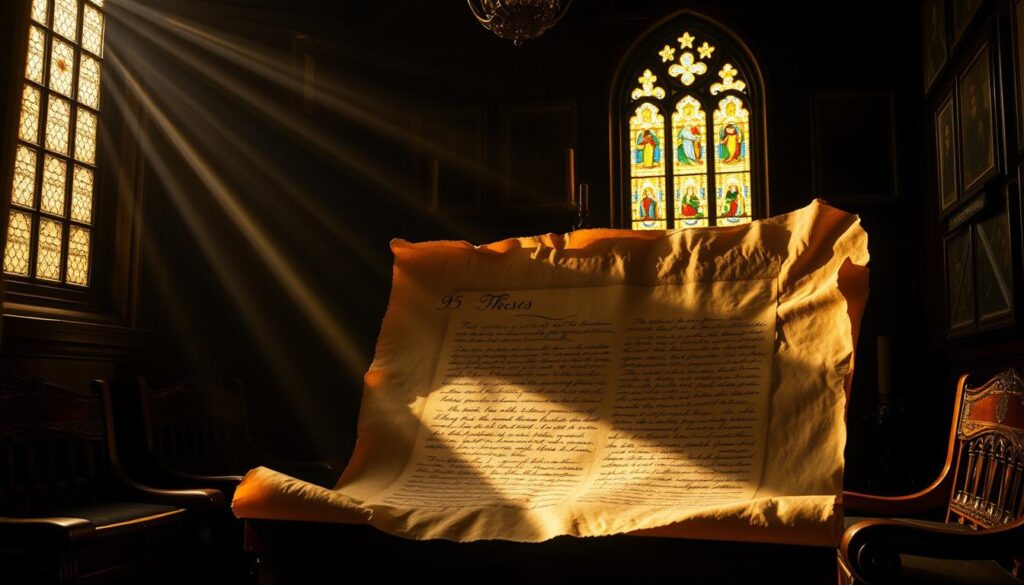
Luther’s theses targeted a specific abuse: the Catholic Church‘s sale of forgiveness certificates. “When coins clink in the chest,” he wrote, “greed and avarice increase.” His radical claim? Salvation comes through faith alone—not payments or rituals.
The printing press transformed Luther’s ideas into wildfire. Within months, translated copies raced across Europe. Common people devoured his writings, realizing they could connect directly with scripture without intermediaries.
| Luther’s Challenge | Church Practice | Impact |
|---|---|---|
| Faith-based salvation | Indulgence sales | Undermined church revenue |
| Scripture accessibility | Latin-only services | Empowered lay believers |
| Priesthood of all believers | Clergy hierarchy | Democratized faith |
At 1521’s Diet of Worms, Luther stood firm before emperors and cardinals. “Here I stand,” he declared, refusing to recant. His courage inspired millions—and reshaped Christianity’s landscape forever.
Between 1518-1525, Luther wrote more works than his 17 closest rivals combined. From Bible translations to hymn lyrics, his words gave common people tools to own their spiritual journey.
Understanding Protestantism History
A dramatic showdown in 1529 gave this movement its name. At the Diet of Speyer, German princes made history by declaring: “In matters concerning God’s honor we must obey God rather than men.” Their protest against imperial religious restrictions birthed the term Protestant – a badge of courage worn by millions.
Defining Moments in the Movement
Three earth-shaking events shaped early Protestant growth:
- 1517: Luther’s radical challenge to church authority
- 1521: The defiant “Here I stand” speech at Worms
- 1555: Peace of Augsburg allowing state-chosen faiths
These turning points transformed theological debates into lasting social change. The movement’s spread relied on bold ideas traveling faster than ever through printed pamphlets and translated Bibles.
Key Figures and Doctrines
While Luther sparked the Reformation, other thinkers added crucial teachings:
| Reformer | Core Belief | Legacy |
|---|---|---|
| John Calvin | Divine sovereignty | Inspired Puritan movements |
| Huldrych Zwingli | Symbolic communion | Shaped Swiss Reformation |
| Philip Melanchthon | Educational reform | Built Lutheran schools |
Central doctrines like sola fide (faith alone) and sola scriptura (scripture alone) became spiritual anchors. These beliefs empowered ordinary people to interpret sacred texts personally – a revolutionary idea that still influences religious practice today.
European Transformation: Lutheran, Reformed, and Beyond
How did revolutionary ideas reshape Europe’s spiritual landscape? From Alpine valleys to English cathedrals, new faith expressions emerged with distinct flavors. Each region blended core principles with local needs, creating a mosaic of belief systems that still influence modern Christianity.

Switzerland’s Radical Reinvention
John Calvin transformed Geneva into a theological powerhouse after 1541. His Reformed doctrine taught that God’s absolute power determined human destiny. “Man’s chief end is to glorify God,” Calvin wrote, creating strict moral codes enforced by church-led government.
Exiled believers flocked to Geneva, turning it into a training ground for reformers. Calvin’s ideas raced to Scotland through John Knox and inspired French Huguenots. This theological export shaped Presbyterian and Reformed churches worldwide.
England’s Compromise Solution
Henry VIII’s marital drama sparked England’s break from Rome. By 1534, the Church of England crowned kings as spiritual leaders. Elizabeth I later crafted a unique blend – keeping bishops and stained glass while embracing Protestant theology.
This middle way satisfied neither hardline Catholics nor Puritans. But it created a national church that valued tradition and scripture equally. The Book of Common Prayer became its heartbeat, merging old rituals with new beliefs.
Printing: The Reformation’s Megaphone
Gutenberg’s invention supercharged religious change. Pamphlets explaining Reformation ideas outsold Latin Bibles 10-to-1. For the first time, farmers could read scripture in German or English while debating Luther’s latest tract.
Print shops became idea factories, spreading Calvin’s works to Transylvania and Lutheran hymns to Sweden. This communication revolution let reformers bypass traditional authorities, planting seeds for diverse denominations we recognize today.
Politics, Power, and Social Change in the Reformation
Faith and politics collided dramatically as spiritual debates became battles for control. Rulers saw an opportunity to strengthen their authority while challenging Rome’s dominance. This explosive mix reshaped nations and ignited conflicts lasting generations.
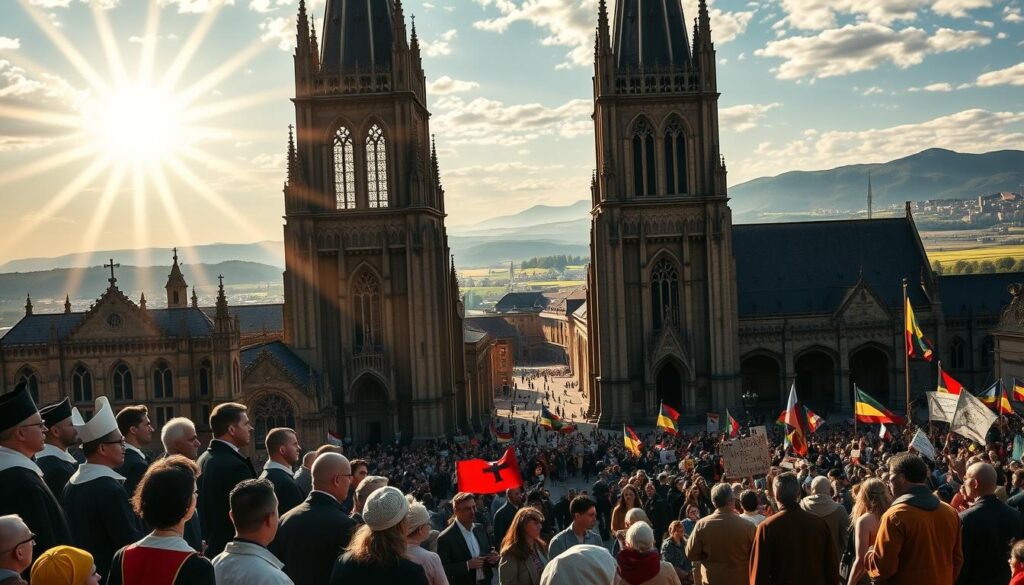
Rising Nationalism and Secular Authority
Monarchs cleverly used religious reforms to boost their power. At the 1521 Diet of Worms, Luther’s famous stand became a showdown between emperors and emerging national identities. “Why should foreign bishops rule our lands?” German princes whispered.
The Peace of Augsburg (1555) made it official: rulers could choose their territory’s faith. This landmark agreement shifted spiritual decisions from popes to palace halls. Local leaders gained unprecedented control over both church and state affairs.
Religious Conflicts and Wars
Not all reforms brought peace. When peasants rebelled in 1524, demanding equality from nobles, Luther shocked supporters by backing the princes. His choice showed how religious ideals often bowed to political realities.
The Thirty Years‘ War (1618-1648) became Europe’s bloodiest religious conflict. Entire regions vanished – some German areas lost 40% of their people. This devastation proved that mixing faith with authority could have catastrophic consequences.
- National identities grew as countries rejected papal influence
- Rulers used the Reformation began to centralize control
- Warfare reshaped borders and political alliances for centuries
These changes laid groundwork for modern concepts of state sovereignty. What started as theological debates became permanent shifts in how societies govern themselves – impacts we still navigate today.
Protestantism in the New World: Pilgrims, Puritans, and American Roots
When religious dissenters crossed stormy seas seeking purity, they planted seeds for a nation’s soul. Two groups emerged from England’s spiritual turmoil: Separatists who abandoned the Church of England, and Puritans determined to reform it from within.
From England to New England
Separatists first fled to Holland in 1607, seeking freedom to worship differently. But foreign life proved harsh. They faced poverty and worried their children were losing English traditions. “We were weary travelers,” one wrote, “longing for a promised land.”
In 1620, 102 pioneers boarded the Mayflower. These Pilgrims founded Plymouth Colony, creating America’s first permanent churches free from the Church of England. Their compact established self-governance – a radical idea that shaped future colonies.
Puritans followed a decade later, settling Massachusetts Bay. Unlike Separatists, they hoped to purify English practices, not reject them. Governor John Winthrop declared their colony “a city upon a hill,” setting high standards for moral living.
This freedom to interpret scripture sparked explosive growth in denominations. By 1700, the United States hosted Quakers, Baptists, and Congregationalists – each forming distinct churches. Religious diversity became America’s unexpected hallmark.
The Pilgrims’ journey shows how determined people can reshape nations. Their search for spiritual authenticity laid foundations for the United States‘ core values – proving sometimes, the boldest reforms happen oceans away from old power centers.
Lasting Legacy: Cultural, Intellectual, and Religious Impact
Imagine a world where music, art, and daily life carry echoes of a 500-year-old spiritual revolution. The movement’s influence stretches far beyond Sunday services, weaving through traditions that shape how we learn, create, and connect. This enduring impact shows how ideas about faith can transform entire societies.
Harmonies and Humanities
Reformers made music a practice for everyone, not just choirs. Luther’s hymns turned congregations into participants, while Calvinists used psalms to teach scripture. These musical traditions still resonate in modern worship songs.
Education became a cornerstone of reform. Schools teaching literacy spread rapidly, letting ordinary people engage with teachings directly. This focus on learning laid groundwork for public education systems we value today.
Faith in Modern Times
Today’s churches showcase stunning diversity. From energetic Pentecostal services to contemplative Lutheran liturgies, denominations adapt ancient beliefs to contemporary life. Many blend traditional rituals with fresh approaches – a Baptist food pantry or Methodist climate initiative, for example.
This flexibility keeps denominations relevant while honoring core principles. Whether through social justice work or digital worship, modern practice proves revolutionary ideas can thrive in new contexts – just as reformers envisioned centuries ago.
FAQ
What sparked Martin Luther’s decision to challenge the Catholic Church?
Martin Luther, a German monk, opposed practices like selling indulgences. His 95 Theses in 1517 criticized corruption and emphasized faith over rituals, igniting debates that reshaped religious authority.
How did John Calvin influence Protestant beliefs beyond Luther’s ideas?
Calvin’s teachings in Switzerland stressed predestination and strict moral living. His work Institutes of the Christian Religion shaped Reformed theology, impacting groups like Puritans and Huguenots.
Why did England create its own church during the Reformation?
King Henry VIII broke from Rome in the 1530s to annul his marriage, forming the Church of England. This “Middle Way” blended Catholic traditions with Reformed doctrines, later refined under Elizabeth I.
What role did the printing press play in spreading Reformation ideas?
The printing press let reformers share writings quickly. Luther’s pamphlets and vernacular Bibles reached masses, weakening the Catholic Church’s control over information.
How did the Reformation affect education and culture in Europe?
Reformers promoted literacy to read Scripture, leading to public schools. Art and music shifted focus to congregational singing and biblical themes, influencing Western cultural development.
Why did some Protestant groups migrate to the American colonies?
Pilgrims and Puritans sought freedom from England’s religious policies. Settling in New England, they established communities based on their beliefs, shaping early American values.
What caused conflicts like the Thirty Years’ War during the Reformation?
Tensions between Catholic rulers and Protestant princes, mixed with political rivalries, led to wars. The 1648 Peace of Westphalia let rulers choose their realm’s religion, reducing papal influence.
How do modern Protestant denominations differ from early Reformed churches?
While core ideas like sola fide (faith alone) remain, modern groups vary in practices. Baptists emphasize believer’s baptism, Methodists focus on social justice, and Lutherans retain liturgical traditions.