From colonial meeting houses to modern megachurches, religious traditions have left an indelible mark on America’s identity. Protestant beliefs helped forge foundational values like personal responsibility and civic engagement, principles that still guide national conversations today.
Nearly half of Americans identify with Protestant denominations, making this faith tradition the country’s largest religious grouping. Baptists form the biggest branch, with the Southern Baptist Convention alone serving millions nationwide. These communities extend beyond Sunday services – many churches operate food banks, schools, and disaster relief programs.
The emphasis on accessible scripture and individual interpretation created a unique spiritual landscape. This approach influenced early education systems and inspired social reforms from abolition to civil rights. Even non-religious Americans encounter Protestant-inspired values in literature, holidays, and legal traditions.
Key Takeaways
- Protestantism remains the largest religious grouping in the United States
- Core values shaped America’s approach to education and civic life
- Churches historically served as community hubs beyond worship spaces
- Diverse denominations share common emphasis on personal faith
- Cultural influence appears in literature, laws, and social movements
Introduction to Protestantism in the United States
The story of American Protestantism is a tapestry woven with threads of tradition, reform, and cultural adaptation. Churches here range from centuries-old congregations to modern worship spaces, each contributing to the nation’s spiritual mosaic. This faith tradition thrives through its ability to evolve while maintaining core principles.
| Category | Focus | Community Role |
|---|---|---|
| Mainline Churches | Historical traditions & social outreach | Operate food banks, interfaith programs |
| Evangelical Groups | Personal conversion & biblical teaching | Youth ministries, mission trips |
| Black Churches | Social justice & cultural preservation | Civil rights advocacy, music programs |
These denominations share a common foundation but address modern challenges differently. Many members find their churches serve as neighborhood hubs – hosting everything from job fairs to summer camps. You’ll often see parking lots doubling as farmers’ markets on weekends.
The emphasis on accessible scripture sparked early literacy movements. Today, this legacy appears in Bible study groups and faith-based book clubs. Nearly 60% of Protestant adults report reading religious texts weekly, according to Pew Research.
From urban storefront chapels to rural megachurches, these communities keep adapting. They balance ancient rituals with contemporary issues like digital worship and environmental stewardship. Yet all maintain focus on personal faith journeys and service to others.
Historical Roots of American Protestantism
In the chilly autumn of 1620, a ship called the Mayflower anchored near Cape Cod, carrying radical believers who would shape a nation’s spiritual DNA. These early settlers established patterns of faith that still influence community life and personal values centuries later.
Puritan Influence and Early Settlements
The Pilgrims who founded Plymouth Colony weren’t just religious refugees – they were Brownist Separatists breaking completely from England’s state church. Within a decade, Puritans established the Massachusetts Bay Colony, bringing Calvinist beliefs about predestination and moral discipline.
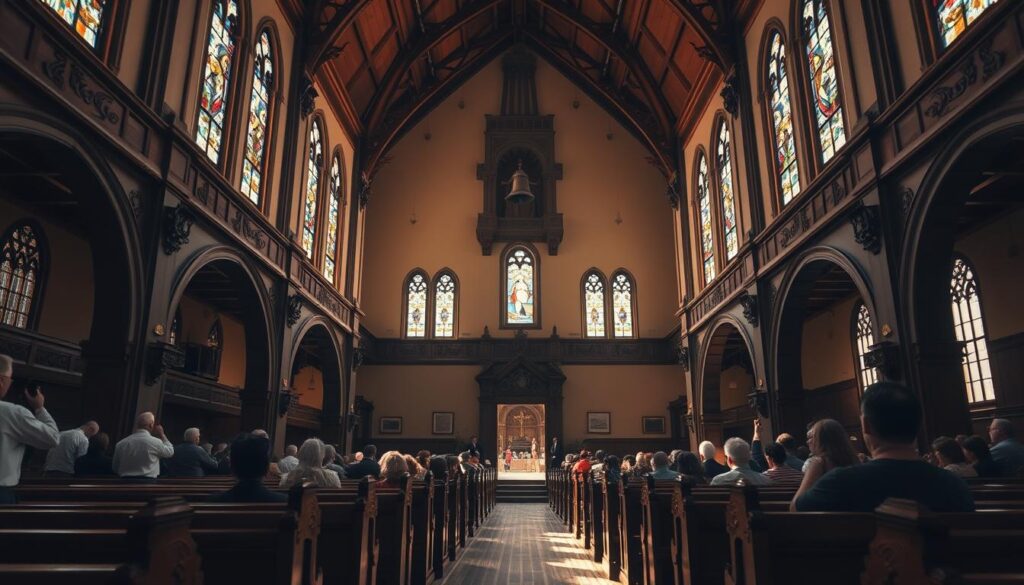
During the Great Migration period (1630-1640), over 20,000 Puritans crossed the Atlantic. They built societies where church membership determined voting rights and social standing. Their “city upon a hill” vision demanded literacy for Bible reading, leading to America’s first public schools.
Colonial Religious Practices
Sunday services lasted four hours, blending psalm singing with fiery sermons. Communities enforced strict Sabbath rules – no work or games from sunset Saturday to Sunday evening. This created a culture valuing self-examination and communal responsibility.
Local churches operated independently through congregational governance, a tradition that later influenced political structures. Deacons handled poor relief while ministers educated youth – blending spiritual and social roles.
These 17th-century practices left lasting marks. Modern town meetings and public education systems trace their roots to Puritan innovations. As one historian noted: “They came seeking purity, but built institutions that embraced diversity.”
Influence on American Colonial History
Colonial meetinghouses doubled as civic centers where faith and governance intertwined. Protestant groups shaped early debates about authority, planting seeds for democratic ideals that still grow today. Their values influenced everything from voting rights to public education systems.
Establishment of Church-State Relations
Twelve original colonies had Protestant majorities, creating a unique religious landscape. Maryland stood apart with Catholic roots, though even there, freedom debates reflected broader tensions. Local church leaders often held political power, blurring lines between spiritual and civic roles.
The Revolution tested loyalties when Anglican ministers faced impossible choices. Sworn to support the British crown, many fled as patriots gained ground. This crisis birthed new approaches – churches redefined their missions to align with American independence.
Early leaders drew from Protestant ideas like covenant theology. The “city upon a hill” concept became shorthand for national purpose. These principles helped justify breaking from foreign rule while preserving religious identity.
By 1789, these experiments in balancing freedom and order found expression in the First Amendment. The United States emerged with a novel approach – protecting individual conscience while preventing state-sponsored faith.
Evolution of Protestant Denominations in the USA
Diverse Protestant roots took hold early, with settlers bringing varied beliefs that evolved into distinct American denominations. Colonial ports welcomed Anglican planters, German Lutherans, and Dutch Reformed groups, each planting seeds for future spiritual movements. These communities didn’t just transplant European traditions – they adapted scriptures to frontier realities.
Early Diversity and Immigration Impact
Imagine 18th-century docks where Swedish Lutherans unloaded hymnals while Scottish Presbyterians debated theology. This mix created a spiritual laboratory. Churches reshaped worship styles to match America’s vast landscapes, birthing innovations like outdoor revivals and traveling preachers.
Nineteenth-century immigration waves added fresh layers. Norwegian Lutherans established midwestern colleges, while Methodist circuit riders galloped between frontier towns. One historian notes: “The prairie became a pulpit, and camp meetings turned strangers into neighbors.”
Revival movements sparked further changes. The Second Great Awakening (1790–1840) birthed new denominations like the Disciples of Christ. These groups emphasized personal conversion over rigid doctrines, appealing to pioneers seeking flexible faith.
Today’s landscape reflects this adaptive legacy. Some churches preserve centuries-old liturgies, while others use rock bands and podcasts. Yet all share a common thread – empowering members to shape their spiritual journeys within ever-changing communities.
Statistical Trends and Demographic Shifts
Numbers tell a story of adaptation and resilience within America’s religious landscape. The Pew Research Center’s comprehensive studies show dynamic membership trends reshaping how communities practice faith today. These patterns reveal both continuity with historical roots and responses to modern social changes.

Key Data from Pew Research Center
Recent surveys highlight fascinating details about religious affiliations. Evangelical groups make up 55% of Protestant traditions, while mainline denominations account for 32%. Black churches represent 14% – a testament to their enduring cultural impact.
Baptist congregations remain the largest branch at 33%, but newer movements gain ground. Nondenominational churches now claim 13% of members, appealing to those seeking flexible worship styles. “People increasingly value personalized spiritual experiences,” notes one Pew Research analyst.
Changing Memberships Over Centuries
Membership rolls have shifted dramatically since colonial times. Traditional denominations like Methodists and Lutherans now share space with growing Pentecostal and Restorationist groups. Urbanization and digital culture play key roles in these changes.
While some groups see declining numbers, their cultural influence persists. Mainline churches still operate 40% of religious-affiliated schools nationwide. The data suggests members balance heritage with modern needs – 63% attend churches offering both traditional services and community programs.
These trends provide crucial information for understanding faith in contemporary life. As the Pew Research Center shows, adaptability remains central to maintaining relevance across generations.
Protestantism USA – Key Figures and Movements
Bold ideas need brave champions. America’s religious landscape transformed through visionary leaders who turned radical concepts into enduring freedoms. Their legacies shaped how communities worship and govern themselves today.

Pioneers of Religious Liberty
Roger Williams stood like a lightning rod in colonial debates. Banished from Massachusetts for demanding church-state separation, he founded Rhode Island as a haven for dissenters. “Soul liberty isn’t a privilege – it’s every person’s right,” he declared, planting seeds for First Amendment protections.
Williams and ally John Clarke sparked the Baptist movement through daring actions. In 1639, they established America’s first Baptist churches – radical spaces welcoming diverse beliefs. These congregations became blueprints for self-governance and scriptural study.
Early evangelicals understood the term “Protestant” meant action. They created networks supporting education and civic participation. Literacy programs ensured people could read scripture – and eventually, voting ballots.
Three lasting impacts emerged from these leaders:
- Congregational decision-making models
- Interfaith dialogue practices
- Public service as spiritual duty
Their courage still inspires movements addressing modern challenges. From civil rights to climate action, the pattern remains: faith-driven people creating change through conviction and community.
Mainline, Evangelical, and Black Churches
America’s spiritual landscape thrives through three distinct church traditions, each weaving unique threads into the nation’s cultural fabric. These communities balance historical roots with modern service, creating spaces where faith meets action.
Distinct Characteristics and Contributions
Mainline churches often lead social justice efforts, operating food pantries and immigrant support programs. Their stained-glass windows frame both ancient hymns and contemporary debates about climate change.
Evangelicals prioritize personal spiritual journeys, with 72% of members attending weekly services. Their megachurches host job training centers alongside vibrant youth ministries, blending Bible study with community building.
Black churches like the African Methodist Episcopal (AME) Church fuel cultural resilience. Founded in 1815 after Richard Allen’s historic split from segregated congregations, these groups became hubs for civil rights organizing and gospel music innovation.
Each tradition shapes neighborhoods differently. You might find mainline churches hosting interfaith dialogues, evangelical campuses running addiction recovery programs, or AME members organizing voter registration drives. Together, they prove faith communities remain vital threads in America’s ever-evolving story.
FAQ
How did early Protestant groups shape American culture?
Groups like the Puritans emphasized education, hard work, and moral discipline. Their values influenced laws, schools, and social norms, creating foundations for community life still visible today.
What role did religion play in colonial church-state relations?
Many colonies had official churches funded by taxes. However, dissenters like Baptists pushed for separation, paving the way for the First Amendment’s religious freedom protections.
Why are there so many Protestant denominations in the U.S.?
Immigration brought diverse traditions from Europe, while theological debates and revival movements—like the Great Awakenings—sparked new groups. This blend created a dynamic religious landscape.
What do recent surveys say about membership trends?
Pew Research Center data shows a decline in mainline groups since the 2000s, while evangelicals remain stable. Over 40% of adults still identify with Protestant traditions, reflecting its enduring presence.
How have Black churches contributed to society?
The African Methodist Episcopal Church and others led civil rights efforts, blending faith with justice. They provided community support and became hubs for education and cultural preservation.
What distinguishes evangelicals from mainline Protestants?
Evangelicals focus on personal conversion and biblical authority. Mainline groups often prioritize social justice and adapt teachings to modern contexts, leading to differing cultural influences.