Exploring ancient spiritual wisdom requires more than linguistic skill—it demands respect for cultural depth. Hindu scriptures, rich with insights on life’s purpose, have shaped civilizations for thousands of years. Translating these texts bridges worlds, connecting modern readers to timeless truths.
Sacred writings like the Vedas and Upanishads contain layered meanings that challenge even expert linguists. Nuances in Sanskrit grammar and spiritual symbolism require interpreters to balance accuracy with reverence. Without this care, translations risk losing the essence of teachings like dharma or moksha.
Modern scholars combine traditional knowledge with contemporary tools to preserve authenticity. Digital libraries now offer annotated versions, making these works accessible globally. Whether studying philosophy or seeking personal growth, readers gain clarity through carefully crafted interpretations.
Key Takeaways
- Ancient Hindu texts demand both linguistic expertise and cultural sensitivity for accurate interpretation
- Sanskrit’s complex structure poses unique challenges for modern language adaptation
- Digital advancements have increased global access to spiritual teachings
- Core concepts like karma require context-aware explanations for English audiences
- Scholarly collaborations ensure translations maintain original philosophical depth
Exploring the Cultural Impact of english to hinduism translation
Translating sacred texts bridges time, connecting ancient insights with modern seekers. Hindu scriptures, known as sastra, serve as protective guides when their wisdom is applied. A Sanskrit principle states: “sasanat trananac caiva sastramityabhidhiyate”—these works safeguard communities through ethical codes and eternal inspiration.
Guardians of Timeless Wisdom
Converting classical texts into modern formats does more than decode words. It preserves philosophical depth while adapting teachings for today’s challenges. Early efforts by 18th-century scholars introduced Hindu thought to Western audiences, sparking global interest in concepts like karma and dharma.
From Manuscripts to Mainstream
Today’s projects blend scholarly rigor with digital tools, creating resources that honor original meanings. Universities worldwide use these interpretations to explore spiritual practices and societal values. By capturing cultural context alongside literal meanings, translators ensure teachings remain transformative across generations.
Modern renditions help spiritual seekers and academics alike access texts that once required specialized study. This fusion of old and new keeps ancient wisdom alive in our fast-paced world.
Resource Hub for Hindu Scriptural Insights
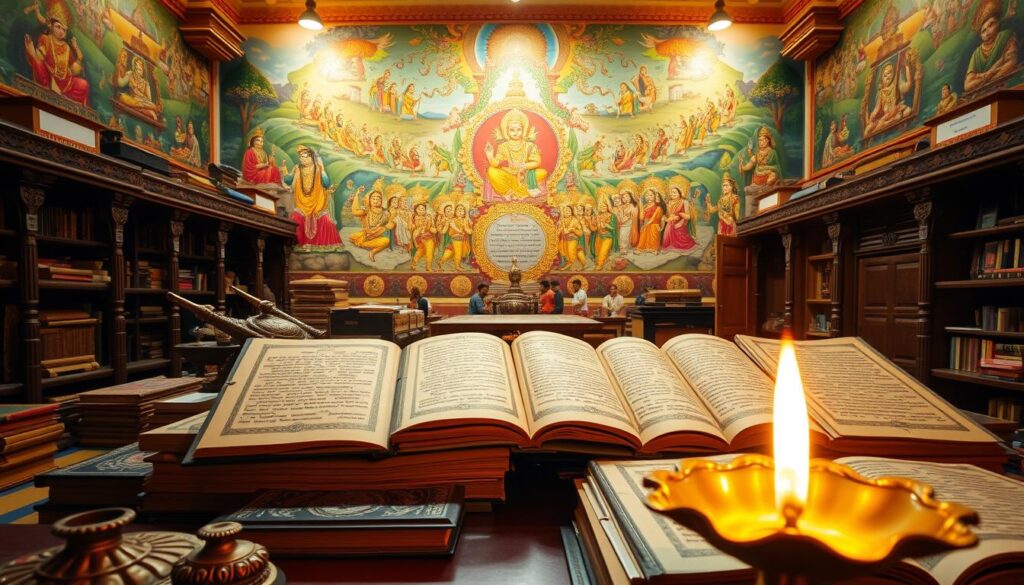
Accessing sacred texts has never been easier, thanks to modern tools blending centuries-old knowledge with digital innovation. Researchers and spiritual seekers now navigate a wealth of materials spanning rare manuscripts to interactive databases.
Diverse Sources and Notable Editions
Key works like Ralph T.H. Griffith’s 1896 Rig Veda interpretation laid groundwork for modern studies. Today’s scholars build on this legacy through:
- Academic editions from Princeton’s Firestone Library
- Digital archives like the Internet Sacred Text Archive
- Comprehensive anthologies combining multiple scriptures
Swami Harshananda’s 2000 compilation remains essential, offering transliterated Sanskrit alongside clear explanations. Universities use these editions to teach everything from Vedic hymns to legal codes in the Dharmashastras.
Insights from the Rig Veda to Dharmashastras
The oldest layers of wisdom coexist with practical guides for daily living. Modern platforms let readers:
- Compare 19th-century translations with current interpretations
- Explore connections between ritual poetry and ethical teachings
- Access commentaries from multiple cultural perspectives
This resource diversity ensures every reader – whether academic or casual explorer – finds pathways to engage with timeless truths.
Diverse Editions and Translations: Ancient Wisdom and Modern Interpretations
Understanding Hindu scriptures requires exploring how experts interpret them across generations. Three landmark approaches reveal evolving methods in bringing sacred texts to contemporary audiences.
Comparative Analysis of Translation Pioneers
Victorian scholar Ralph Griffith approached the Rig Veda as linguistic archaeology. His 1896 edition meticulously preserved grammatical structures but sometimes missed cultural context. Wendy Doniger’s 20th-century work blended storytelling with academic rigor, making complex myths relatable.
| Scholar | Era | Key Work | Methodology | Locations |
|---|---|---|---|---|
| Griffith | 19th c. | Rig Veda | Literal syntax focus | Firestone Library |
| Doniger | 1970s- | Upanishads | Narrative analysis | Chicago Archives |
| Olivelle | 1990s- | Dharmasūtras | Cultural precision | Oxford Repositories |
Navigating Global Knowledge Repositories
Major libraries offer unique editions for hands-on study:
- Princeton’s Firestone Library houses Griffith’s original manuscripts
- Oxford collections feature Olivelle’s annotated editions
- Digital archives provide cross-referencing tools
These locations serve as bridges between eras. A 19th-century palm-leaf manuscript might sit beside Doniger’s paperback interpretations – tangible proof of wisdom enduring through changing mediums.
Conclusion
The art of preserving sacred texts thrives through innovation and deep respect for their origins. These works act as living code systems, carrying spiritual insights across eras. Modern interpreters balance technical precision with cultural awareness to maintain their transformative power.
Global collaborations between linguists, historians, and tech experts create accessible resources. From university archives to mobile apps, seekers now explore philosophical concepts with unprecedented ease. This ecosystem supports everyone from curious readers to dedicated researchers.
Ethical practices guide contemporary efforts, ensuring authenticity meets accessibility. As digital tools evolve, so do methods for sharing age-old wisdom. Future projects promise richer connections between ancient teachings and modern lives.
FAQ
How does translating Hindu texts help preserve cultural heritage?
Translating sacred works like the Rig Veda or Dharmashastras bridges ancient wisdom with modern audiences. It ensures rituals, philosophies, and values remain accessible while maintaining their spiritual essence across generations.
Why is historical context crucial for interpreting Hindu scriptures?
Many texts reflect specific eras, societal norms, or regional practices. Understanding timelines—like Vedic vs. post-Vedic periods—helps avoid misinterpretations and reveals deeper layers of meaning in verses or teachings.
Where can I access authentic editions of Hindu philosophical works?
Trusted publishers like Motilal Banarsidass and academic platforms such as SARIT offer rigorously edited versions. Libraries like the Bhandarkar Oriental Research Institute also house rare manuscripts for scholarly study.
How do translations by Griffith, Doniger, and Olivelle differ?
A: Ralph T.H. Griffith focused on poetic structure, while Wendy Doniger emphasizes cultural narratives. Patrick Olivelle prioritizes legal and social contexts in works like the Upanishads, blending accuracy with readability.
What resources explore themes like Vedanta or karma in depth?
Academic journals like Journal of Indian Philosophy and annotated editions by scholars such as Swami Gambhirananda provide detailed analyses. Digital archives like the Digital Library of India also host rare commentaries.
How do modern interpretations balance tradition with today’s audience?
Translators simplify archaic terms without diluting core messages. Footnotes, chapter summaries, and cross-references to parallel texts (e.g., Bhagavad Gita and Mahabharata) help contextualize teachings for contemporary readers.