On September 15, 1963, an act of violence shook Birmingham, Alabama, and became a defining moment in America’s fight for equality. A Sunday morning explosion at a prominent African American house of worship left four young girls dead and galvanized nationwide outrage. This tragedy exposed the harsh realities of racial hatred while uniting activists to demand justice and change.
The targeted site was more than a spiritual center—it served as a gathering place for civil rights leaders organizing marches and meetings. Families trusted its walls as a safe space, making the attack feel deeply personal. Eyewitnesses described chaos: shattered stained glass, smoke-filled halls, and grief-stricken congregants.
National figures like Reverend Martin Luther King Jr. condemned the bombing, calling it “one of the most vicious crimes of the century.” The event accelerated support for landmark legislation, including the Civil Rights Act of 1964. It reminded the nation that progress often comes at a heartbreaking cost.
Key Takeaways
- The 1963 bombing marked a turning point in mobilizing civil rights activism across the U.S.
- Four children lost their lives during Sunday services, sparking national mourning.
- The church was a vital hub for organizing protests and community support.
- Public outrage after the attack helped push forward critical anti-discrimination laws.
- Martin Luther King Jr. highlighted the event as a symbol of systemic racism’s brutality.
Introduction and Overview
Why does a single act of violence become a catalyst for nationwide change? This case study examines the 1963 tragedy that transformed grief into momentum for civil rights progress. By exploring its roots and ripple effects, we uncover how collective pain can fuel lasting reform.
Purpose of the Case Study
Our goal is to unpack the layers of this pivotal moment. Through eyewitness stories, legal records, and historical analysis, we’ll answer key questions:
- How did systemic racism create conditions for such violence?
- What made this location a symbolic target?
- How did national leaders like Martin Luther King turn tragedy into legislative action?
Scope of the Article
We’ll walk through three main areas:
- Context: Birmingham’s racial climate before the attack
- Impact: Immediate aftermath and delayed justice
- Legacy: Connections to the 1964 Civil Rights Act
You’ll discover how ordinary people became extraordinary advocates. As one survivor noted:
“Our tears watered the seeds of change.”
Historical Context of Birmingham and Segregation
Birmingham, Alabama, earned the nickname “Bombingham” long before 1963 due to frequent attacks on African American homes and institutions. The city’s strict segregation laws created two separate worlds. Public spaces like parks, buses, and water fountains carried “Whites Only” signs, while Black residents faced inferior facilities and limited opportunities.
Racial Landscape in Birmingham
City leaders like Commissioner Eugene “Bull” Connor enforced racial divides through intimidation. Police turned a blind eye to cross burnings and beatings. In 1962, over 50 unsolved bombings targeted Black neighborhoods, creating constant fear.
Economic and Social Disparities
Black workers earned half the wages of white counterparts for similar jobs. Most were barred from skilled positions, trapping families in poverty. Housing policies confined African Americans to overcrowded areas with poor sanitation.
These conditions made Birmingham’s civil rights activists relentless. As one organizer recalled: “We couldn’t drink from the same fountains, so we drank from the same well of courage.” The 16th Street community center became a rallying point, where strategies for equality took shape amid growing resistance.
The Role of the 16th Street Baptist Church in the Civil Rights Movement
Strategically positioned near key city landmarks, this historic building became more than a spiritual sanctuary—it operated as the command center for Birmingham’s fight against segregation. Its steps welcomed organizers, students, and families united by a shared vision of justice.
Community Hub for Activism
Leaders like the Southern Christian Leadership Conference (SCLC) chose the location for its accessibility. Situated blocks from the Birmingham public commercial district and City Hall, it allowed quick mobilization during protests. Weekly meetings here shaped plans for boycotts and sit-ins that challenged discriminatory laws.
The space provided safety in a city where the Klux Klan routinely threatened activists. One volunteer recalled: “We knew the walls had ears elsewhere, but here, we could speak freely.” For decades, the site symbolized resilience, hosting icons like Dr. King and serving as a classroom for nonviolent resistance training.
After the 1963 attack, the building’s name echoed across the United States as a testament to courage. News photos of its damaged facade stirred national empathy, transforming it from a local gathering spot into a timeless emblem of the movement’s sacrifices and strength.
Prelude to the Tragedy: Tensions in Birmingham
By 1963, Birmingham had become a tinderbox of racial tensions, where even small sparks risked catastrophe. The city earned its grim nickname “Bombingham” after over 20 unsolved explosions rocked African American neighborhoods since 1950. Families lived with constant dread, knowing their homes or gathering places could be next.
Local Racism and Violence
Systemic segregation created powder-keg conditions. White supremacists burned crosses on lawns and firebombed activists’ cars with impunity. One resident recalled: “We slept in shifts, listening for broken glass or footsteps.” Economic inequality deepened divides—Black workers earned 45% less than white counterparts despite similar jobs.
Community Warnings and Rising Tensions
Leaders like Martin Luther King Jr. had warned about escalating dangers months earlier. In May 1963, the Gaston Motel—King’s headquarters—was bombed during protests. Yet city officials dismissed concerns, claiming activists “exaggerated threats.”
By September, community meetings buzzed with urgent whispers. Church deacons patrolled basements for suspicious packages. A shopkeeper’s diary entry read: “The air feels heavy, like thunder without rain.” These overlooked warnings foreshadowed the coming storm.
16th Baptist Church Bombing: A Case Study
At 10:22 AM on September 15, 1963, a hidden dynamite bundle detonated beneath a staircase, collapsing part of the building during Sunday school. This calculated act of violence targeted a space where children gathered, turning a day of worship into a national reckoning.
Incident Overview and Significance
The explosive device contained 15 sticks of dynamite, planted hours earlier by white supremacists. Survivors described a deafening blast followed by screams and falling debris. Four young lives were lost instantly—Addie Mae Collins, Carole Robertson, Cynthia Wesley, and Carol Denise McNair, aged 11 to 14.
Eyewitness James Stone recalled: “The stained-glass Jesus hung sideways in the rubble, watching over those four little souls.” Rescue workers dug through wreckage with bare hands, finding shoes and hymnbooks amid the chaos.
| Key Aspect | Details | Impact |
|---|---|---|
| Timing | 26th Sunday after integration protests began | Highlighted racial retaliation |
| Victims | Four little girls in restroom | Humanized systemic racism’s toll |
| Investigation | FBI identified suspects within days | Delayed justice revealed institutional bias |
This attack became America’s wake-up call. Northern newspapers that rarely covered Southern violence ran front-page photos for weeks. As one senator noted:
“When they kill four little children in God’s house, we’re all complicit.”
The tragedy exposed how segregationist policies enabled domestic terrorism. It shifted public opinion, proving that legalized discrimination didn’t just limit opportunities—it cost lives.
The Horrific Explosion and Immediate Impact
A deafening roar shattered the calm of a Sunday morning as worshippers gathered for youth day services. At 10:22 AM, hidden dynamite detonated beneath the basement stairs, collapsing part of the building. Panic erupted as smoke filled the halls, trapping children and adults under debris.
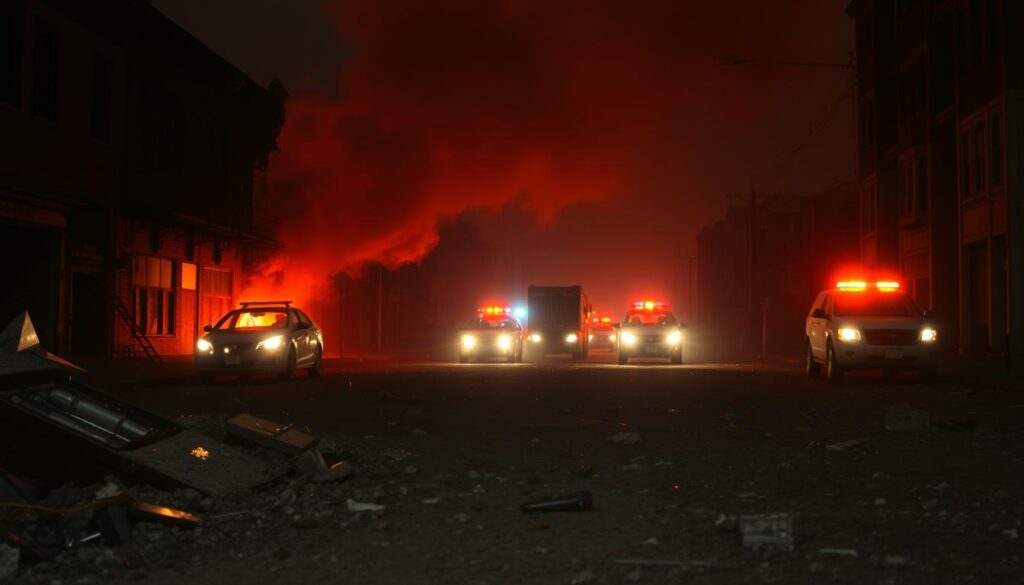
Timeline of the Explosion
The attack unfolded with chilling precision. At 8:45 AM, witnesses reported a suspicious car parked near the east wall. By 10:15, Sunday school classes were in full session when the blast ripped through the lower level. Survivors described a “wall of fire” followed by screams for help.
Casualties, Damage, and Aftermath
Four young lives—Addie Mae Collins, Carole Robertson, Cynthia Wesley, and Denise McNair—were lost instantly. Over 20 others suffered injuries from flying glass and falling bricks. The explosion blew out windows blocks away, damaging nearby stores and a parked ambulance.
Within minutes, community members formed human chains to clear rubble. Medics used pews as stretchers while nurses triaged wounds on the sidewalk. As one volunteer later recalled, “We didn’t see strangers that day—only neighbors needing help.”
The building’s eastern wall crumbled, exposing Sunday school artwork still hanging in shattered classrooms. Firefighters worked for hours to stabilize the structure, their boots crunching on broken hymnals. This collective trauma would soon fuel demands for justice and stronger civil rights protections nationwide.
Eyewitness Accounts and Personal Testimonies
Personal stories from survivors and grieving families reveal the human cost of racial violence. These accounts transform statistics into heartbeats, reminding us how systemic hatred reshaped individual lives forever.
Survivor Narratives
Sarah Collins Rudolph, then 12, was steps away from her sister Addie Mae when the blast occurred. “Glass flew like arrows—I lost an eye, but others lost their futures,” she recalled decades later. Shrapnel embedded in her body became permanent reminders of the attack’s brutality.
Other witnesses described scenes of confusion. A deacon’s grandson, aged 9, mistook the explosion for thunder until he saw blood on his shoes. Rescue worker Jefferson Drew later wrote: “We lifted bricks stained with Sunday school lessons. The violence stole innocence, not just lives.”
Impact on Affected Families
Parents of the victims faced unimaginable grief. Carole Robertson’s mother kept her daughter’s intact choir robe in a cedar chest, unwashed for 40 years. Cynthia Wesley’s adoptive parents withdrew from public life, their silence speaking volumes about unresolved pain.
Despite this trauma, many families channeled sorrow into action. Denise McNair’s father joined NAACP leadership, declaring: “Hate broke our hearts, but the movement mends communities.” Their courage turned personal loss into collective resolve, proving that even shattered spirits could rebuild.
The Aftermath: Community Response and Unrest
Grief became a bridge between communities as Birmingham faced its darkest hour. Within hours of the tragedy, crowds gathered outside the Sixteenth Street Baptist site, their candles flickering like defiant stars against the night. Mothers held photos of the victims while students carried signs reading, “Their dreams live in our march.”
Public Mourning and Outrage
Over 8,000 people attended the girls’ joint funeral three days later—a sea of sorrow stretching blocks. One mourner described the scene: “Black and white hands clasped hymnbooks together, but anger simmered beneath the hymns.” While many white residents condemned the attack, others blamed activists for “stirring trouble.”
The tragedy ignited fresh determination. NAACP chapters nationwide saw membership double within weeks. Youth protesters adopted the victims’ names as rallying cries, chanting “Remember Addie, Carole, Cynthia, Denise!” during sit-ins. Even hesitant allies joined marches, realizing segregation’s human toll.
- Memorial services drew interfaith leaders, amplifying calls for justice
- Business districts faced boycotts as consumers demanded accountability
- Artists created murals honoring the girls, turning walls into classrooms
As Dr. King told reporters:
“This crime didn’t just wound a house of worship—it exposed America’s moral fractures.”
Thecivil rights movementharnessed this collective anguish, transforming tear-stained vigils into unstoppable momentum for change.
The Investigation: FBI and Legal Pursuits
Within hours of the explosion, federal agents descended on Birmingham, marking the start of a decades-long quest for justice. Investigators faced immediate hurdles—witnesses feared retaliation, and critical evidence seemed to vanish. A 1963 memo to J. Edgar Hoover revealed early doubts: “Local cooperation remains… problematic.”
Initial FBI Efforts
The Bureau identified four suspects within days, including Bobby Frank Cherry, through bomb residue analysis and car descriptions. Yet witnesses refused to testify, and prosecutors deemed evidence “insufficient for trial.” Key documents sat untouched in the Birmingham Public Library archives for years, containing unverified tips about Klan involvement.
Cold Case Reopenings and Evidence
New momentum came in 1971 when the New York Times published leaked FBI files, reigniting public interest. Advances in forensic technology allowed experts to match 1963 dynamite fragments to a suspect’s workshop in 1997. Former Klansmen’s testimonies finally broke the silence—one admitted hearing Cherry boast about “teaching them a lesson.”
| Investigation Phase | Key Evidence | Outcome |
|---|---|---|
| 1963-1965 | Witness statements, bomb fragments | No charges filed |
| 1977-1979 | FBI memo analysis | Grand jury convened |
| 1997-2002 | Forensic matches, deathbed confessions | Cherry convicted (2002) |
Legal teams faced race against time as suspects aged. Prosecutor Doug Jones later noted:
“Justice delayed isn’t justice denied—it just requires more stubborn hope.”
Persistent advocacy groups and declassified files ultimately turned the tide, proving truth could outlive fear.
The Trials and Convictions of Perpetrators
Justice arrived in waves, decades after the attack that claimed Addie Mae Collins and three other girls. Legal teams faced a maze of obstacles—lost evidence, reluctant witnesses, and institutional indifference—but persistence rewrote the story.
Landmark Legal Decisions
Robert Chambliss became the first convicted perpetrator in 1977 after his niece bravely testified about his role. Prosecutor Bill Baxley used old FBI tapes where Chambliss called dynamite his “equalizer.” The verdict marked a turning point, proving hate crimes wouldn’t fade into history.
Thomas Blanton and Bobby Frank Cherry faced trials in 2001-2002, aided by fresh forensic matches and declassified files. Former civil rights activists rallied survivors to share suppressed memories. Attorney Doug Jones famously declared:
“Time doesn’t heal all wounds—it just gives us better tools for truth.”
Key outcomes reshaped legal precedents:
- Chambliss: Life sentence (1977)
- Blanton: Four life terms (2001)
- Cherry: Life imprisonment (2002)
These convictions validated decades of advocacy, showing delayed justice still carries weight. Families of Addie Mae Collins and others found closure, while the Civil Rights Act gained renewed respect as a shield against systemic violence.
Martin Luther King Jr. and National Reactions
In the wake of unspeakable loss, a voice emerged to channel collective grief into purposeful action. Dr. Martin Luther King Jr. stood before cameras three days after the tragedy, his words cutting through America’s numbness. “The blood of these innocent children demands that we confront our nation’s sickness,” he declared, framing the attack as a moral test for all citizens.
Leadership Amid Crisis
King’s telegram to Alabama Governor George Wallace laid bare the stakes: “The southern christian leadership you ignore today will shape tomorrow’s conscience.” He organized interfaith vigils while urging Northern allies to pressure Congress. Newspapers nationwide reprinted his speeches, transforming local pain into a unifying call for justice.
The 1963 bombing Birmingham response revealed King’s strategic brilliance. He balanced raw emotion with policy demands, telling reporters: “Tears alone won’t change laws—but votes will.” His coalition-building efforts gained traction as white religious groups joined marches, signaling shifting attitudes.
Key outcomes of his leadership:
- Rallied bipartisan support for the Civil Rights Act within months
- Inspired the national park service to later designate key sites as historical landmarks
- Strengthened the southern christian leadership conference’s role in national dialogues
Decades later, King’s words during this crisis remain etched in public memory. As one historian noted: “He turned a crime against four children into a referendum on America’s soul.” The national park service now preserves these stories, ensuring new generations understand courage’s cost.
Media Coverage and Legacy in Public Memory
Headlines across America transformed a local tragedy into a national awakening. Front-page photos of shattered stained glass and grieving families forced readers to confront racial violence’s human toll. Outlets like the New York Times framed the event as a moral failure, with one editorial asking: “What kind of nation lets children die for equality?”
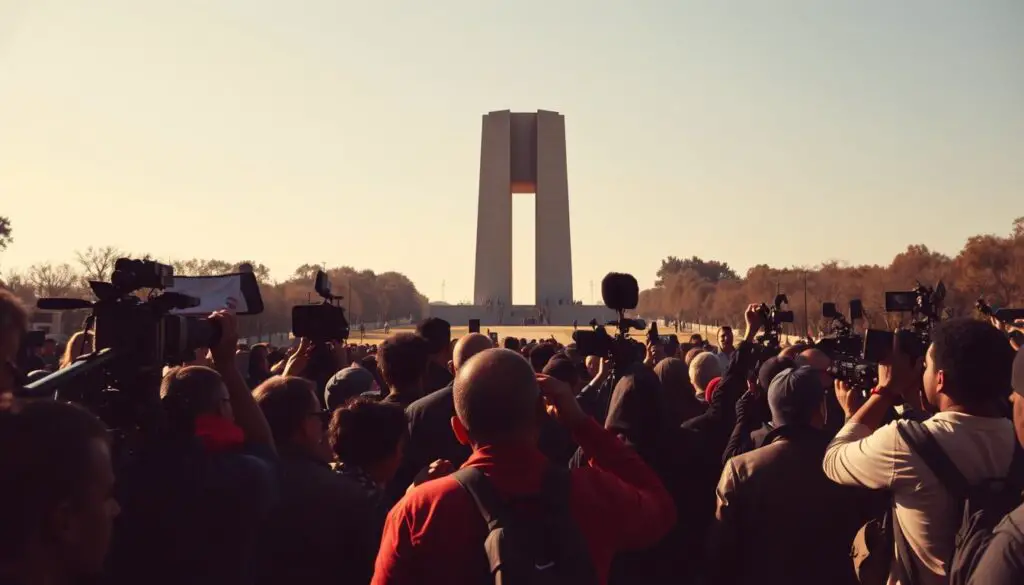
Contemporary Reporting
Initial coverage focused on the victims’ youth, dubbing them “four little girls” to emphasize innocence lost. Reporters highlighted the Christian Leadership Conference’s role in organizing memorials, linking spiritual resolve to political action. While Southern papers downplayed racial motives, national outlets connected the attack to broader American civil rights struggles.
Television networks aired footage of Dr. King’s eulogy, amplifying his call for legislative change. A CBS anchor noted: “This isn’t just Alabama’s shame—it’s America’s crossroads.” Such framing shifted public opinion, turning regional grief into federal policy demands.
Long-Term Media Impact
Decades later, documentaries like 4 Little Girls reintroduced the story to new generations. Museums now display the Times’ original headlines alongside victims’ diaries, creating visceral connections between past and present. Annual retrospectives keep the Christian Leadership Conference’s message alive, showing how media can combat historical erasure.
Social media campaigns recently paired #FourLittleGirls with modern injustice stories, proving the power of enduring narratives. As one journalist observed:
“Truth doesn’t expire—it just needs retelling.”
Through books, films, and digital archives, theAmerican civil rightsmovement’s pivotal moment remains a living lesson in courage and consequence.
Long-Term Impact on Civil Rights Legislation
A community’s loss became the nation’s moral compass, steering landmark laws into existence. The tragedy at the sixteenth street gathering place shocked lawmakers into action, proving that grassroots pain could reshape federal policy. Within months, stalled bills gained momentum as public pressure reached a tipping point.
President Lyndon B. Johnson signed the Civil Rights Act of 1964 just nine months later, banning segregation in public spaces. Legal experts credit the Birmingham tragedy for breaking Senate filibusters. As one congressman admitted: “How could we block reforms while mothers buried their daughters?”
The legislation sparked a domino effect. The Voting Rights Act (1965) and Fair Housing Act (1968) followed, dismantling systemic barriers nationwide. These laws transformed the rights movement from street protests to enforceable mandates, embedding equality into legal frameworks.
| Legislation | Key Provisions | Connection to Event |
|---|---|---|
| Civil Rights Act (1964) | Banned employment discrimination | Directly referenced in Johnson’s speech |
| Voting Rights Act (1965) | Outlawed literacy tests | Funded federal election monitors |
| Fair Housing Act (1968) | Prohibited housing bias | Inspired by displaced families |
Decades later, the Americans with Disabilities Act (1990) and marriage equality rulings drew inspiration from these precedents. Activist Diane Nash observed:
“They tried to bury justice in rubble—we turned it into bedrock.”
Today, the sixteenth street site reminds us how courage can rewrite laws. Its legacy lives in every jury box, classroom, and ballot booth where fairness prevails over fear.
The Rebirth of a Historic Landmark
Decades after tragedy, a landmark rises from the ashes, symbolizing resilience and unity. Once a target of violence, this sacred space now stands as a testament to collective healing. Preservationists and community members joined forces to repair both physical scars and fractured trust.
Church Rehabilitation Efforts
By the 1990s, weather damage and aging threatened the building’s structure. A $3 million grant from the National Park Service’s African American Civil Rights Program launched critical repairs in 2017. Workers restored stained-glass windows shattered in 1963, including one depicting a Black Christ—a powerful symbol of endurance.
Local teens partnered with the public library to archive oral histories displayed in the new education wing. As project lead Marcia Conwell noted:
“We’re not just fixing bricks—we’re rebuilding connections between generations.”
| Initiative | Funding Source | Impact |
|---|---|---|
| Structural repairs | Federal Heritage Grant | Stabilized foundation and walls |
| Education Center | Community Donations | Hosts 15,000 annual visitors |
| Memorial Garden | State Arts Council | Honors the four girls |
Ongoing programs address broader justice themes, including exhibits on Robert Chambliss’s 1977 conviction. Tours now link past struggles to modern activism, proving preservation fuels progress.
Reflecting on Forgiveness and Resilience
Healing often begins where pain runs deepest. Survivors of the 1963 tragedy transformed personal anguish into pathways for reconciliation, proving that courage comes in many forms—even quiet acts of mercy.
Sarah Collins Rudolph’s Journey
Blinded in one eye during the attack, Sarah Collins Rudolph spent decades wrestling with anger. “I wanted justice, not revenge,” she told the New York Times in 2013. Her sister, Denise McNair, was among the victims, but Sarah chose forgiveness over bitterness. She became a vocal advocate for dialogue, speaking at schools and interfaith events nationwide.
Her memoir, My Sister’s Keeper, details how faith guided her healing. “Hate is a heavy load to carry,” she wrote. Community initiatives now use her story in conflict resolution workshops, showing how personal grace can mend collective wounds.
Community Healing and Renewal
Birmingham’s reconciliation projects focus on shared futures rather than divided pasts. The “Healing Steps” program pairs survivors’ families with former segregationists to co-lead neighborhood cleanups. A local mural honoring Denise McNair and the other girls includes tiles painted by descendants of Klansmen—a visual truce.
Civil rights leaders amplify this message. Reverend Jesse Jackson once noted during a New York rally:
“Love builds bridges where rage burned them.”
Annual unity marches now end at the restored church, where participants swap stories instead of stones. These efforts remind us that resilience isn’t about forgetting—it’s about rewriting tomorrow’s script.
Conclusion
In the shadow of tragedy, communities find strength to forge lasting change. The 1963 attack on Birmingham’s spiritual hub revealed both humanity’s capacity for cruelty and its resilience. While figures like Bobby Frank Cherry delayed justice for decades, survivors transformed grief into tools for progress—pushing civil rights laws forward and rebuilding trust.
This case study reminds us that historical wounds can shape futures. Landmark legislation like the 1964 Civil Rights Act emerged from collective outrage, proving systemic change often follows profound loss. Yet the true legacy lies in everyday courage—families choosing forgiveness, neighbors bridging divides, and new generations upholding equality.
As we reflect on these events, their lessons remain urgent. Modern activists draw inspiration from those who turned pain into purpose, showing how unity outlives hatred. Let their stories challenge us to ask: How will we honor their sacrifice in today’s fight for justice?
FAQ
Why was the 16th Street Baptist Church significant during the civil rights era?
The church served as a vital gathering place for activists, hosting meetings led by figures like Dr. Martin Luther King Jr. Its central location made it a symbol of unity and resistance against segregation in Birmingham.
How did the 1963 attack impact national civil rights laws?
The tragedy galvanized public support, accelerating the passage of the Civil Rights Act of 1964. It exposed the urgency of addressing racial violence and systemic inequality across the United States.
Were the perpetrators ever brought to justice?
Yes, but decades later. Robert Chambliss was convicted in 1977, followed by Thomas Blanton and Bobby Frank Cherry in the early 2000s. These trials highlighted the persistence of cold case investigations in seeking accountability.
What role did media play in shaping the legacy of this event?
Outlets like The New York Times amplified the story, forcing national attention on Birmingham’s racial violence. Photographs of the devastation became enduring symbols of the fight for equality.
How did survivors like Sarah Collins Rudolph contribute to healing?
Sarah, who lost her sister Addie Mae Collins, became a vocal advocate for forgiveness and education. Her resilience inspired community efforts to rebuild and honor the victims’ memories.
Is the church still active today?
Absolutely. Restored as a National Historic Landmark, it remains a place of worship and education. The Birmingham Public Library also preserves archives to ensure the tragedy is never forgotten.
Did local leaders anticipate violence before the explosion?
Tensions were high due to repeated threats. Activists had warned of potential attacks, but inadequate protections left vulnerable spaces like churches exposed to hate-driven acts.
How did Dr. King respond to the bombing?
He condemned the attack as a “moral blindness” and urged nonviolent resistance. His eulogy for the victims reinforced the movement’s commitment to justice through peaceful means.