For centuries, this sacred emblem has stood as a universal sign of hope and spiritual connection. More than just a historical artifact, it bridges the gap between divine mystery and human experience, inviting believers to reflect on its layered meanings.
At its core, the symbol represents transformation – turning pain into purpose and despair into renewal. Its shape tells a story of sacrificial love that reshapes how communities understand suffering. Through theological teachings, it becomes a doorway to understanding how ordinary moments hold extraordinary spiritual content.
Modern believers continue to find relevance in this ancient form. From church altars to personal jewelry, its presence in daily life reminds people of enduring truths. It’s not about dwelling on loss but celebrating the victory that emerges from it – a truth that resonates across generations.
Key Takeaways
- Represents spiritual transformation and the power of sacrificial love
- Connects historical events to modern spiritual practices
- Transcends cultural boundaries as a universal emblem of hope
- Encourages personal reflection on life’s challenges and purpose
- Integrates seamlessly into both communal worship and private devotion
History and Origins of the Catholicism Cross
What began as a brutal execution tool became Christianity’s most hopeful emblem. Early followers saw past its grim origins, reshaping it into a beacon of spiritual triumph. This shift didn’t happen overnight—it unfolded through centuries of cultural adaptation and theological reflection.
The Early Beginnings and Theological Roots
First-century believers cautiously used symbols like the Staurogram, a clever blend of Greek letters representing Christ’s sacrifice. Manuscripts from ancient times reveal this mark in sacred texts, showing its quiet role in early worship. Another favorite, the Chi Rho, combined letters spelling “Christos,” offering coded hope during times of persecution.
Transition from Ancient Symbols to Medieval Iconography
By the 4th century, the simple Latin shape dominated churches. Its clean lines mirrored Christianity’s growing openness after Emperor Constantine’s conversion. Medieval artisans then added layers of meaning—like the stepped cross’s three tiers symbolizing virtues every believer cultivates over time.
| Cross Type | Unique Feature | Historical Period |
|---|---|---|
| Latin | Simple vertical beam | 4th century onward |
| Stepped | Three-tiered base | Byzantine Era (610-641 AD) |
| Patriarchal | Double crossbars | Medieval Church |
| Papal | Three horizontal bars | Developed post-12th century |
| Byzantine | Flared ends | Eastern Empire influence |
These designs did more than decorate churches—they taught salvation stories visually. A Patriarchal cross’s extra bar might represent Christ’s title plaque, while triple bars on papal versions mirrored church hierarchy. Each adaptation kept the symbol fresh yet faithful to its core message about the son of God’s redeeming act.
Symbolism and Spiritual Meanings Behind the Cross
A simple shape holds layers of meaning for millions worldwide. This sacred symbol doesn’t just mark historical events—it reveals how suffering and triumph intertwine in spiritual growth. Believers see it as a map showing the path from earthly struggles to divine connection.
The Role of Sacrifice and Resurrection in Catholic Thought
The crucifix tells a story in two acts. First, it shows sacrifice—a divine response to human brokenness. Christ’s choice to embrace suffering transforms pain into purpose, proving love stronger than death.
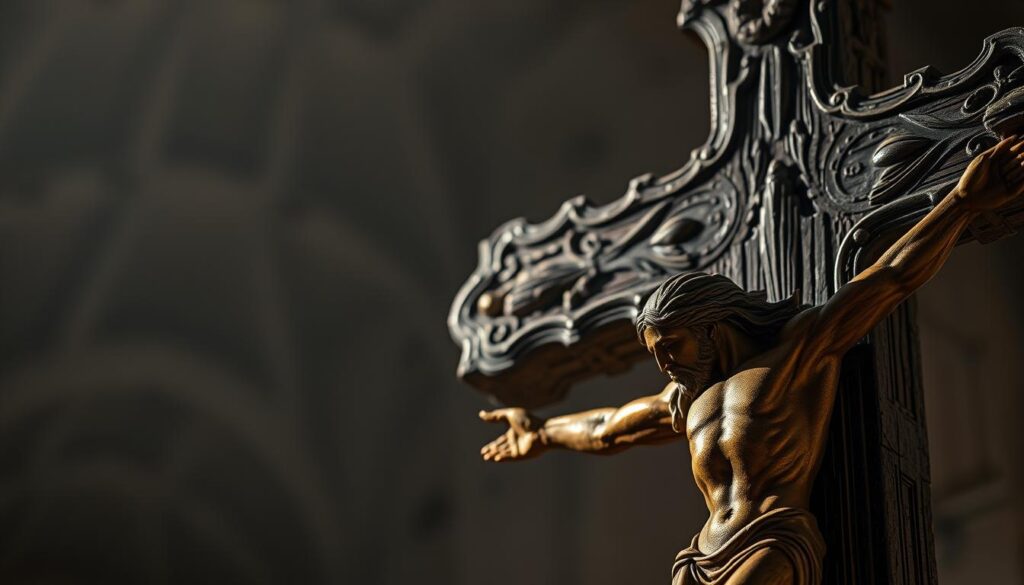
Resurrection completes the narrative. Empty tombs and folded burial cloths turn despair into hope. This dual focus shapes Catholic worship: “We preach Christ crucified… the power of God,” as scripture says. Every Mass celebrates this victory over sin.
Comparing the Crucifix with the Plain Cross in Worship
Why do Catholics favor the crucifix over empty crosses? The answer lies in their view of worship. The body on the cross makes Christ’s sacrifice tangible during Mass. It’s not about ignoring resurrection—it’s about honoring the cost of redemption.
Protestant churches often use plain crosses to highlight Easter’s triumph. But Catholic tradition stretches Easter joy across 50 days, with weekly “mini-resurrections” in Sunday services. The crucifix becomes a year-round reminder: new life springs from selfless love.
Art, Architecture, and Cultural Impact of the Catholicism Cross
This sacred symbol shapes both grand cathedrals and quiet moments of prayer. Architects have turned stone and glass into living sermons—like St. Paul’s Cathedral, where the Latin floor plan forms a giant cross under visitors’ feet. These designs invite people to walk through sacred space literally shaped by faith.
Liturgical Art and Its Reflection of Faith
In worship spaces, the crucifix does more than decorate walls. It acts as a spiritual compass. Medieval carvers once said, “We don’t make crosses—we reveal what’s already in the wood.” This philosophy still guides artists today who balance tradition with fresh perspectives.
Personal devotion items carry this power into daily life. A grandmother’s rosary or a hiker’s summit cross on Mount Royal—each becomes a bridge between earthly struggles and heavenly hope. These small signs whisper big truths about love conquering death.
Modern creators keep reinventing this ancient symbol. One sculptor recently described her steel crucifix as “a collision of suffering and glory.” Whether in cemeteries or digital art, the message remains: what looks like an end can become the start of new life.
Conclusion
In every generation, believers find new meaning in this ancient sign. The crucifix isn’t just a reminder of pain—it’s a map showing how love rewrites endings. Through Christ’s sacrifice, what looked like defeat became humanity’s path to salvation.
This symbol teaches that true power god shows up in weakness. When couples exchange vows saying “With my body, I thee worship,” they echo the self-giving love displayed on that first Good Friday. It’s a pattern for how we treat one another daily.
The empty cross of Easter morning completes the story. Resurrection assures us that no suffering is wasted when offered with faith. Whether in grand cathedrals or quiet prayers at home, this truth shapes how millions live with purpose today.
As dawn breaks each day, the cross invites us to see our struggles through heaven’s eyes. Here, mercy meets justice, and death becomes the doorway to life unending. That’s the lasting promise etched in wood and worn close to the heart—a story of glory written in scars.
FAQ
Why does the crucifix include a figure of Christ while other crosses don’t?
The crucifix emphasizes sacrifice and the resurrection, central to Catholic teachings. It visually reminds believers of Christ’s suffering and victory over death. Plain crosses often symbolize hope and faith without focusing directly on the crucifixion event.
How did early Christians adopt the cross as a symbol of faith?
Early believers initially used discreet signs like fish or anchors to avoid persecution. After Emperor Constantine’s vision of a cross in 312 AD, it became a public emblem of divine power and redemption, merging ancient spiritual ideas with Christian worship.
What role does the cross play in Catholic liturgy and art?
In liturgical art, the cross bridges humanity with divine love. It’s woven into rituals, church designs, and sacraments to reflect Christ’s presence. From stained glass to altar carvings, it serves as a focal point for prayer and reflection on salvation.
Is the cross seen differently in other Christian traditions?
Yes! Some denominations prefer empty crosses to highlight the resurrection, while Catholics often use the crucifix to honor Christ’s sacrifice. Both forms share a common foundation in faith but express theological nuances in worship practices.
How does the cross connect to justice and mercy in Catholic teaching?
The cross embodies God’s justice—addressing sin—and His boundless love. It reminds believers to live humbly, serve others, and seek forgiveness, mirroring Christ’s ultimate act of mercy for humanity’s sake.