What happens after we die? For centuries, this question has shaped spiritual journeys across cultures. The Catholic Church offers a vision of eternity that transcends popular ideas of fluffy clouds or endless picnics. Instead, it invites believers into a transformative relationship—one rooted in divine love and purpose.
Cardinal Joseph Ratzinger (later Pope Benedict XVI) cautioned against reducing the afterlife to earthly metaphors. In his book Eschatology: Death and Eternal Life, he argued that simplistic imagery fails to capture the profound reality of being united with God. The Catechism echoes this, describing heaven as seeing Christ “face to face” through the beatific vision—a state of perfect joy and communion.
This perspective isn’t about escaping life but fulfilling it. Unlike cultural depictions of passive bliss, Catholic teaching emphasizes active participation in God’s love. It’s a way of existence where every soul finds its true home, free from earthly limitations.
Why does this matter today? In a world searching for meaning, the Church’s ancient wisdom bridges timeless truth and modern longing. Let’s explore how this vision answers our deepest questions about existence beyond the grave.
Key Takeaways
- The Catholic perspective moves beyond literal imagery to focus on a transformative relationship with God.
- Heaven involves the “beatific vision”—direct communion with Christ, not physical landscapes.
- Cardinal Ratzinger warned against oversimplified portrayals that misrepresent eternal joy.
- Eternal life fulfills our earthly journey rather than negating it.
- This teaching addresses modern searches for purpose with theological depth.
Introduction to the Catholic Understanding of Heaven
The Church’s vision of eternal life reflects a tapestry woven from scripture, tradition, and centuries of faithful inquiry. Early thinkers like Augustine of Hippo laid foundations by exploring divine communion, while medieval scholars such as St. Thomas Aquinas deepened these ideas through philosophical rigor. Over time, councils like Trent and Vatican II clarified teachings, ensuring clarity without losing mystery.
| Time Period | Key Contributors | Core Insights |
|---|---|---|
| Early Church (1st–5th c.) | Church Fathers | Emphasized unity with Christ through baptism and martyrdom |
| Medieval Era | St. Thomas Aquinas | Described heaven as the soul’s ultimate fulfillment in God |
| Modern Times | Pope John Paul II | Reinforced heaven as relational, not spatial |
Historical Context and Traditional Teachings
Ancient writings reveal a focus on life transformed rather than relocated. The Didache, a first-century text, urged believers to “gather often” to seek eternal truths. By the Middle Ages, Aquinas framed heaven as the mind’s joyful grasp of divine essence—a concept still shaping Catholic thought today.
Modern Reflections on Eternal Life
Recent teachings emphasize accessibility. Pope John Paul II noted, “Heaven is neither an abstraction nor a physical place… but a living relationship.” This shift helps people connect timeless truths to daily experiences. The Church teaches that divine love, not geography, defines our final home—a view resonating in today’s search for meaning.
Exploring the Concept: catholicism heaven as a State and a Place
Many imagine the afterlife as a distant realm with golden streets or celestial gardens. But Catholic teaching invites us to think deeper. It presents heaven not just as a place but as a transformed state of existence—a reality where love transcends physical boundaries.
Defining Heaven in Traditional and Contemporary Terms
Pope John Paul II reshaped modern understanding by calling heaven “the fullness of communion with God.” This shifts focus from geography to relationship. While older artworks showed clouds and angels, theologians stress that eternal joy flows from divine connection, not scenery.
https://www.youtube.com/watch?v=O0mrlrA9Iks
The Church acknowledges a qualified sense of location. After the final resurrection, glorified bodies will exist in a renewed creation. But this doesn’t reduce heaven to coordinates on a map. As one priest explains, “We’re made for God, not zip codes.”
State of Beatific Vision versus Physical Location
The beatific vision—seeing God face-to-face—defines heaven’s essence. It’s an unending moment of clarity where every soul finds purpose fulfilled. Unlike earthly sights, this vision satisfies completely, removing all longing.
Think of it like sunlight versus a lamp. Earthly metaphors (the lamp) help us grasp heavenly realities (the sun), but they’re incomplete. The Catechism clarifies that resurrected bodies will share Christ’s glory, blending spiritual and physical existence harmoniously.
“Heaven is neither an abstraction nor a physical place… but a living relationship.”
This dual perspective enriches prayer life. Believers seek both union with God now and hopeful anticipation of bodily resurrection later. It turns heaven from a far-off destination into a present-moment journey.
Biblical Foundations for the Afterlife
The foundation of eternal hope is deeply rooted in sacred writings across both Testaments. These texts don’t just describe a destination—they reveal a transformational encounter with divine light that reshapes human understanding of existence beyond death.
Scriptural Passages Illuminating Eternal Joy
Four key verses anchor Catholic teaching about final communion with God:
- Revelation 22:4: “They will see His face”
- 1 Corinthians 13:12: “Now we see dimly, then face to face”
- Matthew 5:8: “Pure in heart… shall see God”
- 1 John 3:2: “We shall see Him as He is”
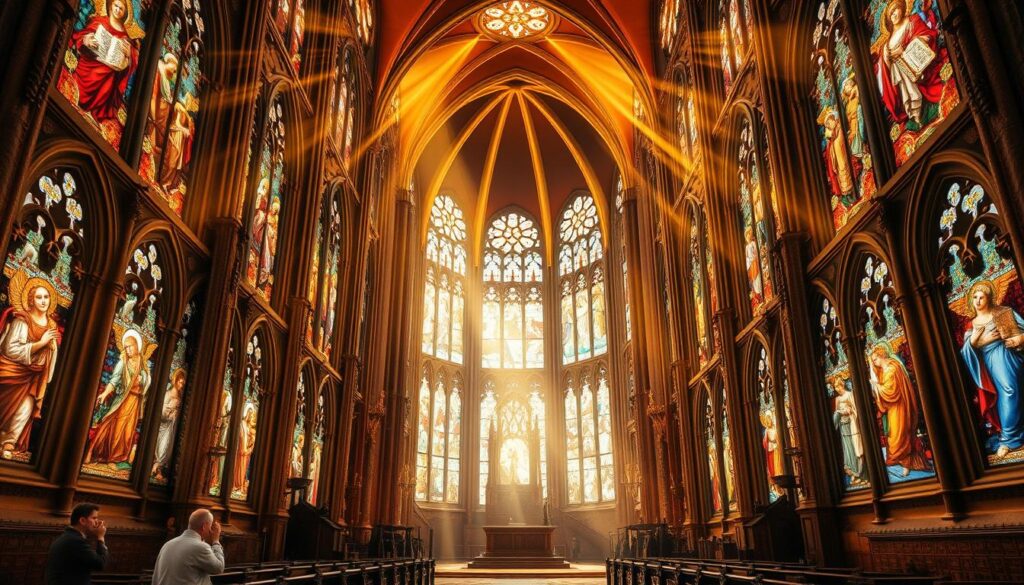
These passages use the words “see” and “face” metaphorically. Matthew 18:10 clarifies this isn’t physical sight—angels behold God’s presence without eyes. The truth here is about spiritual perception, not retinal images.
Resolving Apparent Contradictions
Some verses seem conflicting. Exodus 33:20 states, “No one may see Me and live,” while Matthew 5:8 promises vision of God. How does this align?
| Scripture Passage | Apparent Contradiction | Theological Resolution |
|---|---|---|
| Exodus 33:20 | Human limitation before divine holiness | Purified souls receive capacity for divine communion |
| John 1:18 | “No one has seen God” | Christ makes the invisible Father known |
| 1 Timothy 6:16 | God “dwells in unapproachable light” | Beatific vision granted through grace, not human effort |
Jesus Christ bridges these ideas. As Lord Jesus taught, eternal life means knowing God (John 17:3). The end of earthly struggle opens into endless clarity—not by human merit, but through perfected love.
The Beatific Vision: Experiencing God Face to Face
Imagine standing before an endless ocean of light, where every question finds its answer. This captures the essence of the beatific vision—the Church’s most profound teaching about eternal fulfillment. Unlike earthly sight, this experience engages the soul’s deepest capacities for truth and connection.
Intellectual and Spiritual Comprehension of Divine Glory
Pope Benedict XII described this vision as seeing God’s essence directly—no metaphors or middlemen. St. Thomas Aquinas compared it to suddenly understanding a complex symphony: “The blessed grasp creation’s entire order through divine light.” This isn’t about memorizing facts but experiencing reality as God knows it.
Think of a puzzle finally completed. Every life event, from joy to suffering, clicks into place. The glory here isn’t flashy brightness but radiant meaning. As one theologian notes, “It’s like waking from a dream to true awareness.”
Union with Christ and the Saints
This vision creates perfect union. Picture a choir where every voice harmonizes effortlessly. The saints aren’t distant figures but close companions sharing divine love. Mary’s experience shines brightest, her soul reflecting God’s light like polished glass.
“The blessed see more in one moment than scholars learn in lifetimes.”
Your capacity for this joy grows through daily choices. Like building muscles for a marathon, each act of kindness or prayer expands your soul’s “container” for eternal glory. Those mourning losses find comfort here—every tear will make sense when bathed in this light.
Bodily Gifts and the Transformed Existence in Heaven
What if your body could move through walls or shine like sunlight? Catholic teaching reveals four extraordinary qualities awaiting resurrected bodies. Drawing from St. Thomas Aquinas and the Council of Trent, these gifts perfect our human nature rather than erase it.

Subtility, Agility, and Impassibility Explained
Subtility lets bodies move freely like Jesus did post-resurrection. Walls become as passable as air. Agility enables instant travel—think Paris to Tokyo in a blink. No traffic jams, just pure freedom.
Impassibility means no more pain or sickness. Imagine skin that never burns and joints that never ache. As Revelation 21:4 promises, “Death and mourning will be no more.” Your body becomes its healthiest self forever.
The Glory of the Resurrected Body
Picture glowing like the sun without blinding others. This brightness reflects divine glory, as seen in Jesus’ Transfiguration. St. Thomas called it “a share in God’s radiance”—not flashy, but deeply meaningful.
“The blessed will shine like stars, perfected through grace.”
These gifts aren’t sci-fi fantasies. They show how eternal life enhances our humanity. Your body becomes a perfect instrument for loving God and others—the ultimate upgrade.
Philosophical and Theological Perspectives on Heaven
Great minds have shaped how we understand eternity through rigorous thought and spiritual insight. From medieval scholars to modern theologians, these perspectives reveal how divine love and human purpose intertwine in eternal union with God.
Insights from St. Thomas Aquinas and the Council of Trent
St. Thomas Aquinas described our deepest longing as a “natural appetite to know creation’s full order.” His Summa Contra Gentiles teaches this hunger finds fulfillment in the beatific vision—a complete grasp of divine truth. Like solving a lifelong puzzle, every mystery clicks into place through God’s light.
| Thinker/Event | Key Contribution | Impact |
|---|---|---|
| St. Thomas Aquinas | Linked human curiosity to eternal fulfillment | Groundwork for understanding heavenly joy |
| Council of Trent | Clarified purification before divine communion | Strengthened doctrinal clarity |
The Council of Trent built on these ideas, emphasizing purification as preparation for perfect union. It taught that grace refines souls, much like fire purifies gold, making them ready for endless life with God.
Contemporary Views and Theologians on Union with God
Modern thinkers like Karl Rahner reimagined traditional concepts. He proposed Jesus didn’t ascend to a preexisting place but created “heaven’s possibility” through resurrection. This shifts focus from location to relationship—a view resonating in today’s search for meaning.
“Eternal joy isn’t about where we go, but who we become through Christ.”
Current theologians stress daily choices shape our capacity for divine love. Acts of kindness and prayer stretch the soul’s “container,” preparing it for ultimate fulfillment. These insights bridge ancient wisdom with modern questions about purpose and connection.
The Afterlife Continuum: Heaven, Hell, and Purgatory
Eternity isn’t about zip codes but relationships. Pope John Paul II reshaped modern understanding by teaching that afterlife realities are states of being—conditions shaped by our response to divine love. This perspective moves beyond maps to focus on the quality of our eternal communion with God.
Understanding Distinct States of Communion with God
Three possibilities emerge after death, each reflecting our earthly choices:
- Heaven: Fullness of joy through perfect union with God
- Hell: Self-imposed isolation from divine love
- Purgatory: Purification preparing souls for eternal communion
Hell isn’t a divine punishment but the tragic result of persistently rejecting grace. As the Catechism notes, it’s “the ultimate consequence of sin itself.” Imagine refusing sunlight until your eyes forget how to see.
| State | Cause | Outcome |
|---|---|---|
| Heaven | Accepting God’s grace | Beatific vision |
| Hell | Final rejection of love | Existential emptiness |
| Purgatory | Unresolved attachments | Purification process |
Purgatory acts like spiritual detox—removing every trace of selfishness. As Pope Benedict XVI wrote, “Nothing unclean can enter God’s presence.” This cleansing isn’t punishment but mercy, ensuring we’re ready for perfect communion.
“Hell is the state of those who freely and definitively separate themselves from God.”
These states highlight our freedom. Every prayer, act of kindness, or moment of forgiveness shapes our capacity for eternal communion. The afterlife isn’t a lottery—it’s love’s logical conclusion.
Living the Faith: Sacramental Life as a Foretaste of Heaven
Daily rituals and sacred moments offer glimpses of eternal joy here and now. The Church’s sacraments aren’t just ceremonies—they’re invitations to taste divine communion before entering its fullness. Like sunlight breaking through clouds, these practices shape our capacity for everlasting love.
The Role of the Eucharist
At Mass, believers encounter Christ’s real presence—a mystery echoing the beatific vision. Vatican II called the Eucharist “the source and summit” of Christian life, bridging earthly worship with heavenly unity. Each reception deepens our spiritual “appetite” for eternal truth, much like training muscles for a marathon.
St. Augustine famously wrote, “We become what we receive.” This transformation isn’t symbolic. Just as bread nourishes the body, the Eucharist strengthens souls for their ultimate purpose: union with God. It’s practice for perfection—a weekly reminder that faith isn’t abstract but embodied.
Sacramental living turns ordinary moments into portals of grace. Forgiveness in Confession mirrors divine mercy. Marriage reflects Christ’s covenant with the Church. Every sacrament whispers, “This is just the beginning.” Through them, eternity becomes tangible—one holy encounter at a time.
FAQ
Is heaven a physical place or a spiritual state?
Catholic teaching describes it as both. While it’s not a geographical location, it’s a state of perfect union with God—the Beatific Vision. The Catechism emphasizes this as the ultimate fulfillment of human longing, where souls experience divine love beyond earthly limits.
What does the “Beatific Vision” mean?
It refers to seeing God “face to face” in eternity. St. Thomas Aquinas taught that this vision fulfills the soul’s deepest desire, granting direct knowledge of God’s essence. It’s not just intellectual but a transformative communion with divine truth and love.
How does the resurrected body differ from our earthly one?
The Church teaches that glorified bodies will possess qualities like subtility (freedom from material limits), agility (perfect responsiveness), and impassibility (freedom from suffering). These gifts reflect St. Paul’s words about a body “raised in glory” (1 Corinthians 15:43).
What distinguishes heaven, hell, and purgatory?
Heaven is eternal communion with God. Hell is separation from Him due to unrepented sin. Purgatory, as the Council of Trent clarified, is a purification process for souls destined for heaven but needing cleansing. Each state reflects God’s justice and mercy.
How do sacraments connect to eternal life?
The Eucharist, called the “pledge of future glory,” offers a foretaste of heaven’s joy. Through sacraments, believers receive grace to grow in holiness, preparing them for the fullness of divine life promised by Jesus Christ.
Do saints in heaven pray for us?
Yes! The Church teaches that saints, united fully with Christ, intercede for the faithful. This reflects the communion of saints—a spiritual solidarity between those in heaven, purgatory, and on earth, bound by God’s love.