What does modern religious life look like for over 1.4 billion people worldwide? Recent reports from the Vatican reveal steady changes in how communities engage with faith traditions. The 2025 Pontifical Yearbook shows a 1.15% rise in Catholic adherents since 2022, reaching 1.406 billion globally. This consistent growth mirrors patterns seen in recent years, sparking conversations about shifting spiritual landscapes.
Tracking these trends involves more than counting church attendance. Analysts examine birth rates, migration flows, and cultural shifts influencing religious identity. Some regions report rapid increases in followers, while others face membership declines. These variations create a complex picture of faith in motion.
Understanding these patterns helps both scholars and communities prepare for future challenges. This exploration will highlight how technology, generational values, and regional priorities shape membership numbers. We’ll also look at clergy distribution and conversion rates affecting the church’s global footprint.
Key Takeaways
- The worldwide Catholic community grew by 16 million members between 2022 and 2023
- Growth rates remain steady at 1.15%, matching trends from previous years
- Regional differences significantly impact expansion or decline patterns
- Demographic tracking combines birth rates, migration data, and cultural factors
- Changing membership numbers influence religious leadership and resource allocation
Global Trends in Catholic Growth
Global Catholic communities show striking contrasts across continents. While some areas surge with new members, others maintain steady patterns shaped by local cultures and birth rates.
Continental Growth Leaders
Africa’s 3.31% annual increase stands out dramatically. This growth adds 9 million people to the Catholic population since 2022 – equivalent to filling 180 football stadiums. The Democratic Republic of Congo now counts 55 million faithful, surpassing entire European nations combined.
Steady Versus Stagnant Regions
The Americas retain their position as the church’s stronghold:
- Brazil alone accounts for 13% of global Catholics
- Mexico and Colombia show consistent 1.2% annual increases
- U.S. numbers remain stable at 70 million
Asia’s 0.6% growth masks fascinating local stories. The Philippines continues as Asia’s Catholic heartland, while Vietnam sees rising conversion rates among young professionals.
Vatican Statistics in Action
Recent yearbook data reveals strategic insights:
| Region | Growth Rate | Total Catholics |
|---|---|---|
| Africa | 3.31% | 281M |
| Americas | 0.9% | 672M |
| Europe | 0.2% | 287M |
These numbers guide clergy assignments and multilingual resources. As one Vatican analyst noted: “Population shifts require us to rethink traditional mission strategies.”
Examining the Question: is catholicism growing
Recent statistics reveal how religious communities evolve through numbers and action. The 2022-2023 biennium shows a 1.15% global increase in followers, but regional stories differ wildly. Church leaders now balance celebration and strategy as they respond to shifting demographics.
Analysis of Growth Patterns Over the Biennium
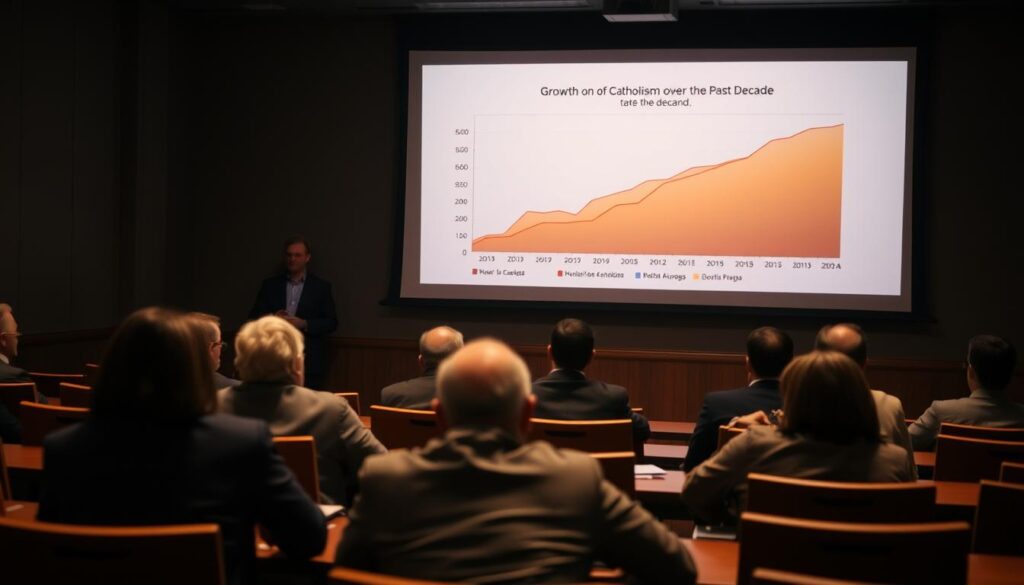
Africa’s 3.31% surge contrasts sharply with Europe’s 0.2% uptick. This two-year period saw structural changes supporting expansion:
- Seven new dioceses created across high-growth areas
- Three episcopal sees upgraded to Metropolitan status
- One Apostolic Administration became a full diocese
These adjustments help manage communities in regions adding millions annually. The Democratic Republic of Congo’s 55 million members now surpass several European nations combined.
Factors Influencing Church Expansion
Four key elements shape membership changes:
- Birth rates: African nations see 4+ children per family
- Migration: Hispanic populations spread traditions globally
- Cultural values: Asia’s young professionals explore faith options
- Resource allocation: New dioceses target member clusters
While some areas face decline, others bloom through unique local conditions. Political stability and economic factors also play roles, creating complex growth mosaics. As one Vatican planner noted: “Our maps constantly redraw themselves.”
Shifting Roles in the Church
Leadership structures within religious organizations are transforming as membership patterns evolve. Recent statistics reveal surprising changes in clergy numbers that reflect broader cultural shifts.
Bishops, Priests, and the Changing Clergy Landscape
The Catholic Church added 77 bishops worldwide last year – a 1.4% increase. This growth occurred across all continents except Oceania, where leadership numbers held steady. “More bishops help us guide expanding communities,” explains a Vatican spokesperson.
Priest counts tell a different story. While Africa (+2.7%) and Asia (+1.6%) saw gains, other regions faced declines:
| Region | Priest Change |
|---|---|
| Europe | -1.6% |
| Americas | -0.7% |
| Oceania | -1.0% |
Permanent deacons now number over 51,000 – a 2.6% surge. These lay leaders increasingly handle weddings, baptisms, and parish administration. Their growth helps maintain daily church life where priests are scarce.
Seminarian numbers paint a worrying picture. Global totals dropped 1.8%, with only Africa showing improvement. This decline could affect future priest availability, particularly in areas already struggling with clergy shortages.
These shifts highlight how regional growth impacts religious leadership. As one expert notes: “Vocational trends mirror where people actively engage with faith traditions worldwide.” The church now faces complex decisions about training programs and resource distribution.
Modern Conversions and Evolving Faith
A quiet revolution reshapes spiritual journeys across America. Dioceses like Fort Worth report 72% more adult baptisms since 2023, with young professionals driving this surge. “I needed roots deeper than coffeehouse worship,” shares Sydney Johnston, a 28-year-old convert from Texas.
Conversion Trends Among Young Adults
Three key factors draw millennials to Catholic churches:
- Historical connections spanning 2,000 years
- Structured rituals offering stability
- Countercultural resistance to modern trends
The pandemic created unexpected time for reflection. Many explored online resources while home, discovering ancient traditions through digital doors. Over 75% of new members in North American parishes now arrive through web-based inquiries.
The Impact of Digital Outreach
YouTube creators like Cameron Bertuzzi attract thousands weekly. His video debates about church history rack up 500K views monthly. “Viewers crave substance,” he notes. “They’re tired of self-help sermons.”
Parishes adapt by expanding RCIA programs. Some churches now offer hybrid classes blending in-person and online learning. This flexibility helps working professionals balance faith exploration with busy schedules.
As one Chicago priest observes: “Our new members bring fresh energy. They ask tough questions but crave authentic community.” These shifts suggest lasting changes in how people engage with spiritual homes across North America.
Conclusion
The global Catholic landscape reveals a tapestry of growth and contraction. Religious sisters now number 589,423 worldwide, though their distribution tells two stories. Europe saw a 3.8% decline in these women leaders last year, while Africa’s ranks grew by 2.2%. These shifts mirror broader population trends across both regions.
Church communities face new realities as membership patterns evolve. Nearly one-third of religious women serve in Europe, but their numbers dwindle as Asian and African congregations expand. This changing spread impacts daily parish life, from school staffing to healthcare ministries.
Looking ahead, leaders balance resource allocation between thriving and struggling areas. Efforts to support Africa’s 14% share include training programs and multilingual materials. Meanwhile, digital tools maintain connections in regions with aging populations.
Modern migration patterns and social attitudes reshape traditional structures. The church’s adaptability – through local initiatives and global partnerships – will define its role in coming years. As centers of influence shift southward, ancient traditions meet contemporary challenges in unexpected ways.
FAQ
How has the Catholic population changed globally in recent years?
According to Vatican statistics, the worldwide Catholic population grew by 1.1% between 2020 and 2022, reaching over 1.38 billion. Growth remains strongest in Africa and Asia, while Europe and North America see slower rates.
Which regions are driving growth in the Catholic Church today?
Africa leads with a 3% annual growth rate, followed by Asia at 1.5%. Countries like the Democratic Republic of Congo, Nigeria, and the Philippines now account for nearly 30% of global baptisms.
What challenges does the Church face with clergy numbers?
While the total number of priests increased slightly to 462,388 in 2022, Europe saw a 14% decline since 2010. Many dioceses now rely on priests from Africa and Asia to fill vacancies.
Are young adults still converting to Catholicism?
Digital outreach through platforms like Ascension Presents and Word on Fire has helped engage younger audiences. Over 40% of new U.S. converts in 2023 were under 35, though retention rates remain a focus.
How does the Vatican Yearbook track demographic shifts?
The Annuario Pontificio uses parish registrations, sacramental records, and national census data to map membership trends. Recent editions highlight urbanization impacts, with 60% of Catholics now living in cities.
What role do women play in modern Catholic growth strategies?
Women lead 85% of parish catechetical programs globally and comprise 70% of lay missionaries. Organizations like the Catholic Women’s League increasingly shape evangelization efforts in growing regions.