Nearly 300 million people across the continent today identify with this ancient faith tradition. Though its global presence has expanded dramatically, the region remains a cornerstone of Catholic identity. Over a century ago, most followers worldwide lived here – now that number has shifted as other regions experience growth.
What makes this story unique? Unlike elsewhere, membership numbers have stayed steady here despite modern secular trends. From grand cathedrals to quiet village chapels, the physical and cultural imprints endure. Nearly 40% of residents maintain ties to these traditions, blending ancient practices with contemporary life.
The Church’s structure here reflects remarkable diversity. Thirty-nine distinct rites operate across 45 nations, each adding local flavor to shared beliefs. This network has shaped everything from education systems to holiday customs for generations.
Modern challenges test this legacy. Urbanization and changing social values create new dynamics for faith communities. Yet the persistence of pilgrimage routes and vibrant parish festivals shows how spiritual traditions adapt while maintaining core identity.
Key Takeaways
- Nearly 300 million Europeans maintain Catholic affiliations today
- Membership rates remain stable despite global demographic shifts
- 39 distinct religious rites operate across 45 countries
- Faith traditions influence education, arts, and community services
- Modern secular trends coexist with centuries-old practices
- Historic sites and rituals remain central to cultural identity
Historical Foundations and Legacy of the Catholic Church
The story of faith in this region begins with a fisherman’s final journey. According to tradition, Saint Peter’s martyrdom in Rome planted seeds for a global religion. His burial site became the foundation of Saint Peter’s Basilica – the heart of Vatican City.
From Persecution to Power
Early believers faced harsh trials. By the 4th century, the Catholic Church began shaping kingdoms. Medieval monasteries preserved knowledge while grand cathedrals redefined skylines. Consider these changes over time:
| Country | 1910 Catholic % | 2010 Change |
|---|---|---|
| France | 95% | -38% |
| Italy | 99% | -19% |
| Poland | 75% | +15% |
Enduring Symbols, Shifting Landscapes
The 44-hectare Vatican City punches above its weight. As one historian notes:
“This tiny state holds more spiritual sway than nations 10,000 times its size.”
Pilgrimage routes tell their own story. Santiago de Compostela’s trails have guided walkers for 12 centuries. Assisi’s peaceful hills still inspire visitors, proving ancient traditions adapt without losing their core.
Through plagues and revolutions, the Catholic Church kept reinventing its role. Its survival proves how deeply it’s woven into the part of human experience that seeks meaning beyond daily life.
Modern Impacts on Culture, Society, and Politics
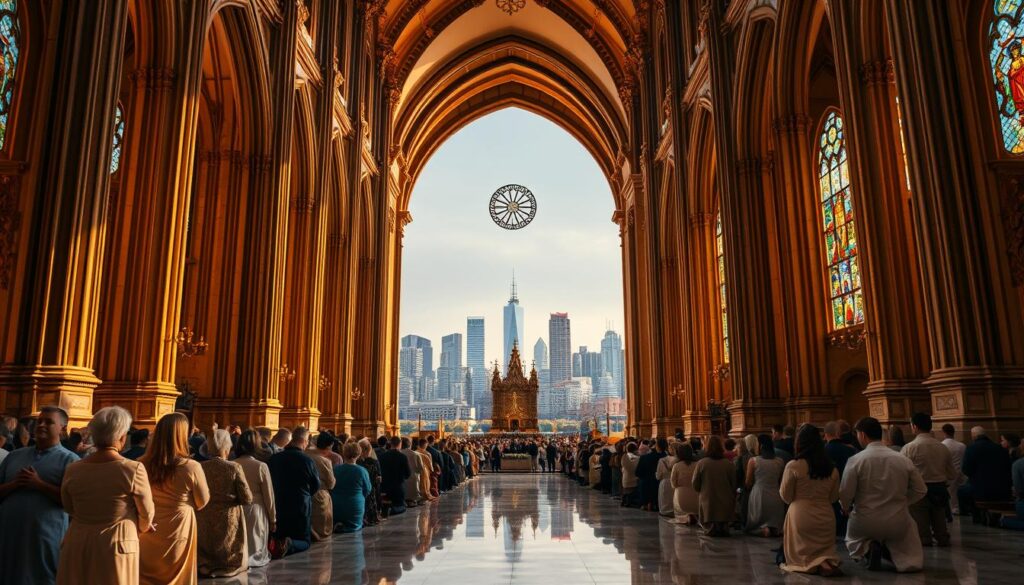
Sacred traditions continue shaping daily life in surprising ways across the continent. From classroom debates to voting booths, faith principles influence modern institutions while sparking fresh conversations. This dynamic interplay between old and new creates fascinating tensions in how communities balance tradition with progress.
Cultural Heritage and Identity
Cathedrals and festivals aren’t just relics – they’re living parts of local identity. In many regions, over 60% of historic landmarks have religious roots. Schools run by faith-based groups educate millions, blending academic rigor with moral teachings.
Artistic traditions also carry forward these values. Renaissance masterpieces still draw crowds, while modern artists reinterpret biblical themes. One curator notes: “Our galleries tell a 1,000-year story of hope and human struggle.”
Political Movements and Policy Influences
Voting patterns reveal faith’s role in shaping laws. Some nations see strong alliances between religious groups and parties promoting traditional values. Recent elections in Central Europe show how these ties impact policies on family rights and education funding.
| Country | Key Policy Area | Voter Influence |
|---|---|---|
| Poland | Abortion laws | 82% Catholic voter turnout |
| Italy | School vouchers | 73% support faith-based education |
| Hungary | Family subsidies | 68% approve pro-family policies |
Leaders within the Church actively address social issues. Cardinal Marx recently argued:
“True unity grows from shared compassion, not border walls.”
This vision clashes with nationalist movements, creating complex debates about collective identity.
Current Trends in catholicism europe and Community Dynamics
A surprising wave of young adults is breathing new life into ancient religious traditions. Recent data shows remarkable growth in participation, particularly among those under 25. This shift challenges assumptions about secularization while reshaping community structures.
Youth Revival and Changing Fervor
France’s Easter celebrations revealed striking patterns. Over 10,000 adults chose baptism this year – a 45% jump from previous records. Nearly half were aged 18-25, outpacing older age groups for the first time. “Young people crave authenticity,” notes Parisian catechist Marie Dubois. “They’re drawn to rituals that connect generations.”
UK figures tell a similar story. Catholics now form 31% of active churchgoers, up from 23% in 2018. Among under-35s, this group claims 41% participation – doubling Anglican numbers. Ash Wednesday services reported unprecedented crowds, with teens comprising a third of attendees.
Demographic Shifts and Regional Variations
Growth patterns vary widely across regions. Urban centers see vibrant multicultural parishes, while rural areas maintain traditional practices. The table below highlights key contrasts:
| Country | Youth Baptisms (2023) | 5-Year Change |
|---|---|---|
| France | 17,400 | +58% |
| United Kingdom | 9,200 | +41% |
| Germany | 4,800 | +12% |
Eastern regions show stronger retention of lifelong members, while Western nations attract more converts. Immigrant communities contribute significantly, blending cultural traditions with local customs. Student-led prayer groups and digital outreach programs help bridge these diverse experiences.
These changes suggest a turning point for religious institutions. As one London priest observes:
“Our challenge isn’t filling seats – it’s keeping up with the energy of these new believers.”
Challenges, Controversies, and Future Directions
Modern faith communities face complex crossroads between ancient traditions and evolving social values. Balancing spiritual heritage with contemporary expectations requires careful navigation. 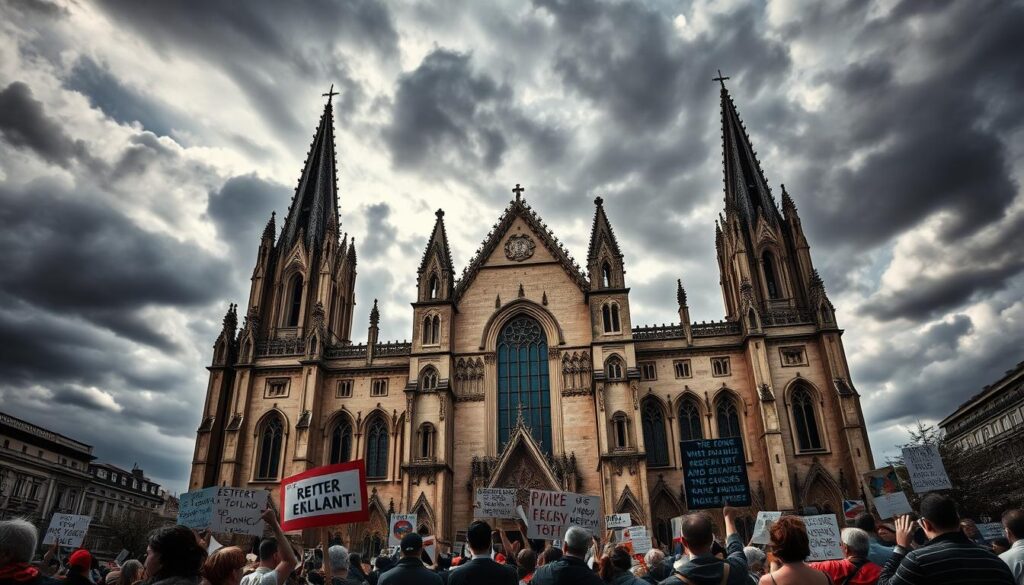
Secularism Versus Tradition in the Public Sphere
A growing majority of young adults across the European Union now identify as religiously unaffiliated. Recent surveys show 58% of 18-34 year-olds consider themselves “nones.” This shift creates pressing questions for the Catholic Church about engaging younger generations.
Recent scandals have intensified these challenges. High-profile abuse cases in France and Germany led to historic drops in church attendance. “Trust must be rebuilt through action, not words,” states German reform advocate Klaus Mertes. Many parishes now implement strict accountability measures and youth protection programs.
Managing Institutional Change and Global Influence
The Church maintains active dialogue with European Union institutions through COMECE, its official policy group. This relationship helps shape discussions on family policies and human rights. Vatican City’s unique status as a Eurozone member strengthens financial ties across the region.
Internal debates about modernization continue gaining momentum. Key issues include:
- Expanding roles for women in leadership positions
- Reevaluating celibacy requirements for clergy
- Addressing LGBTQ+ inclusion in sacramental practices
These changes occur against a backdrop of shifting demographics. While Western nations see declining participation, immigrant communities bring new energy to urban parishes. The coming years will test how effectively the Church can honor its core values while adapting to a rapidly changing world.
Conclusion
With 286 million followers across 45 nations, the Catholic Church maintains deep roots in the continent’s identity. Its organizational web – from Vatican City’s global diplomacy to COMECE’s EU policy work – bridges ancient traditions with modern governance. Nearly 40% of the region’s population still participates in sacraments, festivals, and community services that shape local cultures.
Regional contrasts reveal fascinating adaptations. Western urban centers blend diverse immigrant traditions with historic practices, while Eastern areas preserve stronger ties to inherited customs. The Council of Bishops’ 39 member conferences reflect this mosaic of approaches to faith in daily life.
Future influence hinges on addressing dual pressures: nurturing youth engagement while maintaining theological clarity. As younger generations reinterpret rituals and digital tools reshape outreach, institutions must balance innovation with continuity. One truth remains – after twenty centuries, this religion still molds art, ethics, and social frameworks across countless communities.
What emerges is a living tradition neither frozen in time nor swept away by modernity. Its capacity to evolve while preserving core values will determine its role in Europe’s next chapter.
FAQ
How has the Catholic Church shaped Europe’s cultural identity?
From art and architecture to education and social values, the Church has deeply influenced Europe’s cultural fabric. Landmarks like Notre-Dame and traditions like Christmas celebrations reflect this enduring legacy, even as societies modernize.
What role does the Vatican play in European politics today?
While less dominant than in past centuries, the Vatican still impacts policies on issues like immigration, bioethics, and human rights. Its diplomatic presence and moral authority often spark debates in the European Union and individual nations.
Are younger generations in Europe still engaged with Catholic traditions?
Participation varies regionally. Countries like Poland and Ireland see stronger youth involvement, while Western Europe faces declining attendance. New movements, however, blend traditional practices with modern social activism to attract younger followers.
How do demographic changes affect Catholic communities in Europe?
Declining birth rates and migration patterns are reshaping membership. Immigrant populations from Africa and Asia often revitalize local parishes, creating dynamic multicultural congregations alongside aging native-born communities.
What challenges does the Church face in balancing tradition and modernity?
Debates over LGBTQ+ rights, gender equality, and clerical accountability test the institution. Reformists push for progressive changes, while traditionalists emphasize preserving doctrine, creating tensions within global and European leadership.
Which European countries have the strongest Catholic populations today?
Italy, Poland, and Spain remain strongholds, with over 70% identifying as Catholic. However, countries like Germany and France show significant secularization, with active members forming smaller, more devoted subgroups.