Exploring the spiritual landscape of one of the world’s oldest religions reveals a vibrant mosaic of beliefs. Unlike many faiths, this tradition embraces diverse perspectives—from worshiping multiple divine forms to focusing on a universal essence. This flexibility makes it unique among global spiritual systems.
At its core, the tradition celebrates countless divine expressions. Terms like Deva (divine masculine) and Devi (divine feminine) represent these sacred energies. Over thousands of years, these concepts evolved from early Vedic rituals to the rich symbolism seen today across South Asia and beyond.
Practitioners might focus on a single beloved figure or honor many. Some even approach spirituality without traditional worship. This adaptability reflects the philosophy’s depth—it’s less about rigid rules and more about personal connection.
Key Takeaways
- Hindu spirituality supports diverse approaches, including monotheistic, polytheistic, and non-theistic perspectives
- Divine concepts have transformed significantly since ancient Vedic times
- Key terms like Ishvara (supreme being) and Bhagavati (divine mother) help navigate the tradition
- Regional practices across India and Southeast Asia showcase cultural adaptability
- Modern interpretations balance ancient roots with contemporary understandings
Introduction to Hindu Deities and Their Complexities
The vibrant world of Hindu spirituality centers around divine figures called Deva (masculine) and Devi (feminine). These terms translate to “heavenly” or “divine excellence,” reflecting their sacred roles. Unlike simple characters, they embody complex energies that shape cosmic balance and human understanding.
Defining Deva and Devi
Rooted in ancient Sanskrit, Deva and Devi represent more than just gods and goddesses. They symbolize universal principles—light, wisdom, creation, and transformation. Each carries rich stories that explain natural phenomena and spiritual truths.
Sacred texts list 108 names for major deities, a number tied to cosmic cycles. These aren’t random labels. Chanting Lakshmi’s names for prosperity or Shiva’s titles for renewal creates specific spiritual connections. Devotees often use these names like keys to unlock deeper meanings.
What makes this system unique? It honors both masculine and feminine energies equally. While Deva might represent protective strength, Devi channels creative power. Together, they show how opposites weave through existence—a dance of balance central to Hindu thought.
Vedic Beginnings of Hindu Deities
The roots of Hindu divine concepts stretch back to ancient rituals and sacred chants. During the early Vedic period (1500–500 BCE), spiritual practices focused on cosmic forces personified as powerful beings. These foundational ideas evolved into the rich symbolism we recognize today.
Insights from Vedic Texts
The Rigveda, one of the oldest known Vedic texts, introduces deities like Indra and Agni. Indra, celebrated as a warrior king, governed storms and courage. Agni, the fire deity, acted as a divine messenger linking humans and celestial realms.
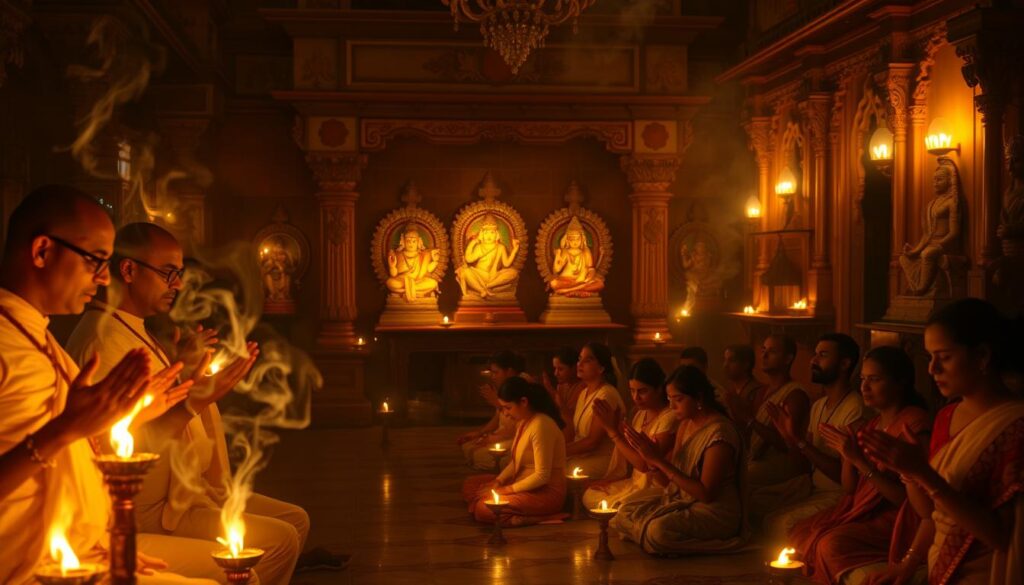
Early deities often represented natural elements. Soma, associated with a sacred plant and ritual drink, symbolized spiritual awakening. These figures weren’t just symbols—they guided daily life through stories and hymns.
| Deity | Role | Symbolism |
|---|---|---|
| Indra | Storm & War | Leadership |
| Agni | Fire | Transformation |
| Soma | Sacred Ritual | Enlightenment |
The Role of Early Rituals
Sacrifice formed the heart of Vedic worship. Elaborate yajna ceremonies used fire to honor divine forces. Priests chanted hymns while offering grains and herbs, believing these acts sustained cosmic order.
By 500 BCE, a clear distinction emerged between benevolent Devas and opposing Asuras. This shift reflected evolving spiritual priorities—from appeasing forces to seeking personal connection.
Evolution from Vedic to Medieval Representations
The stories carved in ancient temples reveal a fascinating journey of sacred figures. Between 500 BCE and 1200 CE, spiritual traditions transformed through epic tales and regional practices. Texts like the Puranas reimagined early divine concepts, giving them vibrant personalities and family ties.
Consider Rudra’s evolution—a storm deity in Vedic hymns became Shiva, the cosmic dancer. Early sculptures from the 2nd century show him as Shiva-Rudra, blending old and new traits. By the 13th century, artists depicted him with flowing locks and a crescent moon, symbols millions recognize today.
This period also enriched visual storytelling. Deities gained distinct colors, weapons, and animal companions. Vishnu’s blue skin signaled infinite wisdom, while Durga’s lion mount symbolized courage. These details helped worshippers connect with different aspects of the divine.
Sacred texts played a key role. The Ramayana and Mahabharata wove moral lessons into divine adventures. Regional variations flourished too—a temple in Tamil Nadu might celebrate Shiva differently than one in Gujarat. Yet all shared a core belief: spiritual truths adapt without losing their essence.
The Concept of Brahman and Absolute Reality
Imagine a cosmic glue holding everything together—seen and unseen. This is Brahman, the bedrock of Hindu philosophy. Unlike typical ideas about divinity, it’s not a deity you pray to but the ultimate fabric of existence itself.

Brahman in Vedantic Thought
Vedanta teachings describe this one supreme reality as both everywhere and beyond everything. Think of ocean waves: individual yet part of the whole. Scholar Ishwar Chandra Sharma put it best:
“Absolute Reality transcends dualities—existence and non-existence, light and darkness.”
Three main views shape how people understand Brahman:
| School | Perspective | Key Idea |
|---|---|---|
| Advaita | Impersonal | No separation between self and Brahman |
| Dvaita | Personal | Divine essence exists apart from creation |
| Vishishtadvaita | Transpersonal | Unity with distinctions |
This explains why Hindu traditions honor many deities. Each represents different facets of the same universal essence. Whether through rituals or meditation, the goal remains—connecting with what’s called Brahman in its boundless form.
Unifying Themes in the Hindu Pantheon
Picture a symphony where every instrument plays a unique melody yet forms one harmonious piece. This mirrors how Hindu traditions view their deities—distinct expressions of a shared cosmic rhythm. Ancient temples showcase this unity through stunning sculptures that blend divine forms into single figures.
Take Harihara, a half-Vishnu, half-Shiva figure carved in stone. Or Ardhanārīshvara, merging masculine and feminine energies into one being. These manifestations aren’t contradictions—they’re visual reminders that all sacred forms flow from the same source.
Three major traditions highlight this interconnectedness. Vaishnavism celebrates Vishnu’s nurturing power, while Shaivism honors Shiva’s transformative energy. Shaktism reveres the divine feminine through goddesses like Durga. Despite different focuses, they share rituals, festivals, and core philosophies.
Why does this matter? It explains why a devotee might light lamps for Lakshmi and chant Shiva’s name without conflict. Each deity represents specific aspects of existence, like colors in a prism revealing sunlight’s full spectrum.
Scholar Meera Nanda observes:
“The pantheon acts as a spiritual toolkit—different tools for different needs, all serving the same purpose of connection.”
This approach keeps the tradition vibrant. New aspects emerge while honoring ancient roots, proving that unity thrives in diversity. Whether through temple rituals or home altars, the message remains: many paths, one supreme truth.
Exploring the Trimurti: Creator, Preserver, and Destroyer
Picture three cosmic architects shaping existence itself. This is the Trimurti—three sacred forms working together to sustain universal rhythms. Brahma sparks creation, Vishnu maintains balance, and Shiva clears space for renewal. Together, they form a divine blueprint for life’s endless cycles.
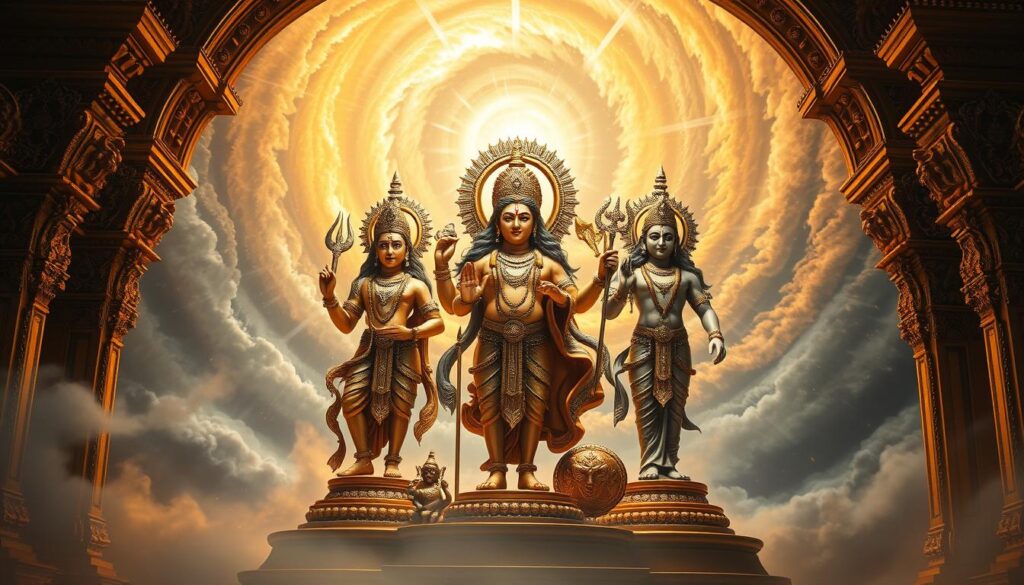
Brahma: The Creator
Brahma emerges from a golden lotus rooted in Vishnu’s navel, symbolizing creation’s birth from preservation. His four faces represent the four Vedas, ancient texts holding cosmic wisdom. Despite his role as the creator god, fewer than ten temples honor him today.
Why the lack of worship? Legends suggest Brahma’s focus shifted after completing creation. Unlike Vishnu and Shiva, he rarely intervenes in worldly matters. His imagery—holding scriptures and water pots—reminds us that beginnings require both knowledge and nourishment.
Shiva: The Destroyer
Shiva’s title often misleads newcomers. His third eye doesn’t just erase—it transforms. The crescent moon on his head symbolizes time’s cycles, while his trident cuts through illusion. Followers celebrate him during Maha Shivaratri, chanting hymns that echo his dual nature.
Modern science mirrors Shiva’s role. Just as forests need fires to regenerate, universes require dissolution to rebirth. This makes the “destroyer” essential to cosmic sustainability—a truth etched in temple carvings across India.
| Deity | Role | Symbols | Temples |
|---|---|---|---|
| Brahma | Creator | Lotus, Vedas | <10 |
| Vishnu | Preserver | Conch, Discus | Thousands |
| Shiva | Transformer | Trident, Moon | Thousands |
Scholar Anika Patel explains:
“The Trimurti shows how opposites collaborate—like seasons ensuring Earth’s survival.”
This framework helps devotees see unity behind apparent contrasts, much like recognizing day and night as parts of one rotating planet.
Major Deities: Vishnu, Shiva, and Shakti
Three powerful forces shape modern Hindu practice—Vishnu’s compassion, Shiva’s transformative energy, and Shakti’s creative spark. These deities anchor distinct spiritual paths while sharing core principles of balance and connection.
Vishnu shines as the preserver, celebrated through beloved avatars like Krishna and Rama. Followers of Vaishnavism cherish his role in restoring harmony. Ancient texts describe him descending whenever chaos threatens cosmic order—a divine safety net for righteousness.
Shiva captivates as both destroyer and renewer. His meditative poses and fiery third eye symbolize inner transformation. Shaivites see his dance as the universe’s heartbeat—destroying illusions to make space for growth.
The goddess Shakti fuels existence through forms like Durga and Kali. Worshipped in Shaktism, she embodies raw creative power. Durga’s victory over the buffalo demon isn’t just myth—it’s a metaphor for overcoming life’s struggles.
| Deity | Role | Symbol | Tradition |
|---|---|---|---|
| Vishnu | Preserver | Conch shell | Vaishnavism |
| Shiva | Transformer | Trident | Shaivism |
| Shakti | Creator | Lotus | Shaktism |
These paths aren’t competing truths but different lenses to view the divine. As scholar Dr. Anika Patel notes:
“Whether through Vishnu’s grace or Shakti’s strength, all routes lead to the same eternal truth.”
Modern temples reflect this diversity. You might find Krishna’s playful smile beside Durga’s fierce stance—proof that Hindu deities offer multiple doorways to spiritual awakening.
god of hinduism: Monotheistic Perspectives in Hindu Traditions
Imagine a spiritual framework where devotion takes countless forms yet shares common threads. A 2021 Pew Research study reveals this balance—29% of Indian Hindus see one god as supreme, while 61% honor multiple divine expressions. This duality defines the tradition’s unique flexibility.
Groups like the Arya Samaj emphasize one supreme reality, rejecting idol worship. Vedanta philosophy describes Brahman as the singular essence behind all existence. Even Krishna-centered practices blend devotion to a personal deity with recognition of universal oneness.
What makes these perspectives coexist? The answer lies in respecting personal spiritual paths. As scholar Ravi Mishra notes: “The divine isn’t confined to theological boxes—it’s experienced through individual lenses.”
Modern temples reflect this harmony. You might find a Krishna statue beside abstract symbols of formless divinity. Whether through chanting or silent meditation, the goal remains connection with the sacred essence that unites all traditions.
This approach keeps ancient wisdom relevant. It allows space for both focused devotion and philosophical exploration—proof that unity thrives within diversity.
FAQ
Is Hinduism polytheistic or monotheistic?
Hindu traditions embrace both perspectives. While many deities exist, they’re often seen as manifestations of one supreme reality called Brahman. This unity-in-diversity concept allows for diverse worship practices while recognizing a singular divine essence.
What are the oldest texts referencing Hindu deities?
The Rigveda, composed around 1500–1200 BCE, is among the earliest sources. It highlights deities like Agni (fire), Indra (storms), and Varuna (cosmic order), reflecting early Vedic rituals and spiritual ideas.
How do Brahma, Vishnu, and Shiva differ in roles?
These three form the Trimurti: Brahma creates, Vishnu preserves, and Shiva transforms the universe. While Brahma is less widely worshipped today, Vishnu and Shiva remain central, often linked to devotional movements like Vaishnavism and Shaivism.
What is Brahman’s relationship to individual deities?
In Vedantic philosophy, Brahman is the unchanging, infinite reality underlying all existence. Deities like Vishnu or Shakti represent its dynamic aspects, helping devotees connect with the divine through relatable forms.
Why is Shakti significant in Hindu worship?
Shakti embodies the divine feminine energy, seen as the active force behind creation. She’s worshipped as Durga, Kali, or Parvati and is central to Shaktism, emphasizing power, fertility, and the inseparable bond with Shiva.
Can Hinduism be considered monotheistic?
Certain traditions, like Vaishnavism or Shaivism, focus on a single supreme deity (Vishnu or Shiva) while acknowledging other forms. This “one with many names” approach reflects Hinduism’s adaptability across regional and philosophical contexts.
What role do avatars play in Hindu belief?
Avatars, like Vishnu’s incarnations Krishna or Rama, represent divine interventions to restore cosmic balance. These stories, found in texts like the Bhagavad Gita, illustrate ethical ideals and the deity’s accessibility to devotees.
How do modern Hindus engage with deities?
Practices vary widely—from temple rituals and home offerings to meditation and yoga. Many choose a personal deity (ishta devata) for focused devotion, blending ancient traditions with contemporary spiritual needs.