One of America’s largest conservative Protestant groups traces its roots to 19th-century German immigrants. Today, this faith community blends deep theological traditions with active engagement in modern society. With over 1.7 million members nationwide, it ranks as the second-largest Lutheran body in the U.S., offering a unique perspective on Christian practice.
Headquartered in Kirkwood, Missouri, the organization oversees thousands of congregations across all 50 states. Its structure includes 35 regional districts, each supporting local churches while maintaining shared doctrinal standards. This balance of centralized leadership and grassroots flexibility helps preserve unity amid cultural shifts.
Founded by immigrants seeking religious freedom, the denomination has grown from its humble Midwestern beginnings into a nationally influential institution. Its commitment to biblical authority distinguishes it from more progressive branches of Protestantism, creating a distinct identity within American Christianity.
Key Takeaways
- Second-largest Lutheran denomination in the U.S. with 1.7 million members
- Headquartered in Missouri with congregations in all 50 states
- Maintains traditional theological views while adapting to modern challenges
- Originated from 19th-century German immigrant communities
- Operates through 35 regional districts for localized support
Historical Roots and Founding of the LCMS
In the early 19th century, waves of German settlers brought more than their belongings to American shores—they carried deep-rooted spiritual traditions. By the 1830s, scattered communities of European immigrants sought to preserve their faith while adapting to frontier life. This blend of cultural identity and religious devotion laid the groundwork for a new chapter in American Christianity.
German Immigrant Beginnings
Pioneer families faced unique challenges maintaining their spiritual practices. Without organized leadership, many feared their traditions might fade. A group of pastors recognized this crisis, declaring: “Our people need structure to keep the faith alive across generations.”
Establishment in Chicago
Twelve determined clergymen made history on April 26, 1847, uniting fourteen congregations from six states. Their meeting in Chicago birthed the German Evangelical Lutheran Synod of Missouri, Ohio and Other States—a name reflecting both their origins and vision. This collaboration created a framework supporting thousands of believers while safeguarding doctrinal integrity.
Over time, the organization expanded beyond its initial Midwest stronghold. Its founding principles—unity through shared beliefs and adaptability to local needs—continue shaping its identity today. What began as a solution for immigrant communities now serves diverse populations across America.
Overview of the Lutheran Missouri Synod
Spanning from coast to coast, this denomination maintains a robust network of nearly 6,000 worship communities. Recent figures show over 1.7 million baptized individuals participating in these faith groups nationwide. These numbers make it America’s second-largest Lutheran body, trailing only the Evangelical Lutheran Church in America.
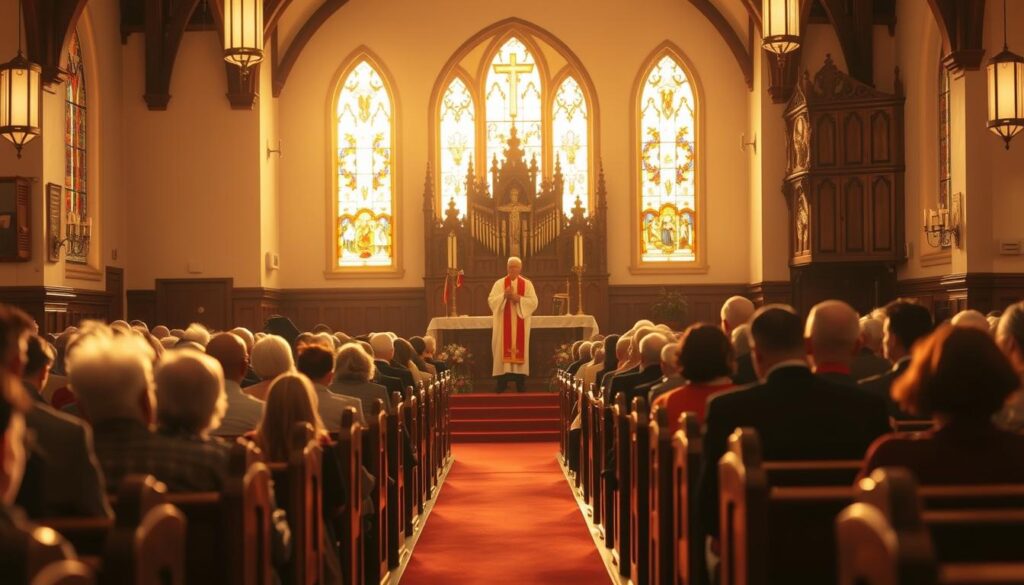
What sets this group apart? Unlike some modern religious organizations, it holds firmly to historical Christian teachings. A denominational leader explains: “We view Scripture as God’s unchanging truth—our anchor in shifting cultural tides.” This commitment shapes everything from worship styles to community outreach programs.
The structure balances independence with unity. Local churches make their own decisions about ministries and budgets. Yet all follow shared doctrinal standards set by national leadership. This approach helps communities address unique needs while maintaining core beliefs.
| Feature | LCMS | ELCA |
|---|---|---|
| Total Members | 1.7 million | 3.3 million |
| Theological Stance | Conservative | Liberal |
| Global Partners | International Lutheran Council | Lutheran World Federation |
Through international partnerships, the denomination connects with like-minded groups across 35 countries. These relationships allow shared resources while preserving distinct identities. It’s a model that’s worked for generations—and continues evolving today.
Saxon Immigration and Early German Influences
When religious ideals clashed with changing European norms, hundreds of families made an extraordinary choice. In 1838, entire communities packed their lives into trunks, driven by unwavering commitment to their faith. This mass exodus from Saxony marked a turning point for traditional Christian practices in America.
Martin Stephan and the Immigrant Journey
Pastor Martin Stephan became the unlikely architect of this daring migration. His fiery sermons denounced modern theological compromises, declaring: “We must preserve pure doctrine or perish as a people of God.” Over 600 followers risked everything—families sold farms, craftsmen abandoned workshops, and elders faced uncertain futures.
The ocean voyage tested their resolve. Four ships battled winter storms, with one vessel vanishing beneath the waves. Survivors reached New Orleans after two harrowing months, only to confront sweltering heat and unfamiliar customs. Many wondered if their sacrifice would prove worthwhile.
Missouri’s wilderness became their proving ground. Settlers transformed Perry County’s dense forests into thriving faith communities within years. Though Stephan’s leadership later collapsed amid scandal, his followers forged ahead. Their tight-knit settlements became incubators for doctrinal traditions that still shape the evangelical Lutheran identity today.
This pilgrimage established crucial patterns—prioritizing theological education, maintaining German-language services, and resisting cultural assimilation. Children learned catechism beside freshly cleared fields, ensuring their parents’ convictions took root in new soil. What began as escape became enduring legacy.
Missionary Efforts and Wilhelm Löhe’s Legacy
In the quiet Bavarian town of Neuendettelsau, a pastor’s vision sparked a transatlantic movement that would reshape American Christianity. Wilhelm Löhe saw German immigrants struggling to maintain their faith in unfamiliar territory. His solution? Train leaders who could bridge cultural divides while preserving doctrinal purity.
Training Pastors for the New World
Beginning in 1841, Löhe transformed his parish into a missionary hub. He famously declared: “We don’t just send prayers across the ocean—we send servants equipped to build God’s kingdom.” Within two years, his first theological students boarded ships bound for America, carrying Bibles and practical training.
The Bavarian leader’s systematic approach produced remarkable results:
- Over 80 trained clergy established congregations across Ohio, Michigan, and Indiana
- Frankenmuth became a model settlement combining worship, education, and community development
- Concordia Theological Seminary emerged as a cornerstone for pastoral education
This network of doctrinally sound churches provided spiritual homes for thousands of immigrants. Löhe’s graduates didn’t just conduct services—they published hymnals, started schools, and coordinated relief efforts. Their work created lasting connections between European traditions and American innovation.
Today, this legacy lives on through international partnerships and educational institutions. The seminary Löhe helped found continues training leaders who value both scriptural authority and compassionate service. As one modern scholar notes: “His blueprint for mission work remains shockingly relevant—local solutions with global vision.”
Evolution of Confessional Lutheran Doctrine
While many religious groups adapted to cultural shifts, one church held firm to its foundational texts. The denomination’s constitution required strict loyalty to the Book of Concord—a collection of Reformation-era documents outlining core beliefs. This commitment created clear boundaries: no cooperation with churches holding different doctrines, and only approved materials in worship or education.
This approach set the group apart during 19th-century theological debates. As other Lutheran bodies embraced “American Lutheranism,” leaders argued: “Truth isn’t shaped by trends—it’s revealed through Scripture and our confessions.” Their stance preserved traditional practices but sometimes limited partnerships with broader Christian movements.
Educational systems became vital for passing down confessional Lutheran doctrine. Seminaries trained pastors to teach catechism classes, while schools reinforced biblical literacy. A modern theologian notes: “Our classrooms aren’t just about facts—they’re where children learn to see the world through Lutheran eyes.”
Balancing tradition with relevance remains an ongoing challenge. The church updates how it communicates ancient truths without altering their substance. Through this careful evolution, it maintains what members call “timeless faith for changing times”—a distinctive blend of historical conviction and contemporary engagement.
The LCMS and the Book of Concord
At the heart of this denomination’s identity lies a 16th-century document collection that still shapes every sermon and sacrament. The Book of Concord isn’t just historical—it’s the living framework guiding theological decisions across thousands of congregations. Leaders describe it as “the North Star for biblical interpretation,” ensuring consistent beliefs from urban megachurches to rural chapels.

Foundational Doctrinal Commitments
Every pastor and congregation formally promises to follow these Reformation-era writings. “Our confessions aren’t museum pieces,” explains a seminary professor. “They show how Scripture answers life’s toughest questions—then and now.” This pledge creates remarkable unity, with 21st-century worship rooted in 500-year-old principles.
The collection’s Law and Gospel distinction shapes weekly messages. Preachers first reveal humanity’s shortcomings through God’s commands, then proclaim forgiveness through Christ’s sacrifice. This pattern—used since Martin Luther’s time—helps believers balance repentance with hope.
While Catholic and Protestant groups debate salvation, this church stands firm on justification by faith alone. Members see the Word of God as their ultimate authority, filtered through the confessions’ time-tested lens. As cultural trends shift, these documents act like theological guardrails—keeping practices anchored while allowing fresh ways to share eternal truths.
Transformation: From German to English Worship
Over three decades, a quiet revolution reshaped Sunday mornings. For the first thirty years of the 20th century, congregations balanced ancestral traditions with their children’s American identity. German-language services preserved heritage, but younger members craved English—the language of their schools and workplaces.
World War I accelerated change. Anti-German sentiment made some communities rethink their public image. A pastor from Indiana recalled: “We kept our doctrine but changed how we shared it—like pruning a tree so it grows stronger.”
By 1930, most evangelical Lutheran churches offered bilingual services. Hymnals began printing English verses beside German texts. This shift wasn’t about abandoning roots—it aimed to connect faith with daily life.
Today, the transition serves as a model for cultural adaptation. While preserving core teachings, the church found new ways to unite generations. What began as a practical choice became a testament to enduring faith through changing times.
FAQ
What distinguishes the LCMS from other Lutheran groups?
The LCMS emphasizes strict adherence to biblical teachings and historic Lutheran confessions like the Book of Concord. Unlike some denominations, it practices closed communion and maintains traditional views on ordination and liturgy.
Why did early members immigrate to America?
German settlers sought religious freedom and opportunities to preserve their confessional beliefs. Leaders like Martin Stephan and Wilhelm Löhe organized communities to establish churches aligned with their doctrinal convictions.
How did worship practices change over time?
Early services were conducted in German, reflecting immigrant roots. By the mid-20th century, most congregations transitioned to English to connect with younger generations while retaining liturgical traditions.
What role does the Book of Concord play?
It serves as the doctrinal foundation, unifying teachings on sacraments, scripture, and grace. Pastors and congregations pledge to uphold these confessions as authoritative guides for faith and practice.
Are women allowed to become pastors in the LCMS?
No, the denomination reserves the pastoral office for men based on its interpretation of New Testament teachings. Women, however, actively serve in other leadership and educational roles.
How does the LCMS approach missionary work?
Missions focus on both global outreach and local community service. Training through institutions like Concordia Seminary equips clergy and laypeople to share the Gospel while addressing practical needs.
What is closed communion?
This practice restricts participation in the Lord’s Supper to those who share the LCMS’s doctrinal beliefs. It reflects the conviction that communion unites believers in both faith and practice.
Do LCMS churches use contemporary worship styles?
While some congregations incorporate modern music, many retain traditional liturgies and hymns. Worship style varies but remains rooted in sacramental and scriptural centrality.