Exploring America’s religious landscape reveals fascinating stories of community and heritage. One denomination’s journey stands out for its deep ties to history and geography. With nearly 9,000 congregations nationwide, this faith tradition has shaped regions from snowy Midwestern towns to sunny Caribbean islands.
Why are so many churches clustered in places like Minnesota? The answer lies in 19th-century immigration. Scandinavian settlers sought familiar climates and farmland, creating hubs that still thrive today. Cities like Minneapolis-St. Paul became cultural anchors, though the denomination’s headquarters settled in Chicago.
Modern tools now let us visualize this growth like never before. Interactive resources show how congregations spread across states, adapting to new environments while preserving traditions. From Alaskan villages to Hawaiian parishes, these communities reflect both resilience and diversity.
This guide unlocks the patterns behind their distribution. Discover how historical roots meet modern innovation—and why geography still matters in faith communities today.
Key Takeaways
- Over 9,000 congregations serve diverse regions across the U.S. and Caribbean
- Upper Midwest clusters trace back to Scandinavian farming communities
- Interactive tools reveal settlement patterns and membership trends
- Historic immigration shaped current demographic concentrations
- Technology bridges centuries-old traditions with modern exploration
- Geographic adaptability defines the denomination’s ongoing story
The Landscape of Lutheranism in the United States
Crossing stormy Atlantic waters in wooden ships, Scandinavian families carried more than belongings—they brought a spiritual legacy that would reshape America’s heartland. From 1820 to 1920, over 2 million people from Sweden, Norway, and neighboring nations arrived seeking farmland and freedom.
Seeds of Faith in New Soil
These settlers chose the Upper Midwest for its familiar winters and fertile soil. Minnesota’s forests mirrored Norway’s pine-covered hills, while Dakota’s plains recalled Sweden’s farmlands. Communities formed around church buildings that doubled as cultural hubs, hosting Scandinavian language classes and holiday celebrations.
By 1900, lutefisk dinners and St. Lucia festivals became cherished traditions. Families passed down Lutheran teachings through confirmation classes and hymn-singing circles. This blend of old-world customs and new-world opportunities created lasting bonds.
Unity Through Change
Three major Lutheran groups merged in 1988, forming the Evangelical Lutheran Church in America (ELCA). This union combined resources while respecting regional differences.
“Our strength lies in shared beliefs, not identical practices,”
notes an ELCA archivist.
Modern congregations balance tradition with innovation. Many churches now offer bilingual services and community gardens. From urban food pantries to rural youth programs, these adaptations ensure Lutheran values remain relevant across generations and geographic areas.
Exploring the “lutheranism map” Across America
Color-coded dots on digital screens tell stories of service spanning from Texas border towns to Great Lakes suburbs. The ELCA’s interactive tools reveal how 9,000+ faith communities connect through shared missions and localized outreach.
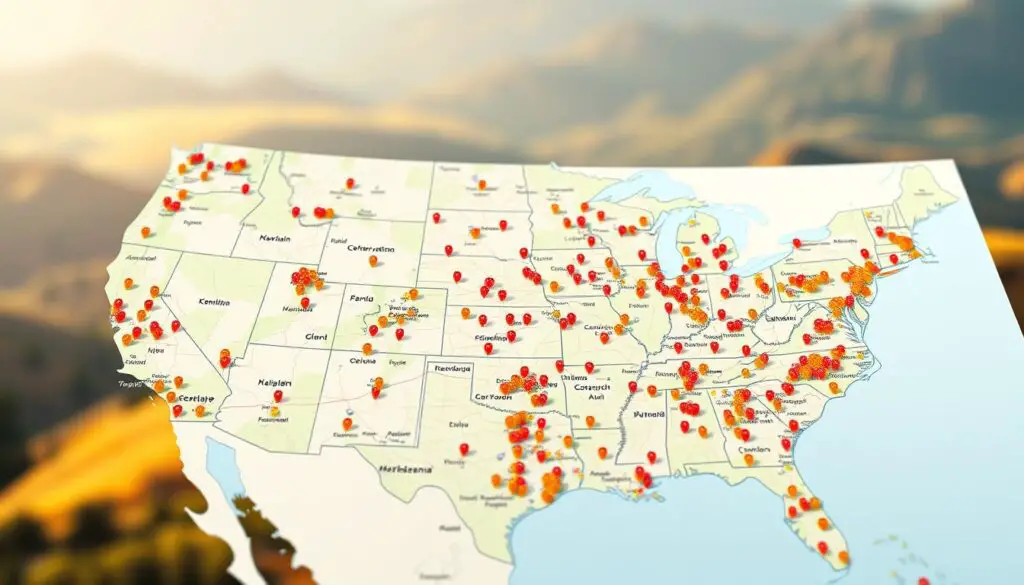
Mapping Congregational Impact and Presence
Three distinct markers guide users through this living network:
- Orange: Welcoming congregations providing migrant support
- Black: Sanctuary synods offering legal resources
- Green: AMMPARO-affiliated groups aiding refugee families
Urban churches in Chicago and Houston host ESL classes alongside Sunday services. Rural parishes in Iowa and Nebraska organize crop-sharing programs. “Our locations aren’t random—they’re responses to community needs,” explains an ELCA outreach coordinator.
These visual resources help families find food pantries, youth mentors, or immigration assistance. Real-time updates show pop-up vaccination clinics or disaster relief efforts. By partnering with Central American counterparts, the network extends its impact beyond U.S. borders.
The system’s true power lies in linking isolated members. A farmer in Montana accesses Spanish-language Bible studies. A teacher in Florida connects with trauma counselors. Through coordinated work across regions, the church maintains its relevance in rapidly changing communities.
Regional Narratives: Alaskan, Hawaiian, and Southwestern Congregations
America’s most remote Lutheran communities thrive where roads end and traditions begin. Three distinct regions reveal how faith adapts to unique landscapes while serving local needs.
Alaskan Outreach and Community Resilience
Shishmaref Lutheran Church stands as the ELCA’s northernmost congregation. On this 2-square-mile island, 600 people—40% under 18—balance Iñupiat traditions with modern challenges. Permafrost thaw threatens homes, yet the church anchors community life through shared meals and youth programs.
“Our work isn’t just Sunday worship,” says a local leader. “It’s helping families haul water during freeze-ups.” The church blends subsistence living values with Christian teachings, creating a safety net in harsh climates.
Hawaiian Hospitality, Music, and Ministry
Oahu’s Lutheran Church of Honolulu harmonizes island warmth with urban outreach. Since 1915, its choir has drawn visitors while serving kōkua (help) to homeless individuals and food-insecure families. High living costs—median homes exceed $1 million—make their food pantry vital.
Members also welcome LGBTQIA+ folks through inclusive worship. “Aloha means caring for every person,” explains a volunteer. “Our doors stay open through storms and sunshine.”
Rock Point’s Spiritual Identity and Service
In Arizona’s desert, the Navajo Lutheran Mission transforms lives daily. Key services include:
- Hózhó Café: 200+ meals served weekly
- Solar power programs for off-grid homes
- Water access for 40% without plumbing
Over 2,000 families rely on their food bank. Youth programs teach Navajo and Christian values side by side. “This isn’t charity—it’s partnership,” says a mission worker. “We build solutions with our neighbors, not for them.”
The Shifting Dynamics: ELCA Membership Trends and Challenges
Mainline Protestant groups face a critical crossroads in modern America. For the ELCA, membership shifts reveal both challenges and unexpected opportunities. Since 2003, baptized members dropped from 5 million to under 3 million—a change reshaping how congregations operate nationwide.

Statistical Insights and Declining Membership
The 2009 policy shift on same-sex relationships marked a turning point. Over 250,000 members left within a year—equivalent to losing every resident of Pittsburgh. Today, confirmed members number 1.5 million fewer than two decades ago.
Older members often maintain ties through baptism records, while younger generations disengage faster. This creates financial strain: 70% of congregations now serve fewer than 100 weekly worshippers. “We’re running ministries designed for 1950s-sized groups,” shares a Minnesota pastor. “Our heating bills don’t shrink with attendance.”
Future Opportunities for Mainline Lutheranism
Creative adaptations offer hope. Some churches convert underused spaces into community kitchens or childcare centers. Others partner with immigrant groups, blending traditions through shared meals and language exchanges.
“Our mission isn’t about filling pews—it’s feeding souls through action,”
explains a Texas church leader. Digital worship reaches homebound members, while urban gardens provide fresh produce and neighborly connections.
The denomination’s legacy of social justice remains its strongest asset. Food pantries, climate initiatives, and LGBTQIA+ alliances attract folks valuing faith-driven service. By focusing on relationships over rosters, Lutheran communities might write their next chapter—one lived mission at a time.
Conclusion
From frozen tundras to sunbaked deserts, nearly 9,000 faith communities prove service knows no zip code. These congregations feed hungry families in Minnesota, shelter storm survivors in Puerto Rico, and teach sustainable farming in Navajo Nation. Each ministry reflects a simple truth: “God’s love knows no boundaries, even if maps do.”
Modern tools help connect this vast network. Interactive resources share real-time information about food pantries, language classes, and disaster relief efforts. Yet the heart of this work remains face-to-face relationships—a volunteer handing out water bottles, a pastor learning local traditions.
The Lutheran Church thrives by meeting people where they live. Urban parishes host job fairs alongside worship services. Rural congregations preserve immigrant heritage through folk schools and festivals. This blend of tradition and adaptability keeps ministries vibrant across generations.
Looking ahead, these communities continue writing their story through action. Whether restoring wetlands or mentoring children, they show faith isn’t just a Sunday thing—it’s hands-on work building hope, one neighborhood at a time.
FAQ
How did Lutheran communities first establish roots in the U.S.?
Many arrived with European immigrants in the 17th–19th centuries, settling in regions like the Midwest. They built churches to preserve cultural traditions, worship practices, and theological teachings, creating tight-knit hubs that still thrive today.
What makes Alaskan Lutheran ministries unique?
Congregations in Alaska often blend traditional teachings with local Indigenous values. They prioritize community resilience through outreach programs, food banks, and partnerships addressing rural challenges like isolation and resource access.
How does the ELCA address declining membership trends?
The Evangelical Lutheran Church in America focuses on revitalizing ministries through youth engagement, social justice work, and interfaith collaboration. Efforts include reimagining worship styles and expanding digital outreach to connect with younger generations.
Why do Hawaiian congregations emphasize music in ministry?
Music bridges cultural gaps and celebrates Hawaii’s diverse heritage. Hymns often incorporate ‘Ōlelo Hawaiʻi (Hawaiian language) or instruments like the ukulele, fostering unity and reflecting the islands’ spirit of aloha.
How do Southwestern churches adapt to their communities?
In areas like Rock Point, congregations integrate Navajo traditions with Lutheran theology. Bilingual services, community gardens, and education initiatives address local needs while honoring spiritual and cultural identities.
What role do maps play in understanding congregational impact?
Visual tools highlight where ministries actively engage with social issues, like disaster relief or immigrant support. They reveal patterns of growth, service areas, and how regional demographics shape outreach strategies.